Marketing Case Study Examples That Actually Drive Conversions
The five-part structure that separates case studies that convert from those nobody reads.

Most case studies die a quiet death. Someone in marketing writes one, legal softens it, sales forgets it exists, and it lives out its days as a gated PDF that three people download a year. The thesis of this piece is simple: the case studies that actually convert buyers do specific, identifiable things differently, and those things can be reverse-engineered into a checklist any marketing team can follow.
The gap here isn't effort. Companies pour real budget into producing these things: interviews, design, approval cycles that drag on for weeks. What they don't invest in is making the asset work once it exists. "We needed a case study" is, on its own, a bad creative brief, because it skips the actual questions: who is this for, what stage of the decision are they at, and what argument are we trying to win? Skip those and you get a format in search of an audience. The real test was never "did we publish one?" It's whether the thing moves a specific buyer, at a specific moment, closer to a signature.
How much weight buyers actually put on case studies before talking to anyone
I went looking for a number that would justify the amount of time marketing teams spend agonizing over case studies, and this is the one that stopped me: Research shows that 60% of the B2B purchase journey wraps up before a buyer ever talks to a salesperson, and separately, Forrester Research found that 67% of purchasing decisions are effectively made before that first contact. Read that twice. By the time your sales rep gets a calendar invite, the deal is more than halfway decided, and it was decided using content the buyer found on their own. A case study is often the closest thing to a sales conversation that happens without a salesperson in the room.
Which raises a question worth sitting with: if the case study is doing sales's job before sales shows up, why do most companies still write it like an afterthought?
It gets more complicated once you consider who's actually reading. Buying committees on complex purchases now average somewhere between 11 and 14 internal stakeholders, which means a single case study has to satisfy the CFO scanning for ROI, the IT lead hunting for the security gotcha, and the end user who just wants to know if the tool is annoying to use. Eighty percent of B2B buyers use case studies during research, and 42% say they're valuable at both the middle and late stages of the decision, not just one or the other. Ninety percent of buyers who read positive customer success content say it influenced what they bought. A case study that only speaks to one type of reader on that committee is leaving votes on the table it never knew existed.
There's also an emotional layer that the spreadsheet-brained version of B2B marketing likes to ignore. The Google and Motista B2B Emotion Study, from 2025, found that buyers are up to eight times more likely to choose a vendor they feel some emotional connection to. Rational structure, charts, percentage lifts, none of that alone closes the gap. The case study has to feel like something, not just prove something.
What the cases that actually convert have in common structurally
Research has found that information delivered as a story gets remembered up to 22 times better than the same information delivered as isolated facts. That's not a marginal edge; that's the difference between a case study someone recalls in a boardroom three weeks later and one they forgot the moment they closed the tab. Write your case study like a quarterly report and you've already lost on recall alone, regardless of how good the numbers are.
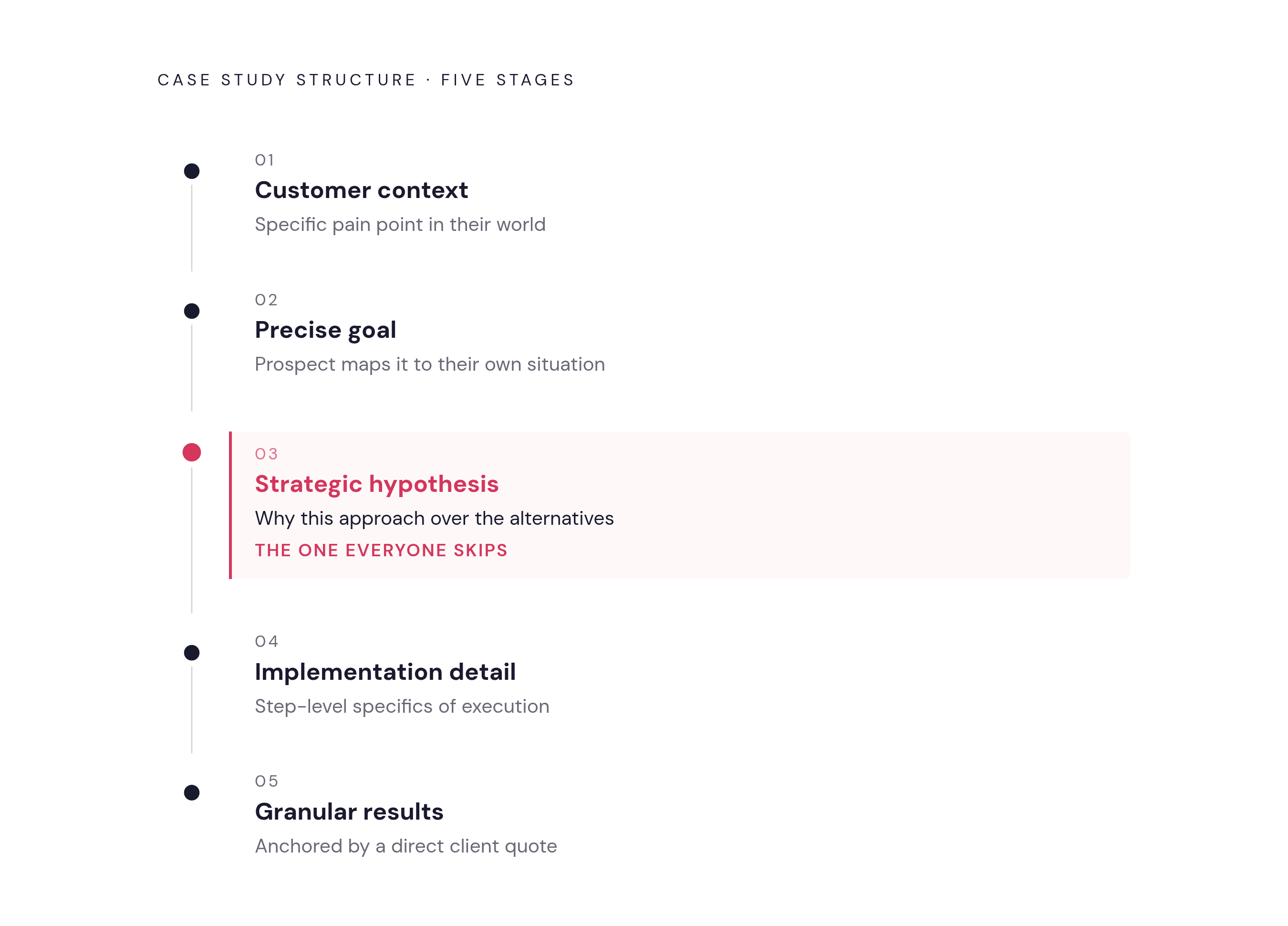
I kept trying to shortcut this into a three-part structure, and it kept breaking, because the cases that actually convert share a five-part arc, and skipping any one piece is usually where things fall apart. First, a customer context and a pain point specific enough to feel real, not the vague "they needed a solution" line that could describe literally any company. Second, a goal precise enough that a prospect can map it onto their own situation. Third, and this is the one everyone skips: the strategic hypothesis. Why this approach, and not the six other approaches that were probably on the table? Fourth, implementation detail at the step level, enough that the result feels earned rather than conjured. Fifth, results reported at the most granular level available, anchored by a direct quote from the client's own mouth.
Order matters more than people think. Cases that open with the measurable result, before the client's logo even shows up, respect the reader's time and signal a kind of confidence that logo-first cases don't. If you're proud of the number, lead with it. If you're leading with the logo instead, ask yourself why.
There's a specific structure worth stealing here, sometimes called the CAR framework: Context, Achievement, Relevance. One clean example: "The restructuring of the lead nurturing process led to a 43% increase in conversion rate, which generated additional annual revenue in the seven figures." Notice what that sentence does. It doesn't just claim a win, it makes the win defensible, because it connects a specific action to a specific number to a specific business outcome. That chain is what a skeptical CFO is actually looking for when they read your case study during their lunch break.
And then there's the client quote, which most companies badly underuse. "Working with them was great" tells a prospect nothing. A quote that names the actual problem that got solved, in the client's own words, does work that no brand claim ever could, because prospects trust other buyers more than they trust you. Pair that with a CTA that isn't just "Contact Us," and you've got a case study that's actually trying to close, not just exist.
The Smartling and Clearwing examples: what pipeline-level results actually look like
Smartling is a good example of what happens when you follow the money all the way through. From 2022 to 2024, the work drove a 118% increase in organic blog traffic and a dramatic lift in blog conversions, and critically, the case study connects those conversions to millions in resulting pipeline. That last step is the one most teams cut. It's easy to report traffic growth; it's harder, and far more persuasive, to trace that traffic through conversions into actual pipeline dollars. A case study that stops at the traffic number has left its most convincing evidence sitting in a spreadsheet nobody read.
Clearwing's case study with HubSpot works for a different reason: the "before" is miserable in a way that's instantly recognizable. An event production company juggling disjointed data and manual processes is not a niche problem; it's basically every operations-heavy business that's ever existed. Once data got unified and campaign execution got automated, the results showed up as concrete revenue and ROI figures, precise enough to feel real rather than rounded up for effect.
What links these two cases isn't the industry or the tool. It's that both make the mechanism visible. Neither one just says "results improved." Both explain how the intervention produced the improvement, step by step, so a reader in a similar mess can see their own path out of it.
Sector-specific examples where conversion lifts were tied to case study strategy
Taylor Made Marketing, working in home improvement, sustained a 35% conversion rate against an industry average sitting somewhere around 3 to 5%. Do the math on that gap and you understand immediately why the case study works: the argument isn't the 35% number in isolation, it's the distance between that number and what everyone in the industry already assumes is normal. Anchoring a result to a known benchmark is what turns an abstract percentage into something a prospect in that exact sector can feel in their gut.
ThinSlim Foods, in a case study with Single Grain, saw impression share rise dramatically alongside a sharp rise in conversion volume after restructuring their advertising around dynamic product ads. What makes this one hold up is restraint: the case study isolates one tactical change and attributes the lift specifically to it. Most marketing case studies hedge with "we did a bunch of things and results went up," which sounds honest but reads as vague. Naming the single lever that moved the needle is a braver, and more useful, kind of honesty.
A mid-market e-commerce brand moved content production in-house and sharpened its value proposition around speed and clear pricing. Costs dropped, click-through rate rose, and conversion improved, most noticeably on mobile. This one earns its place on the list because it's not an ad-spend story; it's an operational one, and readers dealing with their own in-house-versus-agency debate will recognize themselves in it immediately.
Then there's Stangl Law, working with Madison Marketing over a full decade. Lead volume roughly doubled in year two, and by year ten, annual inbound leads had grown several times over against the year-one baseline. That's not a case study about a campaign; it's a case study about compounding, and the ten-year window is itself the argument. A 90-day sprint result and a decade of steady growth are pitching two entirely different things to two entirely different kinds of buyer, and the second pitch is a lot harder to walk away from if you're evaluating a long-term partnership.
Airbnb's example sits slightly outside the traditional case study format, but it's instructive precisely because of that. There's no single campaign to point to; the review and rating system itself functions as the conversion mechanism, running continuously in the background of every booking decision. TrustRadius found that 79% of B2B buyers consider peer reviews the most trustworthy source in the final phase of a purchase decision, and Airbnb essentially built that dynamic into its product at scale. The lesson for B2B marketers isn't "build a review system," it's that the client voice inside a case study is doing the exact same trust work as a peer review, and it needs the same specificity to earn it.
Where format — written, video, or interactive — determines whether the case study reaches the right buyer at the right moment
Video feels like the upgrade, the shinier format, the one that looks better in a deck. But feeling better and working better at every stage are two different claims, and conflating them is where a lot of case study strategy goes sideways.
At the top of the funnel, video earns its reputation. People retain more from video than from text, and video testimonials are widely cited as earning stronger trust than written ones. So far, video looks unbeatable.
Except: try forwarding a video to your CFO with three sentences of annotation explaining why it matters. Try quoting a video inside an internal approval memo. You can't, not easily, and that's the format's blind spot. Once a buyer moves from "do I trust this vendor" to "can I defend this choice to the people who control the budget," the job changes, and video isn't built for that job. Written case studies, with their data tables and documented outcomes, are what actually travel through a buying committee, because they can be copied, pasted, highlighted, and argued over in a Slack thread.
Interactive formats sit in between, and they're worth watching. Interactive case studies are increasingly cited for producing higher engagement than static formats, and companies producing case studies in multiple formats tend to see meaningfully higher engagement than companies stuck on one format alone. That points toward a sequencing strategy rather than a single "best" format: video to open the door, written to help someone walk it through their own building, interactive for the self-directed researcher who wants to poke at the numbers themselves.
None of this matters if distribution is an afterthought. A case study sitting alone on a resource page, three clicks deep, has already lost most of the reach it was capable of. Format is only half the equation; getting the format in front of the right eyes is the other half, and it's the half most teams treat as optional.
The production and strategy gap that keeps most case studies from being built at all
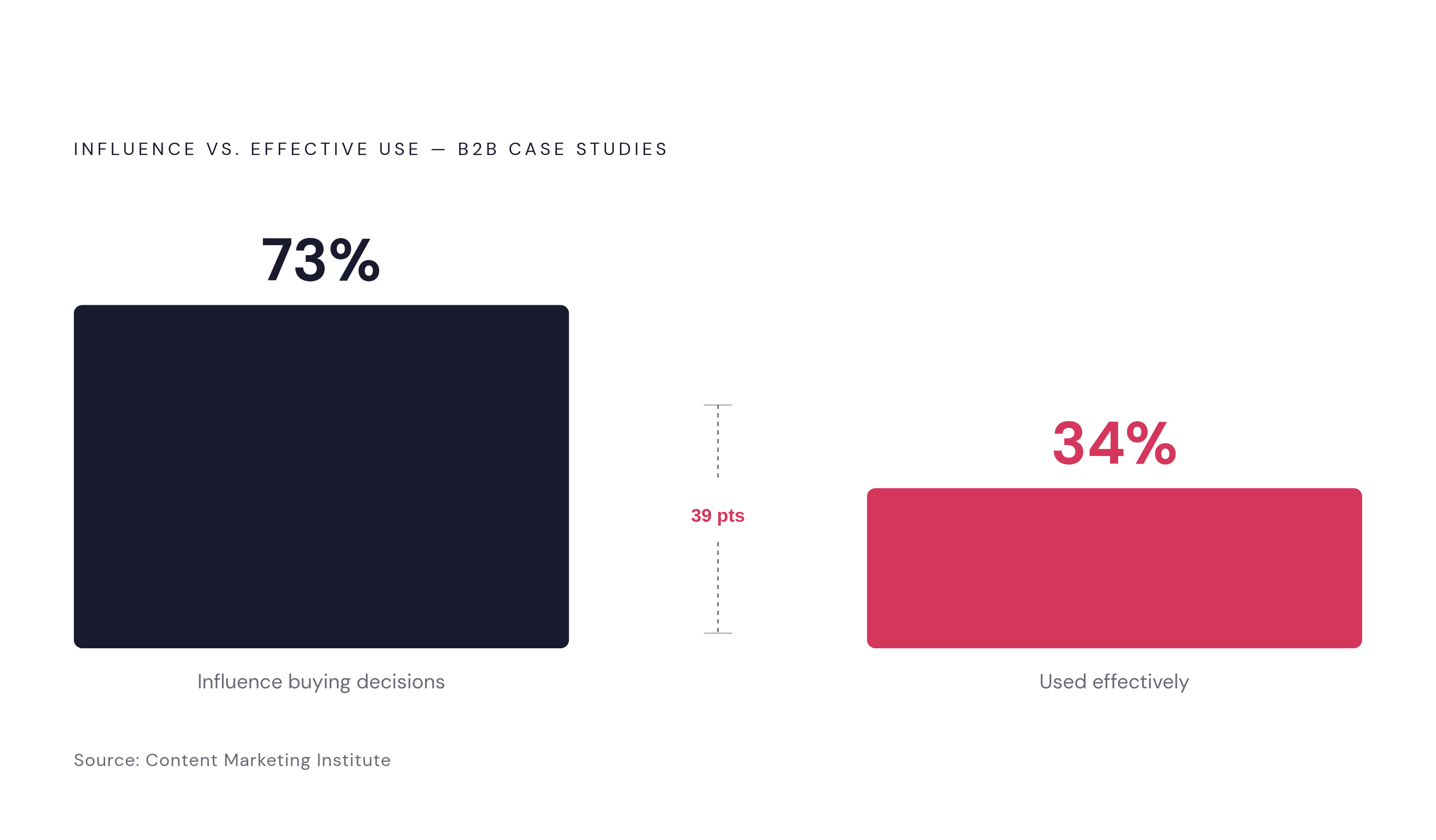
Here's the uncomfortable number: the Content Marketing Institute found that 73% of B2B decision-makers say case studies significantly influence what they buy, yet only 34% of companies say they use case studies effectively. That's a 39-point gap between "this thing works" and "we're doing it right," and it's not a small crack, it's a canyon.
The gap isn't a knowledge problem. Nobody in marketing needs to be convinced that case studies matter; ask any marketer and they'll nod before you finish the sentence. The actual bottleneck is production velocity paired with weak strategic framing at the start. SaaS companies now maintain an average of 64 case studies apiece, up sharply from 2022, which sounds like progress until you realize volume without structure just produces 64 forgettable assets instead of one. More case studies isn't the goal. More case studies that do their job is.
The failure modes repeat across companies in ways that are frustrating for anyone stuck fixing them. Writing starts before anyone defines an audience segment or funnel stage, so the case study tries to speak to everyone and ends up convincing no one. Client approval cycles chip away at the sharpest, most specific details, the actual numbers, the honest description of how bad the "before" state really was, until what's left is a rounded-off, lawyer-approved version of the truth. Sales never touches the finished asset because nobody built it with a sales conversation in mind. And there's usually just one PDF, expected to do the job of five different formats for five different readers.
The speed-versus-quality tradeoff that gets blamed for all this is mostly a myth, or at least an avoidable one. When the strategy comes first, when the audience, the stage, and the argument all get defined before a single sentence gets drafted, the endless rounds of "actually, can we reframe this" revisions mostly disappear. Marketing leaders who keep ownership of the writing process, rather than farming it out entirely to an outside agency with no direct relationship to the customer, tend to keep the specificity that actually moves buyers. Platforms built around AI-assisted drafting paired with real editorial structure, tools like Contentoo or Letterstory, an end-to-end content automation platform that moves a draft from topic through publishing, can factor into closing that gap between a good customer story and a finished, published asset, though the details that make a case study worth reading still have to come from someone willing to dig for them.
A replicable checklist for case studies built to convert, not just to exist
Before anyone opens a blank document, four questions need real answers. Which buyer segment and funnel stage is this actually for, because "all prospects" isn't a segment, it's an excuse. What's the single most credible result, and can it be said in one sentence? Is the client willing to be named and quoted with specifics, since vague attribution ("a leading company in the industry") undercuts trust before the reader gets past paragraph one? And which format, written, video, interactive, or some sequence of all three, actually fits the stage this case study is meant to serve?
Inside the structure itself, a handful of choices separate the cases that convert from the ones that vanish. Open with the outcome, not the client's name. Make the "before" state uncomfortable and specific enough that a prospect winces in recognition. Show the mechanism, the actual why behind the result, not just the fact of it. Anchor the number against a sector benchmark wherever one exists, the way Taylor Made Marketing's 35% only means something next to that 3 to 5% industry baseline. Run every major result through the Context-Achievement-Relevance structure. Use a client quote that names a real problem, not a compliment that could apply to any vendor in any category. And close with a call to action matched to whatever question that specific reader is likely asking next, not a generic form that asks for their email and gives nothing back.
After publishing, most teams stop, and that's the last mistake worth naming. A single case study should get versioned at least three ways: a short brief for sales to drop into an email, a full asset for marketing to publish and promote, and an SEO-optimized page built for organic search. Same story, three different jobs. Map each case study to the specific objection it answers so sales knows exactly when to pull it out mid-conversation. And treat the whole thing as a living document, updated with fresh numbers annually, rather than something you write once and quietly retire eighteen months later when the stats go stale.
The payoff for doing all this compounds, and it compounds in a fairly literal sense. Stangl Law's 549% growth in inbound leads over ten years isn't a fluke or a lucky year; it's what happens when a case study program built on a structure like this one gets left alone to keep working, year after year, while everyone else is still arguing about which template to use.