Content Pillar Examples for B2B SaaS Brands
Align your content's topic themes with its SEO hub-and-spoke structure.

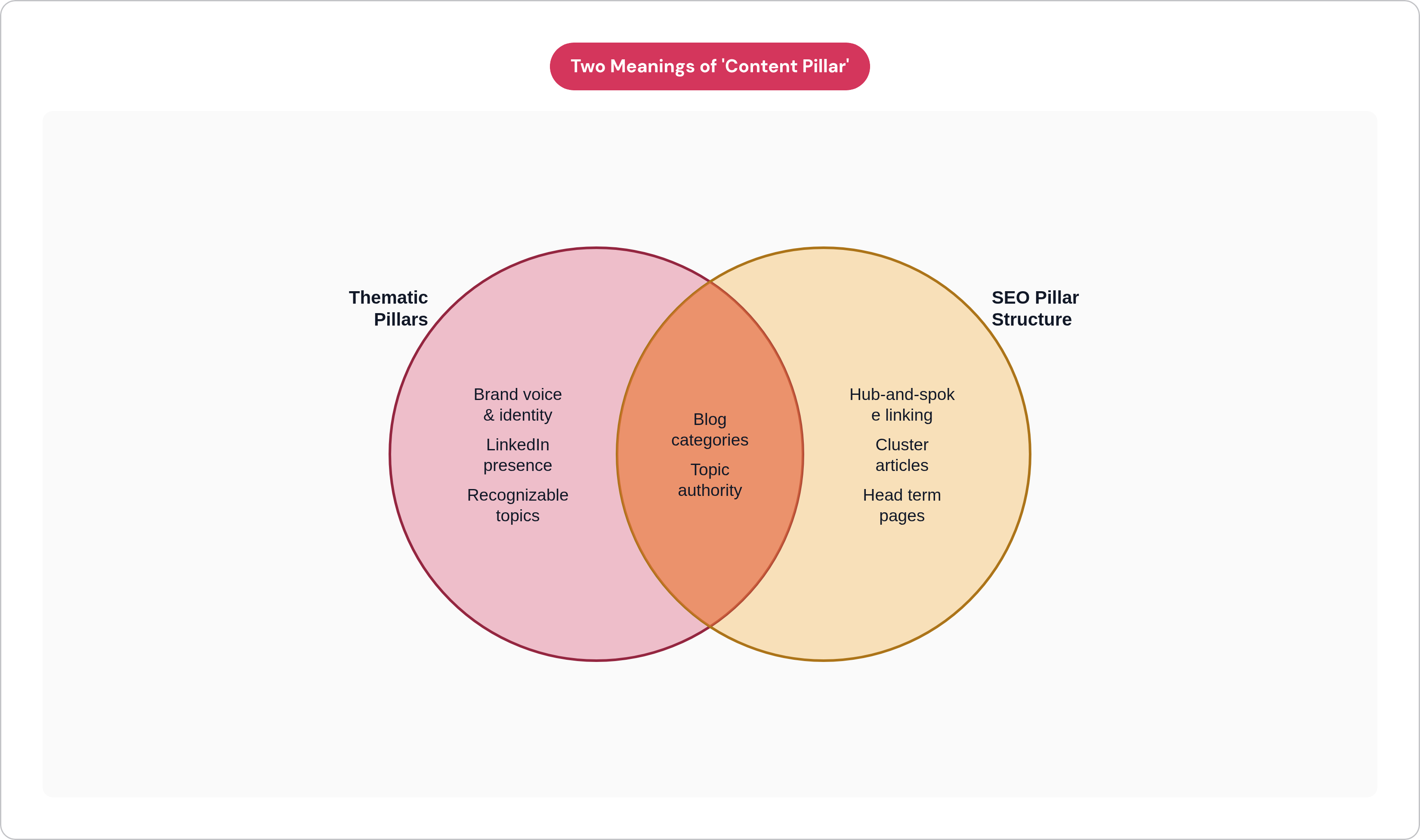
"Content pillar" gets used two different ways in B2B SaaS marketing, and mixing them up is why so many content strategies feel scattered even when the team is putting in real work. One meaning is thematic: the handful of big topics that give a brand's blog, social, and campaigns a sense of "oh, that's what they talk about." The other meaning is structural, the SEO hub-and-spoke model, where one broad pillar page links out to a set of focused cluster articles that link back to it. Both matter, and the SaaS companies that get real mileage out of content tend to run both on purpose instead of stumbling into one while ignoring the other.
Here's where people trip up: you can have thematic pillars with zero pillar pages. Plenty of B2B brands have a clear voice and a recognizable set of topics on LinkedIn without ever building a hub-and-spoke setup on their site. You can also build pillar pages with no thematic coherence behind them, which is basically what happens when an SEO consultant hands a content team a keyword list and says "go." Neither approach alone gets you far. The strongest programs line up both layers so the topic a brand is known for matches the topic its internal linking is built around.
The mechanics themselves are simple once someone lays them out. A pillar page covers a broad head term at a level that's useful but not exhaustive, something like "SEO basics" or "remote work." Cluster pages each take one narrow slice: a specific question, a specific use case, a long-tail search someone types into Google at 11pm. Every cluster page links back to the pillar, and often to each other, so a pile of disconnected blog posts turns into a network with a center of gravity.
Want a shortcut for spotting this in the wild? Check a company's blog category structure. Categories are almost always a stand-in for pillars; tags reveal the cluster subtopics underneath. You don't have to guess at anyone's content strategy. Most of the time they've already told you, right there in the site navigation.
Why the pillar model pays off disproportionately for SaaS buyers and search engines
Start with the buyer, not the algorithm. B2B buyers work through roughly 13 pieces of content before they contact sales, according to Forrester's 2023 B2B Buying Study, and a pillar-and-cluster structure fits that kind of research crawl. Instead of bouncing between ten unrelated posts on ten different domains, a buyer lands on one pillar, follows links into the subtopics that matter to their role, and stays inside a system the brand controls the whole time.
The buying cycle is also getting stranger in a way that makes this more important, not less. 6sense data shows first contact with a vendor dropped from 69% of the buying journey to 61% between 2024 and 2025. That's not buyers knowing less; it's buyers digging around more before they'll take a call. If most of the research phase happens before a rep is even in the room, the content sitting in that phase is carrying more of the deal than it used to.
Deals aren't decided by one person, either. A typical B2B purchase runs 6 to 10 decision-makers deep, and a cluster structure lets different pages talk to different people in that group: the champion who needs the framework, the finance lead who needs the ROI numbers, the IT person who wants the integration details spelled out.
The SEO math backs this up. HubSpot Topic Cluster Research found pillar pages backed by 10 or more cluster articles generate 3.4 times more organic traffic than standalone long-form posts. A cluster of 8 to 15 articles around one pillar tells Google, and increasingly tells AI search systems, that a site actually knows the subject instead of just having an opinion about it once.
Sit with that AI piece for a second. Generative AI results now shape 84% of Google search queries, and 46.5% of AI Overview citations pull from pages ranked outside the top 50 in traditional search. That second number is the strange one: showing up inside an AI answer is turning into its own distribution channel, separate from classic rankings, and a dense internal linking structure is one of the clearer signals a site can send about what it covers and how deep that coverage runs.
None of this is free, but it's cheap next to the alternative. FirstPageSage data puts organic cost per lead at $164 against $310 for paid. The pillar model is what makes that gap real, since it's what lets organic content compound instead of expiring the day the ad budget runs dry.
The five types of content pillars SaaS brands actually build
Picture a spectrum with "pure teaching" on one end and "pure pitch" on the other. Almost no SaaS brand sits at either extreme; most blend types depending on the page and the funnel stage.
Educational pillars sit closest to the teaching end. These are the broad guides structured roughly as problem, context, framework, action steps. They work because they cast the brand as a mentor instead of a salesperson, which lines up with what Google's E-E-A-T guidance rewards, and they cover both top-of-funnel discovery and mid-funnel comparison shopping.
Thought leadership and original research pillars are the ones nobody else can copy: proprietary benchmarks, annual surveys, executive commentary on data no competitor has access to. Content marketing runs about 62% cheaper than outbound while generating roughly three times the leads per dollar, and original research pushes that number even higher, since it earns backlinks and citations on its own, without extra promotion behind it.
Product-led pillars are where the product itself is the natural answer to the question the page asks. Think how-to guides that reference the tool directly, integration pages, "best X for Y" roundups, comparison and alternatives pages. These skew bottom-of-funnel and convert well precisely because anyone searching that phrase has already decided to buy something. The only open question is what.
Social and community pillars play out on LinkedIn, in newsletters, inside community forums and Slack groups; this is the thematic version of the whole idea. 93% of B2B tech marketers say LinkedIn delivers their best content results, per omnius.so data, and 55% of B2B buyers say thought leadership content has meaningfully swayed a purchase decision, according to LinkedIn's own research. Voice lives here even when the SEO structure doesn't.
Customer proof pillars treat case studies as a category, not a one-off. 49% of B2B SaaS marketers rate case studies as very effective at generating sales, well ahead of general website content at 20%, ebooks and whitepapers at 11%, and blog posts at 10%. Most teams park all their proof on a hidden "customers" page instead of threading it into cluster content earlier, before anyone's asked for a demo. That's the mistake worth fixing first.
How HubSpot built category authority through the pillar model it later taught to everyone else
HubSpot is the meta-example here, because the company didn't just run topic clusters, it wrote the manual and handed it out free, which is itself an act of thought leadership. Its "inbound marketing" thematic pillar built something close to category synonymy: over four years, more than 400 third-party citations across industry publications meant that by the time HubSpot went public, "inbound marketing" and "HubSpot" were nearly interchangeable, in analyst reports and in Google's eyes alike.
On the SEO side, look at the "productivity apps" pillar page, built around a broad topic HubSpot's small-business audience searches constantly. It doesn't try to rank for every long-tail variation of that phrase. Instead it links out to and back from cluster articles that each own a narrower subtopic, and every new cluster piece strengthens the pillar's authority, which in turn lifts the whole cluster.
So what's the actual lesson? Not "write more blog posts." It's that the thematic pillar and the SEO pillar structure pointed the same direction. Owning "inbound marketing" as an idea and owning it as a search topic reinforced each other instead of running as two separate projects that happened to share a logo.
How Zapier turns product function into an evergreen content pillar system
Zapier's blog runs on four main pillars, all tied back to workflow automation and the small-team audience the product serves: app picks, company updates, product updates, and product help content. Look at the category list and you're basically reading the pillar strategy out loud, the same shortcut mentioned above.
The "Ultimate Guide to Remote Work" is worth studying because it breaks the assumption that pillar pages have to be sprawling multi-thousand-word essays. It reads closer to an index: bullet-pointed, lean, mostly there to point readers toward cluster content on remote brainstorming, tool setups, and the usual remote-work headaches. Architecturally it's doing the job of a table of contents more than a textbook, and it works fine that way.
The bigger scale play is Zapier's app integration pages. A large share of Zapier's monthly organic traffic comes from the combination of its blog and its app integration pages. Each "Zapier + Slack" style page works as a cluster article inside a broader workflow automation pillar, and there are hundreds of them, each aimed at one specific use-case search. It's scaled content production organized under a small number of core themes rather than hundreds of one-off ideas somebody dreamed up separately.
Here's the part worth stealing: if your product touches integrations or a defined category of tools, you already have a pillar structure sitting there unused. Those feature-page bullet points aren't just bullet points. They're clusters waiting for a pillar to sit under.
How Gong built a content pillar no competitor can copy by mining its own product data
Gong's moat is data nobody else has: millions of analyzed sales calls, which yield things like talk-to-listen ratios, which pricing phrases tend to close deals, how top reps actually handle objections in real time rather than in theory. That's not a research report someone wrote over a long weekend. It's a byproduct of the product actually getting used.
That's the structural difference from ordinary thought leadership. A competitor with a bigger budget and better writers still can't produce this content, because the content needs Gong's specific dataset to exist at all. Every new piece published reinforces that the product itself is generating the insight, so the content and the product aren't separate assets marketing has to stitch together after the fact. They're the same asset, doing two jobs at once.
What that earns is backlinks, citations, social shares, and brand authority, all from a single research pillar that would normally take four separate content types to produce. Any SaaS company sitting on usage data, aggregate customer outcomes, or behavioral signals across its platform has the raw material for this. The limiting factor usually isn't the data itself. It's whether the content team has ever been let anywhere near it, which is a people problem dressed up as a data problem. B2B SaaS SEO averages a 702% return over three years per First Page Sage data, and proprietary research might be the single highest-leverage input into that number, since it's the one content type that compounds in ways paid channels structurally can't.
How Ahrefs makes its product the answer inside educational pillar content
Ahrefs writes broad educational guides, "SEO basics," "keyword research," topics buyers need to understand regardless of what software they end up using, and then shows Ahrefs tools as the natural way to act on the advice. The product is never the subject of the article. It's the instrument used to do the thing the article is teaching, and that's the difference between a genuinely useful guide and a page that's actually just a sales pitch wearing a trench coat.
Structurally it's textbook hub-and-spoke: "SEO basics" as the pillar, with cluster articles on keyword research, on-page SEO, and topical authority each linking back. What makes this replicable outside of Ahrefs is the sequence it implies. Figure out the broad topic your buyer has to understand before your product is even useful to them. Build the pillar around that topic, not your feature list. Then let the cluster articles handle the specific subtopics where your product happens to be the clearest way to execute.
Ahrefs' blog categories (SEO, content marketing, link building) are the thematic layer; each category's pillar page and cluster set is the SEO execution underneath. Same strategy, just running at two different altitudes at once.
What these examples have in common and where most SaaS brands fall short
Line up HubSpot, Zapier, Gong, and Ahrefs and the pattern isn't subtle: every pillar is organized around a problem the buyer is already searching for, never around a product feature or an internal org chart. In each case, the thematic identity and the SEO cluster structure describe the same topics, whether you're looking at the blog categories or the internal link map.
Where does the average SaaS content program lose the thread? A few familiar spots. Cluster articles get published without a pillar page tying them together, so traffic shows up but authority never compounds; it just leaks out the side. Pillar pages get built around product features instead of buyer questions, which gets the format right and the logic backward. Pillars get treated as a project with an end date instead of an editorial system meant to keep adding cluster coverage indefinitely. And proof content, case studies, ROI breakdowns, gets locked away on a customers page instead of woven into cluster articles where a buyer would actually run into it earlier.
Cadence matters more than most teams want to admit: brands blogging around 9 times a month see 35.8% more Google traffic than those publishing only 1 to 4 posts. The cluster model doesn't compound on its own. It compounds because someone keeps building the cluster, month after month, long after the initial burst of enthusiasm wears off, which, if we're honest, is where most content calendars quietly die.
Here's a choice most brands never make on purpose: the same keyword can be answered with an educational guide, a product-led page, or a proprietary research piece, and each does something different depending on where the buyer sits in the funnel. Making that call on purpose, instead of defaulting to whichever format is easiest to write on a Tuesday afternoon, is roughly the difference between a real content strategy and a content calendar with extra steps.
How to identify and validate your own content pillars before you build
Start with the problems, not the product. Write down every question your buyers ask before they even know your product exists; these are your head terms. Then check that list against sales call transcripts, support tickets, and whatever's getting asked in your community or Slack group, because the exact phrasing buyers use is the keyword layer you build around, and it's rarely the phrasing your own product team uses internally.
Next, audit what you've already published. Your blog categories and tags are a direct stand-in for the pillars you already have, whether you meant to build them or not. They often reveal a structure that's been implicit in six months of posts nobody sat down and organized on purpose. Look for cluster orphans too: articles that clearly belong under a pillar topic but never got linked back to one. Those are quick wins. They don't need new writing, just a home to link back to and a reason to exist as part of something bigger than a single post floating on its own.