Marketing Automation Campaign Architecture for Content Teams
76% of businesses already run marketing automation, and 96% of marketers have used or plan to use a platform. That question is settled. What's not settled is why owning the tools and actually making money off them have become two different problems, and what content teams are supposed to do about the space between them.
Start with the ugly number: only 16% of RevOps professionals trust the accuracy of their own data. That's not a rounding error. That's most of the industry running automated campaigns on numbers they wouldn't bet lunch money on. It lines up with a pattern worth sitting with for a second: organizations that have struggled to scale AI initiatives point repeatedly to integration failures and bad data as the culprit, not thin ambition or a tight budget. Companies don't quit because the idea is wrong; they quit because the wiring underneath the idea is a mess.
So here's where this piece lives: content teams have more software than they've ever had, and less coherent output to show for it. Competitive advantage used to come from just owning the platform. Now it comes from how well you built the thing underneath the platform, the part nobody screenshots for a case study. That underneath part is architecture, and it's the difference between a system that compounds over time and one that just generates more tickets for someone to fix on a Friday afternoon.
What "campaign architecture" actually means for a content team
Architecture is the deliberate design of how strategy, triggers, content assets, and workflows connect in sequence, so the whole operation behaves like one system instead of six separate ones stapled together and wearing a trench coat. A tech stack is a list. Architecture is the logic that makes the list actually do something.
It's also different from a workflow, and the distinction carries more weight than it sounds like it should. A workflow is one process: a welcome email fires, three days pass, a follow-up sends. Architecture governs every workflow at once. It decides how audience data shapes what content gets made in the first place. It decides what specific behavior triggers a specific asset to reach a specific person, how that asset moves from a writer's draft to a live send without six people manually forwarding files, and whether the whole operation can handle twice the volume without needing twice the headcount to babysit it. Platforms such as Letterstory, an end-to-end content automation system built for humans and AI agents, exist precisely to close that gap between production and delivery.
Why does any of this matter more now than it did five years ago? The martech landscape has grown to over 15,384 solutions in 2025, up 9% year-over-year. In a field that crowded, architecture is the only thing standing between "we have options" and "we have chaos with a login screen." Nobody drowns from one wave. People drown from losing track of which way is up once there are fifteen thousand of them coming at once.
The four-layer model that holds a campaign automation system together
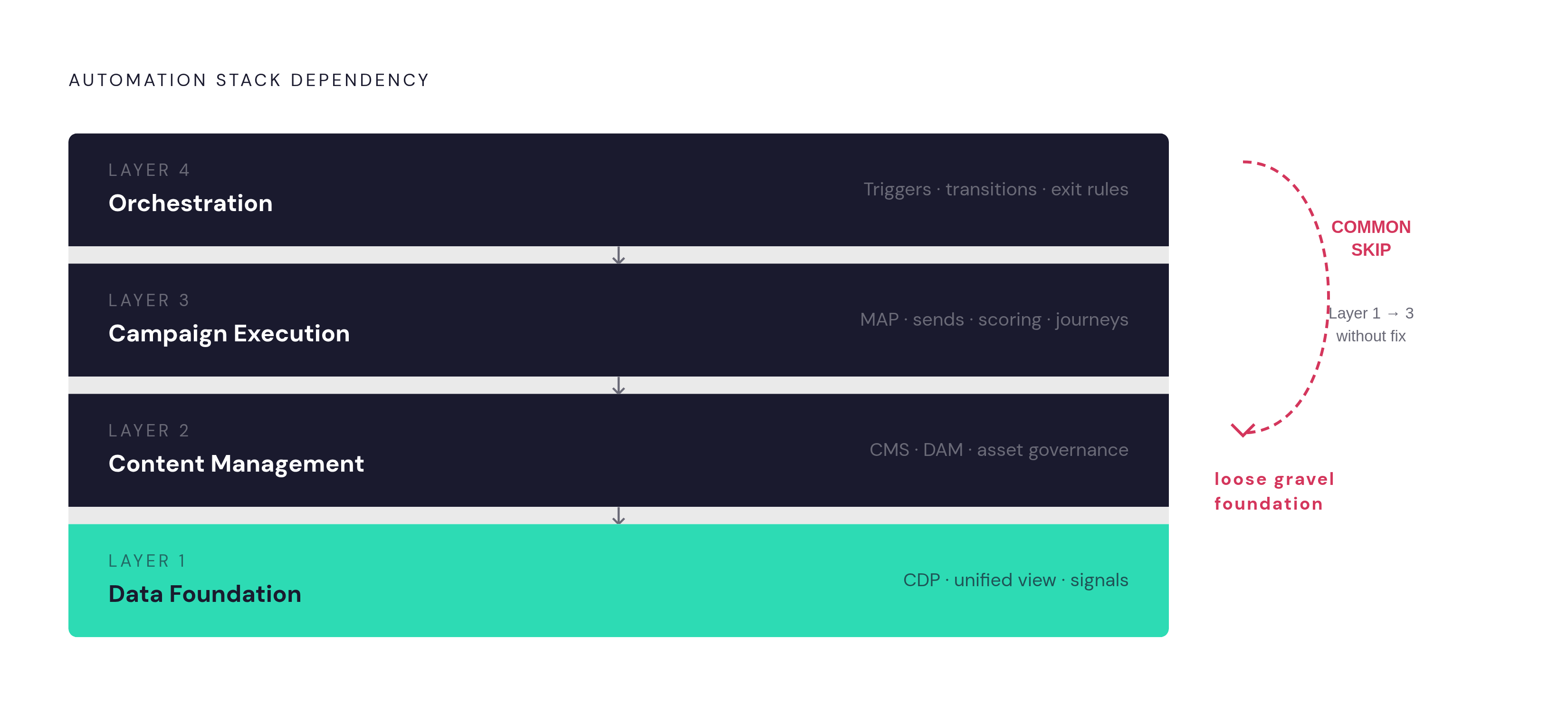
Picture four layers stacked on top of each other, not four items on a menu you can order in whatever sequence suits you. Each one depends on the layer below it actually working, which is a less glamorous way of saying there's no shortcut.
Layer one is the data foundation, usually a CDP or data warehouse, and it's what everything else eats from. Layer two is content management, the CMS and DAM pairing that acts as the production backbone where assets get made, stored, and kept in line. Layer three is the campaign execution engine, the marketing automation platform handling the actual sends, scoring, and segmentation. Layer four is orchestration: the rules and sequencing logic deciding which data signal triggers which piece of content and moves a contact from one lifecycle stage into the next.
Build in that order. Teams that jump straight to layer three, the flashy automation platform with the good-looking dashboard, before fixing their data are building a house on a foundation of loose gravel and good intentions. The underlying problem is bigger than most people assume: the average enterprise now runs roughly 897 applications, and only 29% of them are actually integrated, according to MuleSoft's 2025 Connectivity Benchmark Report. Architecture's job is closing that gap where it counts, at the seams where content actually gets delivered to a human being.
Building the data foundation that makes segmentation and triggers reliable
A CDP's job, stripped of the marketing copy around it, is to pull behavioral data from every touchpoint, digital and physical, into one unified customer view. Skip that step and segmentation breaks quietly, which is worse than breaking loudly, because nobody notices until the wrong email lands in the wrong inbox at exactly the wrong moment.
Miss this layer and triggers start firing on incomplete signals. Someone gets dropped into a nurture sequence built for a different buying stage entirely. Lead scores drift out of alignment with reality. Personalization, which is supposed to feel like attention, starts to feel like noise, because the system is guessing instead of knowing. That 16% trust figure from the opening isn't sitting off to the side as trivia; it's the direct consequence of skipping this step. When the data underneath automation is shaky, automation doesn't just fail to help. It actively erodes the trust it was built to earn.
There are a handful of serious options here in 2025: Segment, Adobe Real-Time CDP, Salesforce, mParticle, each suited to a different scale and a different appetite for integration complexity. Before picking any of them, map out every behavioral signal that should actually change what content someone receives. Then define the smallest version of a unified profile that still does the job. You don't need fifty fields; you need the six or seven that genuinely move the needle. Set data hygiene rules before this layer ever connects to the automation platform above it, because garbage in doesn't just mean garbage out. It means garbage out at scale, on autopilot, at 2am while nobody's watching.
Once that foundation holds, the next question is whether the content sitting on top of it is just as well kept.
Connecting content production to the automation system without creating asset chaos
The CMS and DAM together form the production backbone, and how well they talk to each other decides whether the right asset actually reaches the right workflow or just sort of wanders off into the archive. When a DAM connects to a CMS through an API, the kind of setup you get with headless architecture, only approved and rights-cleared assets are even available for placement. Outdated files, restricted images, and unapproved variants get filtered out before a human has to catch the mistake themselves.
Headless CMS tools like Contentful, Storyblok, Sanity, and WordPress running headless plugins let content ship fast across devices and channels without duplicating the same piece five different times for five different endpoints. That's not a small convenience; it's the difference between updating one source of truth and chasing five copies scattered across five systems, which is how afternoons disappear. The decoupled CMS and composable martech stack market is forecast to grow at roughly a 14.5% compound annual rate through 2032. Enterprises are voting with their budgets for exactly this kind of separation between content and delivery.
Skip this layer and here's what breaks in practice: the execution engine keeps pulling outdated or off-brand assets because nobody told it not to. Personalization logic correctly identifies the perfect message for a segment, then discovers there's no approved version of it to actually send. Someone starts tracking which asset is current in a spreadsheet, and campaigns that should take days start taking weeks instead. This isn't just a compliance footnote either. Asset governance sits a lot closer to the top line than most content teams give it credit for, because inconsistent or off-brand assets erode the credibility that every other layer of the system is working to build.
Before building new workflows, catalog what you already have against your lifecycle stages. Gaps in that library are architecture gaps. They're not proof you need more content; they're proof you need more of the right content, in the right place, at the right time someone actually asks for it.
How the campaign execution engine translates data and content into audience journeys
The MAP is where strategy and assets actually turn into something a human being receives: email drips, triggered sends, transactional messages, lead scoring, basic segmentation, forms and landing pages. This is the layer most people picture the second they hear "marketing automation," even though it's really just the third of four floors.
Lifecycle stage gives this layer its structure. Subscriber to Lead to MQL to SQL to Customer to Advocate, and each stage wants something different from you. An MQL wants proof, so give them a case study. A brand-new customer wants orientation, so give them an onboarding video series instead of another sales pitch. An Advocate isn't looking to be sold anything; they're looking for a way to help, so hand them a referral program or a co-creation invite. Automation rules should move people between stages based on what they actually do, not on someone remembering to check a spreadsheet on a Tuesday afternoon.
The payoff for getting this right isn't subtle. Automated emails generate 320% more revenue than non-automated ones, and welcome emails, often the least strategized message on the entire calendar, average a 68.6% open rate, usually the best-performing flow in the whole stack. But more isn't better here: 15 to 20 workflows that are actually optimized and maintained will outperform 50 workflows nobody's touched since launch day. Tools at this layer range widely in cost and complexity, from HubSpot and ActiveCampaign to Salesforce Marketing Cloud, Iterable, and Oracle Eloqua. HubSpot's Marketing Hub Professional starts around $800 a month and scales to $3,600-plus for Enterprise tiers with adaptive testing and multi-touch attribution built in. And 31% of marketers rank email automation as the highest-ROI channel they have, which makes this the layer where the whole architecture either proves itself or quietly doesn't.
The creative bottleneck that automation architecture cannot route around
Here's the part the tooling can't fix, no matter how well you've built the first three layers. A recurring finding across marketing surveys is that content teams consistently report needing more personalized content than they can actually produce, with demand rising across channels. You can have the smartest trigger logic on the market, and it still can't conjure an asset that doesn't exist yet.
This matters more than it sounds like it should. Creative isn't a nice-to-have sitting off to the side of performance; it is widely recognized as among the most influential factors in whether advertising works at all. It's also, ironically, usually the least optimized part of the whole workflow. Everyone spends months tuning trigger logic and leaves the creative pipeline running on whatever the last freelancer had time to deliver before their contract ended.
Watch what happens at scale without a fix here. The MAP has a trigger sitting ready to fire, but the DAM has no approved version of the asset for that specific segment, so the personalization either gets disabled or gets flattened into something generic. Campaign speed ends up gated by design review cycles, not by anything the platform is technically capable of. The response gaining traction is creative automation: build one master creative, then generate and adapt every variant from it programmatically. Teams that have adopted creative automation report dramatic increases in output volume without proportional increases in headcount. Creative automation also opens the door to faster review cycles, which means governance and speed stop fighting each other for once. The lesson for architecture: plan for how much creative your team can actually produce, not just how fast your platform can theoretically deliver it.
Where AI fits inside the architecture, and where it doesn't replace strategic judgment
92% of marketers now use AI somewhere in their automated workflows, and 75% of leaders at organizations that have invested in it report positive ROI, according to HubSpot's 2025 AI Trends for Marketers report. That's a lot of adoption in a short window. It raises an obvious question: adoption for what, exactly?
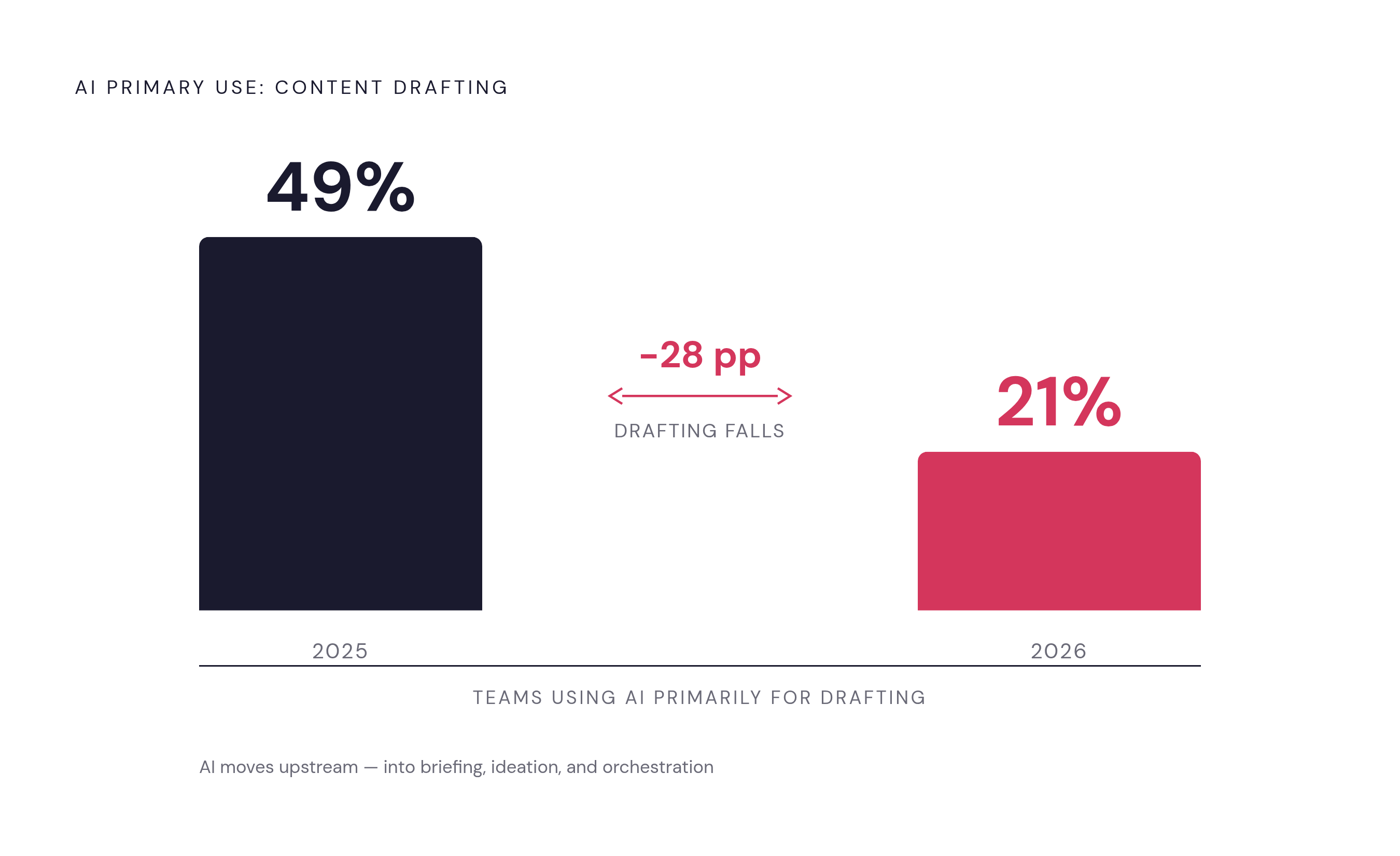
The answer is shifting under everyone's feet as we speak. In 2025, drafting content was the top AI use case, with 49% of teams using it mainly for that. By 2026, only 21% say drafting is the primary use. That's a real move, not a rounding error, and it suggests AI is climbing up the pipeline into briefing, ideation, and process orchestration rather than sitting at the end of it cranking out paragraphs on command. Architecturally, that means AI is becoming part of how campaigns get designed, not just a shortcut bolted onto production at the last minute before a deadline.
The concrete uses worth building for: predictive lead scoring that catches behavioral patterns a static point system would miss, dynamic content personalization that serves the right variant off real-time profile data, send-time and channel optimization that decides when and where a message lands instead of a calendar deciding for it, and AI-assisted briefing that shortens the distance between a strategic decision and a production-ready brief. Agentic AI is the layer worth watching next: systems that take an objective, pick channels, generate personalized content, sequence the actions, and adjust in real time without someone hand-writing rules for every single campaign. Gartner found fewer than 5% of enterprise applications had task-specific AI agents in 2025, and expects that to reach 40% by the end of 2026. That's not a gentle curve; that's closer to a cliff, and it means the window for designing an architecture that can absorb agentic tools is now, not next year's roadmap. McKinsey's 2025 analysis suggests up to 22% of a brand marketer's current activities could be automated within five years, with roughly 40% productivity gains specifically in campaign monitoring and performance analysis.
None of that replaces judgment, though. AI without a defined audience model, a real content framework, and a mapped lifecycle just produces fast, confident, irrelevant output, at a speed that used to take a junior employee an entire week to achieve manually.
Orchestration logic: designing the triggers and sequences that connect all four layers
Orchestration is where the other three layers either snap together or reveal they were never really connected at all. Split the logic into two buckets. Back-end workflows handle lead scoring, segment updates, and lifecycle transitions, decisions that happen invisibly and quietly make everything downstream smarter. Customer-facing workflows are the part the audience actually sees: welcome emails, behavior-triggered sequences, push notifications, recommendation blocks.
Behavioral triggers beat time-based ones, consistently and by a wide margin. "Downloaded the pricing guide" tells you something real about intent; "it's day seven of the drip sequence" just tells you what day it is. A page view and a content download aren't the same signal and shouldn't trigger the same response. Treating them identically is how relevant automation quietly turns into spam with better formatting. Negative triggers deserve just as much design attention as positive ones, if not more. Someone opting out, going quiet, or downgrading should suppress future sends, not get lumped in with everyone else who's still actually engaged.
Design sequences at the lifecycle-stage level first, then build individual campaigns to fit inside that frame, not the other way around. Every sequence needs an exit condition: some behavior that says this person has moved on and shouldn't keep receiving the same three emails on a loop forever. Re-entry rules stop contacts from cycling back through a sequence they've already outgrown. And that 15-to-20-workflow principle from the execution layer applies here with even more force, because orchestration complexity is the fastest route to a system nobody can explain anymore, not even the person who built it. Document every workflow with a named owner, a written trigger condition, a defined audience, and a set review cadence. Skip the documentation and the whole system quietly turns into a black box that runs itself until it runs straight into a wall.
Governance and failure modes that collapse automation systems from the inside
Back to that majority failure figure from the opening, because it belongs here too, maybe more than anywhere else in this piece. Most of those failures trace back to architecture, not to the technology falling short of its promises.
The common ways this collapses look almost boring once you list them out, which is part of why they're so easy to miss until it's too late. Data layer drift happens when a CDP goes stale because nobody's maintaining the behavioral inputs feeding it, so segments quietly build on fields that stopped being accurate months earlier. Asset-workflow mismatch happens when the execution engine keeps referencing something that's been archived or restricted in the DAM, and nobody updated the workflow pointing at it. Workflow proliferation without governance might be the quietest killer of all: every new campaign spawns a new workflow, old ones never get retired, and eventually the system starts contradicting itself in ways that take a full afternoon of forensic spreadsheet work just to untangle.
None of these are software problems. They're maintenance problems, the kind that don't show up on a demo call and don't get solved by buying tool number 15,385. The architecture holds up exactly as long as someone keeps tending it. That's a less exciting sentence than "AI-powered growth engine," sure, but it happens to be the one that's actually true.