Data-Driven Decision Making in Campaign Planning
Most teams have the data but not the discipline to use it before the campaign launches.
95% of organizations call data-driven insight critical to their success. Only 61% of C-suite leaders admit their companies rarely act on it. That gap is basically the whole story of campaign planning right now. The dashboards are full, the tools are paid for, and most teams still make a gut call first, then build a chart afterward to justify it. This piece walks through how audience insight, channel selection, budget, and measurement actually connect, and where treating them as four separate steps quietly wrecks a campaign.
What it actually means to build a campaign on data, not just data access
Having data and knowing what to do with it are two different skills, and most planning meetings blur past that difference without noticing. Marketing teams sit on more customer data than they'll ever touch meaningfully: it lives in a CRM, in an ad platform's back end, in a spreadsheet somebody exported in March and never opened again. That spreadsheet has a name, always some variation on "Q1_FINAL_v3," and by the time anyone goes looking for it, nobody remembers who built it or why it stopped mattering.
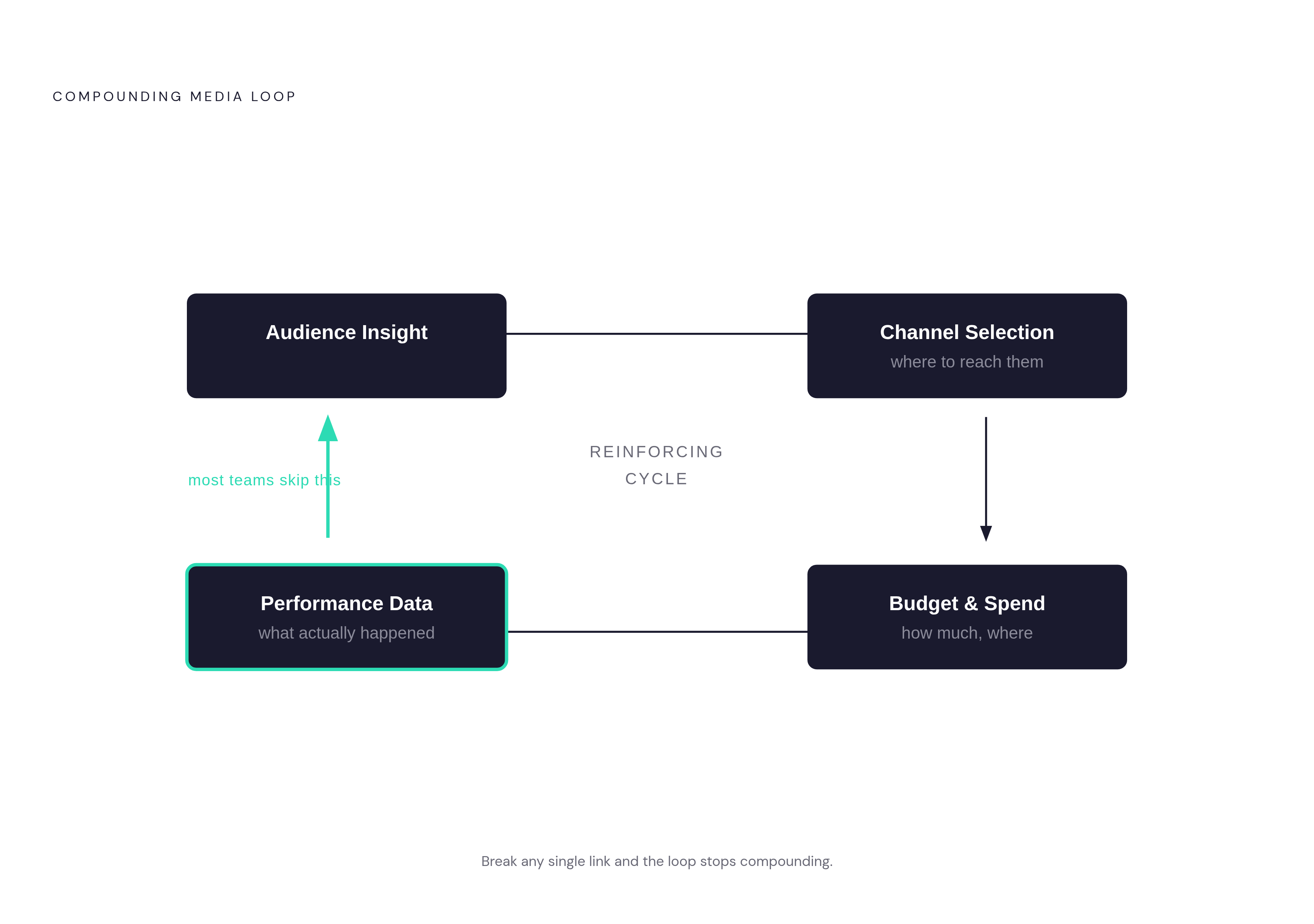
Data-driven planning works as a loop, not a checklist. Audience insight feeds channel selection, channel selection shapes spend, and spend produces performance data that flows back into audience insight and sharpens the picture on the next pass. Break one link and the loop stops compounding; what's left is a diagram nobody actually follows.
That's why the same analytics license produces wildly different results at two companies sitting three floors apart in the same building. One team writes down its campaign questions before pulling a single report, picks KPIs tied to revenue or retention instead of whatever looks good in a deck, and uses the data to argue with its own assumptions. The other builds the campaign in the hallway first, then goes looking for numbers to defend it, running identical software toward opposite outcomes.
The global data-driven decision market was valued at £42 billion in 2025. None of this is a fringe practice anymore, it's the default posture of the industry. What separates teams now has less to do with whether they have data and more to do with whether they use it before launch, instead of after, when somebody just needs a slide for the retro.
Building audience understanding before a single channel is chosen
Everything downstream, channel, creative, budget, rests on one question answered honestly: who exactly are you trying to reach, and what actually moves them? Skip that question and every later decision inherits the same blind spot, quietly, without anyone flagging it in the room.
Real audience understanding pulls from three kinds of signal. Behavioral data shows what people actually do, past their age bracket or zip code. Intent signals, search patterns, content consumption, past purchases, show what they're considering right now. Attitudinal data, pulled from surveys and sentiment tracking, shows why. Demographics alone tell you almost nothing; two 34-year-olds living three doors apart can have opposite purchase intent and share nothing besides a birth year.
Segmentation is where this stops being theory and starts being work. About 44% of companies now use AI to build customer segments, moving past broad buckets into clusters based on actual behavior, and it pays off: campaigns built on real customer data instead of demographic guesswork see average ROI gains of 31%.
Here's the uncomfortable part. Research consistently shows a wide gap between how well companies think they personalize and how customers actually experience it. That disconnect traces straight back to shallow audience data at the planning stage. It's a segmentation problem nobody went back to fix, and it shows up later as a trust problem instead.
Data silos are the structural reason this keeps happening. When marketing, sales, and CRM systems don't talk to each other, teams work from a partial view of the customer and mistake it for the whole picture. Every decision built on that partial view inherits the same gap, leaving teams to navigate with half the information and wonder why the same problems keep recurring.
How audience data translates into channel selection decisions
Channel selection is a data question before it's a preference question. Where is your specific audience reachable, and where can you actually tell if it worked?
A June 2024 survey from Ascend2 found 47% of marketing decision-makers cite email as the channel where data-driven marketing proves most useful, with customer experience close behind at 46% and paid advertising at 41%. Read that ranking with a little suspicion, though, because it probably says more about measurability than about attention. Email hands you clean, closed-loop data. A billboard hands you almost nothing back, no matter how many people drive past it.
That matters because channels where you can close the feedback loop fast let you learn fast. A channel that reports back in 48 hours beats one that reports back in six months, even when the slower channel technically reaches more eyeballs. Speed of learning compounds; slowness just sits there, taking up budget and pretending to be strategy.
Being present on five channels isn't the same as having a coherent strategy across them. Audience data should decide which channel introduces, which one nurtures, and which one closes the sale. Skip that sequencing and channel budgets default to whatever got funded last year, regardless of whether the audience actually moved with it.
First-party data has become the foundation under all of this. A growing share of marketers plan to increase their use of it, partly because a growing portion of the open internet is already unreachable by traditional trackers, thanks to Safari, Firefox, and mobile app privacy defaults. The tracking cookie is fading across large parts of the web, gradually but unmistakably, and it shows no sign of returning to its earlier dominance.
And the consequence of skipping this groundwork? Many marketers acknowledge they can't reliably identify which channels actually drive performance. That's a significant share of the industry running on guesswork dressed up as strategy, which is a strange place for an entire profession to be standing.
Allocating budget across channels when the data is imperfect
Budget is where audience and channel decisions stop being strategy slides and turn into real money changing hands. It's also where sloppy data discipline gets expensive, fast.
Attribution is the root problem here. With a large majority of marketers unable to say which channels drive results, most budget calls amount to educated guesses dressed up in a spreadsheet. Weak attribution means budget misallocation is effectively invisible until after the money is spent. That's real money leaking out through a gap nobody has patched, quietly, month after month.
Two attribution approaches tend to get used, and they complement each other rather than compete. Multi-touch attribution suits granular, real-time digital optimization, crediting individual touchpoints along the path to conversion. Marketing mix modeling suits long-term planning and offline channels, where nobody's tracking a billboard click because the individual signals just don't exist. The more mature approach runs both together, with MMM filling in the gaps MTA can't see.
Get this right and the payoff shows up quickly. Teams that implement multi-touch attribution tend to see meaningful cost-per-acquisition improvements alongside measurable ROI gains in the near term.
Budget shouldn't get locked in at the planning stage and left untouched for three months, though, and that's where people trip. Real-time analytics allow continuous reallocation as performance data rolls in; treating an approved media plan as fixed defeats the entire point of having real-time data in the first place.
About 70% of marketers planned to increase performance marketing spend in 2024, a clear sign the industry wants more accountability. But accountability isn't free. It needs attribution infrastructure built before the money goes out the door, not a forensic audit after the quarter closes and everyone's already moved on to the next one.
What predictive analytics adds to campaign planning before launch
Descriptive data tells you what already happened: which audiences engaged last time, which channels converted, what last quarter's numbers looked like. Predictive analytics asks something else entirely. Which audiences are likely to convert next time? Which creative variant will actually perform, and which budget split hits the target ROI before a dollar goes out the door?
Adoption is still catching up. Only 46% of companies use predictive analytics today, though it's the fastest-growing capability in marketing data infrastructure, and there's a reason for that. Nielsen reports that for 59% of global marketers heading into 2025, AI-driven campaign personalization and optimization ranks as the single most impactful industry trend. Prediction and personalization have essentially merged into one capability in most practitioners' heads.
Leading practitioners offer a useful reference point here. Results at scale don't come from a clever algorithm alone; they take the underlying data infrastructure, plus a willingness to trust predictive signals over historical averages before launch.
In practice, predictive analytics changes three things about how campaigns get built. It scores prospects by likelihood to convert, working with finer gradations than treating a whole segment as one uniform blob. It pre-tests creative at scale using historical engagement patterns, so a message that flops gets caught before the budget's already spent on it. And it models budget scenarios across channel mixes before the campaign goes live, rather than after the invoices land on someone's desk and everyone starts asking questions.
Worth sitting with for a second: predictive models are only as good as the first-party data feeding them, which ties straight back to the audience work a few sections up. Weak inputs just produce confidently wrong predictions, and confidence is exactly what makes a wrong prediction dangerous.
Personalization as the execution layer where planning data becomes campaign experience
This is where all the upstream work, segmentation, channel logic, prediction, either pays off or falls apart in front of an actual human being. Personalization is the moment planning data turns into a message somebody actually reads, or deletes.
Start with a number that's hard to shrug off: personalized calls-to-action consistently outperform generic versions by a wide margin. That gap has nothing to do with who wrote the snappier line. It's a direct readout of how precise the underlying audience data was to begin with.
Fast-growing companies tend to outpace slower-growing peers on personalization returns, which suggests it compounds over time rather than working as a one-off trick. And the risk cuts both ways now. Research increasingly shows that consumers will abandon brands that fail to personalize, with a meaningful share already having switched to a competitor for exactly that reason. Skipping personalization used to be a neutral choice. It costs you customers now, plainly.
Real-time personalization, responding to what a user is doing in the moment, tends to beat batch personalization, which pre-builds tailored experiences from historical segments before the session even starts. That gap shows up in the numbers, not just in the theory behind them.
Budgets reflect the shift. Budget allocations toward personalization have grown substantially in recent years, a notable shift for an industry that usually moves slowly and cautiously on structural change.
One complication worth naming: a significant share of companies say privacy regulation has made personalization harder to pull off. That loops back to the first-party data conversation from a few sections ago, and forward into measurement, since privacy limits tend to show up first as holes in tracking and attribution.
Measuring performance in ways that actually close the decision loop
Measurement's job is to sharpen the next campaign. A dashboard can look immaculate and still fail at this if nothing on it changes what happens next quarter.
Three tiers of metric matter, and they aren't interchangeable. Vanity metrics (impressions, open rates, page views) describe activity without tying it to any outcome. Signal metrics (conversion rate by segment, cost-per-acquisition by channel, revenue per touchpoint) generate decisions worth making. Predictive metrics (lead quality scores, churn probability, lifetime value projections) feed forward into next quarter's audience and budget models.
Frequency matters too. Companies using real-time analytics report a 29% improvement in decision speed and a 21% reduction in operational costs, largely because they reallocate mid-campaign instead of waiting around for the postmortem.
Testing deserves its own mention here, as a measurement discipline rather than an extra step tacked on after launch. A/B and multivariate tests generate the kind of controlled signal that separates a genuine performance difference from plain noise, and teams that build rigorous testing into their process report efficiency gains of 15% to 30% over teams running on gut instinct.
Attribution ties it all together, again. Without it, performance data can't be traced back to whatever channel or message actually produced it, so the next round of budget defaults to assumption instead of evidence. Businesses that build this loop properly, where measurement output directly reshapes the next campaign's inputs, see 5 to 8 times higher ROI than those that don't use data-driven strategies at all.
Where the decision loop breaks down in practice, and why
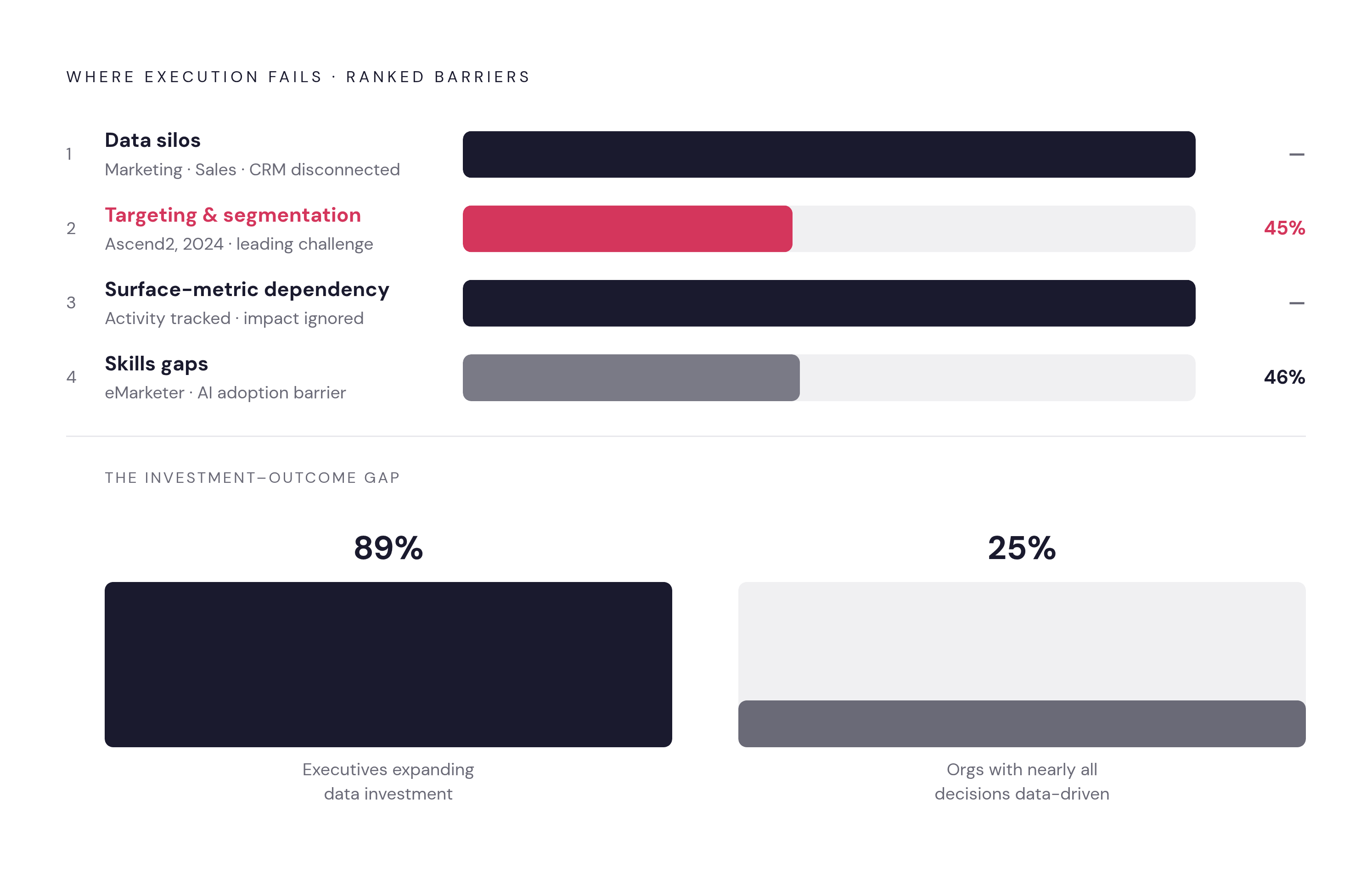
So if the loop is this well understood on paper, why does it keep breaking in practice? The answer isn't flattering to anyone sitting in the room when it happens.
About 89% of executives plan to expand their data investment, yet only 25% of organizations say nearly all their strategic decisions are actually data-driven. Access to data clearly isn't the constraint anymore. The gap sits in execution discipline, the unfunded, unglamorous part of the job that never makes it into a slide deck.
Four failure points show up again and again, and they compound each other. Data silos top the list: when marketing, sales, and CRM data don't connect, the audience picture is partial by design, and every campaign built on it inherits that same hole. Targeting and segmentation comes second; per Ascend2's 2024 data, it's the leading execution challenge, cited by 45% of practitioners. Plenty of companies own segmentation software. Far fewer have the data quality, or the patience, to use it well. Third is surface-metric dependency, where teams chasing open rates and page views end up measuring activity instead of impact, and decisions built on activity compound errors in exactly the wrong direction. Fourth, skills gaps: eMarketer found 46% of companies cite a skills deficit as their top barrier to AI adoption in marketing. The tools showed up faster than the people trained to translate their output into an actual decision.
Then there's the speed trap. Real-time data creates real pressure to act fast, but speed without rigor produces confident decisions built on noise. Acting quickly on the wrong signal doesn't make it any less wrong; it just makes it wrong faster.
The workflow problem, once you strip away the jargon, comes down to this: insight needs to move between audience research, channel planning, budget, and measurement without getting lost in a handoff or mangled in translation between departments that don't share a vocabulary. Ascend2 classified 63% of organizations as only "somewhat successful" with data-driven marketing in 2024. That's the big middle tier, pointed at the right idea but missing the week-to-week precision to actually pull it off.
Building campaign planning workflows that use data at every decision point
The shift here is one of degree, not kind. Data-informed campaigns consult data somewhere along the way; data-driven workflows let data shape each decision before it's made, instead of validating one after the fact.
A workable sequence looks something like this. Start with audience intelligence, defining segments from behavioral and intent data before anyone touches a channel plan or creative brief. Pick channels based on where those segments are actually and measurably reachable, with attribution data available to close the loop later. Put budget behind attribution-supported channels first, and model scenarios with predictive data before committing spend, not after. Build personalization directly into the creative brief, treating it as the execution of decisions already made upstream rather than something bolted on at the end. And define your measurement criteria before launch: which metrics actually close the loop, how often you'll check them, and who on the team answers for what they show.
None of this is complicated in concept. It's sequential work that resists shortcuts, which is probably why 61% of C-suite leaders still describe their own companies as only slightly or rarely data-driven, despite believing in the idea completely. The gap between aspiration and execution stopped being a data problem a while back. What's missing now is discipline, and nobody's built a system yet that accounts for it on a balance sheet.