Content Strategy vs Content Marketing for SaaS Companies
Most SaaS teams confuse planning with doing, then wonder why traffic doesn't convert.
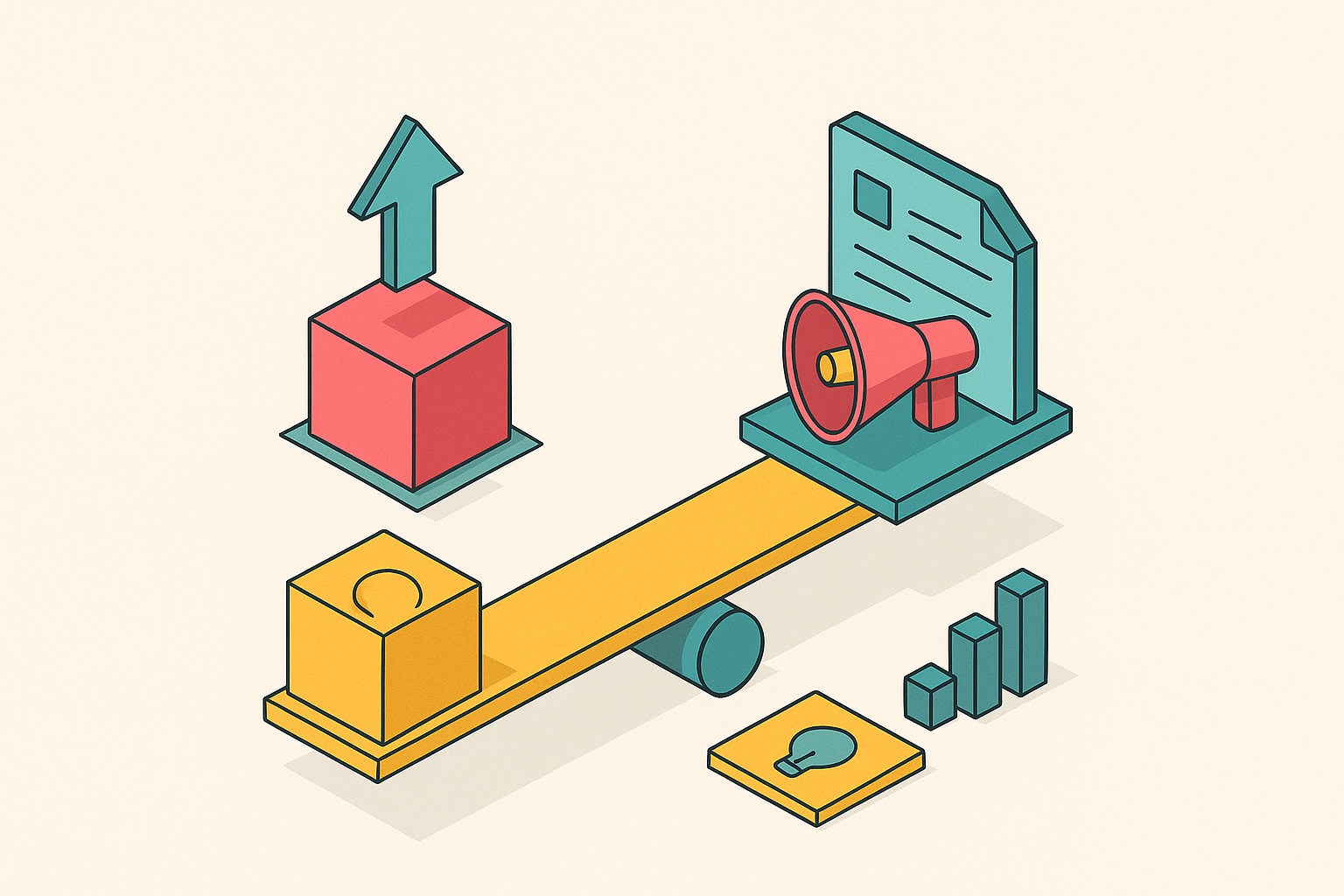
Content strategy and content marketing get treated as interchangeable in SaaS, and that's the whole problem in one sentence. One is the plan: audience, funnel stage, goals, what you will and won't cover. The other is the execution: the writing, filming, publishing, promoting. Confuse the two long enough and you get a blog that pulls decent traffic and a pipeline that refuses to move, which is a bit like spending three hours sharpening a knife and then using it to butter toast.
Why SaaS buying behavior makes this distinction unusually consequential
SaaS purchases don't happen on impulse, not even close, and sales cycles commonly stretch 30 to 180 days. Across that stretch, content has to hold someone's attention through weeks of internal back-and-forth. A blog post that spikes traffic for a day and gets forgotten by Friday does nothing for a buyer who won't sign until next quarter.
Then there's the committee. B2B SaaS purchases rarely involve one person with a company card; they involve multiple stakeholders across functions, each evaluating the decision through a different lens. A content strategy has to speak to all three at once, and that's a coordination problem before it's ever a writing problem. Good execution can't compensate for a strategy that never figured out who it's even talking to.
Here's the part that should make marketing teams a little uneasy: buyers now complete somewhere between 57% and 70% of their research before a salesperson ever enters the picture. Most of that range points to the same conclusion, that a clear majority of buyers show up to the vendor call with requirements already locked. So the blog post someone reads alone, on a laptop, at 11pm in month one, is doing more to win or lose that deal than anything a rep says in month three. If strategy hasn't figured out what that person needs to see, and when, marketing ends up writing very polished content for the wrong audience.
That's part of why the SaaS content mix leans toward original research and interactive tools instead of generic listicles. The people doing this early-stage digging have already read the other ten blog posts on the topic, and they can tell filler apart from substance quickly. That instinct only makes sense once strategy has told you who's reading and why: a project management tool built for scrappy remote startups needs different keywords, pain points, and formats than one built for enterprise construction firms tracking job sites. Same execution playbook. Entirely different game underneath it.
The effectiveness gap that reveals how many SaaS teams have the layers reversed
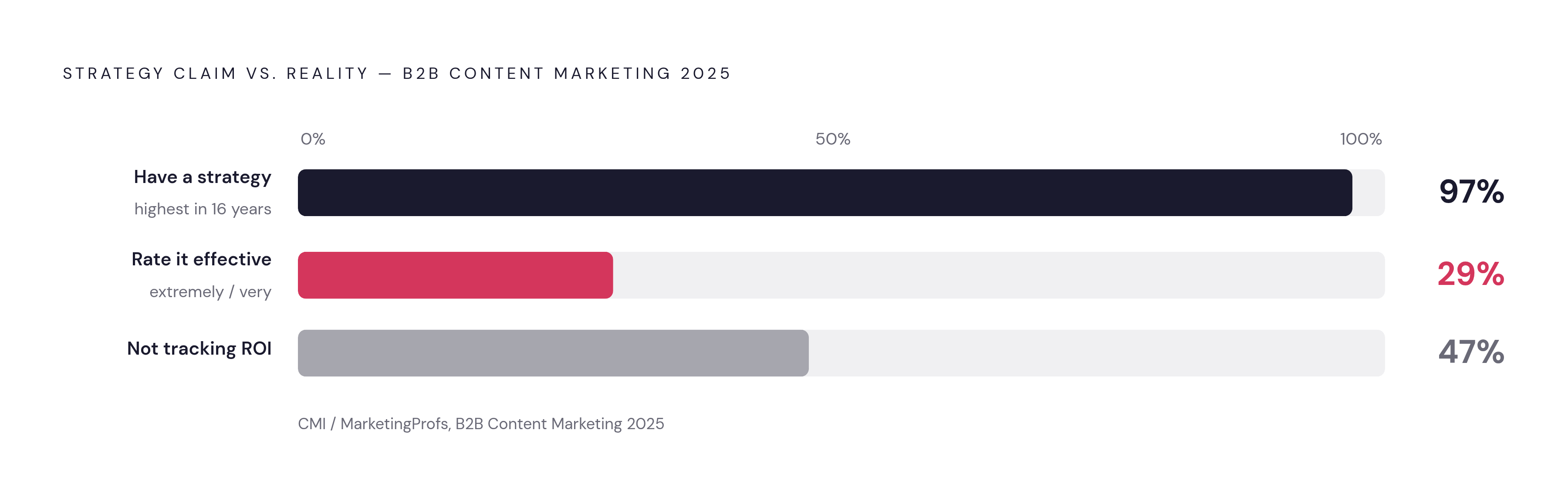
Here's a strange number to sit with for a second. CMI's B2B Content and Marketing Trends report for 2026, based on a survey of 1,015 marketers fielded between June and August 2025, found that 97% of B2B marketers say they operate from some kind of content marketing strategy. That's the highest adoption rate CMI has recorded in sixteen years of running this survey, and nearly everyone claims to have a plan.
So why do only 29% rate that strategy as extremely or very effective, according to CMI and MarketingProfs' 2025 research? A majority, 58%, call it moderately effective, essentially a shrug and an admission that it's fine, not great. Meanwhile 47% of marketers aren't tracking content ROI at all, meaning nearly half the industry has no real way of knowing if any of it is working. Almost everyone's holding a strategy document, yet fewer than a third of them are getting real value from it.
What separates the effective minority isn't glamorous. They write the strategy down instead of keeping it as tribal knowledge in a Slack channel, and they hold regular check-ins to see whether goals, formats, and outcomes still line up. Of marketers who reported improved content effectiveness, 74% credited strategy refinement, ahead of new tools, more content volume, or some clever new channel. The fix was almost always going back and repairing the plan rather than producing more content.
AI complicates this further. Ninety-five percent of B2B marketers now use AI somewhere in their content workflow as of 2025, yet the effectiveness numbers haven't moved much. Running AI on top of an undocumented strategy doesn't close a gap; it produces more content, faster, for an audience nobody bothered to define. The tools sprinted ahead while the strategy layer stayed home.
What a SaaS content strategy actually has to resolve before execution begins
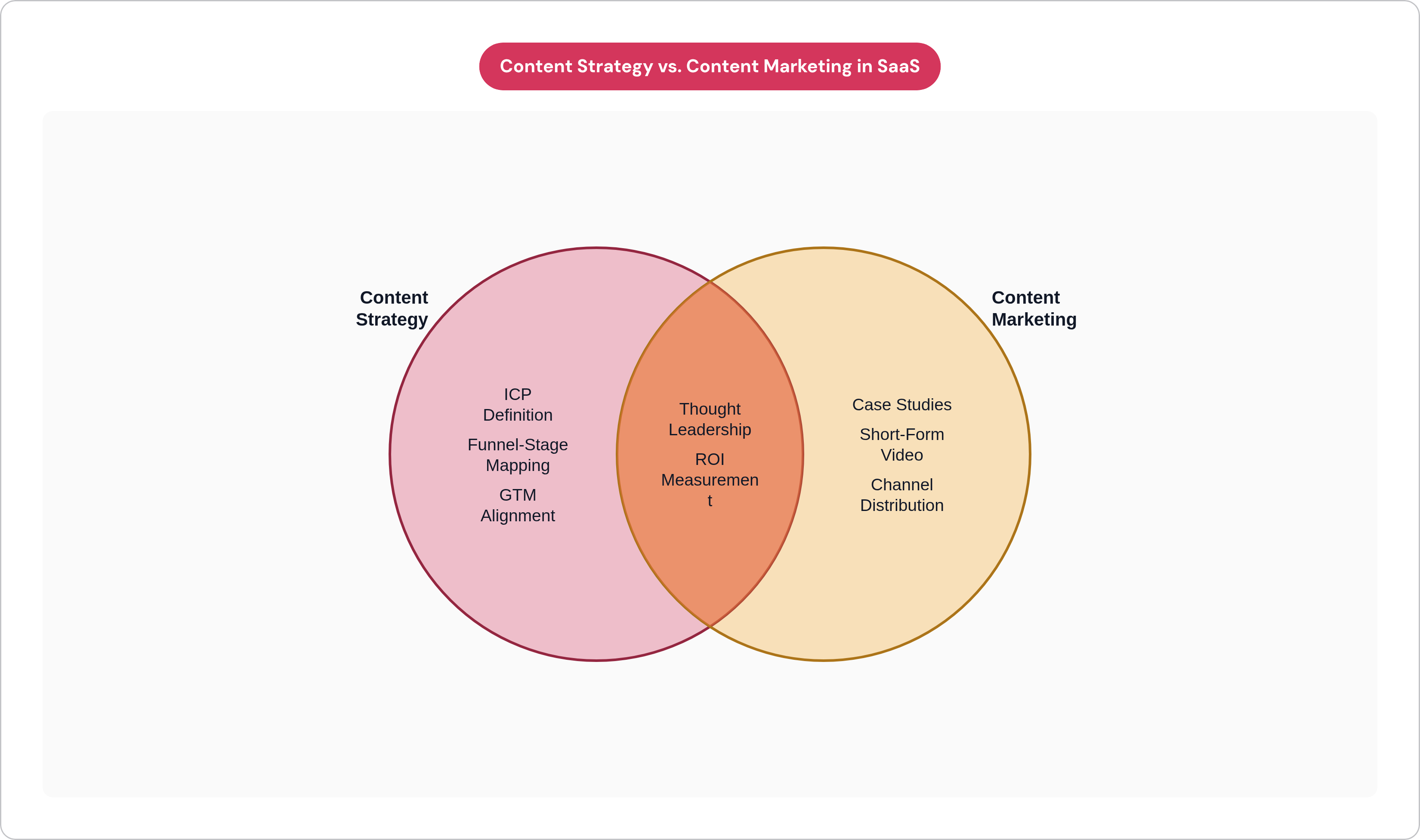
Three things need locking down before anyone drafts a word. First, ICP alignment: who this is actually for, what size company, what role, what specific problem keeps them awake at 2am. That single decision shapes your keyword targets, how deep the content needs to go, and whether the person on the other end wants a two-minute video or a twenty-page report.
Second, funnel-stage mapping. At awareness, buyers know they have a problem but haven't connected it to a category of solution, so content here talks about the pain, not the product. At consideration, they're comparing solution types, which calls for comparison guides and original research. At decision, they're choosing between named vendors, which is where case studies, ROI calculators, and demo content actually earn attention. Show a decision-stage case study to someone who doesn't yet know they have a problem, and you've undercut the whole funnel in one move.
Third, GTM alignment. Does the content match how the company actually sells: product-led, sales-assisted, or full enterprise sales with a six-person buying committee? A product-led company churning out enterprise-style whitepapers is solving a problem nobody in its actual funnel has.
All of this sounds obvious once it's spelled out, yet most teams skip straight to "let's build a content calendar." Companies with specific, documented goals are 376% more likely to succeed with content marketing, which suggests goal-setting is a precondition rather than a nice preamble everyone skims past. Strategy also has to say what the program will not cover. Saying no to certain topics or formats is itself a strategic decision, and skipping that step is how teams end up writing for everyone and converting no one in particular.
How content marketing execution translates that strategy into SaaS pipeline
Execution is where the actual stuff gets made, and it eats the overwhelming majority of time and budget on most SaaS marketing teams. Fair enough, as far as it goes, but it's incomplete if strategy never set the table first.
Case studies remain a workhorse: 49% of B2B SaaS marketers rate them as very effective for driving sales, but a case study only lands if strategy already decided which ICP and funnel stage it's aimed at. Thought leadership matters more than most people expect too. LinkedIn's own research found that a majority of B2B buyers prefer thought leadership over overtly promotional content when evaluating vendors. Thought leadership needs an actual point of view, though, and a point of view is a strategy output, not something a freelancer invents against a Thursday deadline.
Short-form video topped ROI rankings in HubSpot's 2025 State of Marketing Report, useful for demos and quick customer-story clips further down the funnel. Original research and interactive tools sit at the pricier end, differentiation plays for buyers who've read everything else on the internet and are looking for something new.
Channel choice belongs in execution too. Channel selection is itself a strategic decision, and the right mix depends on where a given ICP actually spends time researching. LinkedIn dominates B2B social specifically, with marketers consistently citing it as the highest-value platform for reaching professional audiences. Here's a channel most SaaS teams sleep on: a meaningful share of software buyers now use Reddit to research products before purchase. A site built for freewheeling arguments about lawnmowers and sourdough starters is quietly shaping enterprise software decisions.
Without strategy setting priorities first, execution sprawls. Teams start posting on every channel because someone read that TikTok is big now, without checking whether their ICP has ever opened the app. LinkedIn's own research found 55% of B2B buyers say thought leadership significantly influenced a purchase decision, but that number only becomes reachable once strategy has defined the company's point of view. Otherwise you're posting into the void with excellent production values and nothing to show for it.
What the financial case for SaaS content looks like when strategy drives execution
Scale first: the global SaaS market is projected to hit $512.27 billion in 2026, growing at 19.38% annually through 2029. That's a large, fast-moving market where small compounding advantages turn into large ones over a few years.
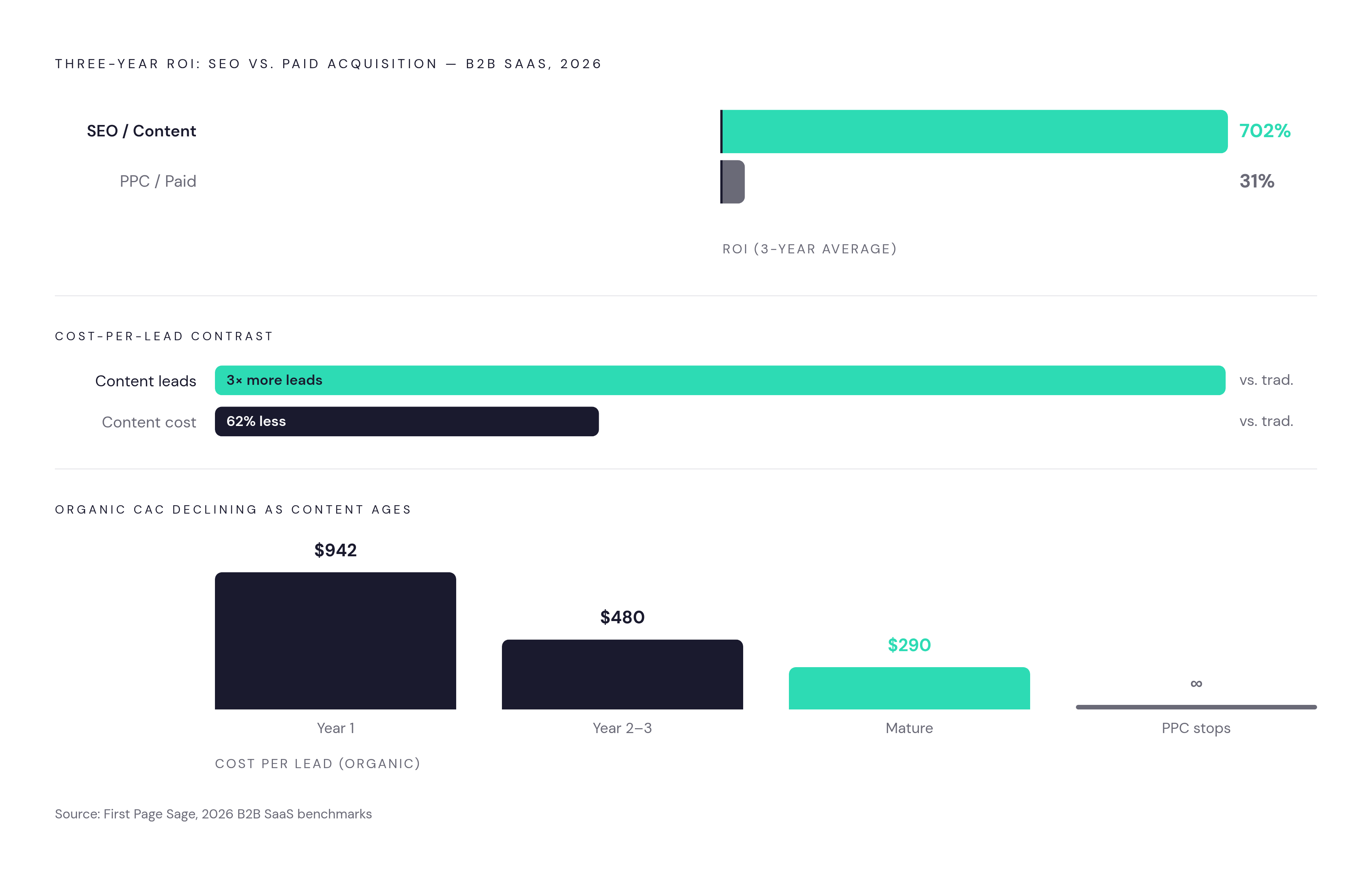
Content compounds in a way paid acquisition rarely does. First Page Sage's 2026 benchmarks put the three-year average ROI from SEO for B2B SaaS at 702%, against 31% for PPC. Content marketing reportedly costs 62% less than traditional marketing while generating three times more leads; roughly, content returns about $3 for every $1 spent, against something closer to $1.80 for paid ads. Organic customer acquisition cost runs $480 to $942 per customer, and that figure can drift down toward $290 as older content keeps ranking and keeps working long after it was published. Paid ads follow a different pattern; turn off the budget and the leads stop that same afternoon.
But the compounding only kicks in if the content was built around durable audience and keyword targets from the start, which is, once again, a strategy decision made before a single draft existed. Content produced without that foundation tends to accumulate rather than compound, the way old files pile up on a desktop nobody's bothered to organize since 2019.
Worth pausing on: 75% of SaaS companies plan to increase content marketing budgets, yet Gartner's 2025 CMO Spend Survey found 59% of CMOs say they don't have enough budget to execute their strategy. That gap looks like a clarity problem wearing a budget problem's clothes; spending more on execution rarely fixes a strategy that was never specific about what it needed in the first place. Strategic content marketing, done properly with funnel and audience work already in place, can cut customer acquisition cost by up to 41%. That number doesn't show up by accident; it shows up when content reaches the right person at the right stage instead of getting published and hoped at.
What goes wrong when SaaS teams treat strategy and marketing as the same job
Five failure patterns show up constantly, and every one of them traces back to the same root cause.
Traffic without pipeline is the first: organic sessions climb, the Monday analytics review looks great, and trial signups stay flat because none of that traffic maps to an actual ICP or funnel stage. Format sprawl is the second, where a team runs blog, video, newsletter, social, and podcast all at once because nobody ranked channels against audience, so effort gets spread thin across everything and deep in nothing.
Third is AI amplifying the wrong output. With 95% of B2B teams using AI somewhere in production, the danger isn't that AI writes badly; it's that AI layered on top of an undocumented strategy just scales the wrong content faster and cheaper than before.
Fourth is the measurement vacuum. Forty-seven percent of marketers aren't tracking content ROI at all, and without strategy-level goals to measure against, there's nothing to correct toward, and you can't fix what you never defined as broken in the first place. Fifth, and easiest to miss, is the retention blind spot. SaaS is a subscription business, so content has work to do after the sale too, in onboarding and retention, not just top-of-funnel acquisition. Treat content purely as a traffic machine and churn quietly becomes someone else's problem, except it isn't, because churn is the one failure mode that's structurally unique to companies charging monthly instead of once.
Is any of this really a marketing failure, or a strategy failure that never got properly named? Almost always the latter. Every one of these five patterns traces back to execution running without strategy resolved first, or someone mistaking an editorial calendar for an actual plan.
How to build the connection between the two layers in practice
Strategy owes execution four concrete things. A documented ICP with clear content implications by persona: topics, formats, channels. A funnel map assigning content types to awareness, consideration, and decision. A measurement framework tying content metrics to actual pipeline outcomes, not page views dressed up as success. And a prioritized channel plan matched to where the ICP actually spends time researching, Reddit apparently included now.
Cadence matters as much as the document. CMI's most effective teams don't write a strategy once and file it in a drawer; they run regular check-ins on goals, formats, and results. Strategy works as an ongoing governance function that gets revisited on a schedule, closer to a living process than a PDF opened once a year during planning season. That 74% figure from earlier is worth recalling here: strategy refinement is what marketers most often credit for real improvement, ahead of new tools or more output.
AI's proper home is inside execution. Once the plan is settled, AI-assisted production helps teams publish at the pace the market expects without gutting editorial quality along the way. It speeds up production, while deciding what to create, and for whom, stays a human call.
So what should a marketing leader hold onto personally, and what can get handed off to tooling? ICP definition, funnel mapping, GTM alignment, and the measurement framework stay owned internally, because they require judgment about the business that no software has access to yet. Content production, on-page optimization, distribution scheduling, and performance reporting are exactly where automation earns its keep.
There's a simple test buried in all this, worth returning to whenever a content plan feels stuck. Ask the room: who is this piece for, what stage of the buying journey are they in, and what action is it supposed to produce? If nobody can answer cleanly, strategy hasn't finished its job, and no amount of additional execution, more posts, more videos, more AI-assisted output, is going to make up the difference.