Marketing Mix Modeling for Digital-First Brands
Privacy collapse has made marketing mix modeling the only honest way to measure what actually works.

Marketing mix modeling measures how much of your revenue actually came from each thing you did versus each thing you tracked. It used to be the dusty, once-a-year exercise a CPG finance team ran to justify next year's TV spend; now it's the thing keeping digital-first marketers honest, because the identifiers that made attribution feel precise have quietly stopped working. This piece walks through what MMM measures, why the privacy fallout made it unavoidable, where it still buckles under digital-native conditions, and what a modern version looks like for brands that never bought a single print ad.
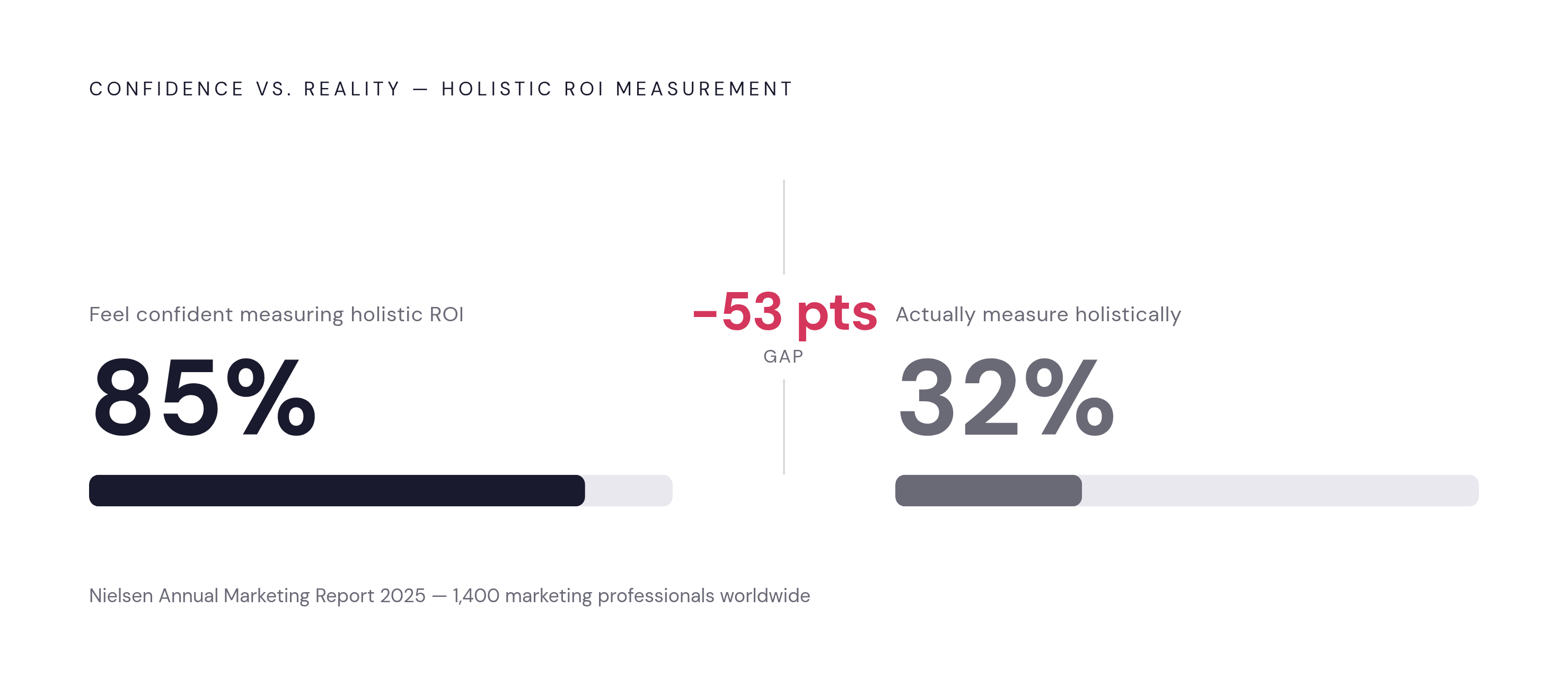
Nielsen's 2025 Annual Marketing Report surveyed 1,400 marketing professionals worldwide and found that 85% feel very confident measuring holistic ROI. Only 32% actually measure spend across traditional and digital channels in a way that's genuinely holistic. That's a 53-point gap between confidence and reality, and closing it is basically the whole point of what follows.
What marketing mix modeling actually measures and how it works mechanically
MMM is a statistical technique, rooted in econometrics, that estimates how much of a business outcome (revenue, units sold, new customers, market share) came from each major driver behind it. The key word is incremental. It tries to isolate what actually caused the sale versus what would have happened anyway, price cut or no price cut, ad or no ad, rather than simply counting clicks or views.
People assume MMM is just media measurement with the precision sanded off. In practice, it covers all four Ps: product, price, place, and promotion, not just ad spend. A last-click dashboard can't tell you that a price increase in March quietly ate into what looked like a strong paid search quarter. MMM can, because price and promotion sit in the model as inputs right next to media spend.
The data going in is time-series, usually weekly or monthly: media spend and volume by channel, revenue or unit sales, pricing and promotional calendars, seasonality markers, and outside variables like weather or a competitor's price cut. Two modeling concepts matter more for digital brands than most people expect. Adstock accounts for the fact that an ad doesn't just work the second someone sees it; a display impression on Monday can still be nudging someone toward a purchase on Thursday, and the model has to decay that effect over time instead of pretending it vanishes instantly. Saturation curves handle the opposite problem: pour more money into Meta or Google past a certain point, and each additional dollar buys less. Anyone who's watched a Facebook campaign's CPA creep upward as budget scales has lived this curve without knowing its name.
What comes out the other end is a decomposition, slower and chunkier than a dashboard you refresh every morning: this much of the month's revenue is baseline (what you'd have sold with zero marketing), this much is seasonality, this much is price effect, and here's the incremental contribution from each channel. It doesn't depend on tracking one person's device ID.
One modeling choice is worth flagging now, since it comes back later. Frequentist models fit their coefficients purely from historical data. Bayesian models start with prior beliefs, drawn from past experiments or vendor benchmarks, and update those beliefs as new data arrives. For a digital-first brand with two choppy years of spend data instead of a decade of steady CPG history, that distinction matters more than it sounds like it should. Through all of it, no user-level data ever touches the model, since that's simply how the method has always worked.
The privacy and signal-loss pressures that made MMM urgent rather than optional
Three things happened around the same time, and together they gutted the identifier-based tracking digital marketers had built their whole measurement stack on. Apple's iOS tracking limits cut deep into mobile attribution. AI search intermediaries started inserting themselves between the click and the conversion, breaking referral chains that used to be clean. Google's cookie saga, meanwhile, after years of announced deprecation and delay, landed in April 2025 with Chrome simply keeping cookies under existing user controls instead of forcing a standalone opt-in prompt.
That last one sounds like a reprieve. Users kept opting out through browser settings and privacy tools regardless, and no deterministic replacement for third-party cookies ever showed up to fill the gap. The signal kept eroding on its own schedule, cookie announcement or not.
eMarketer's 2025 research found 71% of brands had already cut back on how much they lean on user-level data, pushing measurement toward aggregated, probabilistic approaches instead. The practical effect on last-click and platform-reported dashboards wasn't that they disappeared; they kept running, kept producing numbers, kept looking clean. They just quietly became wrong, without the identifiers that used to make them trustworthy in the first place.
The response wasn't limited to individual marketers grumbling on LinkedIn. The discipline has clearly outgrown its niche status, with major analyst firms and industry bodies dedicating increasing attention to MMM as a category in its own right. The MMM software market was valued at $5.8 billion in 2025, while the broader marketing mix optimization market is projected to reach $14.8 billion by 2035, a 10.6% compound annual growth rate.
The privacy crackdown didn't invent MMM's value; it exposed it. Brands that had already put money into aggregated measurement found themselves standing on solid ground while everyone else's dashboards kept reporting fiction with total, unearned confidence.
How widespread MMM adoption actually is among digital marketers today
So how many marketers have actually switched, versus just nodding along at conferences? EMARKETER and Snap's July 2024 survey put US adoption at 53.5%. That's a majority, technically, but it also means nearly half of marketers still haven't made the move. Momentum, not consensus.
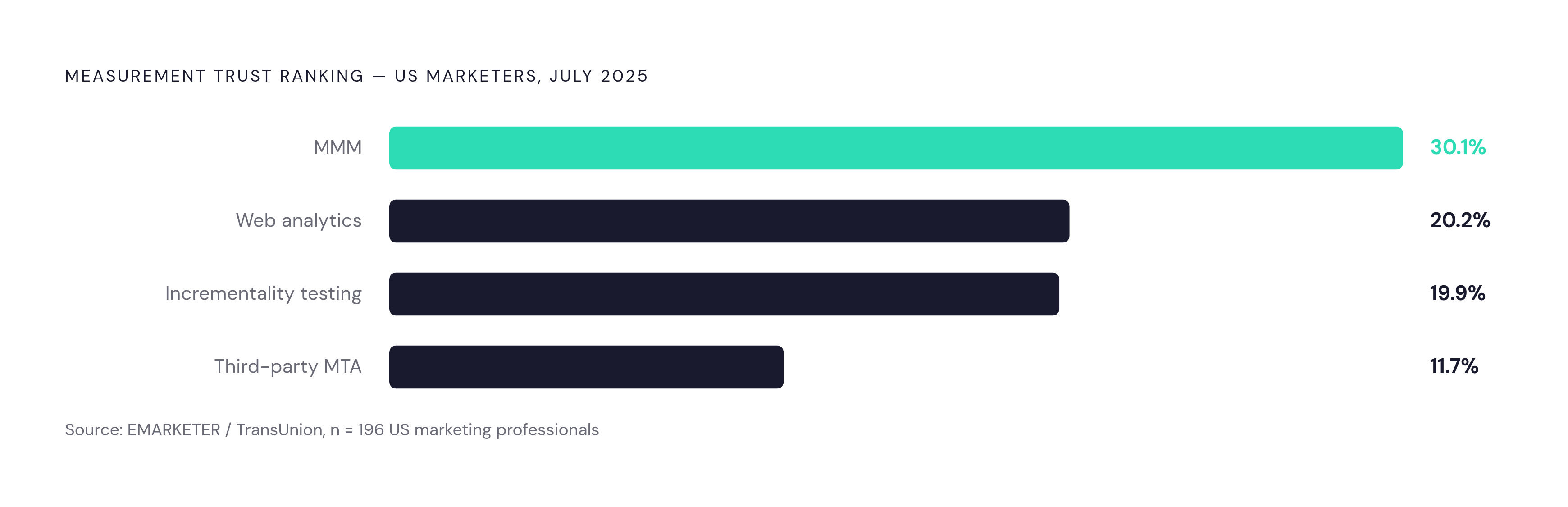
The direction is clear, though. A July 2025 survey from EMARKETER and TransUnion, covering 196 US marketing professionals, found 46.9% planning to invest more in MMM over the next year. Asked which methodology they trust most, MMM won outright: 27.6% named it the single most reliable method, versus 19.4% for multi-touch attribution. On the narrower question of what actually drives business value, MMM led again at 30.1%, ahead of web analytics at 20.2%, incrementality testing at 19.9%, and third-party MTA trailing at 11.7%.
There's a political layer under all this adoption data worth naming directly. TransUnion's October 2025 report found 60% of marketers face internal skepticism from stakeholders about their own metrics, and roughly 29% have watched leadership claw back as much as a fifth of their budget because they didn't trust the measurement behind it. MMM's appeal isn't purely statistical. It produces outputs that survive a board meeting, because they're aggregated and auditable rather than a pixel-fired claim from a platform that profits from taking credit for the sale.
Here's the catch: only 26% of in-house marketing teams actually run MMM themselves, according to Funnel and Ravn Research's April 2024 study. Most of the rest lean on agencies or outside vendors, which slows down how fast anyone can iterate. Speed is exactly what marketers say they want, though: 61.4% named faster, better MMM as their top measurement priority. Everyone wants faster answers, yet most organizations still haven't built the muscle to produce them.
Where standard MMM breaks down for brands built on digital channels
Here's where the method's seams show. Three years of weekly data gives you 156 data points, total. Try fitting a model with a dozen-plus ad channels, seasonality, pricing, promotions, and lagged carry-over effects into 156 observations, and you start to understand why statisticians get twitchy about it. Younger DTC brands, anyone who's pivoted their channel mix recently, and brands whose weekly spend swings wildly all feel this most acutely. A legacy CPG brand with twenty years of steady grocery-store data doesn't have this problem at all.
Then there's the speed mismatch. MMM was built for an era of annual planning cycles, three channels, and a media calendar that moved slowly. IAB's December 2025 guidance on modernizing MMM says it plainly: digital-first brands want weekly data refreshes and monthly model retrains, and a model built for annual cadence can't stretch to meet that without real re-engineering underneath.
Channel blind spots pile on top. A lot of models still lump all audio into one legacy-radio bucket, missing the real difference between a 30-second Spotify pre-roll and a mid-roll podcast ad, a distinction that practitioners and industry guides have increasingly called out. Retail media and digital commerce fare worse: the Forbes Business Council reported that half of surveyed brands say their models don't adequately capture these channels, even though retail media is often the exact thing driving their growth. Only 10% of marketers say they're "very confident" their MMM captures incremental impact accurately across channels.
There's a subtler distortion buried in the inputs themselves, too. Picture someone who sees a connected TV ad, clicks a retargeting ad on social, then converts through a branded search click. Three different platforms will each claim that conversion as their own. Feed those inflated, overlapping numbers into an MMM as if they were clean truth, and the model doesn't correct the distortion; it inherits it. Last-click reporting has been found to overvalue branded search by around 21% relative to its true incremental contribution, and an uncalibrated model just absorbs that inflated number as fact instead of questioning it.
None of this means MMM is broken as a concept. It means the vanilla, decades-old version wasn't built for a world with fourteen ad channels and a spend calendar that changes every quarter.
What modern MMM looks like when it's built for digital-first conditions
Bayesian modeling addresses the small-data problem structurally, rather than serving as just a fancier statistical flavor. Instead of demanding every ounce of insight come from a thin slice of historical time-series, a Bayesian model starts with prior beliefs, drawn from past experiments, incrementality tests, or vendor benchmarks, and updates those beliefs as real data rolls in. It also produces a range of probable outcomes rather than one confident-sounding number, which sounds like a downgrade until you remember that false precision is exactly what got a lot of marketers burned by last-click reporting in the first place. Google's open-source Meridian framework has moved this direction, and a wave of commercial platforms followed.
Calibration is the second leg. Geo-holdout tests, conversion lift studies, and matched-market experiments generate ground-truth incremental numbers, and those numbers feed back into the model to correct exactly the kind of distortion that inflates branded search by 21%. Industry best practice increasingly points to a layered setup where incrementality testing and campaign-level measurement feed into the MMM, rather than trying to replace it outright.
Cadence changes too. Weekly refreshes and monthly retrains replace the old annual cycle, though that only works if the data pipeline from ad platforms, analytics tools, and finance is automated. Manually exporting CSVs into a model that's supposed to update every week doesn't scale past the point where you've got more than one dedicated analyst doing it by hand.
Granularity is the other lever. Modern setups break channels down by geography, audience segment, and sub-type, instead of lumping everything into one top-level "paid social" bucket. That's what finally lets retail media, streaming audio, and CTV get measured as the distinct things they are, rather than getting averaged into mush. And the deliverable a CMO actually wants is a scenario simulator, something that lets someone test "what if we moved a portion of budget from paid search to retail media" before a single dollar actually moves, more than a spreadsheet of coefficients.
MMM versus multi-touch attribution: what each is actually good for
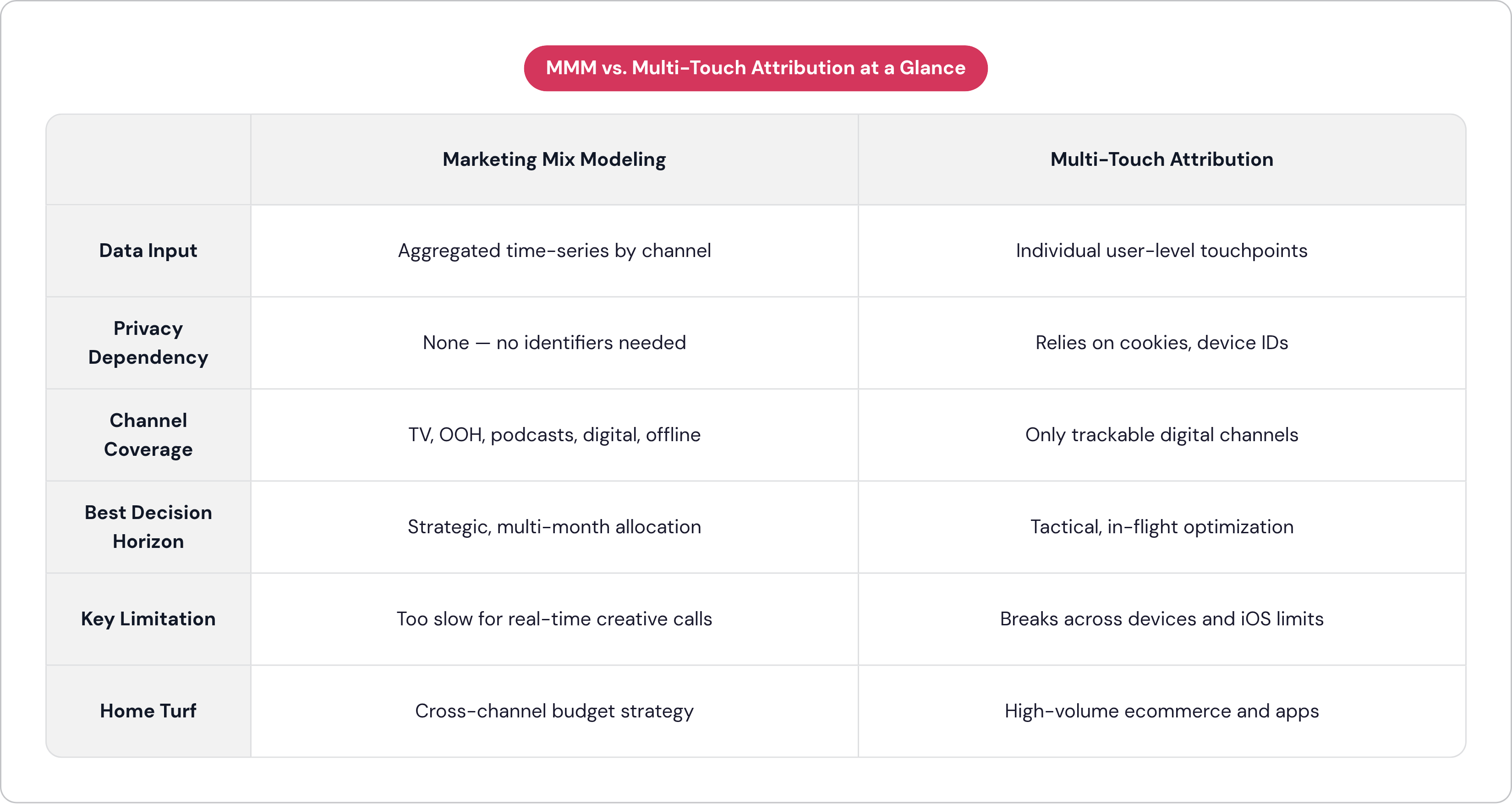
MTA tracks individual users across touchpoints and assigns credit to each one they touched before converting. MMM works from aggregated historical data and estimates the incremental effect of channels on outcomes overall. Different inputs, different math, and, this is the part people skip, different questions being answered.
MTA earns its keep with ecommerce brands, mobile apps, and subscription products running high transaction volume, frequent A/B tests, and spend concentrated in channels where the user journey is actually observable start to finish. That's its home turf, and on that turf it's genuinely useful.
Take it off that turf and it falls apart fast. No channel without a user-level identifier, meaning TV, out-of-home, podcasts, print, can be captured by MTA at all. Add a purchase journey stretching across days or devices, layer on iOS tracking limits and cookie blocking, and MTA's foundation gets shakier every month.
MMM's strengths sit almost exactly opposite: cross-channel strategic planning, blending offline and online spend into one picture, privacy-safe measurement by design, and budget decisions made on a multi-month horizon instead of a daily one. Ask it to optimize a campaign in real time or tell you which specific creative variant worked, though, and it has nothing to say. That's simply not its job.
The honest 2026 answer isn't picking a side but building Unified Marketing Measurement: MTA handles tactical, in-flight optimization, MMM governs the big strategic allocation calls, and incrementality testing sits in the middle keeping both honest. For a digital-first brand starting from zero, if forced to plant a flag somewhere first, MMM is the sturdier ground. It runs without user-level data, and it gives you the strategic clarity to figure out where more expensive, precise measurement is even worth building next.
What MMM-driven budget reallocation produces in practice
None of this matters if it doesn't change what actually happens to the budget. Google's Meridian documentation cites a Deloitte finding that C-level leaders who placed high importance on MMM were more than twice as likely to beat revenue goals by 10% or more. Worth flagging plainly: that's a correlation observed among leaders who already valued the method, not a controlled experiment proving causation. Leaders who take measurement seriously probably do a lot of other things right too.
Still, the reallocation numbers are hard to wave away on their own. A 2024 Sellforte study found ecommerce brands using MMM grew revenue by 2.9% through smarter budget allocation alone. A separate Sellforte analysis from the same year found brands that moved away from last-click attribution and adopted MMM saw 6.5% more sales. And a 2024 Nielsen study found that combining TV and digital advertising boosted campaign effectiveness by 20%, an interaction effect platform-specific attribution literally cannot see, because no single platform's pixel watches what a competitor's ad did to the same customer.
There's a downside worth weighing, and it's not subtle: recall that 29% of marketers have had budget pulled away from marketing entirely because leadership didn't trust the measurement backing it. That's a credibility problem costing you the budget outright, not merely a modeling error costing you precision.
Frame the payoff honestly, because it's easy to oversell this part. The revenue gain comes from the reallocation decision itself, from actually moving the money once the model tells you where it's underperforming. The model just produces the insight; someone still has to act on it, and plenty of good analysis has sat unused in a slide deck because no one followed through.
What it takes to run MMM in-house versus partnering for it
This is a build-versus-buy question, and the honest answer depends less on budget size than on how much data infrastructure a brand already has lying around. Running MMM in-house means someone owns a working pipeline pulling clean spend and outcome numbers from every platform automatically, someone who actually understands Bayesian methods well enough to set sensible priors instead of garbage-in-garbage-out ones, and a standing commitment to retrain the model monthly rather than treating it as an annual chore nobody enjoys.
Remember that only 26% of in-house teams run MMM themselves. That's not laziness so much as a resourcing gap. Building this in-house means hiring or training a data scientist who understands adstock and saturation curves, wiring together a pipeline that survives when a platform changes its API without warning (which happens more often than anyone would like), and running experiments that keep the whole thing calibrated against reality instead of drifting into a comforting fiction.
Partnering with a vendor or agency skips the hiring headache but reintroduces the exact speed problem the last few sections keep circling back to: 61.4% of marketers say faster MMM is their top priority, and outside dependency is usually the bottleneck standing between them and it. A vendor model that refreshes quarterly isn't meaningfully different from the annual CPG-era cadence this whole conversation started out trying to escape.
The practical answer that keeps showing up across brand size and maturity is a hybrid: bring the Bayesian modeling engine and its retraining cadence in-house, once someone actually knows how to run it, and lean on outside partners for the incrementality testing that keeps the model honest. That split matches the layered framework from earlier: MTA for the fast tactical calls, MMM for setting strategy, incrementality testing holding both in check. Marketing mix modeling turned out to have been quietly right the whole time; the industry just needed the old identifiers to break before anyone noticed.