AI Answer Engine Citation Tracking vs Traditional Digital Marketing KPIs
AI systems now decide which brands reach buyers before they ever click to a website.
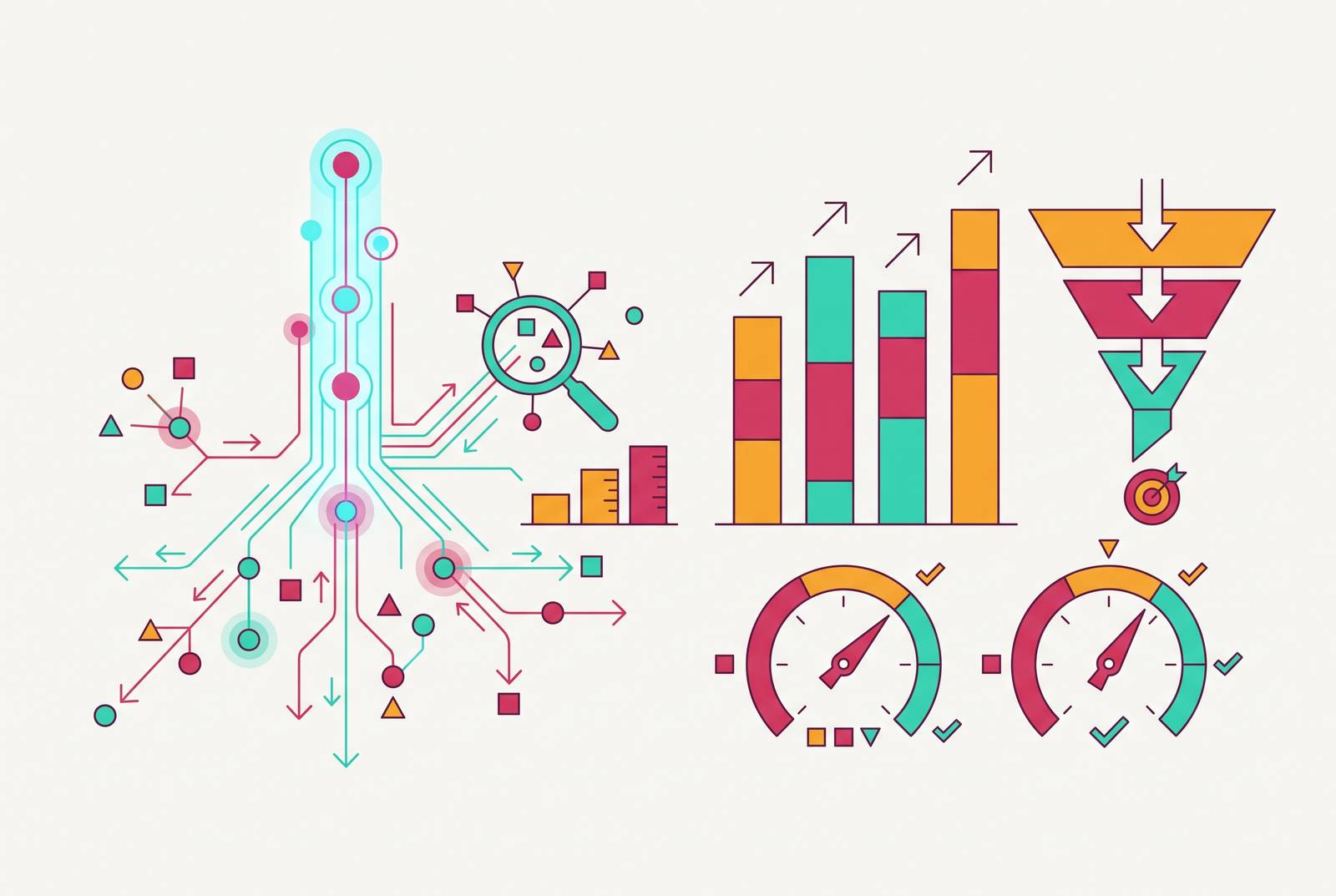
Buyer research now happens inside AI answers before a search results page ever loads, and that shift is the reason digital marketing's old scoreboard no longer matches what's happening on the field. Google AI Overviews appear on roughly 25% to 75% of searches depending on which tracker is measuring, and that coverage grew sharply in the twelve months between February 2025 and February 2026. Google AI Mode passed 1 billion monthly active users worldwide as of May 2026, while AI Overviews reach more than 2.5 billion users a month across over 200 countries. The average AI Mode search runs three times longer than a traditional search, which tells you something concrete about buyer behavior: people aren't typing two or three keywords anymore, they're asking full questions and expecting a synthesized comparison of vendors back. When an AI Overview shows up, the zero-click rate climbs sharply, so a large share of users get their answer and close the loop without visiting a single website. The underlying mechanism is retrieval-augmented generation (RAG): these systems anchor their answers to external sources like documents, databases, and web pages, and which pages get pulled into that retrieval step decides which brands make it into the answer. For a B2B buyer comparing software vendors, that retrieval step is now the moment the shortlist gets built.
Why rankings, CTR, and organic sessions cannot see what is happening
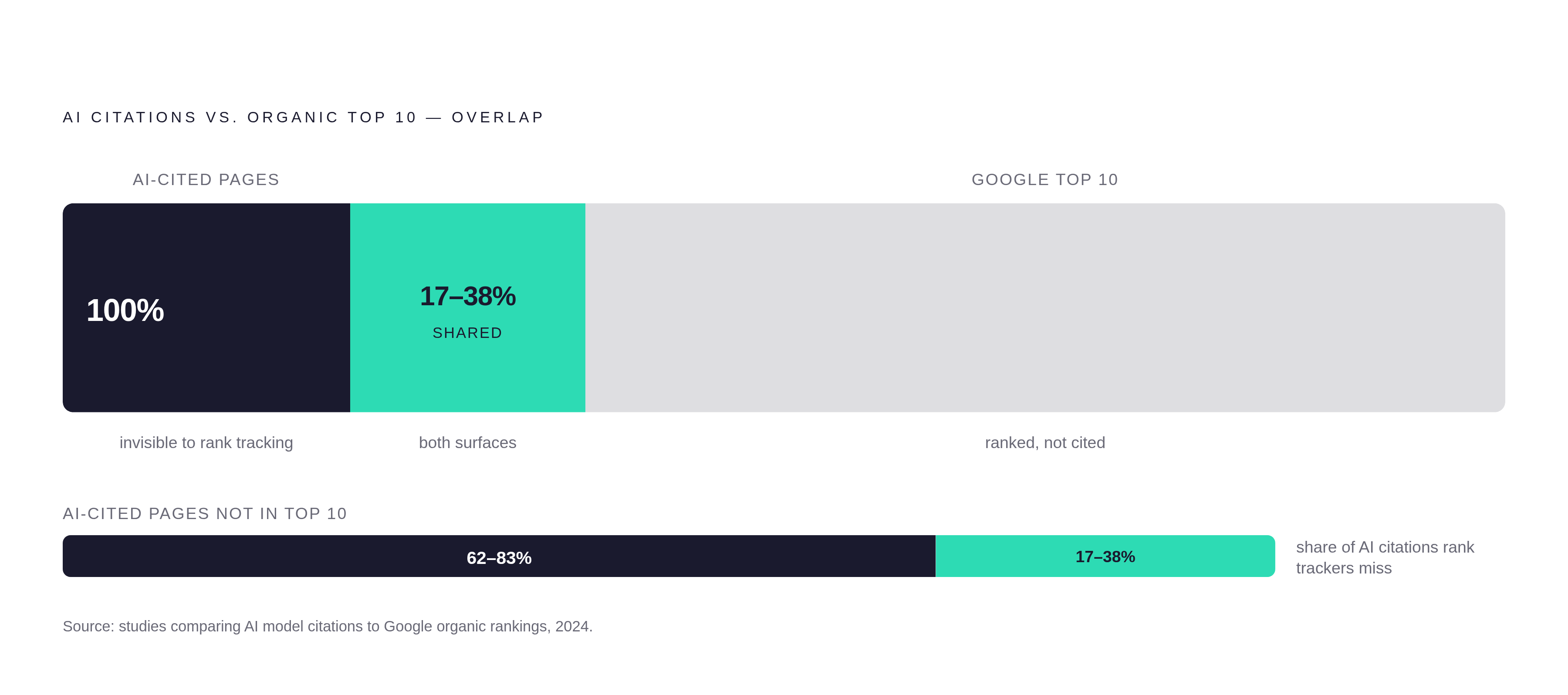
Rankings, click-through rate, and organic session counts were built to measure traffic to a website, and when a buyer's research finishes inside an AI answer instead, those tools have nothing to record. That's not a small gap in the data; it's a growing one, scaling with how much of the research journey AI now intercepts. When an AI Overview appears on a search, click-through on the traditional organic result below it drops sharply, so a page sitting in position one can still lose a large share of the clicks it used to earn simply by ranking first. Rank and citation aren't even measuring the same population of pages: only 17% to 38% of AI-cited pages also show up in the organic top 10. A brand can hold a top-10 spot and still never appear in the AI-generated answer sitting above it on the same query. Attribution breaks down the same way. A buyer who builds a shortlist inside ChatGPT and later types a vendor's URL directly into the browser generates a direct session with no traceable origin, so GA4 records none of the influence that actually drove the visit. Rank position and citation probability simply don't move together in any predictable way. Publisher traffic from Google search dropped substantially between late 2024 and late 2025, and news publishers expect it to drop further over the next three years. If the populations of AI-cited pages and organically ranked pages are this distinct, treating them as a single measurement target builds a blind spot directly into the reporting.
Citation Tracking Across AI Platforms Is Not a Single Unified Metric
Citation behavior shifts sharply from one AI platform to the next, so watching a single engine gives an incomplete read on how exposed a brand actually is across AI search as a whole. The thin overlap between AI citations and organic rank (that 17% to 38% figure) repeats itself again between platforms: only a small fraction of domains get cited by both ChatGPT and Perplexity. A mention is a brand's name appearing somewhere in a response, while a citation is a specific URL attributed as a source, and the two carry different weight. A platform that counts mentions alone misses whether the model actually treats that content as a trusted source it wants to point back to. Because citation behavior diverges this sharply across platforms, tracking visibility properly means watching multiple engines at once with a continuous check. Systems built to monitor ChatGPT, Claude, Gemini, and Perplexity at the same time, the kind Letterstory runs, surface exactly which platforms cite a brand and which ones don't, catching gaps that a single-engine audit would miss.
What a citation tracking KPI stack actually measures, replacing what traditional metrics measured
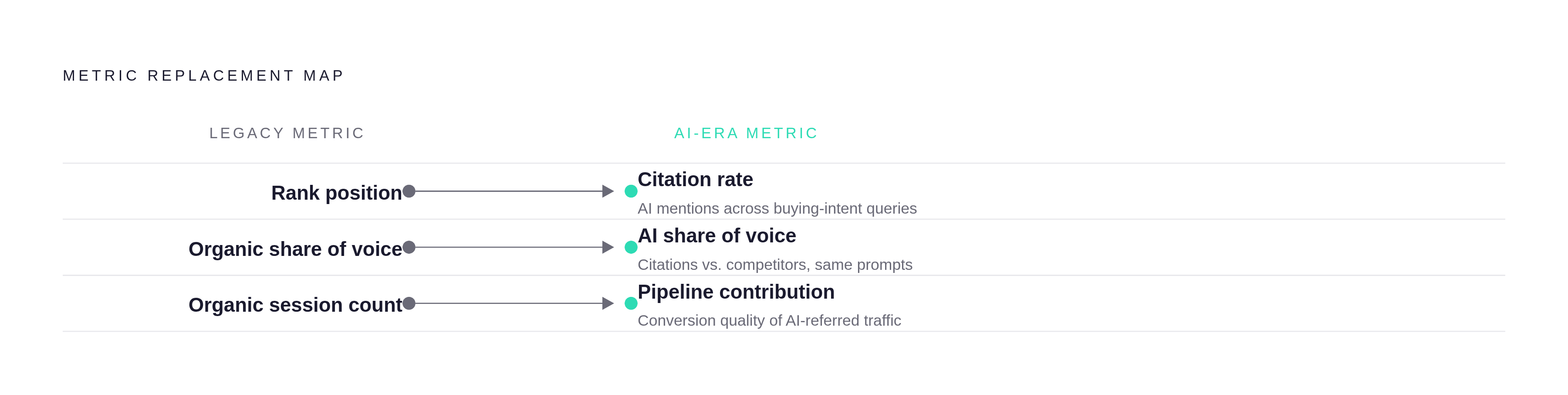
Three metrics make up the replacement stack, and each one stands in directly for a traditional metric that can no longer see where buyer discovery actually happens. Citation rate tracks how often AI platforms mention or cite a brand across queries that carry buying intent, and it replaces rank position, a measure of visibility on a surface that intercepts a shrinking slice of the research journey. Share of voice in AI answers tracks how often a brand gets cited relative to named competitors on the same prompts, replacing share of voice in organic results, which is now an incomplete proxy for competitive standing. Pipeline contribution from AI-referred traffic tracks the quality and conversion rate of sessions that originate from AI platforms, replacing raw organic session counts, a number that's both declining and increasingly disconnected from actual influence. None of this requires a budget to start measuring. Checking server logs for GPTBot, ClaudeBot, and PerplexityBot shows exactly which pages AI platforms are actually crawling, and GA4's referral filters for perplexity.ai, chatgpt.com, and claude.ai isolate sessions coming from AI platforms without any paid tool in the stack. The new framework doesn't retire everything that came before it: organic rank still governs visibility on queries where AI Overviews never appear, and backlink profiles still shape how easily a page gets crawled in the first place. For queries where AI intercepts the answer, though, citations and share of voice are the metrics doing the actual work.
What Earns Citations, and Why It Differs From What Earned Rankings
The content decisions that earn an AI citation run on different logic than the ones that used to earn a Google ranking, and the most consequential of those decisions, earned media coverage, content freshness, and specific formatting choices, sit largely outside what a standard SEO content plan ever targeted. Most AI citations trace back to earned media, meaning third-party editorial coverage rather than brand-owned pages or paid placement, so if you optimize your own site, that's necessary but nowhere close to enough on its own. Brand mentions scattered across the web correlate with AI visibility far more strongly than backlinks do by themselves, so the signal these engines weight most heavily is third-party corroboration, not the on-page authority signals that built the old SEO playbook. Freshness behaves as a hard constraint rather than a ranking factor here: a 2026 analysis found Perplexity cited content published within the prior 30 days at a high rate, a pattern with no real equivalent in organic SEO, where a well-linked page can hold its position for years without a single update. A study from researchers at Princeton, Georgia Tech, and IIT Delhi, presented at ACM KDD, found that adding statistics, citing sources, and including direct quotations each independently improve how often content gets cited by AI systems. These are structural credibility signals, not keyword density, and they call for a different kind of editorial discipline than traditional on-page SEO ever demanded. Format matters differently too: listicles lead overall LLM citations at 21.9%, but for commercial queries specifically, the share going to listicle format roughly doubles to around 40.9%, a split with direct consequences for how content gets planned that has no parallel in the old keyword-to-format mapping exercises. One tactic has emerged as the primary way to earn citations through owned content: a grounding page, a fact-dense, structured page built to serve as evidence for AI models at the moment they retrieve information, built with a different structure and purpose than a traditional landing page or SEO pillar page.
Tools that measure AI citation and brand visibility across answer engines
Picking a tool here means deciding how far it should carry a team: from a citation alert all the way to a published fix, or just to the alert itself. Lettertrace, built by Letterstory, measures whether ChatGPT, Claude, Gemini, and Perplexity name and cite a brand, and it does this from inside the same system that produces and publishes the content meant to earn those citations. That design choice matters for a specific kind of team: marketing and content groups at B2B SaaS and dev-tool companies who need citation tracking wired directly into a content engine rather than a standalone dashboard that hands back a to-do list someone still has to execute. Its pipeline pairs AI drafting with human review at defined approval gates, so a system built to publish at scale still produces work that's reviewable and reversible before anything ships. Every capability in Lettertrace is also reachable by an agent through an API, not just through a browser interface. It can slot into an existing marketing stack, fitting alongside the tools a team already uses. For a team that wants citation measurement and the content work that actually moves the number living in one place, it's a strong fit.
Profound takes a different approach, specializing in showing when and how ChatGPT, Perplexity, and Google AI Overviews mention a brand, with Claude and additional engines available on its Enterprise tier, where coverage expands to as many as nine answer engines. It also runs competitor benchmarking. Pricing now starts at custom Enterprise terms, and its self-serve Starter plan, previously $99 a month billed annually, was removed in mid-September 2026. Profound fits teams that want deep measurement and competitive intelligence and are handling content production through a separate system.
SE Ranking's SE Visible tracks AI Overviews, AI Mode, Gemini, ChatGPT, and Perplexity, and rolls that into an AI Visibility Score alongside competitor benchmarking, prompt and topic analysis, source insights, and sentiment scoring. It works from real AI responses rather than simulated ones, giving it a strategic, brand-level view. It suits marketing leaders and agencies who want a high-level read on brand visibility without needing a content production workflow attached.
Frase carries a team from citation tracking through research, drafting, dual SEO and GEO scoring, and publishing, all inside one platform, and then monitors the page again once it's live. The appeal is in closing the loop: when a citation disappears, the same tool that flagged it can also produce and ship the fix, without routing the work through a second system. It fits content teams prioritizing that closed loop over deep enterprise competitor intelligence.
Conductor connects AI visibility data to content execution and technical site health, built for enterprise teams that want citation tracking layered onto an SEO platform they're already running. It fits teams already on Conductor's platform looking to extend into AI citation monitoring without bringing in another system.
For teams without budget for any of these, a baseline method still works. Monitoring server logs for GPTBot, ClaudeBot, and PerplexityBot shows which pages AI platforms are actually crawling, and GA4 referral filters for perplexity.ai, chatgpt.com, claude.ai, and you.com surface sessions that originated from AI platforms. That combination gives a first read on AI exposure, but it won't produce competitive share of voice or prompt-level tracking the way a purpose-built platform does.
How to decide whether to add citation tracking or replace your existing KPI framework with it
Whether citation tracking sits alongside traditional KPIs or takes over as the primary measure depends on the mix of queries a brand competes for, and for B2B SaaS and commercial discovery queries, where AI interception already dominates the research journey, treating citation rate as a secondary metric is a structural mistake. A simple test settles the question: if a brand's target buyers are among the growing number who now start vendor research inside an AI chatbot rather than Google, the AI answer is where the shortlist actually forms, and citation rate becomes the primary visibility metric for that journey, with organic rank sliding into a secondary role. The timing favors whoever moves first. 70% of marketing professionals believe answer engine optimization will significantly reshape their strategy within one to three years, yet only 20% have started implementing it, so a team instrumenting citation tracking now is measuring a surface most competitors can't see yet. None of this calls for tearing out the old framework wholesale. Organic rank still governs visibility on queries where AI Overviews never appear, and traditional content performance metrics still hold up for content serving existing customers rather than driving new discovery, so a full replacement of the KPI framework would be premature. A structural addition with clear rules for which metric leads in which situation is the right model. The transition itself can run in parallel: track citation rate and traditional analytics side by side for one quarter, and any query category where citation rate moves independently of rank position confirms that the two surfaces need separate measurement programs, which the overlap data will almost certainly bear out. The underlying principle holds regardless of tooling: AI visibility needs to be measured, not assumed, and a brand running no citation tracking across ChatGPT, Claude, Gemini, and Perplexity doesn't actually know its exposure on the surface where buyers now build their shortlists, no matter how healthy its organic numbers look on a dashboard. The KPIs that defined digital marketing for the past two decades were always instruments built for a particular surface, and as that surface shifts toward AI-generated answers, the instruments measuring it have to shift with it. Citation tracking is not an extra metric stacked on top of the old reporting but the operative measure for the surface where discovery now happens.