Editorial Workflow Design for Hybrid AI and Human Teams
Teams need to redesign workflows around AI roles, not just add the technology to existing processes.
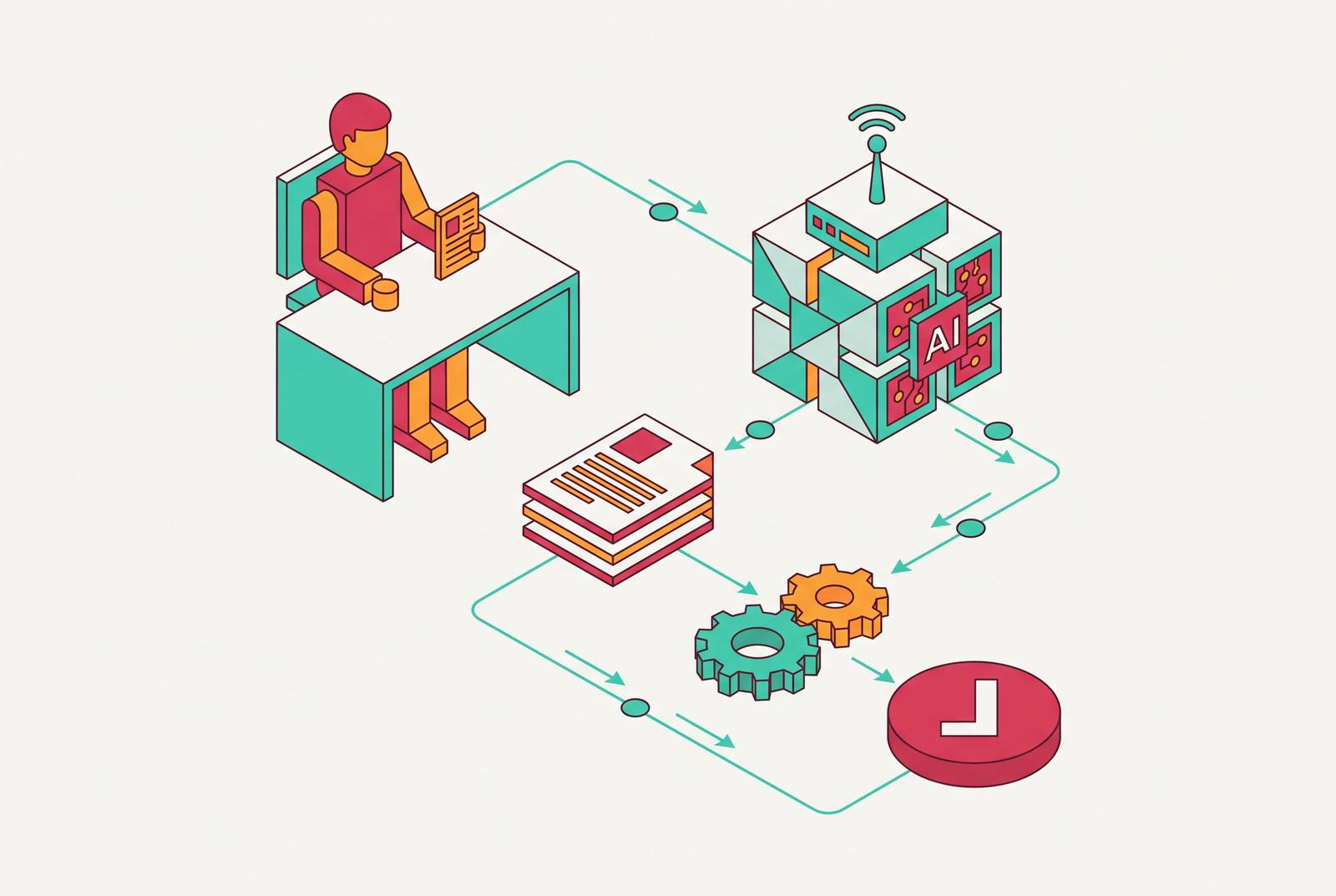
A large majority of marketers now use generative AI somewhere in their workflow, according to recent industry surveys. Yet a global survey of 3,000 executives and practitioners in Adobe's 2026 AI and Digital Trends report finds that many organizations still describe their content supply chain as largely linear and resource-heavy. That gap is the story. Bolting AI onto a workflow that was never redesigned to use it produces busier teams, not better ones. The UK government's June 2026 AI adoption plan found 51% of creative businesses now use AI, against 33% for the wider economy. It says nothing about whether that adoption works. The real question editorial teams need to answer is which decisions belong to humans and which tasks belong to machines. It's which decisions belong to humans, and which tasks belong to machines.
What the three fundamental human-AI workflow models look like in practice
Most teaming approaches trace back to three basic models, and knowing which one a team actually operates in changes every downstream decision about role clarity.
The first, and by far the most common, is human prediction with AI assistance. A person sets direction, chooses the angle, defines the audience, and AI executes discrete tasks along the way: a paragraph here, a headline variant there, a summary of research notes. The human stays in the driver's seat throughout.
The second model is AI-assisted production with human review gates. Here AI does more of the heavy lifting, drafting full pieces and running a first editing pass, but nothing goes out the door without a human sign-off. This is the model most mid-sized content teams are drifting toward in 2026, largely because it captures speed without surrendering the approval moment.
The third is agentic orchestration, and it looks structurally different from the first two. Instead of one tool doing one job, a coordinated layer of agents handles the whole loop: one agent researches, another analyzes performance data, another drafts, another tracks results after publication. Humans set the strategic parameters up front and intervene only at defined checkpoints. This model remains early-stage. The agentic AI market is growing at more than 45% CAGR according to Gartner forecasts cited by Averi.ai, but adoption on the editorial side is still nascent, and forcing a team into full orchestration before its governance is ready tends to create new failure modes rather than solving old ones.
Not every team should aim for model three. What matters is that whichever model a team runs, the same question needs an answer at every stage: who owns this decision?
The decisions that must stay with humans
Frontiers in Artificial Intelligence published an editorial in 2024 (Kluge, Wilkens, Nitsch, and Peifer) summarizing Wilkens et al.'s eight criteria of human-centricity in human-centered AI at work. Trustworthiness, explainability, human agency and augmentation, and accountability and safety culture stand out as the most operationally relevant for editorial teams, and they map cleanly onto five categories of decisions that shouldn't move to a machine.
Strategy and intent mapping comes first: choosing themes, prioritizing audiences, deciding what role a piece plays in the funnel. AI can surface data and suggest options, but it cannot set direction, because direction requires knowing what the business is actually trying to become.
Source judgment is second. Evaluating whether a source is authoritative, current, and appropriate for a brand's credibility takes contextual reasoning that current models don't reliably perform, especially in specialized or regulated fields.
Voice and positioning make up the third category, and this one deserves more weight than it usually gets. AI models are trained on the average of the internet. Their default output is, structurally, generic. Brand distinctiveness has to be held and enforced by a person, because no model is optimizing for "sounds like nobody else."
Fourth: fact-checking and claims verification. AI consistency checkers catch surface errors, timeline contradictions, a character's age changing halfway through a piece, but domain-specific claims produce factual inaccuracies that these checkers do not reliably catch. That distinction matters enormously and gets confused often.
Fifth, and final, is final approval itself, the accountability gate before anything publishes. TechWyse's 2026 analysis found that removing this human gate "usually gets a short burst of speed followed by longer cleanup cycles." Developmental editing, meaning story arc, argument structure, and pacing, belongs in this same human-owned bucket. Inkfluence AI describes a hybrid pattern where the human editor's attention concentrates specifically on this higher-level work rather than sentence-level cleanup.
All five categories share what researchers call jagged AI capability: strong on some tasks and surprisingly weak on adjacent ones that look similar on the surface, because the underlying skills a task draws on do not track surface similarity. Frontiers in Artificial Intelligence's research points to shared mental models and situational awareness as important factors in effective human-AI teaming. Teams that haven't mapped where AI is actually reliable, as opposed to where it seems reliable, tend to either over-trust it or avoid using it where it would genuinely help.
The tasks that AI handles better when humans step back
The flip side of that argument is just as concrete. Some tasks improve measurably once a human stops doing them by hand.
First-pass copyediting is one: catching character name inconsistencies, timeline contradictions, and tone shifts across a long document is exactly the kind of pattern-matching AI does well. Structural first drafts are another. Inkfluence AI's 2026 reporting describes a 90/10 pattern in practice, where AI generates roughly 90% of the raw text and the human contributes the 10% that actually makes the piece distinctive. That's not a replacement of the author's voice; it's a skeleton the human reshapes.
Research compilation and source gathering fall into the same bucket, surfacing inputs for a human to analyze rather than doing the analysis itself. Distribution and scheduling, meanwhile, are close to pure automation candidates: routing assets, managing channel queues, triggering content refresh cycles on a calendar. And performance tracking and reporting is where the time savings compound fastest. A case study cited by AgencyAnalytics documented 240 hours saved per month on reporting alone, for a high-volume shop running many client accounts at once.
Adobe's 2026 AI and Digital Trends report backs this up with numbers. 76% of marketers say generative AI has moderately or significantly improved the volume and speed of content ideation and production. 70% say it improved content creation specifically among non-creative teams. 69% report broader productivity and efficiency gains. Notice where these gains cluster: execution tasks, the kind distinct from the judgment-heavy work named in the previous section. The data doesn't undermine the human/machine split, it validates it.
That same data carries a warning. Pulling human review out too early converts a speed gain into a cleanup cost later. The real workflow design question is at which stage does AI hand off to a human, and getting that handoff point wrong is where most hybrid workflows quietly fail." It's "at which stage does AI hand off to a human," and getting that handoff point wrong is where most hybrid workflows quietly fail.
How to translate role clarity into workflow stages
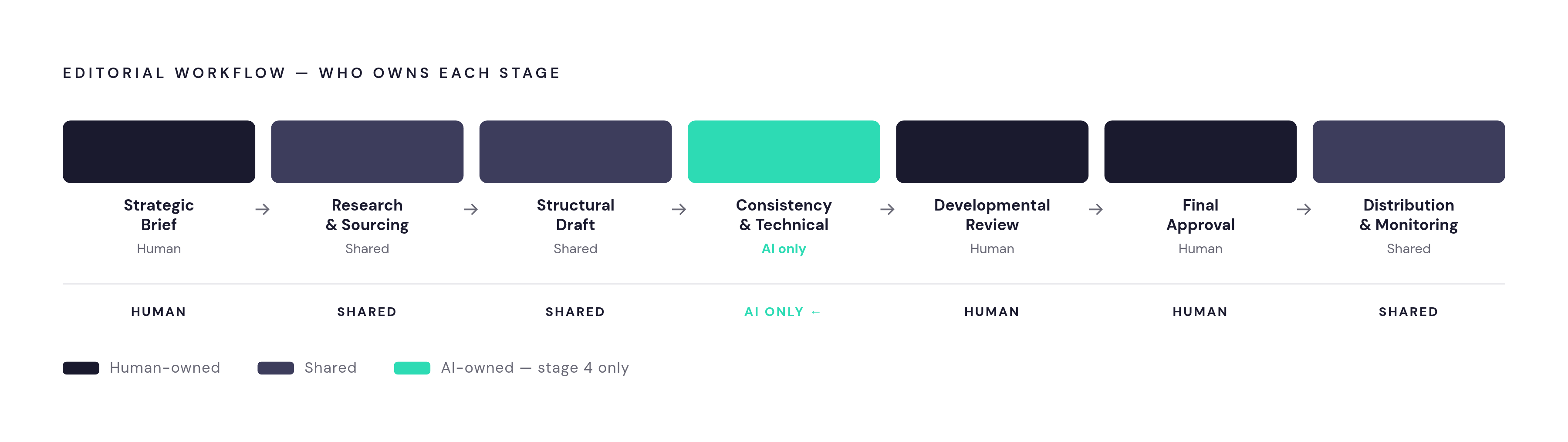
The old linear sequence, assign, write, edit, publish, doesn't survive contact with AI cleanly. It needs to be replaced with a stage-gated system where each stage has a named owner and a defined condition for handing off to the next.
A workable architecture runs seven stages. Stage one is the strategic brief, human-owned: intent, audience, funnel role, brand positioning. AI can feed data into this stage, but it cannot set the parameters. Stage two is research and sourcing, AI-assisted but human-curated: the machine compiles, the person selects and judges authority. Stage three is the structural draft, AI-generated and human-shaped, where the 90/10 pattern from the prior section actually plays out. Stage four is the consistency and technical pass, which is fully AI-owned: copyediting, style checking, schema markup, and the structural requirements that GEO and AEO now demand. Stage five is developmental review, back to human ownership: argument structure, pacing, source judgment, fact verification, positioning. Stage six is final approval, the accountability gate. Stage seven is distribution and performance monitoring, AI-orchestrated but human-reviewed at set intervals, not left running unsupervised indefinitely.
Ackerman's 2025 Creative Intelligence Loop framework, published on arXiv, makes the point that the workflow itself is a medium. The co-creative process actively shapes the nature of the inquiry and its outcome, with the nature of the inquiry and its outcome shaped by how the process is built. Treating a workflow as a neutral pipe that content simply flows through is a design error, not a minor oversight.
Two tactics from that framework transfer directly into editorial work. One is a multi-faceted critique system built to counter AI sycophancy, the tendency of a model to validate whatever direction it's already been pointed toward rather than push back. The other is prioritizing concrete, "feedback-ready" artifacts at human review gates, giving a reviewer an actual draft to react to rather than an abstract prompt to imagine an outcome from.
Stage ownership needs to live somewhere written down, in a form that outlasts team habit. Role clarity that only exists as an unspoken norm erodes fast the moment a deadline gets tight.
Brand governance as a structural requirement, not a style guide problem
HubSpot found 94% of marketers plan to use AI in content creation in 2026. More output is coming, with less editorial oversight applied per individual piece, and AI's default output leans generic precisely because it's trained on the average of everything online. A brand's distinctiveness has to be defended structurally, not hoped for.
That means brand governance can't be a document a writer consults when they remember to. It has to sit inside the tooling itself, embedded at the stage gates where content gets produced.
Several tools now build governance in at the point of production rather than around it. Jasper encodes brand voice, tone guidelines, and messaging frameworks directly into the generation tool, so governance happens as the content is written. Frontify operates one layer upstream: it functions as a brand intelligence system that generation tools connect to via MCP and API, managing brand libraries and production workflows across multiple markets from a central position rather than sitting alongside the output. Typeface, an enterprise content platform, connects to a brand's existing asset libraries, its approved imagery, typography, and color systems, which addresses the specific tension high-volume agency programs face between speed and fidelity. CreativeX takes a different angle entirely, auditing finished creative assets against defined brand metrics, logo visibility, color compliance, and product presence, across an entire portfolio without requiring manual review of every single piece.
For agencies juggling several client brands at once, multi-agent systems can be configured per brand, each with its own voice, keyword strategy, and governance parameters. That configuration has to happen before production starts, though. Applying governance retroactively, after content has already shipped, is closer to damage control than governance.
Thrad sits in this picture as the layer specifically built for AI visibility governance. For agencies managing GEO and AEO performance across a client portfolio, Thrad provides monitoring and analytics infrastructure that tracks how each brand shows up in AI-generated answers, reports on it, and helps maintain that presence over time, extending brand governance from the production side into the AI search surface where a brand's reputation is increasingly built without anyone clicking through to its website.
Why AI search visibility changes what editorial quality control needs to measure
A growing share of searches now end without a click to a third-party site, and AI-generated answers are accelerating that trend. Content can shape a buyer's decision before any session ever registers in an analytics dashboard. That changes what editorial quality control is actually supposed to check for.
Structurally, workflows now need to produce a specific set of things. Headings that mirror how a real person phrases a question, rather than how a marketer titles a section. Clear definitions and direct answers at the top of each section, before the elaboration. Scannable formats, bullets, numbered steps, short paragraphs, built so an AI system can extract them cleanly into a generated answer. Schema markup, FAQPage, HowTo, Product, applied at the technical stage rather than bolted on afterward. Authorship signals and credentials on blog content. Citations pointing to primary sources and recognized publications.
Writer.com's research on GEO and AEO optimization puts a number on a related pattern: roughly 85% of brand mentions in AI search come from third-party pages, not the brand's own site, so a brand is far more likely to get cited through someone else's content than through its own. That reframes GEO as an editorial problem, not a purely technical one. Sourcing decisions, authorship choices, structural decisions, and topical depth all need to happen at the brief and review stages, because none of it can be patched in after a piece is already live.
Platform concentration adds another wrinkle. Conductor's 2026 AEO/GEO Benchmarks Report found that ChatGPT accounts for 87.4% of AI referral traffic across ten key industries on average, but Gemini alone drove 21% of AI traffic specifically to the utilities industry. A single-platform GEO strategy misses real variation between industries, and editorial decisions need to account for which platform actually matters for a given brand's category.
How to monitor and maintain AI visibility across a content portfolio
Citations inside AI-generated answers don't show up in Google Analytics, creating a measurement gap that means editorial teams need an entirely new layer of measurement sitting above traditional web analytics, not a tweak to the existing one. That's the measurement gap, and it means editorial teams need an entirely new layer of measurement sitting above traditional web analytics, not a tweak to the existing one.
The core metric here is Share of Model, or SoM: the percentage of AI-generated responses, across a defined set of category-relevant queries, that actually include the brand. When GEO is working as intended, a brand shows up with a source link, a mention, positive sentiment, and consistent share of voice across that whole prompt set.
Volatility in these citations is structural. Cited sources shift regularly month to month across Google AI Mode and ChatGPT, as models rebalance for diversity, freshness, and topical coverage. A brand cited in Monday's response can be gone from Tuesday's, through no fault of the content itself. Given that pace, GEO strategy needs updating on a quarterly cadence at minimum, since search engines, source patterns, buyer phrasing, and competitor visibility can all shift within a few months.
Each platform, ChatGPT, Perplexity, Gemini, Google AI Overviews, exposes different signals and behaves differently, so cross-platform monitoring isn't optional if the goal is an accurate picture. Thrad's AI visibility platform is built for exactly this layer: tracking brand presence across AI surfaces at scale, with per-client analytics and portfolio-level reporting that rolls up across an agency's whole client roster. The value lies in feeding what gets found back into stage one, the strategic brief: which queries a brand is getting cited for, which third-party sources are actually driving those mentions, and where the visibility gaps sit. It's in feeding what gets found back into stage one, the strategic brief: which queries a brand is getting cited for, which third-party sources are actually driving those mentions, and where the visibility gaps sit all become inputs into the next round of content planning. That feedback loop is what makes a hybrid workflow improve over time instead of just repeating itself.
How agencies manage hybrid editorial workflows across multiple client brands
Agencies running several client brands in parallel can't rely on individual editorial judgment to hold role clarity together. At that scale, standards have to get encoded into tools, templates, and process architecture, because judgment alone doesn't survive being applied by a dozen different account teams simultaneously.
Multi-agent systems make this tractable in practice. Voice, keyword strategy, and governance parameters can each be configured separately per client inside a single platform, which is what allows an agency to run five or ten brand voices at once without them bleeding into each other. Again, though, that governance has to be built in before production starts. Retrofitting it after the fact defeats the purpose.
A few operational requirements follow directly from running things at this scale. Centralized analytics need to show performance across the full client roster while still offering granular, per-client controls underneath. Billing models need to match how the agency actually charges, whether centralized or itemized per client, rather than forcing every account into the same commercial structure. And per-client data exports with custom reporting give account teams the concrete evidence they need to show a client what's actually working, which, in an industry where retaining a client often comes down to demonstrable results, is not a minor feature.
Sources
- Content Marketing Automation 2026 | Human-Led AI Workflows
- Editorial: Human-centered AI at work: common ground in theories and methods
- AI Integration in Publishing Workflows 2026
- The Workflow as Medium: A Framework for Navigating Human-AI Co-Creation
- AI vs Manual Editorial and Where Automation Wins - Clavis Tech
- Human-AI Teaming Through the Lens of Calibration
- conductor.com
- conductor.com