Brand Voice Consistency Across AI-Generated Content at Scale
Most companies own brand guidelines but enforce none, letting AI widen tone gaps silently.

HubSpot puts daily AI use among marketing teams at ninety-one percent. That number ends the adoption argument. What comes next is the harder question: when dozens of people, using dozens of tools, generate content every day, what actually enforces "on brand" at the moment the text gets written? Right now, for most companies, the answer is nothing.
Inconsistency predates AI by years. Research shows that eighty-one percent of companies report ongoing struggles with off-brand content despite having documented guidelines sitting somewhere in a shared drive. AI does not create that gap. It widens it, quietly and without a single visible incident. Nobody sees the moment brand voice breaks the way they'd see a pricing error or a checkout flow that stops working. Instead, tone flattens toward the generic register of average internet writing across dozens of pieces. Proprietary terminology gets swapped for whatever phrase shows up more often in the training data. Thought leadership loses its point of view, because generative models are built to produce consensus, not opinion, a dynamic Contentstack described directly in its own analysis. No single post does the damage. It accumulates until the brand reads like every other account in its category.
Gartner reports that brand-voice drift in customer-facing AI output accounts for 19% of agentic AI deployment failures. That number deserves more attention than it gets, because unlike hallucination or a broken data pipeline, voice drift is a governance failure, not a technical one, and governance failures are fixable without a smarter model. Fixing this one means treating brand voice as a constraint built into the system.
Why having brand guidelines does not solve the problem
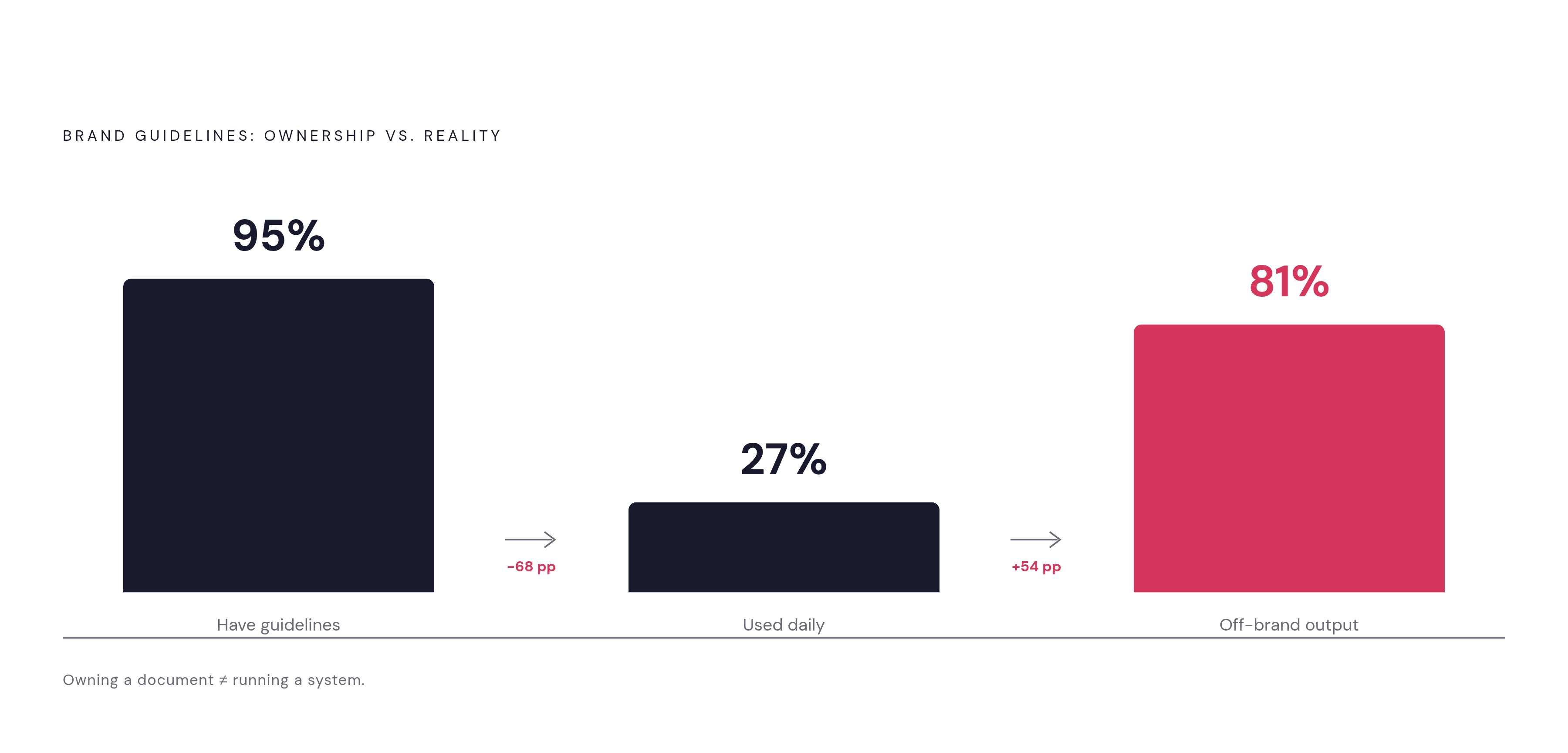
Ninety-five percent of organizations have brand guidelines sitting somewhere. Research shows only 25 to 30% of them get used day to day, and 81% of companies still report chronic off-brand output. The gap between owning a document and running a system is the actual problem, and it predates generative AI by a long stretch. Writing a guideline was never the hard part.
Most guidelines get written for a human reader who can hold ambiguity and turn it into judgment. "Bold yet approachable" means something to a copywriter who has spent years inside the brand. It means nothing to a language model, because AI tools don't interpret intent, they execute instructions, and an adjective is not an instruction. Feeding a generation workflow "confident, not arrogant" gives it no lever to pull. There's no parameter called confidence.
Then there's where these documents actually live. Guidelines sit in slide decks, in wikis behind a login nobody remembers the password to, in an onboarding folder someone skimmed once during their first week on the job. None of that is present at the moment content gets generated. Checking the guide means a deliberate detour, and under deadline pressure, that detour gets skipped almost every time. Nobody decides to ignore brand voice. They just never open the tab.
Forty percent of marketers cite "robotic output" as a top downside of AI-generated content, a figure Six Degrees reported and Apollo cited in its own analysis. That statistic doesn't indict AI as a technology. It indicts the absence of brand-specific grounding at the moment of generation: most tools run on default settings, producing the statistical average of internet writing, because nobody gave them anything else to draw from. Owning a guideline and enforcing one are two different things, and AI at scale is what exposes the distance between them in a way low-volume human drafting never quite did.
What follows from this is a design problem, not an education problem. No amount of onboarding or refresher training fixes it. Brand voice has to stop being something a writer consults and start being something the system already knows before anyone types a prompt.
Treating brand voice as a system input
A system input is a setting, not a memo. Apollo's April 2026 framing gets at the real distinction here: consistency has to build into the generation process itself, not get layered on afterward through editing. This matters because generative models default to averages. Contentstack's analysis shows that, trained on the broad sweep of internet text, they produce writing that sounds like everyone unless something specific interrupts that default. Grounding has to happen before generation, not after it, and that ordering is the whole argument.
In practice, that means three things. Brand rules get stored as structured, machine-readable data, not buried in a forty-page PDF that a model has to summarize on the fly and inevitably gets wrong somewhere along the way. Voice constraints travel with the workflow itself, attached to the system rather than to whichever person happens to be prompting that day. And updates propagate automatically: change a rule once, and it applies across every AI-assisted workflow connected to it, a capability Contentstack ties to headless CMS architecture paired with structured content.
When a junior editor using AI-assisted drafting produces output that meets the same voice standard as a senior strategist's, the system is doing its job. Both are working inside the same constraints, and those constraints now carry weight that used to depend entirely on individual skill built up over years on the job.
Timing decides whether governance actually works, and most teams get the timing wrong. Traditional review catches problems after a draft already exists, often close enough to publication that fixing tone means rewriting rather than editing. Effective governance moves hard constraints, banned vocabulary, structural rules, required framing, to the point of generation itself, so the AI never produces the violation. Review-after-the-fact is the weaker model, full stop. Consistent brand presentation increases revenue by 23 to 33% across channels, according to figures from Lucidpress cited across multiple industry reports, which turns this from a style preference into an infrastructure argument.
The components that make brand voice operationally enforceable
Launchmind.io breaks a working voice system down into three parts, namely a detailed style guide embedded directly into the prompts, a review layer applied after generation, and iterative refinement of those prompts based on how the output actually performs. None of the three works alone. Together they form a loop, and skipping any one of them breaks the whole thing.
That loop runs on specific ingredients, because generic guidance cannot drive consistent behavior. Behavioral rules, not adjectives, do the actual work. "Use active voice" is enforceable. "Sound confident" is not, and the gap between those two instructions is the gap most brand guides fail to close. Glean's June 2026 material offers concrete examples: never hedge with "we believe" when the brand can say "we've seen," open with the answer instead of a question. Vocabulary lists matter too: approved terms, proprietary product names, phrases explicitly banned from output. So do annotated samples pulled from current, accurate content, rather than a landing page from two years ago built around positioning the company has since dropped. Tone also needs to flex by context. A product launch email and a system error message sit in different registers, and a knowledge base that treats them identically will get one of them wrong every time.
Location decides whether any of this gets used. Glean's material states that the guide has to sit inside the systems where writing actually happens: chat tools, document editors, the CMS, ticketing platforms, sales enablement software. Not a slide deck. Not a wiki behind a login nobody remembers.
Retrieval-augmented generation, RAG, does most of the real work here, and it beats static system prompts or fine-tuned models for one specific reason: the exemplar library updates with new content without retraining the underlying model. Voice changes propagate to every subsequent generation automatically, instead of requiring a retraining cycle every time positioning shifts.
Scale complicates this further than most teams expect. A modern campaign can require governing a large number of distinct content units, each its own structural or channel-specific block. The system has to handle that granularity to handle the campaign. The 80/20 rule offers a useful target here: successful brands hold 80% of content to strict consistency and personalize the remaining 20%. Good architecture automates the 80% so human judgment gets spent where it actually matters, on the 20% that needs a person's eye.
Regression testing and ongoing quality control for AI-generated voice
Model updates shift output quality without warning. So do new contributors, evolving campaigns, small changes nobody flagged as significant at the time they happened. None of it produces a single visible incident. Drift gets caught late, usually after content has already gone out the door. Catching it early requires testing infrastructure, not vigilance, because vigilance doesn't scale and testing does.
A golden prompt set is the mechanism worth building. Assemble prompts representing the brand's core content types, product copy, social captions, creator briefs, email subject lines, and store the approved, on-brand outputs as a baseline. Re-run that set weekly, and again after any known model update, then score new outputs against the baseline using semantic similarity, an approach that turns subjective review into a repeatable, structured test. That turns quality control into a repeatable test instead of a gut check performed by whoever happens to review the draft that day.
Human review changes shape under this model. The reviewer approves and checks AI output rather than writing from scratch, which moves the actual creative labor upstream, into system design and prompt curation, instead of into line-by-line editing after the fact. Winning message variants should feed back into the prompt library and the knowledge base itself, becoming shared infrastructure rather than one contributor's personal habit that dies the day they leave the company.
Quality control catches more than tone problems, too. Research shows that seventy-seven percent of brands cite IP and copyright infringement as their top concern when deploying generative AI in marketing. A well-built review layer catches both problems in the same pass, voice drift and legal exposure, because both appear as anomalies against the same baseline once you're actually checking for them.
All of this assumes one brand, one system, one team building and maintaining it. Agencies and portfolio owners face a different order of problem.
How the multi-brand problem differs from the single-brand problem
A single brand needs one governed system, built once and maintained over time. An agency managing a client portfolio needs a distinct system for every client, and those systems have to stay separate from each other without letting configuration bleed across accounts. Client A's banned phrases cannot leak into Client B's drafts. That's a structurally different problem.
Manual oversight breaks down once volume and client count both climb, because no single reviewer can track fragmentation risk across every client and channel at once. A review process built for one brand fails later, and more expensively, once it is applied across ten clients. It just fails later, and more expensively, than anyone expected.
Multi-agent architectures split responsibilities, research, drafting, optimization, distribution, across agents while enforcing a shared rule set that governs all of them. Agents get configured for distinct brands, customer journeys, or use cases inside a single platform, which lets a central team coordinate strategy without hand-writing every asset for every client on the roster.
Multi-brand infrastructure needs four things that single-brand governance never had to solve for. Separate brand knowledge bases, keyword strategies, and voice profiles per client, with zero cross-contamination between them. Centralized analytics that show performance across the full portfolio alongside granular, per-client detail. Audit trails that attribute every AI-generated piece to the correct brand profile, which matters for compliance and for client reporting alike. Billing and access models flexible enough to fit different client structures, instead of forcing every account into the same tier regardless of size or need.
Account teams cannot sell AI voice governance as a service if they can't explain how it works or show it live in a client meeting. Enablement is a core part of the platform's design, built in from the start. It's part of what makes the product sellable.
What to look for in platforms managing brand voice at scale
The right evaluation question asks which platform encodes voice as a system input, rather than a suggestion buried somewhere in a prompt template nobody checks.
A handful of criteria follow directly from everything above. A persistent brand knowledge base, so constraints travel with the workflow instead of depending on whoever happens to be prompting that day. Pre-generation enforcement, meaning banned vocabulary, structural rules, and tone constraints apply at the point of generation, not get flagged during a post-review pass after the draft already exists. RAG-based grounding, or something functionally equivalent, so output draws from a brand's actual content rather than defaulting to generic output. Regression testing built in, with the ability to run a golden prompt set against a stored baseline every time the underlying model changes. Multi-brand isolation, with separate configurations per client and centralized visibility for the team managing the whole portfolio. Reporting that actually demonstrates value: per-client exports and voice-consistency data over time, the kind of evidence an account manager can put in front of a client during a quarterly review.
Thrad builds specifically for agencies managing AI visibility across a client portfolio: a single workspace covering every brand, cumulative analytics across the whole portfolio alongside granular per-client access controls, and weekly reports built for each account that give teams demonstrable proof of performance. It also invests directly in agency staff, so sales reps and account managers can speak with real substance about AI visibility instead of handing a client a login and hoping for the best.
Other platforms solve pieces of this same stack, and none of them try to solve the whole thing. Apollo's AI Content Center operationalizes the brand knowledge base layer specifically inside sales outreach. Contentstack's Brand Kit, built around Knowledge Vaults and Voice Profiles, enforces voice constraints from within a headless CMS. Glean's Enterprise Graph connects company data, people, workflows, and applications directly to AI assistant output at the enterprise level. Each does its slice well. Agencies coordinating brand voice across every client surface at once need something that sits above any single one of these tools, coordinating the whole picture instead of governing one channel and calling it done.
The cost of choosing badly is measurable. Gartner reports that twenty-nine percent of attempted AI agent deployments get abandoned within 90 days, and the leading causes, unclear success criteria and poor data access, are both things a properly evaluated platform should address before deployment even starts.
Brand voice consistency and AI visibility are connected, not separate workstreams
Search behavior has already shifted, and it's no longer a forecast to plan around. Gartner projected traditional search engine volume would fall 25% by 2026; writer.com cites that research to show the prediction has become the current shape of the market. Buyers increasingly meet a brand for the first time inside an AI-generated answer rather than a ranked list of blue links.
Similarweb data shows zero-click search on Google climbed from 56% to 69% following the rollout of AI Overviews. The surface where brand voice lands has changed under everyone's feet. Generative Engine Optimization and Answer Engine Optimization, GEO and AEO, are the practices built around this shift: structuring content and brand presence so AI systems cite and recommend a brand directly inside their answers. Together with traditional SEO, they now make up the full visibility stack a brand has to manage, not a side project layered onto search marketing.
The tie back to voice governance is direct. AI systems favor content that reads as authoritative, consistent, and clearly attributed to its source, and those are the same structural properties a well-governed voice system produces on its own, as a byproduct of doing its actual job. brand voice consistency is increasingly relevant not only for AI engine citations but for broader content discoverability. The two workstreams were never actually separate. They just used to sit with different teams who never talked to each other.
Getting cited is not the same as getting chosen, and this is where most GEO strategy stalls out completely. Tryprofound.com found that research showed AI Overviews excluded a publisher from its actual recommendations 69% of the time despite citing it. Appearing in the citation is not the win everyone assumes it is. Voice authority, the thing that makes a brand recommended rather than merely referenced, matters more than raw visibility, and most teams are optimizing for the wrong one.
Adding statistics to content is the single most effective GEO tactic identified in research from Princeton, Georgia Tech, the Allen Institute for AI, and IIT Delhi, published at KDD 2024, improving AI visibility by 41%. A properly governed brand voice system is built to produce structured, evidence-grounded writing in the first place, so the two are directly connected. The same discipline occurs twice.
The instability is real and ongoing, driven by shifts like Google's January 27, 2026 AI Overviews update, which switched the underlying model to Gemini 3 and replaced roughly 42% of previously cited domains according to SE Ranking's post-bug-fix analysis (initial readings ran as high as 46.3%). Figures from Ahrefs and BrightEdge via ALM Corp show the overlap between top-10 organic rankings and AI Overview citations collapsed from 76% to somewhere between 17% and 38%, depending on the dataset. A single model update reshuffled who gets cited across the entire market in one pass, and teams without monitoring infrastructure found out only after the damage was already done.
The brands holding onto AI visibility going forward treat voice as a system input, track their presence as a measurable, ongoing metric, and revisit their GEO strategy every quarter instead of once a year. That's the same discipline this piece has argued for from the start: brand voice is a governance problem waiting on better systems, and the teams that treat it that way are the ones still getting cited a year from now.