Content Operations Stack for In-House Marketing Teams
Build the content operations stack that reaches AI systems, not just search rankings.

What content operations covers, and what it has historically left out
Publish good content, rank on Google, drive traffic. That was the whole equation for a decade, and it no longer clears. Gartner projected traditional search engine volume would fall 25% by 2026, and Similarweb's clickstream data now puts the zero-click share of Google searches at 68%. Layer AI Overviews on top of that (BrightEdge found they now trigger on roughly 48% of tracked queries, up 58% year-over-year) and the picture gets clearer: a content operations team still optimizing for rankings and clicks is optimizing for a shrinking pool of behavior.
Content operations is the discipline of coordinating people, process, and technology across the full content lifecycle: strategy, creation, governance, distribution, measurement. The software layer is what makes that coordination possible once a team outgrows shared docs and a group chat.
The stack most teams inherited was built to answer two questions: can we make enough content, and can we get it out on schedule. Those questions are basically solved now. The actual 2026 problem is clear: coordinating research, briefs, AI agents, writers, approvers, publishing systems, and performance data without building a maze of disconnected tools nobody fully understands.
What's been missing the whole time is a layer that governs how content performs across AI-powered discovery surfaces, not just search rankings. Ask most stacks whether ChatGPT mentions the brand when someone asks about the category, and there's no answer sitting anywhere, because nothing was built to produce one. That gap is what the rest of this piece maps: strategy and creation first, then distribution, then the AI visibility layer that fills the hole.
Layer one, strategy and planning tools
Strategy gets treated as something that happens in a kickoff call and a shared doc. That's a mistake now, because the decisions made at this stage, which topics, which competitors, which AI surfaces to target, determine whether anything downstream has a chance of landing. This layer covers audience research, topic ideation, competitive content analysis, brief creation, and editorial calendars.
The real shift in 2026 is the move toward AI-powered workflow systems and agents that connect multiple apps, make decisions, and complete multi-step tasks with little human input, and strategy tooling is getting pulled in. AI-powered workflow systems and agents now connect multiple apps, make decisions, and complete multi-step tasks with little human input, and this shift is pulling strategy tooling along with it regardless of whether teams are ready. McKinsey's State of AI report, drawing on nearly 2,000 respondents across 105 countries, found high performers are almost three times as likely as other companies to fundamentally redesign their workflows rather than bolt AI onto an existing process. Teams that skip that redesign and just add a chatbot to the old brief template are wasting the opportunity.
Ahrefs is a useful marker here. It rolled out expanded AI visibility competitor analysis, comparing brands against competitors across mentions, impressions, citations, and AI Share of Voice, which means competitive research now spans traditional search and AI answer surfaces at once instead of treating them as separate projects. Then on August 12, 2026, Ahrefs launched Letaido, an agent-powered marketing workspace built on native Ahrefs data, meant to automate recurring research, reporting, and monitoring work.
GEO and AEO intent needs to get built into the strategy layer from day one. Bolting it on at distribution, after the brief is written and the piece is drafted, is too late to matter.
Layer two, creation, workflow, and approval tooling
Creation tooling in 2026 is not an AI assistant that drafts paragraphs and calls it done. It's the coordination of AI agents, human writers, editors, and subject-matter reviewers moving through a shared workflow, with visibility at every handoff. Teams still running this across scattered spreadsheets hit the same wall every time: missed deadlines, approval bottlenecks, and no single source of truth once content spans more than one channel.
A few platforms show how this layer actually gets built. monday.com lets agencies and multi-brand teams manage client work as one connected portfolio instead of a pile of separate projects, consolidating campaigns, requests, resources, and reporting, with customizable boards and automations that can match a workflow from brief intake through final report. SPH Media used the platform to run campaigns across more than 40 media brands from a single workspace, with over 130 team members collaborating in a shared workspace.
Planable narrows the focus to agencies and multi-brand teams managing complex approval chains. It handles creation, review, and approval across social, blogs, email, and newsletters, though scheduling and live publishing stay limited to social media; blog and email content gets planned on the calendar but can't be pushed live from inside the tool. What it actually replaces is the email thread full of "see attached, final_v3_REAL" feedback, swapping it for a structured, role-based approval workflow. Some platforms are built for situations where approval chains are not just long but carry compliance weight.
Digital asset management is the seam between creation and distribution, functioning in 2026 as the MarTech foundation for organizing and delivering content across many B2B stacks: the place a finished asset lives before it goes anywhere.
None of this is glamorous, but the approval layer is where governance actually lives, and governance is what separates a functioning content operation from a pile of content with good intentions attached. A broken approval process doesn't just slow things down. It produces inconsistent messaging, missed compliance checks, and content published in the wrong version, none of which AI writing speed fixes after the fact.
Layer three, distribution and multi-channel publishing
Distribution used to mean scheduling: pick the channels, pick the times, hit publish. In 2026 it means placing content deliberately across the channels that feed AI systems, and the biggest mistake a content team can make here is still treating the brand's own website as the main distribution target.
That instinct is backwards. Erlin's analysis of more than 500 brands found only 32% of AI citations trace back to brand-owned sites, with 68% coming from third-party sources instead. Muck Rack's Generative Pulse 2025 report, built on an analysis of more than a million citations across ChatGPT, Gemini, Claude, and other models, found 82% of links cited by AI trace back to earned media, journalism and third-party blogs, with journalism alone accounting for roughly a quarter of all citations. Press releases are climbing fast too: citations from press releases increased fivefold between July and December 2025, with structured releases now accounting for up to 6% of citations.
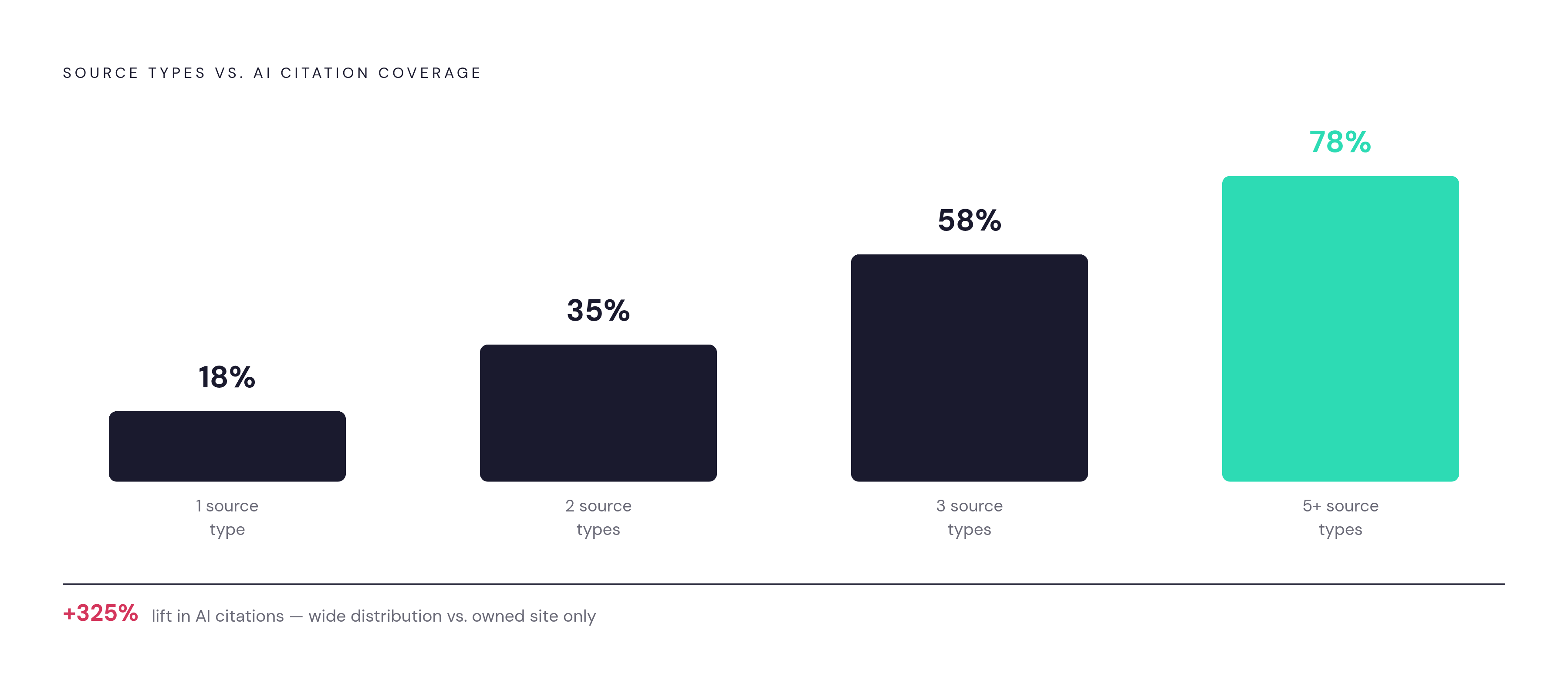
Source diversity compounds hard, and this is the number that should reshape distribution budgets: brands relying on a single source type average just 18% AI coverage. Two source types brings that to 35%. Three, 58%. Five or more, 78%. Stacker's analysis found distributing across a wide range of publications can lift AI citations by up to 325% compared to publishing solely on an owned site. A single-channel distribution plan is a different, much weaker strategy, not a smaller version of a good one. It's a different, much weaker strategy.
Multi-channel publishing, in that light, is no longer just about reaching audiences on their preferred platform; AI systems draw from a pool of sources, and feeding that pool is the actual point now. Yotpo frames this as a tiered source stack, running from verified data banks down through high-trust user content down to brand-owned assets at the bottom, and that hierarchy is worth using to decide where distribution effort actually goes. Schema markup belongs here too, not as an afterthought but as plumbing: Structured schema markup is what makes content parseable to AI systems in the first place.
What GEO and AEO are, and why they are a distinct layer in the stack
GEO, generative engine optimization, means structuring content and brand presence so systems like ChatGPT, Perplexity, Google AI Overviews, and Claude cite and recommend the brand inside their answers. It is not a competition for ranking position. The Writer enterprise guide frames it as a competition for citation and recommendation. AEO, answer engine optimization, is a related but separate goal: structuring content so it gets extracted cleanly and presented as a direct answer in featured snippets, knowledge panels, and AI Overviews, no click required.
The resulting landscape presents a triple threat. SEO covers rankings and clicks. AEO covers direct answer extraction. GEO covers citation and recommendation inside AI-generated responses. All three need separate tracking, because they respond to different levers and get measured on different metrics: SEO on organic traffic, keyword rankings, and click-through rate; AEO on mentions, citations, AI Overview appearances, and zero-click impression share; GEO on Share of Model, brand mention share, citation rate, and sentiment inside AI responses.
Share of Model, a term coined by Jack Smyth and Tom Roach, measures how often a brand shows up in AI-generated answers relative to competitors. It's the AI-era successor to share of voice, except it's earned rather than bought. There's no media budget that guarantees a mention inside a Claude response the way ad spend guarantees an impression, and that changes what the work actually is.
Writer's research found GEO work runs roughly 80% strategic (positioning, ecosystem presence, brand authority) and only 20% technical, and most organizations get that ratio backwards. They tweak schema and metadata first because it feels controllable, while ignoring the harder work of building the third-party authority that actually earns a citation. That's also why GEO forces convergence across PR, content, SEO, and product marketing. It doesn't live inside one team's dashboard. It breaks if any one of those functions works in isolation.
User behavior in AI search backs this up. Growth Memo's research, cited by HubSpot, found the average traditional search query runs 3.37 words, against 23 words for the average ChatGPT prompt. That's a different kind of question, more specific and more conversational, and the person asking it is considerably more likely to act on the answer. Research across multiple sources indicates AI search visitors convert at a substantially higher rate than traditional organic visitors. Adoption still lags badly behind that opportunity: Adoption still lags badly behind that opportunity, and the gap between belief and action is where the next two years of competitive separation gets decided.
The AI citation volatility problem, and why monitoring is not optional
A brand that appears in Monday's AI answer can vanish from Tuesday's asking the identical question, and that instability is a structural feature of how these systems work. It's structural. Models rebuild answers from scratch on each query and rebalance for diversity, freshness, and topic coverage instead of locking in a stable ranking the way search engines do.
A 2025 AirOps study, analyzing 45,000 citations, found only 30% of brands stay visible from one AI answer to the next asked about the same topic, and just 20% remain present across five consecutive runs of an identical query. Yotpo's research puts month-over-month citation volatility at 40 to 60%, against organic search rankings that often hold steady for months at a stretch. Models retrain and context windows shift, and those changes move citation share away from brands that never touched their own content.
The category-level picture is more open than that volatility suggests, but not open for long. Semrush's tracking of five representative prompts across each of 1,094 domestic product categories found only 15.2% had a clear owner in AI-generated answers, 31.2% had an emerging leader, and 53.7% remained genuinely unsettled. That's real opportunity, and it's closing fast: Erlin's 2026 data, again from more than 500 brands, found the visibility gap between winners and losers in AI-generated answers already runs at 9x and widens by 3.2% every month.
Given that widening gap, research from erlin.ai found only 16% of brands systematically track their AI search performance, and that is not a minor oversight. It means most companies are flying blind on the surface where an increasing share of purchase decisions actually get made. Similarweb lays out four dimensions to track: citation with a source link, brand mention inside the generated response, sentiment of that mention, and consistency of share of voice across the prompts relevant to a category. None of those four numbers appears in Google Analytics. That's the whole argument for why this measurement work needs its own dedicated tooling instead of a repurposed traffic dashboard, and it's the argument the next section runs with.
Layer four, the AI visibility monitoring and optimization tools available in 2026
Budgets are already moving toward this layer, fast. GTM8020 estimates the GEO services market at $1.5 to $2 billion in 2026, with projections putting it past $4 billion by 2027 as spend shifts away from blue-link SEO. OmniBound's research narrows to the domestic market specifically, projecting it to hit $365.4 million in 2026 on a compound annual growth rate of 42.9%.
A handful of named platforms mark out what this layer actually looks like in practice, and the differences between them shape which platform is worth adopting more than the category label does. Semrush launched its AI Toolkit in late 2025, the AI Visibility Toolkit, built out as an extension of its existing AEO product line. Ahrefs' expanded AI visibility competitor analysis compares brands head-to-head on mentions, impressions, citations, and AI Share of Voice. On October 31, 2025, a company in this space announced an agreement to acquire XFunnel, a platform built to help businesses monitor, test, and strengthen their presence across large language models through AEO work.
Peec AI shows up in Yotpo's research as a dedicated AI visibility monitoring platform, tracking brand presence across answer engines on an ongoing basis. It gets used alongside a tool called Evertune to identify which third-party sites are actually feeding a given model's answers, which then tells a PR team exactly where to point outreach instead of guessing. Evergreen Media separately cites Peec AI for the same kind of brand-presence tracking. Profound turns up in the same category, and Yotpo's research offers a budget benchmark: a mid-sized e-commerce brand's tool spend might put roughly half its total budget into intelligence platforms like Profound or Semrush. That is the center of the stack now, not a bolt-on expense. It's the center of the stack now.
Rankings and clicks used to be the whole scoreboard. In 2026 they're one column on a longer sheet, and the columns that matter most, citation, mention, sentiment, share of model, are the ones almost nobody had the tooling to track two years ago. Teams that keep measuring only the old column are going to keep missing the story their own customers are already living.