Content Infrastructure vs Content Management Systems
Your content must reach customers through AI answers, websites, and apps, not just websites.
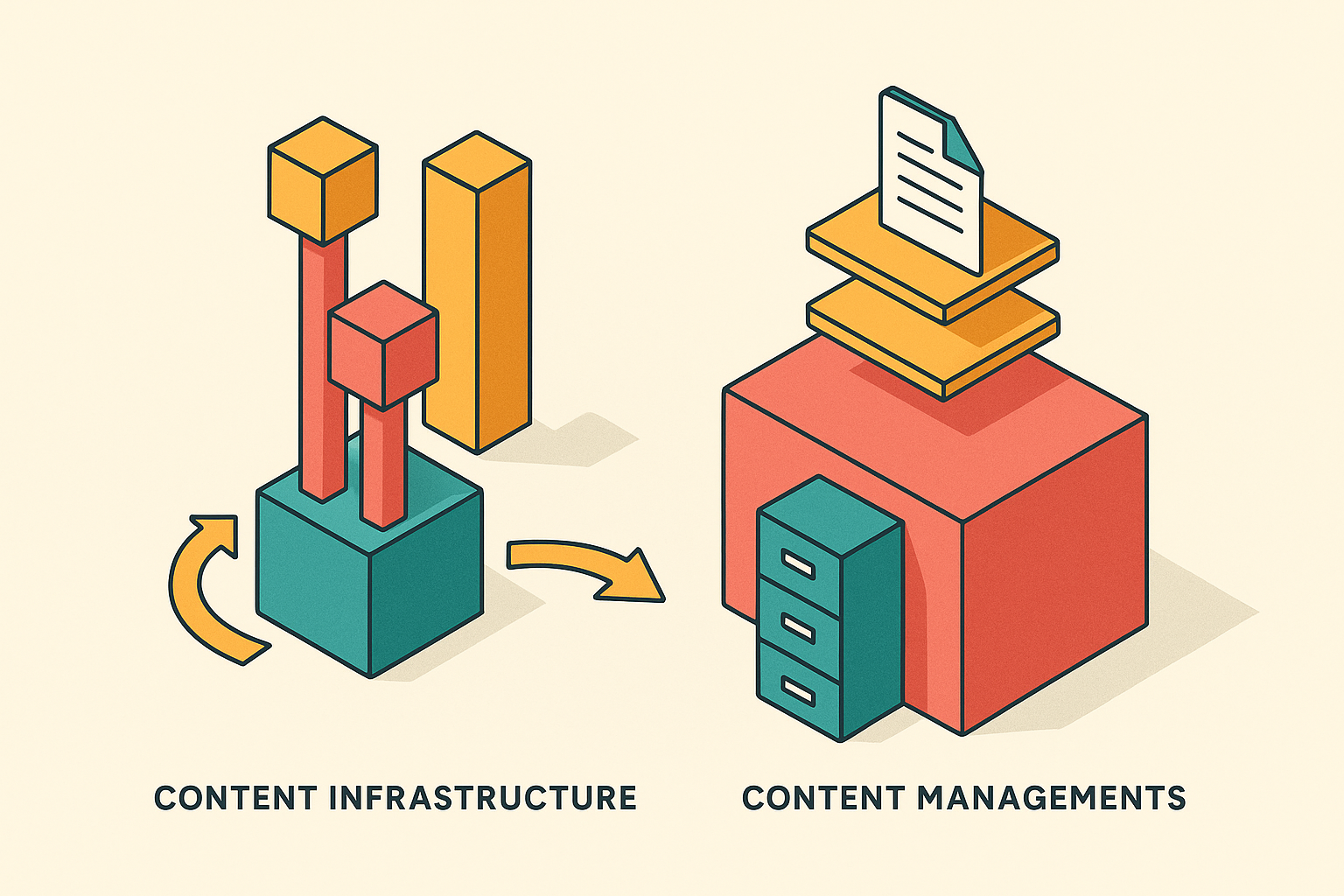
A CMS controls how content gets made and stored. Content infrastructure controls whether that content ever reaches anyone, on a website, in a mobile app, or inside an AI answer that never sends a click back home. That distinction used to be academic. It isn't anymore, and the gap between the two is where a lot of digital strategy is quietly failing right now.
A CMS, in its plain definition, is software that lets a team create, organize, edit, and publish digital content without writing raw HTML for every page. It handles authoring, editorial workflows, role-based permissions, version history, and asset storage. Any content person who has worked inside WordPress or Drupal knows this territory well: draft, review, approve, publish, repeat. Over 80 million live websites run some form of CMS today, roughly 68.7% of everything on the internet. That number alone tells you the category is foundational. It also tells you something less comfortable: a huge share of that installed base is running on architecture built for a web that looked very different from the one brands are trying to reach now.
None of this is a knock on the CMS as a category. A traditional CMS does exactly what it was built to do: manage content for one frontend, one destination, usually a website. The trouble starts when a team expects it to do more, to route content across channels and devices and, increasingly, into AI systems it was never designed to talk to. A standalone CMS behaves like a filing cabinet: it holds everything neatly, but it can't build the different paths a modern buyer expects, and every visitor gets the same generic experience regardless of what brought them there.
How the CMS category evolved from monolith to content hub
The earliest CMS platforms bundled three things into one codebase: the database, the admin dashboard, and the frontend that rendered pages for visitors. This monolithic setup made early web development genuinely simpler. One system, one deploy, one thing to maintain. But as the number of channels multiplied, mobile apps, kiosks, smart devices, that bundling turned into a bottleneck. Every new channel meant wrestling with a system that only knew how to output one kind of webpage.
The fix was decoupling: separate the content management backend from the presentation layer. Content gets stored as structured data and delivered through an API to whatever frontend needs it, rather than baked into a fixed page template. Headless CMS platforms took this further, turning the CMS into a content hub, a central repository that feeds websites, apps, and connected devices through REST or GraphQL APIs. For a lot of teams, this is the base layer they build on as they move toward more composable setups.
Four types of CMS circulate in the market today, and they're worth naming precisely because vendors use the terms loosely. Coupled, or traditional, platforms like WordPress and Joomla keep creation and delivery in one system. SaaS CMS platforms, Wix and Squarespace among them, host everything in the cloud and cut infrastructure overhead for the customer. Decoupled systems separate backend from frontend but keep them loosely tied together. Headless platforms, Contentful and Strapi as examples, deliver content purely through APIs with no frontend assumptions at all.
Here's the nuance worth holding onto: headless solves where content gets delivered, but structuring the broader stack, how services connect, swap, and scale, requires going further, and that gap is exactly where the next section picks up. The market's growth reflects how central this problem has become. The CMS sector is projected to grow at a 10.4% compound annual rate from 2025 to 2030, reaching $57.3 billion. That's not a niche software category anymore. That's core digital infrastructure.
Where content infrastructure begins: composable DXP and the stack beyond the CMS
A composable CMS takes the headless idea and pushes it further: content, search, personalization, and commerce each live as independently deployable, API-connected services instead of features bolted onto one all-in-one platform. A composable DXP, digital experience platform, is the wider version of that same idea. CMS, commerce engine, digital asset management, customer data platform, personalization engine, each assembled piece by piece. In this model the CMS is one node in a larger system, not the system itself.
The distinction that trips people up: every composable CMS is headless, but not every headless CMS is composable. Headless solves the delivery problem, getting content out through an API. Composable solves the architecture problem, letting a team swap and combine best-of-breed tools rather than being locked into whatever one vendor bundles together. A DXP adds orchestration, data, and personalization on top of storage and delivery, the difference between routing content somewhere and actually shaping a customer's end-to-end experience.
The practical question for teams evaluating this isn't "CMS or DXP" anymore. It's how much of a DXP a team wants natively versus how much it wants to compose from separate vendors. Gartner's estimate puts real weight behind this shift: by 2026, at least 70% of organizations will be mandated to acquire composable DXP technology, up from a reported baseline of roughly 50% three years earlier. Individual timelines will vary, but the direction is settled.
Enterprise complexity is where this case gets made hardest. Coordinating content across multiple brands, regions, and channels, all under governance requirements, is exactly where headless CMS and composable DXPs structurally beat monolithic setups: multi-tenant configurations, layered access controls, integrations that don't break under load. Sitecore is a useful enterprise example here. Its composable approach lets large organizations mix CMS, personalization, and commerce rather than accept one bundled package, and its portfolio, XM Cloud, OrderCloud, CDP, Personalize, is built to manage the full customer lifecycle rather than just publishing. In February 2025, Sitecore unveiled over 250 innovations, including brand-aware AI, content copilots, and agentic workflows built into the platform.
Why content infrastructure now extends to AI surfaces, and what that changes
Buyers have already changed how they find brands, and the numbers back this up plainly. One in ten U.S. internet users now turns to generative AI first when searching online. Consumers check an average of 2.4 platforms while making a purchase decision, and 58% now use generative tools for product discovery, sidestepping the friction of a traditional search results page entirely. AI assistant traffic rose 86% in 2025, and time spent on these tools rose 101%. That's not novelty usage. That's a research channel establishing itself.
But there's a catch worth stating honestly. Ahrefs found that AI Overviews cut click-through rates for top-ranking Google content by 58%, up from 34.5% the year before. Content surfacing inside an AI answer doesn't necessarily send traffic back to the source the way a blue link used to. Yet absence from that answer is its own kind of invisibility, arguably worse than a lower click-through rate.
The traditional search engine still dwarfs AI search in raw volume. Google was handling over 14 billion searches a day in early 2025; ChatGPT, by comparison, around 37 million. AI search is growing fast, but it remains roughly 91% smaller than traditional search. Teams need to optimize for both, not treat one as a replacement for the other. AI Overviews already show up in 16% of all Google desktop searches in a major national market, which makes them a standard fixture of the results page, not a fringe feature anyone can ignore.
This is where two new disciplines enter the vocabulary. GEO, generative engine optimization, is about shaping what AI engines like ChatGPT, Claude, and Perplexity say when responding to a relevant query, working from indexed web content rather than ranking position. AEO, answer engine optimization, is about structuring content so it gets pulled directly into featured snippets, knowledge panels, and AI Overviews, no click required. The acronyms, GEO, AEO, LLMO, AIO, still get used more or less interchangeably in practitioner circles, and there's no settled academic consensus on the boundaries as of early 2026. For infrastructure planning purposes, the underlying behavior matters more than the label.
What actually drives brand citations in AI-generated answers
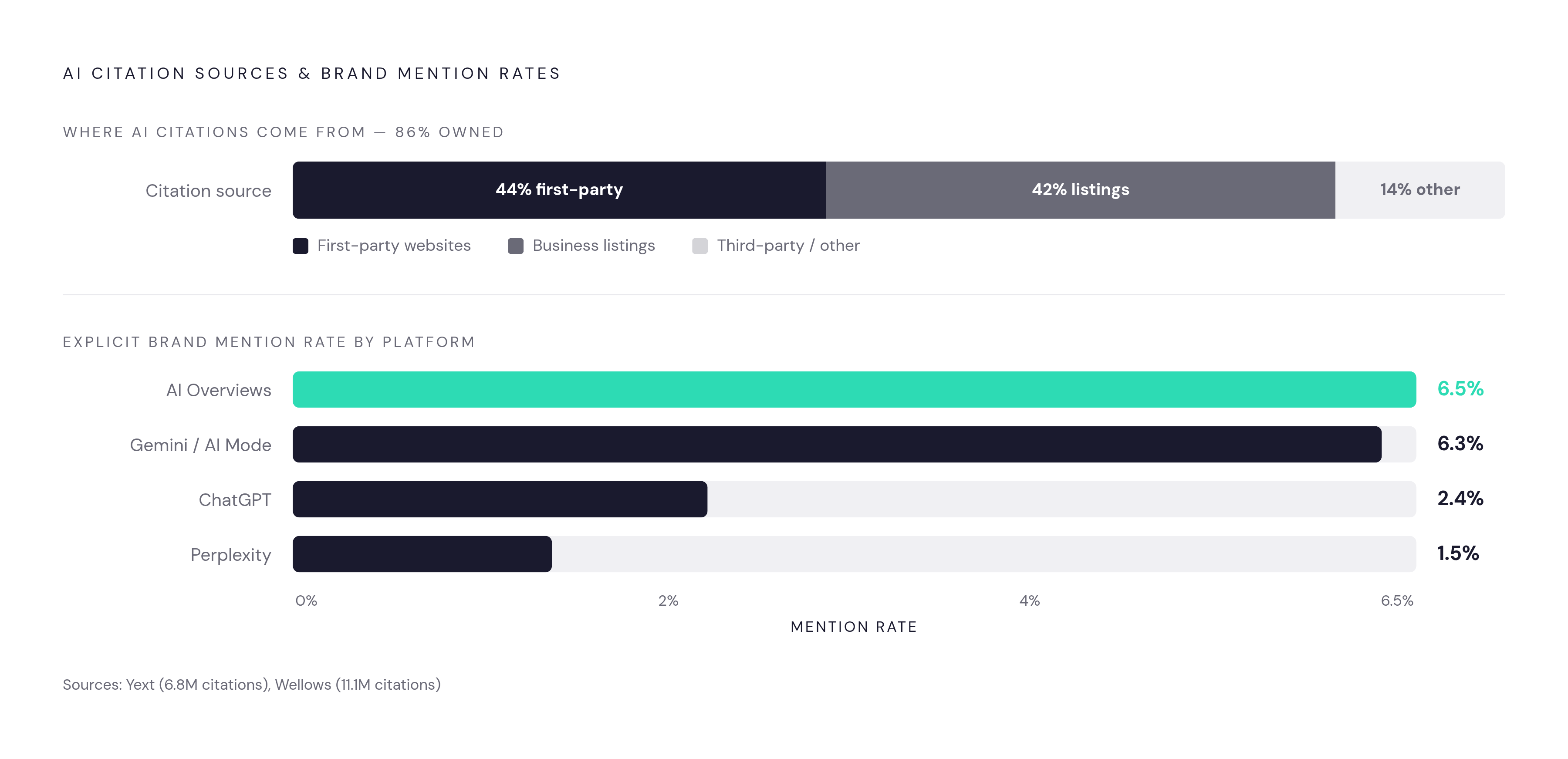
Yext's analysis of 6.8 million AI citations across ChatGPT, Gemini, and Perplexity found that 86% came from sources brands already control, split almost evenly between first-party websites at 44% and business listings at 42%. That's the headline finding worth sitting with: owned infrastructure, not third-party press coverage, is the primary lever for showing up in AI answers.
Each platform cites differently, and treating "AI visibility" as one number hides more than it reveals. Wellows analyzed 11.1 million citations across 571,729 AI answers, 363 brands, and 35 regions between December 2025 and March 2026. ChatGPT carries a brand mention in 7.6% of citations and names the brand explicitly in 2.4% of them. Perplexity is the stingiest on explicit naming, at just 1.5%. AI Overviews sit at 6.5%, Gemini and AI Mode at 6.3%. A single aggregate score across all of these tells a team almost nothing useful; brand presence needs tracking platform by platform.
Domain authority still counts, and it counts more than intuition might suggest. SE Ranking's research found that sites with over 32,000 referring domains are 3.5 times more likely to be cited by ChatGPT than sites with fewer than 200. Domains active on review platforms, Trustpilot, G2, Capterra, Yelp, get cited roughly 3 times more often. Domains with heavy brand mentions on Reddit and Quora see roughly 4 times higher odds of a ChatGPT citation. Distribution compounds this effect: Stacker's research found that spreading content across a wide range of outside publications, rather than publishing only on the brand's own site, can lift AI citations by up to 325%. The CMS is where content lives. Distribution is what makes it findable by the systems doing the citing.
Original data matters too. Adding proprietary statistics or unique data points to a piece of content can lift its AI answer visibility by up to 40%. AI engines lean toward genuine insight over content that just repeats a consensus already indexed a thousand times elsewhere. And behavior differs by platform in ways worth planning around: ChatGPT tends to favor well-known brands, Perplexity mentions more brands per answer than most competitors, Google AI Overviews shows the widest brand diversity, Infrastructure decisions should account for where a brand's actual audience is doing its searching, not just where the volume happens to be largest.
How content architecture determines AI legibility
Getting cited in an AI-generated summary isn't just a content quality question. It's a technical infrastructure question, and platform architecture is an upstream input to that outcome, not a side concern to bolt on later. Content management systems built with AI integration, semantic search compatibility, and composable frameworks in mind aren't adding nice-to-have features. They're meeting an architectural prerequisite for showing up at all.
The llms.txt file makes this concrete in a way that's hard to argue with. On a monolithic CMS, generating an accurate llms.txt means someone manually inventorying everything that's been published, a task that's tedious, recurring, and error-prone by nature. On a composable DXP, that content inventory already exists inside the CMS's own API. Generating and maintaining llms.txt becomes something that can run automatically, a simple integration sitting on top of the Content API rather than a standing manual chore. Composable infrastructure is more legible to AI systems by design, because the content model underneath it is already structured data, not loose text sitting in a database table built for rendering webpages.
API-first delivery means content already exists as discrete, typed data objects, which happens to be exactly the shape AI retrieval systems are built to parse, index, and cite with confidence. The broader pattern is a useful signal: platforms with highly structured, API-accessible content and strong distribution tend to win AI visibility at scale, and it's not a coincidence that structure and distribution consistently show up together in that outcome.
None of this means a team stuck on a monolithic CMS needs to re-platform tomorrow. But the gap between where that architecture sits today and what AI-legible infrastructure requires is only going to widen as more search behavior moves onto AI surfaces.
Monitoring AI brand presence: what consistent measurement requires from the content stack
Auditing AI brand presence isn't a one-time scan a team runs and files away. Every AI platform updates its training data and retrieval behavior on its own schedule, which means a brand's visibility can shift without anyone touching the brand's own content at all. That reality forces a cadence, not a checkbox.
Tools built specifically for this, Profound, Conductor, OpenForge, and Semrush among them, record when a brand shows up as a citation, a linked source, versus a mention, a plain text reference, and use that data to calculate share of voice against competitors. Over time, sampling across enough queries produces a statistically stable read on where a brand sits inside LLM-generated content, but it's worth being clear that this methodology is sampling-based, not a deterministic count. Teams reading these reports should understand that distinction before drawing hard conclusions from a single week's numbers.
Good measurement infrastructure tracks a few things specifically. Citations and mentions need separate columns, since a linked source and a text reference signal different levels of AI trust. Results need breaking out per platform, since ChatGPT, Gemini, Perplexity, AI Overviews, and Copilot all behave differently and aggregating them together erases the signal. Competitor share of voice matters because visibility is relative; a brand can be present in AI answers and still be losing ground to a competitor gaining faster. And trend direction over time carries as much weight as any single snapshot.
For agencies handling more than one brand, this data needs to work two ways at once: reportable client by client, and rolled up in aggregate across the whole portfolio. Bespoke weekly reports and clean per-client data exports are the actual mechanism through which this measurement turns into a retained account, not just a nice dashboard nobody opens. Thrad is built around exactly this need, giving account teams one workspace to manage AI visibility across every brand they handle, with cumulative analytics at the portfolio level and granular controls at the individual client level. The monitoring layer is what completes the infrastructure picture. Getting content into AI systems is only half the job; the other half is a feedback loop that tells a team whether it's working and where to step in.
What agencies specifically need from content infrastructure to operate at portfolio scale
Most agencies were built to serve one brand at a time. Workflows, creative review chains, approval processes, all of it assumes a single entity with one voice talking to one audience. Portfolio scale breaks that assumption almost immediately, and the strain shows up first in the parts of the operation nobody designed for ten or twenty clients running in parallel.
The requirements compound fast at that scale. Content governance has to hold across brands with different voices, different audiences, and sometimes different regional rules governing what can even be said. Approval chains that worked fine for one client turn into bottlenecks the moment they're running across a whole roster simultaneously. AI visibility monitoring needs to surface insight per client without demanding a manual reporting exercise every single week. And billing models need to flex, centralized for some clients, itemized per client for others, rather than forcing every account into the same commercial shape.
AI visibility has added a reporting obligation agencies simply didn't carry two years ago. Clients now ask, directly, where they show up in AI-generated answers, and an agency that can't answer that question with real numbers is exposed in a way that's hard to paper over with a good pitch deck. Having the platform access solves half the problem. The other half is enablement: account teams and sales reps have to actually understand the space well enough to explain it credibly to a client, or the access sits unused. Thrad treats this as a product feature rather than an afterthought, running a dedicated enablement process for agency sales reps and account managers rather than assuming the tooling speaks for itself.
The same governance demands that show up at enterprise scale, multi-tenant setups, layered access controls, integrations that hold up under real load, apply just as directly to an agency running a full portfolio of clients through one system. The tools differ by name, but the underlying architectural problem is the same one this entire piece has been circling: content infrastructure decides whether the work a team produces actually reaches anyone, human or otherwise, and that decision gets made long before a single piece of content goes live.