Pricing Transparency as a Bot Conversion Signal
AI systems skip brands with hidden or scattered pricing entirely.

Someone asks ChatGPT "how much does this cost?" and the answer either includes your brand or it doesn't. There's no browsing, no second chance to catch a buyer's eye on page two of results that no longer exist in this exchange. Pricing transparency has become a discoverability requirement, not a legal formality, and brands still treating their pricing page as fine print get skipped entirely, not penalized, skipped.
Adobe's Q1 2026 data put AI referral traffic to US retail sites up 393% year-over-year, hitting 693% during the 2025 holiday season. The behavior behind those numbers is well-documented: per the Klaviyo 2026 report, 39% of consumers have bought something an AI recommended in the past six months, and a BCG survey across nine countries found more than 60% report high trust in generative AI's shopping recommendations. Meanwhile, recent data shows the flip side: only 40.3% of US Google searchers clicked any organic result by March 2025, down from 44.2% the year prior. If the AI's answer to "how much does X cost?" doesn't name a brand, the buyer never sees that brand as an option. Not a worse option. No option at all.
Why AI systems treat pricing pages the way search engines once treated title tags
A title tag used to tell a crawler what a page was about, short and literal enough that the crawler didn't need to read the whole page to trust it. Offer schema does the same job for a language model answering a shopping question: it states the price, the currency, whether the item's in stock, all in a form the model can lift in one pass instead of digging through paragraphs of marketing copy.
AI systems answering commercial questions aren't browsing the way a person does. They're parsing, hunting for a fact they can state with confidence and attribute to a source. Per lseo.com's analysis of answer-engine optimization, when pricing sits behind a "book a call" wall, or gets scattered across a pricing page, an FAQ, and a PDF nobody's touched since last year, the AI does one of three things: skips the business, answers with heavy caveats, or cites a competitor whose numbers were easier to grab.
That skip carries real weight. Roughly 82% of AI citations trace back to earned media, content that cleared some bar of credibility before an AI system ever touched it, and about 65% of AI-cited pages carry structured data. Structured pricing changes how a page can be found and matched to a query, not the old SEO game of nudging a page up ten spots. It's closer to a prerequisite: the difference between a page an AI can read cleanly and one it has to guess at.
Get it right and the payoff compounds. Pages with full product schema, price, rating, and availability bundled together, see a 74.1% lift in click-through rate once someone actually encounters the citation. Machine-readability doesn't just earn the mention; it improves what happens after the mention lands. Google's AI Overviews already show up on 14% of shopping queries, a 5.6x jump in four months, so the slice of search where a pricing page competes as a source, rather than just a link on a results page, keeps growing.
OpenAI hasn't published "transparent pricing" as a named ranking factor for ChatGPT Shopping. What it has said is that merchants get ranked partly on availability, price, quality, and whether they're the maker or primary seller, with structured data quality shaping which products even get considered. The pattern lseo.com describes, an AI hedging or routing around unclear pricing, fits that framework even without an explicit rule naming transparency itself.
What "machine-readable pricing" actually requires on a page
The floor is Offer schema: price, currency, availability, item condition. That's the minimum an AI system needs to answer a pricing question without hedging.
Schema alone won't get a page cited, though. Plenty of pricing pages carry decent structured data and still don't make it into AI answers, because the page itself doesn't present a clean, self-contained answer to "what does this cost?" The information sits there, but it's buried in a layout built for a human scrolling and comparing tiers visually, not for an extraction pass by a model.
There's a second gap that's easy to miss: unanswered subtopics. If real buyers keep asking about onboarding fees, refund windows, annual discounts, or enterprise procurement terms, and the pricing page never addresses them, lseo.com's analysis frames each gap as an open door for a competitor's page to get cited instead. The fix is a page organized so the right pieces can be found. It's consolidation: pull tier comparisons, FAQ answers, and add-on costs into one pricing hub, rather than spreading them across the homepage, a product page, a sales deck, and a support article nobody's updated in a year.
Conversational commerce raises the difficulty another notch. A shopper asking "has this been cheaper before?" wants a direct answer on the spot. A brand that can't structure that answer for a human reading its own site can't structure it for an AI intermediary either. Either way, the problem is identical; the audience just now includes a system with zero patience for ambiguity.
Hidden costs do the same damage as missing schema, just less visibly. Per-engine fees, seat-based licensing, query overages that push real spend well past the number on the pricing page: none of that shows up in structured data, and none of it lets an AI state a confident number. Faced with that gap, the AI hedges, or cites whichever competitor it can quote without a caveat.
The trust problem that makes pricing opacity doubly costly in AI environments
Distrust of pricing predates AI by a wide margin. YouGov's survey across 17 markets found 51% of consumers believe brands regularly run fake discounts, a figure that climbs to 52% in the US specifically. That's the baseline AI systems inherited, not one they created.
What AI changes is the consequence of that distrust. A skeptical human might still click through to a confusing pricing page and dig for the real number out of habit or stubbornness. An AI system doesn't dig. Pricing that used to just look suspicious to a person now becomes invisible to the system deciding whether to mention the brand at all.
The Cursor situation, as described in builderlab.ai's analysis, makes the mechanism concrete. Customers on a credit-based billing model couldn't predict what they'd actually be charged month to month. The complaint wasn't that the price was too high. Nobody could see it coming, a failure mode indistinguishable from flat-out opacity, just dressed up as a billing model instead of a hidden fee. Per botnation.ai's analysis, AI platforms that obscure consumption costs hit the identical wall: a buyer can't evaluate a tool if the real bill only shows up after thousands of interactions have already run up the tab.
A BCG survey across nine countries found more than 60% report high trust in generative AI's shopping recommendations. That's an inversion worth sitting with: the AI's decision to cite a brand, or quietly leave it out, now functions as a trust verdict the brand has no real way to appeal.
The fix, at least, is the same project twice over. Clear numbers, stated directly and kept current, satisfy the human buyer and the AI system with one piece of work, not two.
How AI citation volatility means pricing clarity must be continuous, not a one-time fix
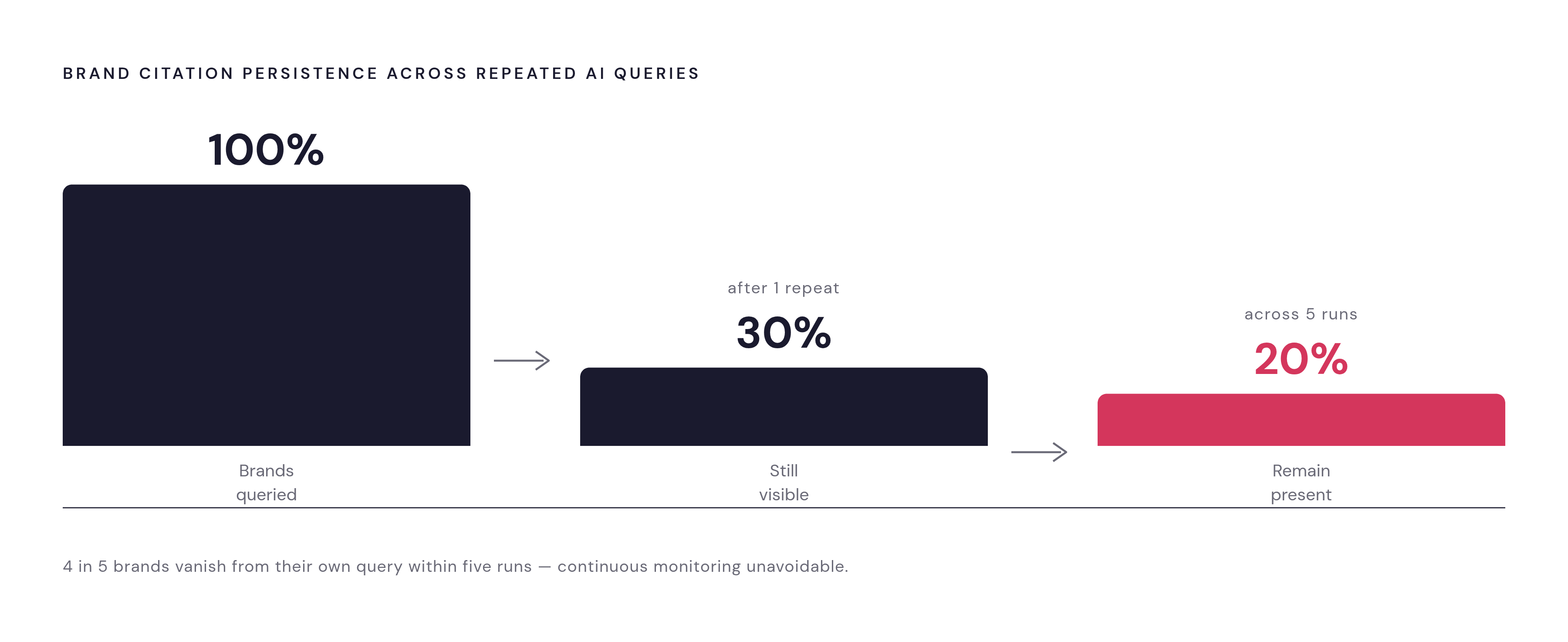
AirOps research found only 30% of brands stay visible from one AI answer to the next on the same query, and just 20% remain present across five consecutive runs of the same query. Citation is a status that has to be maintained continuously. It's a status re-earned, over and over, against a target that keeps moving.
Part of that instability comes from how the models behave: they rebalance toward diversity, freshness, and broader source coverage, so a brand cited Monday can be gone by Wednesday with zero changes on its end. Pricing that was perfectly legible last quarter can lose citation share simply because a competitor added Offer schema, or a model update changed how sources get weighed.
Cross-platform overlap makes the job harder still. ChatGPT, Perplexity, Claude, and Gemini have only about 25% source overlap with each other. A pricing page tuned for one engine isn't automatically tuned for the rest, so tracking has to happen per platform, not as one blended number.
The pricing landscape itself won't hold still either. Builderlab.ai's research tracked roughly 3.6 pricing changes per company across 2025, with credit-based models growing fastest of all. A brand that doesn't update its pricing page in step with its own pricing changes loses citation eligibility the moment its structured data goes stale, sometimes before the internal team even notices the mismatch.
Two tactics show measurable lift here, and they aren't equally strong. Research finds that adding statistics to content improved AI visibility by 41%, the single strongest lever tested. A pricing page citing verifiable numbers about its own value, not just a bare dollar figure, earns more AI surface than one that states a price and stops there. Distribution matters too, but less: distributing content widely across a range of publications lifted AI citations by up to 325% compared to publishing on your own site alone. Statistics first, distribution second. That order isn't interchangeable.
Brand mentions now outperform backlinks as an AI visibility signal, and pricing pages drive mentions
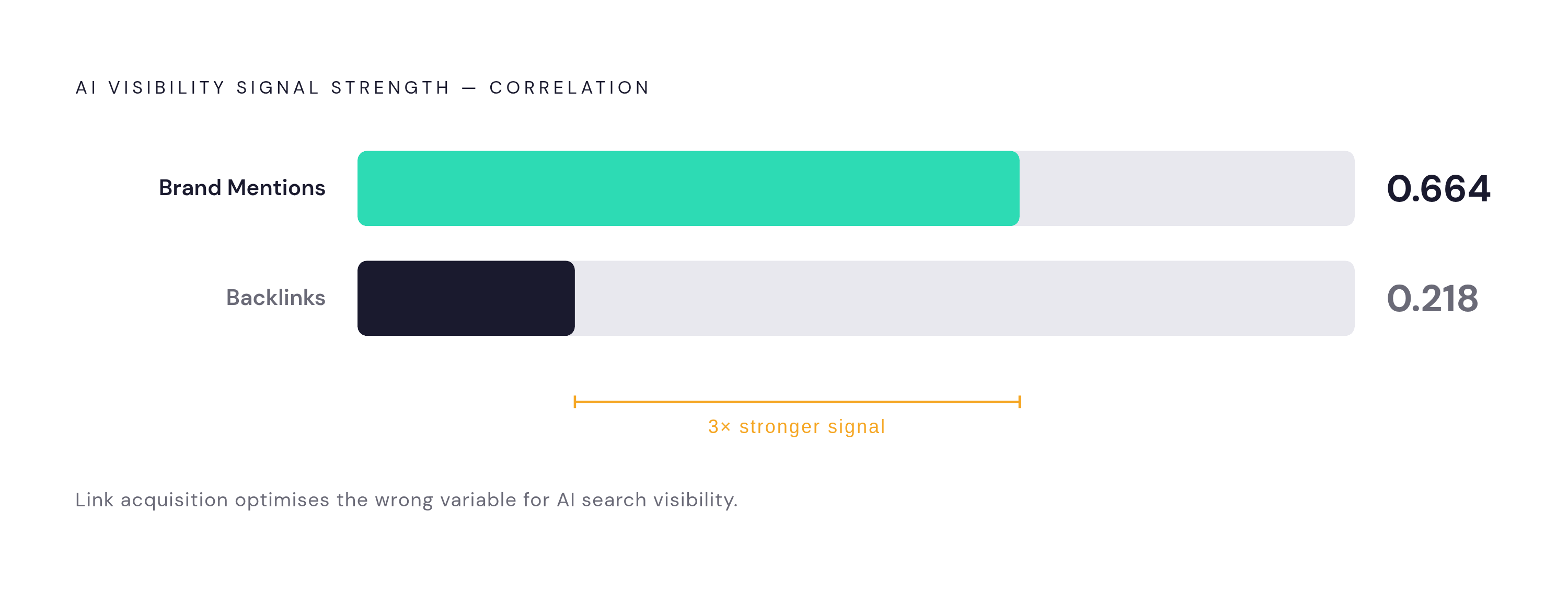
Brand mentions correlate with AI visibility at roughly 0.664, against 0.218 for backlinks. Anyone still running an SEO playbook built around link acquisition is optimizing for the wrong variable. Mentions matter more than links, full stop, and pricing pages are one of the most reliable places a brand earns them.
A pricing page written up in press coverage, cited in a comparison article, or argued over on a forum thread generates the exact kind of mention that feeds AI citation. The page's job includes shaping how the brand is described elsewhere, beyond converting the person who lands on it. It's to seed a trail of mentions elsewhere that eventually brings in AI-referred buyers who never visit the page at all.
That changes how the pricing itself should read. "Starts at $49 a month for five seats, includes onboarding" is the kind of sentence that gets quoted in a Reddit thread or a comparison roundup. "Pricing available upon request" gets quoted nowhere, because there's nothing in it worth repeating.
This is the core of what Generative Engine Optimization, or GEO, tries to formalize: shaping content and brand presence so generative AI systems process it, cite it, and work it into their answers. Pricing transparency sits near the top of GEO's highest-leverage levers, simply because pricing questions are among the most common commercial queries any AI system fields. The US GEO market is projected to hit $365.4 million in 2026, growing at a 42.9% compound annual rate. That's the market pricing in what this piece is arguing: AI visibility infrastructure now treats pricing as a first-class signal, not an afterthought.
What AI visibility tools that track pricing signal actually measure, and what the pricing gaps in the tool market reveal
A distinct product category has formed around tracking brand mentions across AI platforms, with more than 20 dedicated tools on the market as of 2025 and 2026, ranging from free checkers to enterprise suites running into thousands of dollars a month.
Evertune builds for brands that need precise, wide-ranging AI visibility measurement across multiple models and consumer applications. It pairs direct API access to base models with EverPanel, a demographically weighted panel of 25 million users, so it measures both training-level model perceptions and how real consumers experience AI answers day to day.
Profound raised a $96 million Series C in February 2026 at a $1 billion valuation, and sends millions of prompts a day across ten LLM engines. Its Shopping Analysis module tracks product images, placement, and merchant and channel performance inside AI commerce conversations specifically, and a newer Profound Agents feature pushes the product past monitoring into autonomous execution.
Scrunch AI launched in November 2024, built for large organizations that need structured, repeatable control over how their brand shows up across AI search experiences. It's raised $19 million in total funding and counts more than 500 brands as customers, including Lenovo and Penn State University.
Thrad takes a different angle, built for marketing agencies managing AI visibility across a portfolio of client brands rather than for one company managing its own. It gives agencies a single workspace with cumulative analytics across every client, weekly reports, and per-client data exports, plus a training process that gets account managers fluent enough in AI visibility to stop treating it as a black box. Billing flexes between centralized and per-client structures, which matters given how much agency commercial arrangements vary client to client.
Here's where the argument turns back on the tool market itself, and not kindly. Pricing for these AI visibility tools spans roughly $49 a month at the starter end to $3,000 a month or more for enterprise suites, and hidden per-engine fees, seat-based licensing, and query overages routinely push the real bill well past the advertised rate. A tool that quotes one number, then charges separately per engine, per seat, and for API overages, can cost multiples of its sticker price before the first monthly report even ships. That's the exact failure mode this piece has spent five sections describing, now showing up inside the category built to catch it.
A monitoring platform that can't state its own real cost upfront has no business telling a client their pricing page needs to be clearer. Tools that build in usage dashboards, threshold alerts, and hard spending caps earn more trust for an obvious reason: cost predictability is the same feature here that it is on any pricing page, for any product, in any AI environment.
What agencies need to operationalize pricing transparency as a client deliverable
For an agency running pricing strategy across a roster of clients, this can't be a one-time fix applied and forgotten. It has to become a recurring line item in every account audit, alongside content calendars and backlink reports.
The audit covers a handful of specific checks: schema completeness, whether the page's answer formatting actually resolves a commercial question in one read, subtopic coverage for the fees and refund terms buyers keep asking about, staleness against the client's current pricing, and how far that pricing content has spread to third-party publications and comparison sites.
Reporting has to run at the platform level, not in aggregate. Because ChatGPT, Perplexity, Claude, and Gemini only share about 25% of their sources, a client cited on one engine and invisible on another needs to see that split, not a single blended visibility number that papers over the gap. Bespoke, per-client reports and data exports give account teams something concrete to point to when a client asks whether the pricing page rewrite actually did anything.
That's where a lot of agencies fall short, quietly. An account manager who can't explain why restructuring a pricing page moved the needle on AI citations is going to struggle to keep that account past the next renewal. Walking a client through the actual chain, structured data enables AI legibility, legibility earns citation, citation drives AI-referred traffic, is table stakes now. It's the difference between retaining the account and losing it to a competitor who can make that case cleanly.
Metronome's Pricing Index, drawn from more than 50 AI pricing models, found consumer and prosumer tools compete on pricing transparency and frictionless self-serve conversion, while enterprise platforms compete more on customization and the value narrative behind the number. Agencies should build pricing page strategy around that split rather than running the same playbook for a $20-a-month SaaS tool and a six-figure enterprise contract. Those two buyers are reading the page for entirely different reasons, and treating them the same wastes the work.
The number that closes the argument for a skeptical client is the conversion data: AI-referred visitors convert 42% better and spend 37% more per visit than other traffic. AI referrals still sit under 1% of total retail traffic for most brands, but that conversion quality means pricing page work earns its budget line well before volume alone would justify it.