Conversion Rate Optimization for AI Agent Traffic
AI agents convert 42 percent better than regular traffic after flipping from worse a year prior.

AI agent traffic went from a rounding error to a business line in about twelve months, and the conversion math attached to it just flipped upside down. This piece breaks down why AI-referred visitors behave nothing like organic search visitors, what that means for the two very different problems hiding inside the phrase "CRO for AI traffic," and how to actually measure whether any of this is working.
The conversion rate reversal that makes this channel impossible to ignore
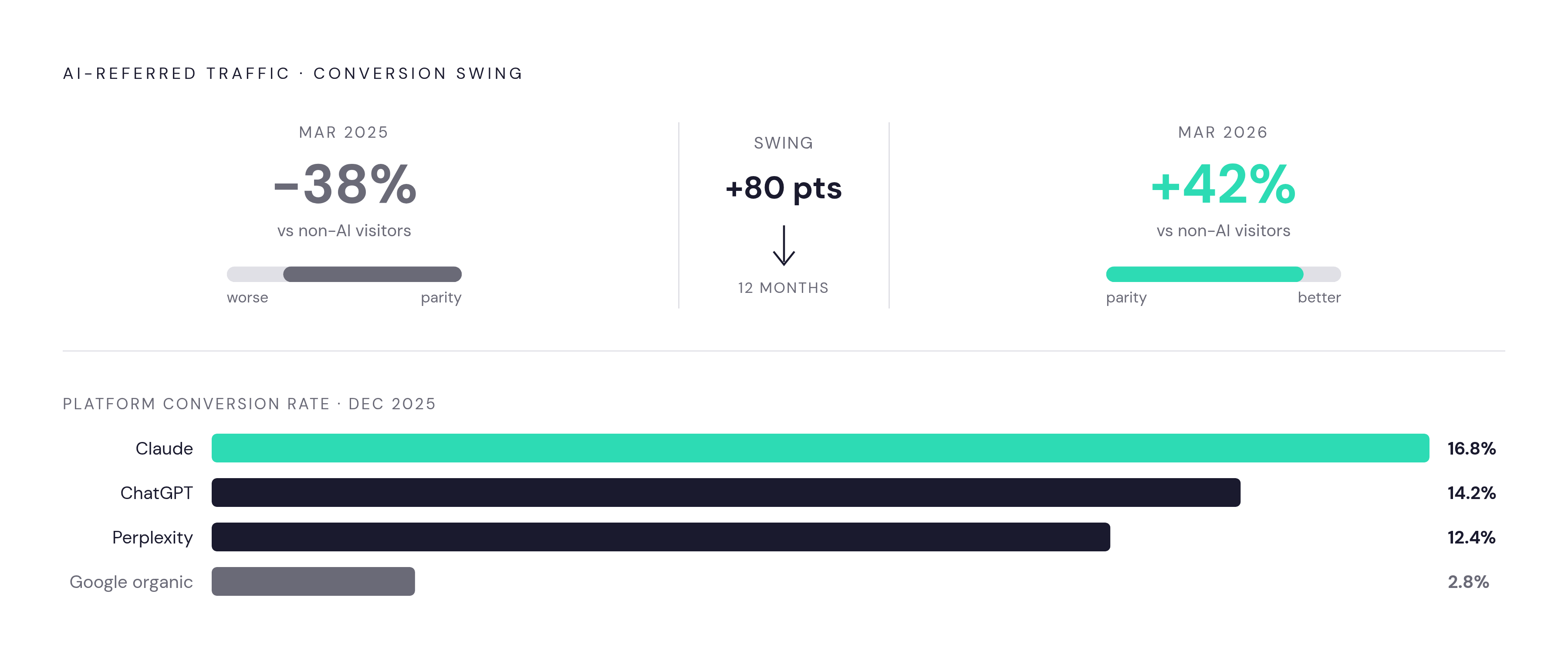
Start with the number that should make any marketing lead sit up straight. In March 2025, AI-referred traffic converted 38% worse than regular site visitors, according to Adobe Digital Insights, which pulled the comparison from more than one trillion visits to U.S. retail sites. By March 2026, that same channel converted 42% better, an 80 percentage point swing in a single year, on a dataset large enough that it isn't noise.
The growth underneath that reversal is its own story. AI-referred traffic to U.S. retail sites grew 393% year-over-year in Q1 2026, and the holiday stretch alone was up 693% year-over-year, per the same Adobe data. Visitors coming in through AI weren't just showing up more often, either; they behaved differently once they landed. Adobe found AI-referred visitors spent 48% more time on page, browsed 13% more pages per visit, and showed a 12% higher engagement rate than non-AI traffic. Revenue per visit from AI referrals sat 37% above non-AI traffic as of March 2026. Put plainly: fewer of these visitors were showing up to kick tires.
Platform-level numbers tell a similar story. Data from amicited.com in December 2025 put average AI traffic conversion somewhere between 12% and 16%, with Claude leading at 16.8%, ChatGPT at 14.2%, and Perplexity at 12.4%. For comparison, Google organic search converts around 2.8%, which makes this not a marginal edge but a different order of magnitude entirely. WebFX ran a longitudinal study across 2.3 billion sessions between January 2024 and December 2025 and found sessions from generative AI platforms grew 796% year-over-year, while conversions from those same sessions grew 6,432% year-over-year. Conversions outran traffic growth by a factor of roughly eight.
Worth a pause here, because the caveat matters more than the headline number. Most of the published research on this comes out of marketing and technology verticals, the segments with the earliest and heaviest AI adoption, and sample bias is real as a result. A brand selling industrial adhesives or regional insurance probably shouldn't expect Claude's 16.8% conversion rate to show up in its own dashboard next quarter. Treat these figures as evidence of direction, not as a universal benchmark to hit.
Why AI-referred visitors arrive in a different psychological state than organic visitors
Here's the mechanism behind the numbers above. A typical organic search visitor lands in consideration mode: they're comparing tabs, reading reviews, figuring out what they even want. An AI-referred visitor usually skips that stage entirely, because the AI already did it for them. By the time someone clicks a link inside a ChatGPT or Claude response, an entire round of comparison shopping already happened inside the chat window, invisible to any analytics tool.
That changes the question the visitor is asking. Organic traffic asks "what are my options?" AI-referred traffic asks "does this page confirm what I was just told?" The AI functions as a pre-qualifying filter, sorting through options and handing the visitor a short list, sometimes a list of one. McKinsey put it sharply: in an agentic world, the customer may no longer be a human with a browser at all. It might just as easily be an autonomous agent acting on that human's behalf, meaning the "visitor" evaluating a page could be software deciding whether to bother sending a person over.
Platform choice adds another layer worth noticing. Claude's user base skews analytical and research-heavy, which correlates with longer dwell time, more pages per session, and that leading 16.8% conversion rate mentioned above. Someone who asks Claude a detailed research question is signaling something different than someone who fires off a quick ChatGPT query between meetings. The platform a person picks says something about how deep their intent already runs, before they've clicked anything.
This dynamic concentrates hardest in research-heavy purchase categories: SaaS, high-consideration retail, professional services. Anywhere a buyer would normally spend days comparing vendors, the AI recommendation now functions like a trusted analyst doing the shortlisting. Which raises the obvious follow-up question: if the visitor already trusts the recommendation, why would a page built to convince skeptics do the visitor any good? It wouldn't, since optimizing for this audience means building for confirmation, not persuasion, and that distinction runs through the rest of this piece.
The two separate problems that "CRO for AI traffic" actually encompasses
Most teams hear "optimize for AI traffic" and picture one project. It's actually two, and they sit at opposite ends of the funnel.
Problem one: getting recommended at all. AI agents only point users toward sites they can read cleanly, parse without guesswork, and trust as a credible source. If the AI never surfaces a brand in the first place, none of the downstream conversion tactics matter, because there's no visitor to convert. This is the domain of generative engine optimization and agent-facing information architecture, and it happens before a human ever loads a page.
Problem two: converting the visitor once they land. A person the AI already vetted needs a page built for decision mode, not discovery mode. Most standard CRO playbooks, the ones built around explaining value propositions and overcoming objections from cold visitors, actively work against this audience, adding friction where the visitor wants confirmation instead.
Here's why the stakes on problem one are higher than most teams assume. Most brands aren't thinking about agent-readiness at all right now, treating it as a future concern rather than a live gatekeeping function. Gartner projected that by 2026, a substantial share of web browsing sessions would be agentically assisted in some form. That's not a forecast about some distant future; that's a description of a mainstream behavior already baked into how a meaningful share of the internet browses. A brand invisible to that 30% is invisible to a segment that, per the Adobe numbers above, converts better than anyone else on the site.
The two sections that follow track this order deliberately: fix crawlability and recommendation signals first, then fix the landing experience for decision-mode visitors. Sequence them the other way and there's a real risk of polishing a page nobody gets sent to.
Making your content readable and recommendable by AI agents
Start with the unglamorous baseline. Most AI crawlers can't execute JavaScript, so content that only renders client-side is functionally invisible to whatever agent is deciding whether to recommend the site. Server-side rendering or plain static HTML for the core content isn't a nice-to-have here; it's the floor.
Freshness matters more than most content calendars account for. AI systems show a measurable pull toward recent material, which means that freshness is a meaningful signal in whether content gets cited. AI systems show a measurable pull toward recent material, which means that evergreen blog post from four years ago, however accurate, is fighting an uphill battle for citation regardless of quality.
Structured data does real work here too. Pages with valid structured data tend to show noticeably better visibility inside AI-generated answers than equivalent pages without markup. Stacking FAQPage, Article, and HowTo schema together through JSON-LD's @graph structure outperforms leaning on any single schema type alone. For teams starting from zero, a sensible build order runs Organization, then Product or Service, then BreadcrumbList, then FAQPage, then Article.
One of the lowest-effort, highest-leverage moves available right now is an llms.txt file sitting at the domain root. It gives AI models a clean, stripped-down summary of what the site covers, without navigation clutter, CSS, or JavaScript eating into the model's context window. It's built for inference time, meaning the moment a model is generating a recommendation and needs to reference the site, not for training. Cheap to build, easy to skip, and most competitors probably haven't done it yet.
Accessibility work does double duty here. Alt text, ARIA labels, semantic HTML, clean heading hierarchy, properly labeled forms; all of it serves AI agents the same way it serves screen readers, by handing over structured meaning instead of a blob of markup. Accessible sites tend to pull more organic traffic and rank for a wider set of keywords, which means accessibility investment and agent-readiness investment reinforce each other rather than competing for budget.
Worth tracking, even if it's not urgent yet: emerging standards aim to let sites expose specific actions directly to browser-based AI agents instead of forcing those agents to fake clicks by parsing the DOM. Nobody needs to build for this tomorrow, but auditing which on-site actions matter most for conversion, and whether they could someday be exposed as agent-callable functions, is a reasonable thing to start scoping now.
Underneath all the technical checklist items sits a content strategy point worth stating plainly: a page that answers one specific question thoroughly beats a page that covers a broad topic shallowly, because AI recommendation engines are surfacing answers, not pages. Depth on a narrow question wins the citation more often than breadth across ten loosely related ones.
Designing the landing experience for a visitor who has already decided
Once someone clicks through from an AI recommendation, the page's job changes completely. That visitor doesn't need convincing that the product deserves consideration; they need the page to confirm the choice they already made in the chat window five seconds earlier. Extensive "what is this company?" copy, broad comparison tables built for undecided shoppers, top-of-funnel calls to action asking someone to "learn more": all of that is friction built for a visitor who no longer exists on this page.
What replaces it? Precise, specific proof points beat generic testimonials, because a visitor past the "is this legitimate?" question wants confirmation of fit, not reassurance of credibility. A case study with a specific, named outcome does more work than a glowing quote with no numbers attached. Calls to action should be unambiguous, since the deliberation already happened elsewhere; the page's job is to make the next step obvious, not to walk someone through a decision tree. Pricing transparency and low-friction inquiry paths matter more here than they would for a discovery-mode visitor who might not be ready for that information yet.
There's a continuity argument worth making too. If the GEO work described in the last section has been done, a brand can get a rough sense of how AI assistants actually describe it to users, and messaging on the landing page that echoes that description creates a sense of continuity. The visitor reads something that sounds like an extension of what they were just told. A mismatch does the opposite: it plants a small seed of doubt, and doubt is what sends a decision-mode visitor back to the search bar.
Page speed and mobile performance stop being nice-to-haves and start being load-bearing. A visitor whose confidence rests on the page confirming a recommendation is more likely to bail on a slow or clumsily structured mobile page than an organic visitor would be, simply because that confirmation is the entire reason they're there, and breaking that confirmation leaves nothing left holding their attention.
None of this can be evaluated without separating the traffic first. AI-referred sessions blended into aggregate organic numbers erase the very signal a brand needs to see. UTM parameters, referrer string filtering for known AI platforms, and separate conversion goals per channel are the minimum setup, not an advanced feature. Segmenting this way also surfaces which platforms send the highest-intent visitors for a given product category; Claude, ChatGPT, and Perplexity will likely differ by vertical and by price point, and there's no way to know which without looking.
One more wrinkle specific to this moment: agentic visitors acting fully autonomously, meaning the "visitor" evaluating the page is itself software working on a person's behalf. For that visitor, the page needs to be operable without a human ever touching a mouse: forms that parse cleanly, actions that trigger programmatically, structured product data an agent can read and compare against a competitor's. This is where WebMCP and action exposure stop being a crawlability concern and start being a direct conversion concern.
How to measure and attribute conversions from AI agent traffic correctly
Here's the quiet failure mode running underneath all of this: most analytics setups still file AI-referred traffic under "organic" or "direct," which means that 42% conversion uplift Adobe documented never shows up in a brand's own dashboard at all. It's sitting there, mixed into a bucket that hides it completely.
The fix starts with referrer strings. ChatGPT, Perplexity, Claude, and other major AI platforms each carry identifiable referrer data that can be filtered and segmented inside Google Analytics 4 or any comparable analytics platform, and that part is easy. The harder part is the growing category of agentic visitors operating with no referrer at all, autonomous agents that show up looking like direct traffic with zero attribution trail. That's a dark-traffic problem that needs its own identification strategy, and there's no fully solved answer for it yet industry-wide.
The minimum viable setup looks like this: dedicated segments for each major AI referral source, separate conversion goals so AI-channel conversion rate can be tracked on its own line rather than folded into an aggregate, and engagement metrics tracked per platform. That last piece matters more than it sounds, because platform-level differences, like Claude's longer average dwell time noted earlier, reveal which sources are sending the most pre-qualified traffic for a specific offer. That's the kind of detail that gets buried the moment everything gets lumped together as "organic."
For anyone trying to build an internal case for spending time on this, the WebFX numbers from earlier do the arguing well enough on their own: 2.3 billion sessions, generative AI referral sessions up 796% year-over-year, conversions from those sessions up 6,432% over the same stretch. That's conversions outpacing session growth by roughly eight times over, and a gap that size doesn't stay a rounding error in the budget conversation for long.