Marketing Automation Best Practices for AI Shopping Agents
Brands betting late on AI agents will find themselves invisible to the shoppers that matter most.

AI shopping agents are already deciding what gets bought, and the marketing automation built for human clickthroughs cannot see them coming. This piece walks through what changes when the customer at the end of the funnel is a language model instead of a person: how agents evaluate products, what data and protocols decide whether a brand shows up at all, and how measurement has to change when nobody clicks a link.
How fast agentic commerce is growing and where most brands actually stand
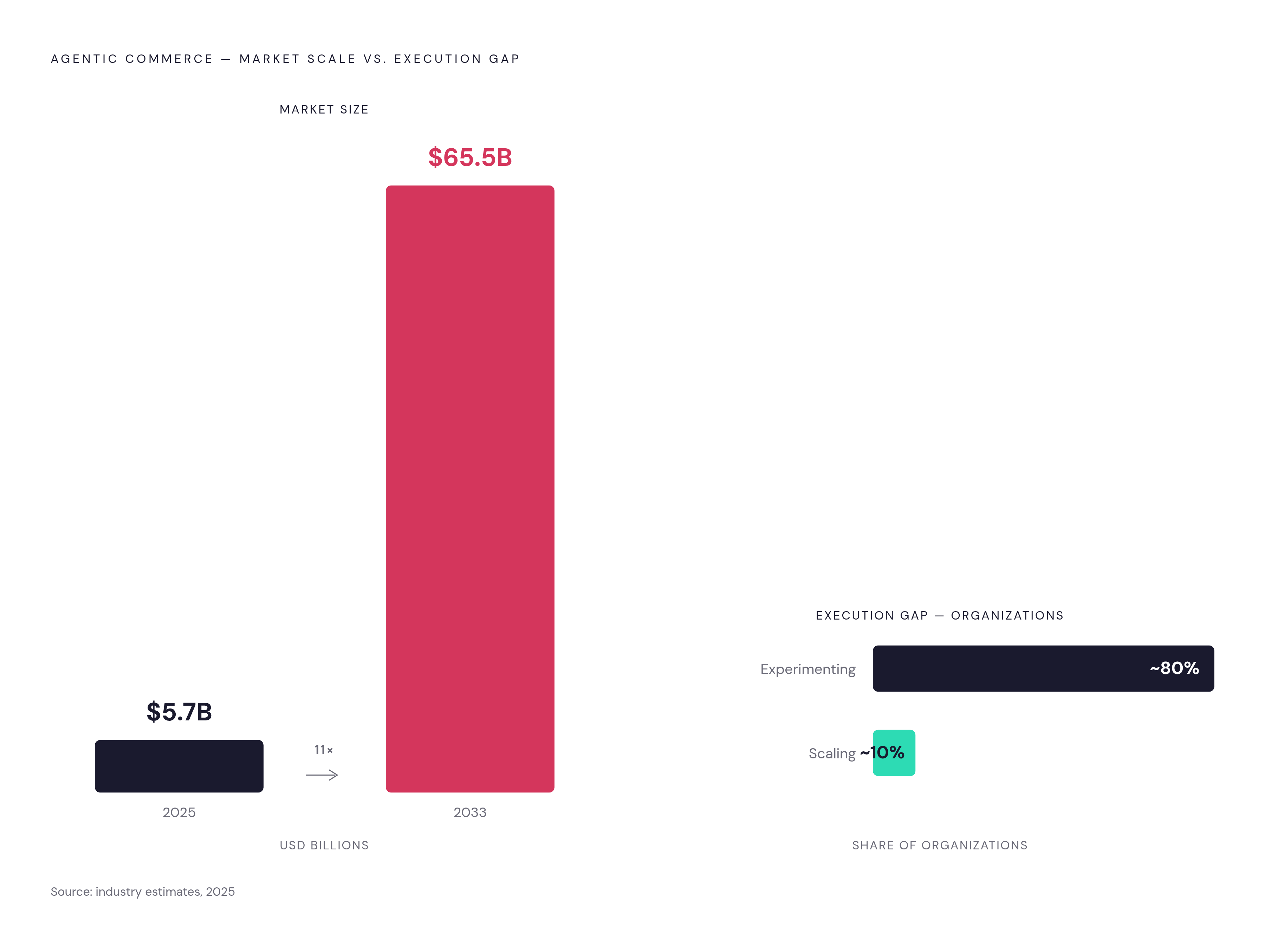
Grand View Research puts the agentic commerce market at $5.7 billion in 2025, headed toward $65.5 billion by 2033. Industry research has found a large majority of organizations experimenting with AI agents, but only a small fraction actually scaling agentic AI in any function. Sitting with those two numbers for a minute, the gap between them is really the whole story of this piece: everybody's experimenting, almost nobody's shipping.
Most brands read that gap backwards. They treat "experimenting" as a safe, responsible middle stage between ignoring the trend and betting the roadmap on it. Looking at how these pilots actually play out, that reading falls apart, and it's worth saying plainly: a pilot that never graduates doesn't function as caution — it functions as inaction dressed up to look like effort in a board deck. A pilot doesn't build the plumbing an agent actually needs to find and evaluate a product; it mostly proves the concept works, which everyone already believed anyway. Deloitte found 63% of global retailers agree that companies without AI agents will fall behind within two years, and most of those same retailers are still running pilots. Knowing the wave is coming and building the seawall are two different projects, and the industry keeps mistaking the first for the second.
A pilot left running too long quietly becomes a delay wearing a strategy's clothes. The brands worth watching have already mapped a backend to a protocol nobody's asked about yet, on the bet that preference patterns set early are hard to dislodge later.
How AI agents actually make product selections — the decision logic marketers must understand
Persuasion doesn't work on a language model the way it works on a person scrolling at midnight. An agent weighs structured signals: attributes, schema markup, feed accuracy, review data, stock availability, and whether the product description says the same thing on the brand's site as it does on the marketplace listing. Selection behaves like a confidence score. Thin data, contradictory data, a missing field here and there, and the score drops; the agent quietly moves to a product it can evaluate cleanly. It's doing exactly what it was built to do, which is cut uncertainty as fast as possible.
BCG found that customers arriving through AI agents spend 32% more time on site with a 27% lower bounce rate than traditional visitors. That's the opposite of what most marketers would guess on first read. Longer sessions usually signal confusion, a shopper hunting for something a page won't give up. Working through what's actually happening here, the explanation flips: most of the comparison shopping already happened inside the model before the visit, so the agent arrives further down the funnel with sharper intent, and the click, when it exists at all, functions as a closing step rather than an opening one.
Whether the visit happens in the first place is a protocol question now, and this is where most marketing teams are focused on the wrong priorities. BCG describes the Model Context Protocol (MCP) as a standardized connector, letting agents talk to backend systems without custom integration work for every platform. Adobe Commerce has committed to both the Universal Commerce Protocol (UCP) and the Agentic Commerce Protocol (ACP). OpenAI and Stripe launched Instant Checkout inside ChatGPT in September 2025, letting transactions complete inside the chat window on existing merchant infrastructure. A brand that hasn't mapped its backend to any of these is invisible to a transactional agent, no matter how sharp the product photography or how well the landing page converts humans.
Discovery, consideration, and purchase no longer behave like one continuous funnel, and most marketing strategy still assumes they do. Similarweb's 2026 Generative AI Brand Visibility Index found 35% of U.S. consumers now use AI tools at the discovery stage, against roughly 14% still relying on traditional search. Discovery has already moved. Most marketing strategy hasn't followed it there yet, and that lag is where budgets get spent on the wrong stage of the journey.
Making products visible to agents: generative engine optimization as a marketing discipline
Generative engine optimization, or GEO, structures content so an agent can find it, evaluate it, and act on it. Treating it as SEO's cousin is the fastest way to waste a quarter, and it's the single most common mistake teams make walking into this. Sources cited by AI assistants like ChatGPT, Gemini, and Copilot overlap surprisingly little with Google's organic top results for the same query. Ranking well on Google says almost nothing about whether a large language model will ever cite the page at all.
So what actually moves the needle? Schema markup helps; it measurably improves how well a model parses a page. But schema alone has limits, and here's the part that should reframe how a mid-size brand thinks about the whole discipline: sites appearing consistently across multiple platforms are substantially more likely to show up in AI-generated recommendations. Being everywhere, consistently, beats being flawless in one place. Content also needs to be citation-friendly: a model should pull a clean, accurate excerpt without wading through three paragraphs of brand voice to find the actual answer. Merchant Center feeds deserve treatment as primary GEO assets, not backend housekeeping. Every SKU, every promotional tag, every availability code needs to be something a crawler can read without guessing.
A significant share of AI citations come from sources outside the top organic results, and sitting with that reality for a moment, it should change how a smaller brand budgets for this work. Clean, well-structured product data lets a smaller brand out-compete a household name in agent-generated recommendations in a way it never could on a traditional results page, where domain authority and ad spend have compounded for a decade. The rules of this game differ from the old one, and most of the field hasn't studied the new requirements yet. Every product page, category description, and FAQ is functionally an agent briefing document now, and it reads best when it's written that way rather than as marketing copy that happens to also live online.
Product data infrastructure as the prerequisite every automation layer depends on
None of the GEO work above matters if the underlying data is bad, and this is the section where that gets said outright: content strategy without clean feed data is wasted spend, full stop. The pattern is clear across the data: agent selection depends on machine-readable feeds, structured attributes, and feed consistency before anything else even gets evaluated. Poor data quality carries well-documented costs that predate the current wave of agentic buying and only grow more severe once agents are the ones reading the feed. A human might tolerate a confusing product page and buy anyway, out of stubbornness or brand loyalty. An agent just moves on to the next listing, with no second chance and no loyalty program to win it back.
So what does agent-ready data actually look like? Every attribute populated, not just the required fields, because agents weigh materials, compatibility, and sustainability claims that a human shopper would skim past without a second glance. Pricing and availability need to update close to real time; an agent that queries stock and gets told "available" when it isn't logs that as a failed transaction, and failed transactions erode trust scores that take a long time to rebuild. Promotional tags and condition codes need to be present and standardized, since agents treat promotions as selection criteria rather than a banner to scroll past. And the same product needs to read the same way on the website, in the feed, and on any third-party marketplace; inconsistency across those three surfaces reads as ambiguity to a model, and ambiguity is exactly what tanks a confidence score.
An agent can surface a product in a synthesized answer, arrive at the transaction moment, fail to resolve one basic attribute, and pick a competitor instead, all within a single query. Months of upstream GEO work, undone at the last step, because the feed underneath it couldn't hold its end of the deal. Platform readiness, meaning integration with AI-ready commerce platforms and API mapping to protocols like MCP and ACP, is the decision everything else sits on top of. Get that order backwards and content teams spend a quarter polishing prose an agent will never trust enough to cite.
Automating signals across the agent evaluation journey, not just the human funnel
The old model, awareness leading to consideration leading to conversion, each stage mapped to an email drip or a retargeting ad, assumes a human moving through a sequence over days. Agents collapse stages, skip stages, or run several at once within a single session.
Discovery automation comes first, and it means making sure brand and product entities show up consistently across the places agents actually pull from: review platforms, comparison sites, editorial coverage, social proof aggregators. Brand representation across those sources is a distribution problem before it's a content problem. Worth automating specifically: tracking where a competitor gets cited and a brand doesn't. Those gaps are rarely bad luck. They're specific, fixable holes in content or feed distribution, and the same three or four gaps tend to repeat across an entire catalog.
Evaluation signal automation comes second, and it's where teams get lazy fastest. Agents compare products on structured criteria: price, attributes, review data, delivery speed, return terms. That information needs to sit as clean, parseable signal rather than staying buried three sentences into marketing copy that reads well to a person and means nothing to a parser. Review velocity and recency matter too, so automating post-purchase review prompts keeps that signal fresh instead of stale. If a brand keeps losing agentic evaluations on one specific attribute, a return window two days shorter than a competitor's, say, that's a policy problem the automation exposed. No clever phrasing papers over it.
Transaction automation comes third, and the stakes are most immediate here. Every extra step between an agent's selection and a completed purchase is a drop-off risk. Protocols like ACP and AP2 let agents complete purchases inside their own interface; brands that don't support this force a handoff to a human checkout flow, and that handoff is exactly where the high-intent moment gets lost. Salesforce's December 2025 data found retailers with AI agent integrations saw roughly seven times better sales growth than those without, a gap that traces less to sharper ads than to fewer places for the sale to fall apart.
Producing agent-ready content at the speed and structure agents require
Content written for an agent needs different bones than content written for a person. Clarity, attribute density, and citability matter more than a clever hook or a distinctive voice, because an agent isn't reading for pleasure and never will be.
The volume problem is real and mostly unsolved. A catalog running into the tens of thousands of SKUs cannot be made agent-ready by a content team typing one description at a time; there aren't enough hours in a quarter for that math to work. Content automation stops being optional at that scale and becomes the only way the work gets done at all. Done well, it means attribute enrichment across the whole catalog, not just the hero products the marketing team already loves. It means structured FAQ content that anticipates the actual questions agents field: comparison questions, use-case questions, compatibility questions. It means one consistent voice across thousands of descriptions, because contradictory phrasing across SKUs creates the exact ambiguity that tanks an agent's confidence score.
Here's the trap, and it's worth naming directly: speed without structure just produces more content that happens to be unreadable to a machine, faster. Volume for its own sake does nothing if the output lacks the attribute specificity an agent needs to act on it. Consumer behavior backs the urgency; preference for AI tools over traditional search jumped from 25% in 2023 to 58% in 2025, more than doubling in two years. That shift already assumes content will read cleanly to machines, updated at the pace the catalog changes, not the pace of a monthly retainer with an outside agency. Teams that keep content production close, instead of routing every update through a slow external cycle, can react to a competitor's move or an agent behavior shift in days instead of weeks.
Measuring marketing automation performance when agents are the audience
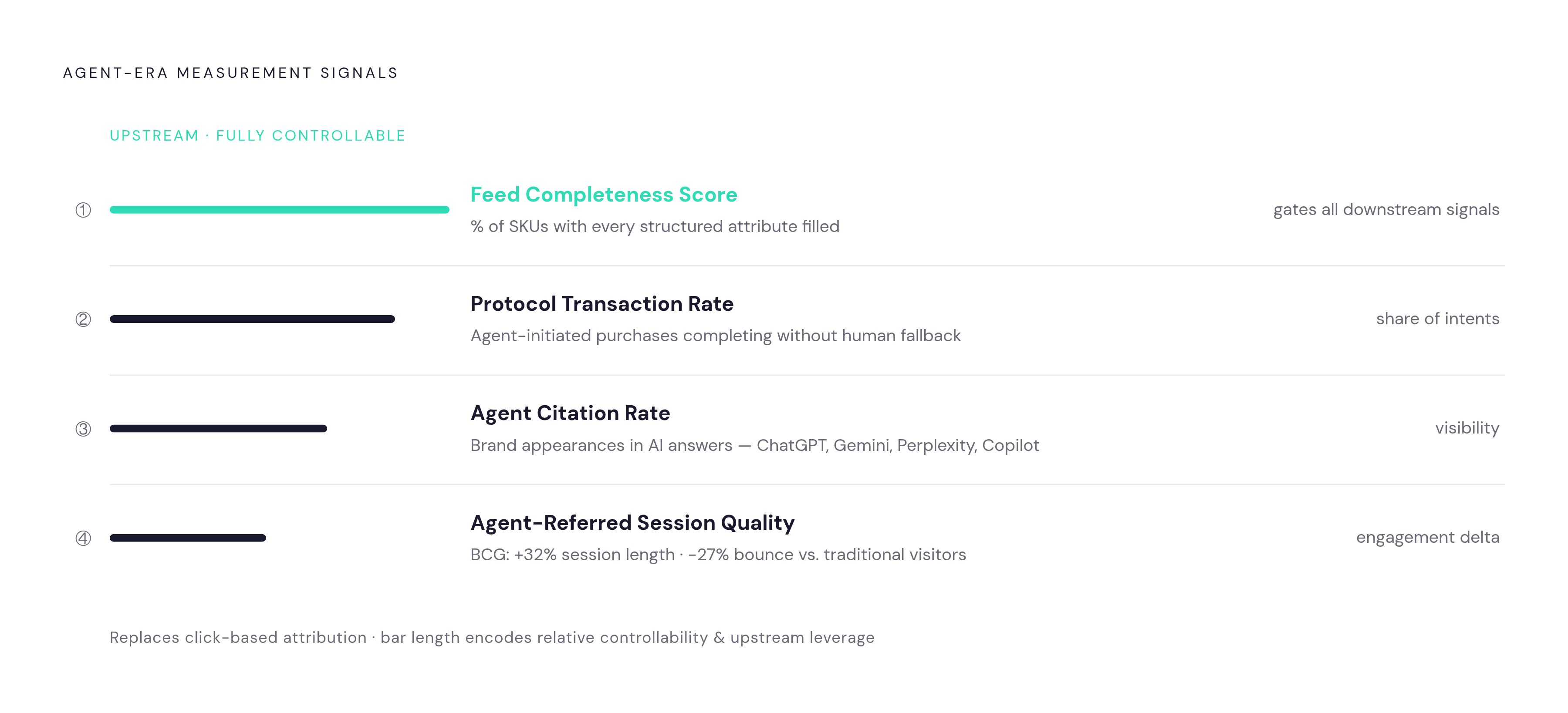
Click-based attribution assumes a click. That assumption breaks the moment a transaction completes inside a chat window with no referral session logged anywhere in a standard analytics setup. So what replaces it?
A handful of metrics are worth instrumenting now, not in six months, and each needs its own dashboard rather than getting folded into the ones already running. Agent citation rate tracks how often a brand or product shows up in AI-generated answers for relevant queries, measured across ChatGPT, Gemini, Perplexity, and Copilot separately, since they don't behave the same way and averaging them hides the gaps. Agent-referred session quality deserves its own benchmark rather than getting lumped into organic traffic; recall BCG's 32% longer sessions and 27% lower bounce rate, numbers that would get flagged as a data error if they showed up buried inside a standard organic report. Feed completeness score, the percentage of SKUs with every structured attribute filled in, works as a leading indicator of discoverability before an agent ever gets involved. Protocol transaction rate, the share of agent-initiated purchase intents that complete without falling back to a human checkout flow, is the cleanest friction measure available at the transaction layer.
The feedback loop matters more than any single dashboard number, and it's the point most measurement plans miss entirely. An agent citation audit that turns up a gap points straight back to a data problem or a content structure problem, feeding directly into the infrastructure and content work covered earlier in this piece. Brands building that loop now, while competitors are still arguing over whether agentic commerce is worth taking seriously, get to iterate against real signal while everyone else keeps guessing.