Replacing Agency Retainers With In-House Content Infrastructure
AI eroded agencies' pricing power; brands now weigh owning content systems versus renting expertise.
Agencies built their pricing model around a knowledge gap, and that gap no longer exists at the execution layer. SEO copy, campaign setup, email flow logic: these were once specialized skills that took years to develop and commanded a premium because so few people had them. AI has made that knowledge available to anyone with a decent tool and an afternoon. What's left is a market working out, in real time, which parts of the retainer were ever worth what they cost.
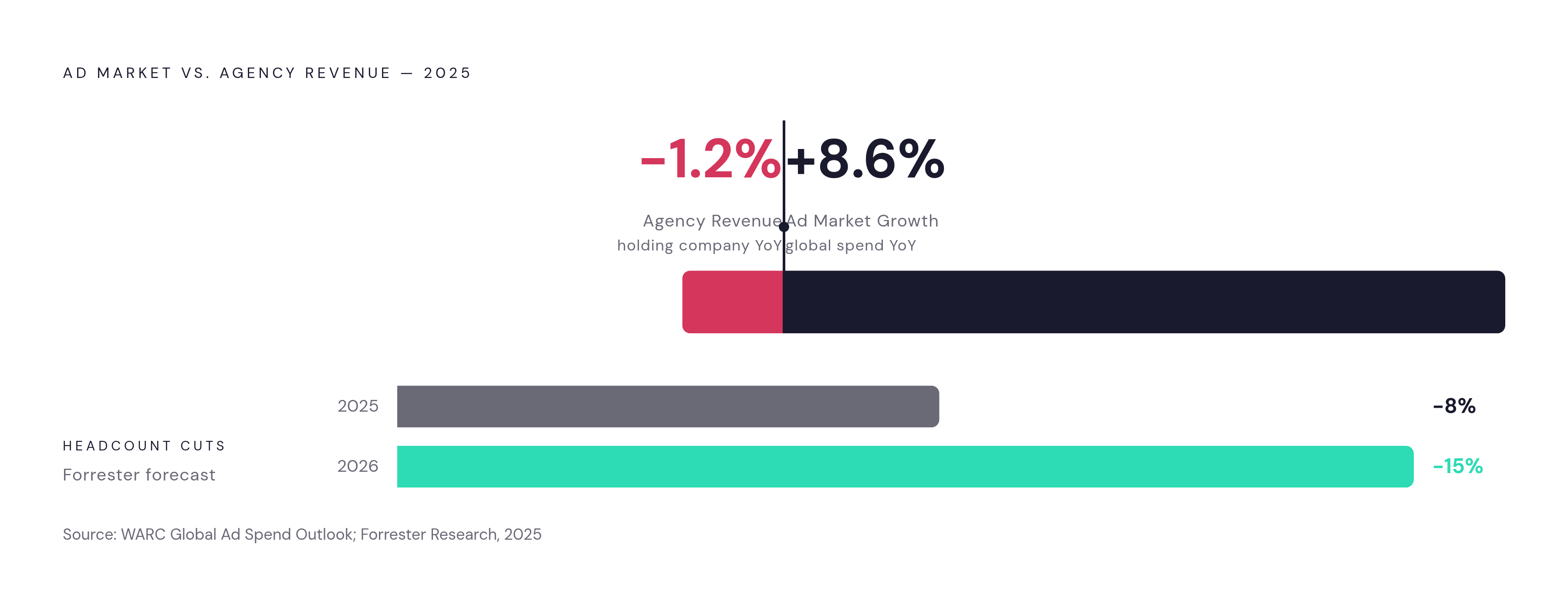
The numbers say the reckoning is already underway. Worldwide ad spending grew 8.6% year over year in 2025, while holding company revenues fell 1.2% over the same period. That's a strange combination: the market for marketing is expanding, and the firms built to serve it are shrinking. Forrester forecasts a 15% cut in agency jobs for 2026, on top of an 8% average headcount reduction across agencies in 2025. That's a trend line with momentum behind it, not a correction. That's a trend line with momentum behind it.
Typeface's 2025 survey of more than 200 senior marketing leaders found 60% planned to spend less on agencies specifically because of AI, and 83% said they'd cut most or all agency spend if content creation could be fully automated. Separately, Focus Digital's 2025 research put annual agency churn at 38%: most client relationships don't survive three years intact. The retainer was never the stable partnership it was sold as. It was a temporary arrangement that happened to renew a few times before it didn't.
None of this means agencies are becoming irrelevant. Crisis communications, investor relations, large-scale media strategy: these still need people who've done it before, who have relationships that took a decade to build. But that work is a fraction of what most retainers actually bill for. The fracture is happening at the execution layer, and execution is where the bulk of the money has always gone. What's shifting is not whether agencies have value, but which kind of value brands are willing to keep renting versus which kind they'd rather own outright.
What brands own after years of paying a retainer
Cancel a retainer, and here's what stays behind: the blog posts already published, the landing pages already live, whatever sits on the brand's own domain. Here's what walks out the door with the agency: the workflows that produced that content, the strategic reasoning behind it, the analytics access that made sense of how it performed. A brand that's paid an agency for five years usually finds, at the end of it, that it owns a body of content and almost none of the system that made that content possible.
The pattern is built into the business model, not a failure of the agencies involved. It's built into the business model. Monthly retainers create monthly dependency, almost by design, and an agency that made itself replaceable would be acting against its own interest. That's just how the incentive runs, not a moral failing. The practical effect, though, is what Marketing ops people sometimes call the "filtered dashboard" problem: brands see agency-curated reports, not the raw data, and not the reasoning that led from data to decision. Auditing performance becomes hard. Transferring knowledge to a new team, in-house or otherwise, becomes harder still.
Firework's report found only 8% of marketers feel confident measuring their own marketing ROI. That number points to where in-house transitions actually break down. It's rarely a headcount problem. It's a measurement problem. A brand can hire three great writers and still have no idea whether the content is producing pipeline, because the analytics infrastructure that would answer that question was never built, or it lived entirely inside the agency's own tools.
Owned systems work differently. Content, data, workflows, institutional memory: these compound when they stay inside the business, the way an investment compounds when nobody withdraws the interest. That's the real case for building in-house, not that agencies do bad work, but that rented systems reset to zero every time the contract ends. None of this argues for wholesale replacement of every agency function. It argues for being honest about what the ownership gap actually contains, so a brand can decide for itself whether closing it is worth the cost.
The cost math for switching, and where it breaks even
A full-service agency retainer for a small or mid-sized business typically runs $5,000 to $15,000 a month, according to Enrich Labs and other industry sources. Most B2B content marketing agencies charge in that same range, and a 2026 survey of more than 350 businesses put the average specifically between $5,001 and $10,000 monthly. Building the in-house equivalent, one SEO manager, a content writer, a link-building budget, and a basic tool stack, runs an estimated $150,000 to $200,000 a year once salaries, benefits, tools, and training are all counted, per GTM 80/20's breakdown.
There's a threshold where the math flips. one industry source puts it at roughly $500,000 in annual creator spend on the low end: below that, agency retainers tend to stay more efficient because a brand avoids the fixed overhead of salaries and software licenses it would otherwise carry year-round. Above a certain scale, in-house teams generally recapture enough margin to justify the build-out. This specific threshold comes from creator and influencer spend data, not content or SEO budgets directly, so treat it as a directional signal rather than a hard rule for every function.
The cost that most spreadsheets leave out is transition risk. When an agency relationship or an in-house team gets dissolved, whatever institutional memory existed, the history of what worked on the site, the rationale behind a past algorithm recovery, the reasoning behind a content strategy pivot, tends to leave with the people who held it. Any serious plan to switch needs to budget for documentation and access handover as real line items, not afterthoughts.
There's also a margin story reshaping the market from the supply side. AI-native micro-agencies are reportedly running at 50% to 80% margins, compared to the 15% to 20% margins typical of traditional shops, according to industry estimates. That gap is part of why the whole market is repricing itself, and it's also the opportunity a brand captures by building in-house with the same AI tooling: the margin that used to go to an agency's junior execution staff can instead stay inside the business. Sopro's AI in Marketing report found teams using AI tools in their marketing function report an average 300% ROI from the combination of revenue lift and cost savings, and separate research finds those teams see 20% to 30% higher ROI than teams relying on human execution alone. Treat those as the upside case, not a floor. The honest exercise here isn't finding the "right" answer, it's figuring out which side of the breakeven a given brand actually sits on before committing to build anything.
What in-house content infrastructure consists of
Infrastructure is the combination of systems, data ownership, and documented process that keeps producing value even after any single person on the team leaves. It's the combination of systems, data ownership, and documented process that keeps producing value even after any single person on the team leaves. A brand can hire five talented marketers and still have no infrastructure at all, if none of what they know is written down anywhere durable.
In-house SEO functions generally split across four buckets: strategy ownership (deciding what to build and why), technical execution (crawlability, site architecture, on-page work), content production at scale (briefs, drafts, optimization), and distribution. Each one used to require a specialist. Agentic AI is what's changing that math. Earlier AI tools generated drafts for a human to review and rewrite. Agentic systems plan the work, execute it, optimize based on results, and report on performance, often without a human touching every single step. It's a similar pattern to what programmatic advertising did to agency media buying a decade ago: the execution layer gets absorbed into software, and the agency's role shrinks to whatever the software can't do.
McKinsey's State of AI research found 79% of organizations now use generative AI in some form, up from 33% in 2023. Adoption itself stopped being a differentiator a while back. What separates one brand from another now is how that AI gets structured into an actual system, not whether it's being used at all.
The tasks AI handles well at the content layer map closely onto what most retainers bill for: social scheduling, SEO drafting, email sequences, ad copy, performance reporting, keyword research and content gap analysis. What remains stubbornly human is a shorter list: high-level strategy, creative direction, relationship-driven media placements, brand partnership negotiation, crisis response. That second list is a minority of a typical retainer's line items, but it's where agency expertise still earns its fee.
For brands running multiple product lines or locations, the interesting development is multi-agent architecture: systems that split research, drafting, optimization, and distribution across separate AI agents, all operating under shared brand rules, with a small central team coordinating strategy rather than writing every piece by hand. That structure removes a specific inefficiency, paying a separate agency retainer per brand or per location, which compounds badly at scale.
None of it matters without measurement built alongside it. Given that only 8% of marketers feel confident in their ROI numbers, an analytics layer tying content to pipeline, not just to traffic, is what makes in-house performance something a team can actually defend in a budget meeting.
Why AI visibility has become the infrastructure decision that cannot wait
Gartner predicted in 2024 that traditional search engine volume would fall 25% by 2026. According to Writer.com, the prediction had already come true by July of that year. That's a fast timeline for a forecast to land, and it changes what "SEO" even means as a discipline.
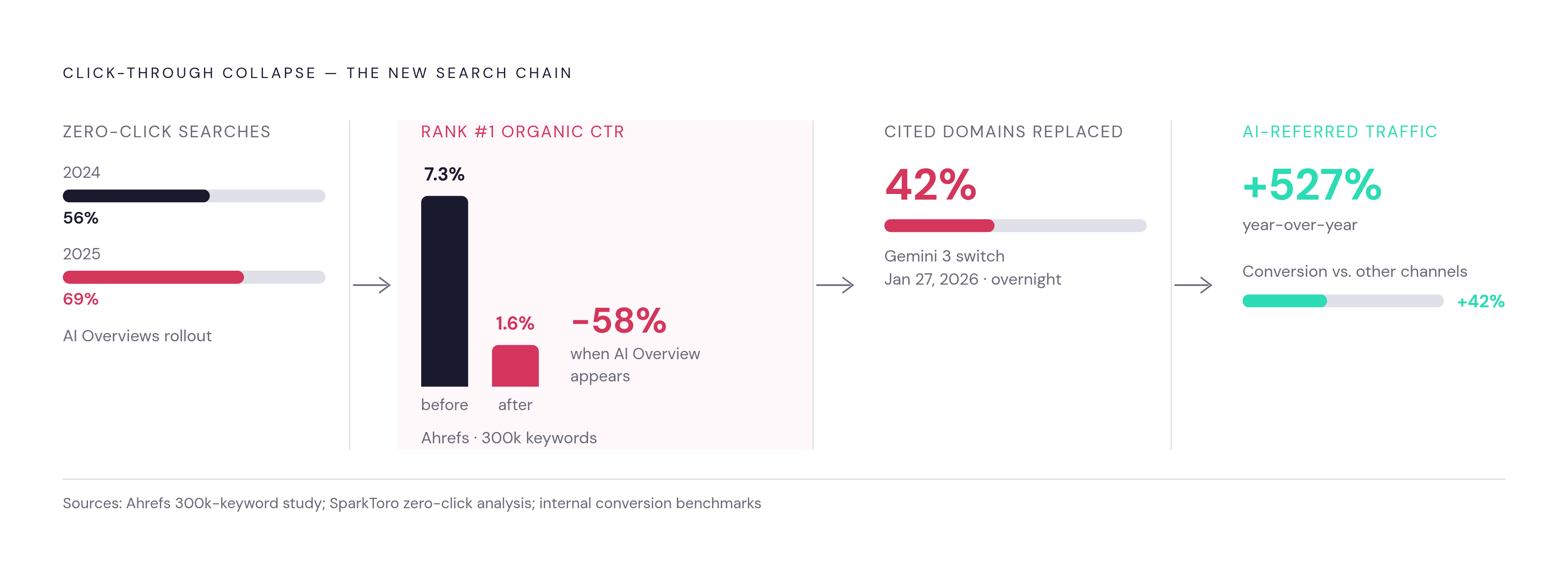
The sharpest inflection point came in January 2026, when Google switched AI Overviews over to Gemini 3 on the 27th of that month. Roughly 42% of previously cited domains got replaced overnight. The overlap between ranking in the top 10 organically and getting cited in an AI Overview, which analysts had already flagged as loose, collapsed further, down to somewhere between 17% and 38% depending on whose dataset you trust. Whatever rules a legacy SEO agency had spent years optimizing for stopped predicting AI visibility in a matter of weeks.
AI Overviews reduce click-through rates for top-ranking pages. Ahrefs' analysis of 300,000 keywords, comparing December 2023 to December 2025, found that where an AI Overview appears, the click-through rate for the page ranking first drops by as much as 58%, from 7.3% down to 1.6%. Similarweb reported zero-click searches on Google climbing from 56% to 69% in the single year following the AI Overviews rollout. And Muck Rack's data found that 82% of AI citations trace back to earned media, not owned content and not paid placement.
Traffic that does make it through from AI surfaces behaves differently than it used to. Previsible's AI Traffic Report clocked a 527% year-over-year surge in AI-sourced traffic between early 2025 and early 2026. A web analytics firm found AI-referred traffic to retail sites in one country up 393% year over year in the first quarter of 2026. retail sites up 393% year over year in the first quarter of 2026, converting roughly 42% better than traffic from other channels, a reversal from a year earlier when AI referrals converted worse than average.
Two disciplines have formed around this shift. Generative Engine Optimization structures content so systems like ChatGPT, Perplexity, Google AI Overviews, and Claude actually cite and recommend a brand inside their answers. Answer Engine Optimization focuses more narrowly on structuring content to answer direct questions cleanly. The two complement traditional SEO rather than replacing it. Writer.com estimates GEO work is 80% strategic and only 20% technical: this isn't primarily a tooling purchase, it's a positioning and content architecture problem that requires PR, content, SEO, and product marketing to actually talk to each other.
The market is moving fast enough that early ownership compounds. Estimates put that country's GEO market at $365.4 million in 2026 with a 42.9% compound annual growth rate. GEO market at $365.4 million in 2026 with a 42.9% compound annual growth rate, while broader analyst ranges for the global GEO services market in 2025 span into the hundreds of millions to over a billion dollars, growing at 34% to 50% annually through 2031 to 2034. An agency that wasn't already optimizing for AI citation before January 2026 has almost certainly not caught up since. A brand outsourcing this function without visibility into whether its agency is actually doing the work is, in a real sense, flying blind on the single fastest-moving part of its own marketing.
What GEO-ready content infrastructure looks like in practice
Princeton's peer-reviewed GEO research (arXiv:2311.09735) found that optimized content can achieve up to 40% higher visibility in generative engine responses, and identified the main drivers as citation density, definition-lead formatting, and statistical enrichment. Content built with verifiable statistics and named sources performs 30% to 40% better in AI visibility than unoptimized content, per the same research, making it the single most empirically validated tactic in the GEO toolkit right now. The implication runs deeper than most brands realize: proprietary research and original data aren't just PR assets anymore, they're infrastructure.
GEO doesn't compete with traditional SEO so much as sit on top of it. Nearly 40% of Google's AI Overviews cite content that also ranks in the top 10 organic results, and almost 70% cite content ranking somewhere in the top 100. Top organic ranking still matters, but it no longer guarantees an AI citation the way it once guaranteed a click. BrightEdge's finding that AI Overview citation increases adjacent organic click-through by 35% resolves a common worry directly: getting cited in an AI answer doesn't cannibalize the organic listing next to it, it tends to lift it.
The structural choices that drive GEO performance are fairly concrete: lead with a definition, embed statistics with named sources rather than vague claims, use headers structured around discrete questions, build clusters of related content around a topic rather than scattering isolated posts. Brand authority signals matter heavily too: consistent named expertise appears across earned media and third-party mentions, and structured content reinforces the same claims in multiple places. Since 82% of AI citations trace to earned media rather than owned content, per Muck Rack, owned content by itself isn't enough. It has to be reinforced from outside the brand's own domain.
None of this is legible without ongoing monitoring: which AI surfaces cite a brand, for which queries, and how those citations shift every time a model updates. Without that tracking, a brand has no way to know if its GEO investment is actually working or quietly eroding. This is where content infrastructure and measurement infrastructure stop being separate conversations.
Thrad's AI visibility platform was built for exactly that gap, launching, monitoring, and proving brand presence across AI surfaces, with per-client analytics, bespoke weekly reporting, and data exports that make GEO performance something a team can actually put in front of leadership. For agencies managing several brands at once, the multi-client workspace means AI visibility gets tracked and demonstrated at the portfolio level, not stitched together account by account.
Where in-house infrastructure still falls short without specialist support
Replacing execution-layer work with AI is a defensible bet at this point. Replacing strategic judgment, relationship-driven placements, or crisis response is not, at least not reliably, and the real risk for brands going in-house is overestimating how much of the retainer that tool stack actually covers.
The measurement gap deserves repeating, because it's the failure mode most teams don't see coming. With only 8% of marketers confident in their own ROI measurement, per Firework's report, a content team built without a matching measurement function has no way to prove its own value. That usually ends one of two ways: budget gets cut, or the brand quietly drifts back to an agency retainer within a year or two.
AI visibility monitoring is its own specialist function, and most in-house teams aren't set up to run it yet. The January 2026 shift to Gemini 3 replaced roughly 42% of previously cited domains in one event. A team without active monitoring in place would have no way of knowing which of its pages lost citation until the drop in pipeline made it obvious, weeks or months after the fact.
Earned media presents a similar problem. It accounts for 82% of AI citations, per Muck Rack, and it depends on PR and outreach relationships that are far harder to automate than drafting a blog post. A brand that guts its PR function in favor of owned content production may be undermining the exact channel that drives most of its AI visibility, without realizing the two are connected.
Multi-brand operations add a layer most in-house tooling wasn't built for. Coordinating strategy, voice, and reporting across several clients or product lines at once is where generic tools, without purpose-built portfolio infrastructure behind them, tend to create more friction than they remove. The honest summary: in-house infrastructure handles execution and builds compounding assets well. It does not automatically supply specialist knowledge, secure earned media, or monitor AI visibility. Those three usually require some mix of specialist hires, purpose-built tools, or a narrower, more selective external partnership than the old full-service retainer ever was.
How to structure the transition without losing momentum
The most common way this goes wrong: a brand hires the team before it builds the systems. New people arrive with no documented workflows, no analytics access, no content infrastructure to actually work inside. Eighteen months later, the brand is back at an agency, having paid twice for the same execution capability.
Sequence affects whether the transition succeeds more than speed does. Document whatever workflows and data access currently live inside the agency relationship before that retainer ends, and negotiate raw data exports as a hard condition of offboarding, not a favor to ask for later. Once the historical knowledge is captured, audit the retainer itself: which line items are genuinely AI-replaceable work, drafting, scheduling, keyword research, reporting, and which ones are billing for judgment that no tool currently replicates. If most of the invoice turns out to be the former, the infrastructure investment case writes itself. If it's mostly the latter, the honest answer might be that the retainer, or some smaller version of it, still earns its keep.
Sources
- How to Replace Your Marketing Agency with AI in 2026: A Complete Playbook | Enrich Labs
- AI vs Agencies: Tools Over Retainers in 2026
- How to Switch From Marketing Agency to In-house: What Companies and Marketers Need to Know
- The Agency Model Is Breaking in 2026 — Here's What Comes Next — Ritner Digital | AI Search & SEO Agency
- frase.io
- Content Marketing Agency Pricing: What to Expect in 2026