Case Study Marketing Strategy for Competitive Differentiators
Restructure case studies for AI discovery systems, not just human buyers signing deals.

A case study built to close a deal and a case study built to get cited inside an AI answer are, structurally, two different documents. Most companies are still only building the first one. The same customer stories that used to drive pipeline now sit invisible to the systems buyers actually consult before they ever type a query into Google. The gap is an architecture problem. It's an architecture problem, and it's costing brands their place in conversations they don't even know are happening.
Why case studies are underbuilt for the job buyers now ask them to do
The case study format was built for a world where a human found you, either through search or through a rep's cold email, and needed proof before signing. That proof document assumed a linear path: awareness, then research, then a PDF full of logos and percentage gains, then a signature. It assumed the buyer showed up.
That assumption no longer holds. A meaningful share of US consumers, roughly 35%, now use AI tools at the product discovery stage, compared to 13.6% who start with a traditional search engine. The funnel hasn't just added a new channel. It's inverted the order of operations, because a buyer can now form a shortlist entirely inside a conversation with an AI system before a search bar or a vendor's homepage ever enters the picture.
Call it what it is: a silent shortlist. Preferences get set, vendors get ruled in or out, and the entire narrowing process happens somewhere no analytics dashboard can see. By the time a prospect lands on a case study page, the AI has often already told them who the credible players are. If a case study wasn't structured to be part of that earlier conversation, it never had a chance to compete.
How AI answer engines decide what to cite
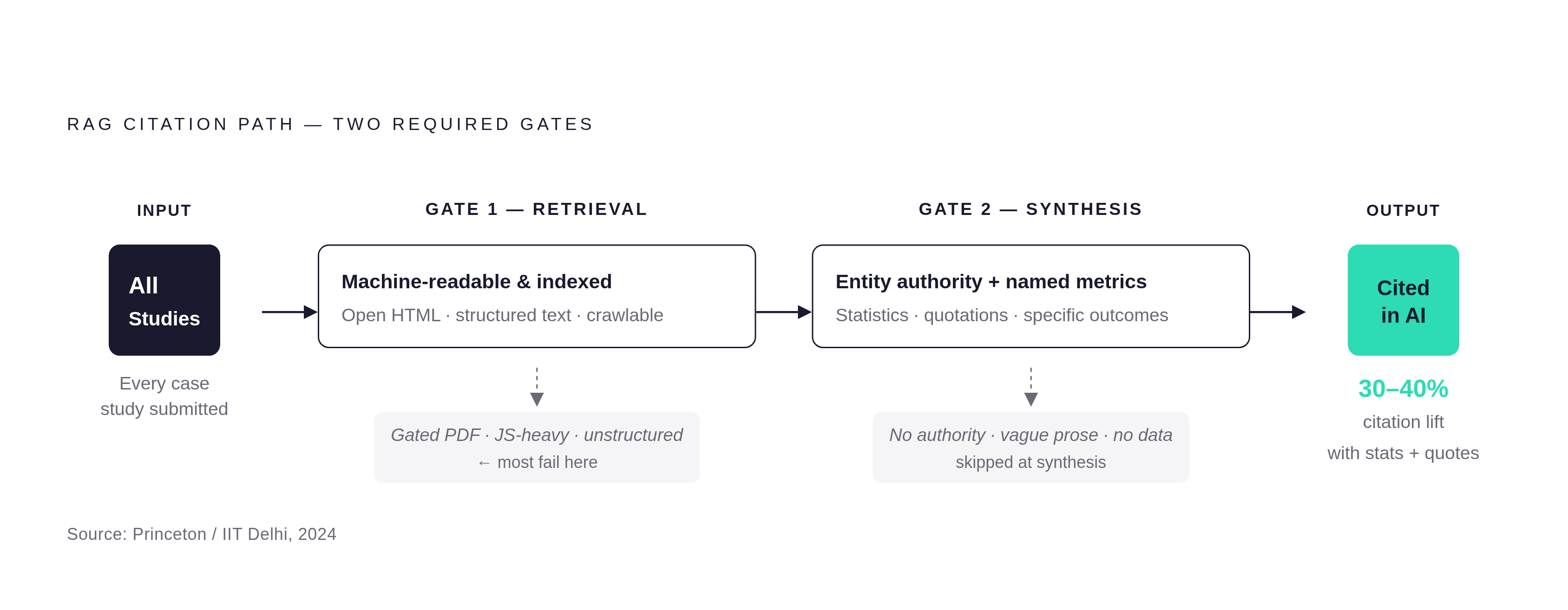
Most AI answer engines run on some version of retrieval-augmented generation, or RAG, which sounds technical but works on a fairly plain logic. A model pulls in outside content relevant to the question, then synthesizes an answer from what it retrieved. That process has two checkpoints, and a case study has to clear both, not just one.
The first is retrieval. Content has to be indexed and readable by a machine before it can be considered. A gated PDF, a page rendered almost entirely in JavaScript, or a wall of unstructured prose without clear claims can keep a case study invisible even if the underlying story is a strong one. It never gets pulled into the pool of candidates.
The second checkpoint is synthesis, and this is where entity authority comes in. Even a fully indexed, perfectly crawlable case study gets left out if the model has no reason to treat the brand behind it as a credible, specific expert in that niche. Being findable isn't the same as being trusted enough to cite.
Research out of Princeton and IIT Delhi in 2024 gives a useful read on what tips that balance. Content modified to include added statistics and direct quotations saw a 30 to 40% jump in visibility inside AI-generated responses compared to unmodified versions, according to that research. Keyword stuffing, meanwhile, actually performed below baseline. The lesson runs contrary to a decade of SEO habit: the old game of loading pages with target phrases now actively hurts a piece of content's odds of being cited.
What competitive differentiation looks like inside an AI-generated answer
When a buyer asks an AI system which vendor is best for a given use case, the model doesn't rank based on marketing spend or domain age. It synthesizes from whatever sources it judges most authoritative and specific, and names the brand whose proof holds up best under that scrutiny.
In AI-mediated discovery, the company whose positioning names a specific outcome, backs it with a real deployment, and can explain that outcome in terms every member of a buying committee understands, from the technical evaluator to the budget owner, is the one positioned to earn the citation. That's proof specificity: a named company, a named metric, a named timeframe. Not a benchmark score. Not an accuracy percentage floating without context.
ELM Learning is a clean example of what happens when specificity, rather than substance, is missing. The company had a real, defensible differentiator: eLearning built around neuroscience principles, formalized under a trademarked methodology called NeuroLearning. But it competed in a market where every rival also claimed to be "innovative," which meant the differentiator existed on paper without being visible anywhere buyers or AI systems could find it. Repositioning around a "people-first" framework didn't invent a new strength. It made an existing one legible, retrievable, and specific enough to cite. Opportunity rate rose 60% in the first 30 days after the repositioning, and multiple enterprise accounts entered the pipeline that hadn't been reachable before. The lesson generalizes: differentiation that isn't retrievable functions, for the purposes of an AI answer, as though it doesn't exist.
Structural requirements for a case study built to earn AI citations
Passing the retrieval gate starts with format. A case study needs to live as clean HTML, not hide behind a PDF wrapper. Semantic markup, fast render times, and a logical information architecture all matter, because a slow or messy page can quietly drop out of an AI system's index even when the content itself would have been worth citing. Schema markup for the relevant content type, whether that's Article, FAQPage, or HowTo, gives the model an explicit signal about what kind of document it's looking at.
Structure the piece with descriptive headings so an AI can extract the answer without reading straight through. And never gate the full case study behind a form. A PDF locked behind an email capture can't be crawled. It can't be synthesized, so, functionally, it doesn't exist to the systems increasingly responsible for shaping a buyer's shortlist.
Passing the synthesis gate is a content problem. Either name the actual customer or describe them with enough specificity that a reader, human or machine, would find the account credible. Name the metric, the baseline, and the result: not "improved performance," but something closer to "cut onboarding time from six weeks to nine days." Name the timeframe, since AI synthesis consistently favors evidence that's specific and dateable over vague, undated claims.
Include a direct quotation from the customer. The Princeton and IIT Delhi research found that quotations, alongside statistics, were the two levers that produced that 30 to 40% lift in citation visibility. And name the competitive context: what the customer used before, why they left, which alternatives they weighed. That competitive framing is exactly the raw material an AI system draws on when a buyer asks a comparison question, so leaving it out means leaving the case study out of the exact conversation it was built to win.
Open with the outcome. AI systems extract more reliably from the beginning of a document than from a conclusion buried six paragraphs deep, so answer-first structure is a retrieval requirement. It's a retrieval requirement. And use the vocabulary the category actually runs on, the words buyers type into a chat window, rather than internal jargon that means something only inside the company that wrote it.
Publishing and distribution decisions that expand where AI can find and cite a case study
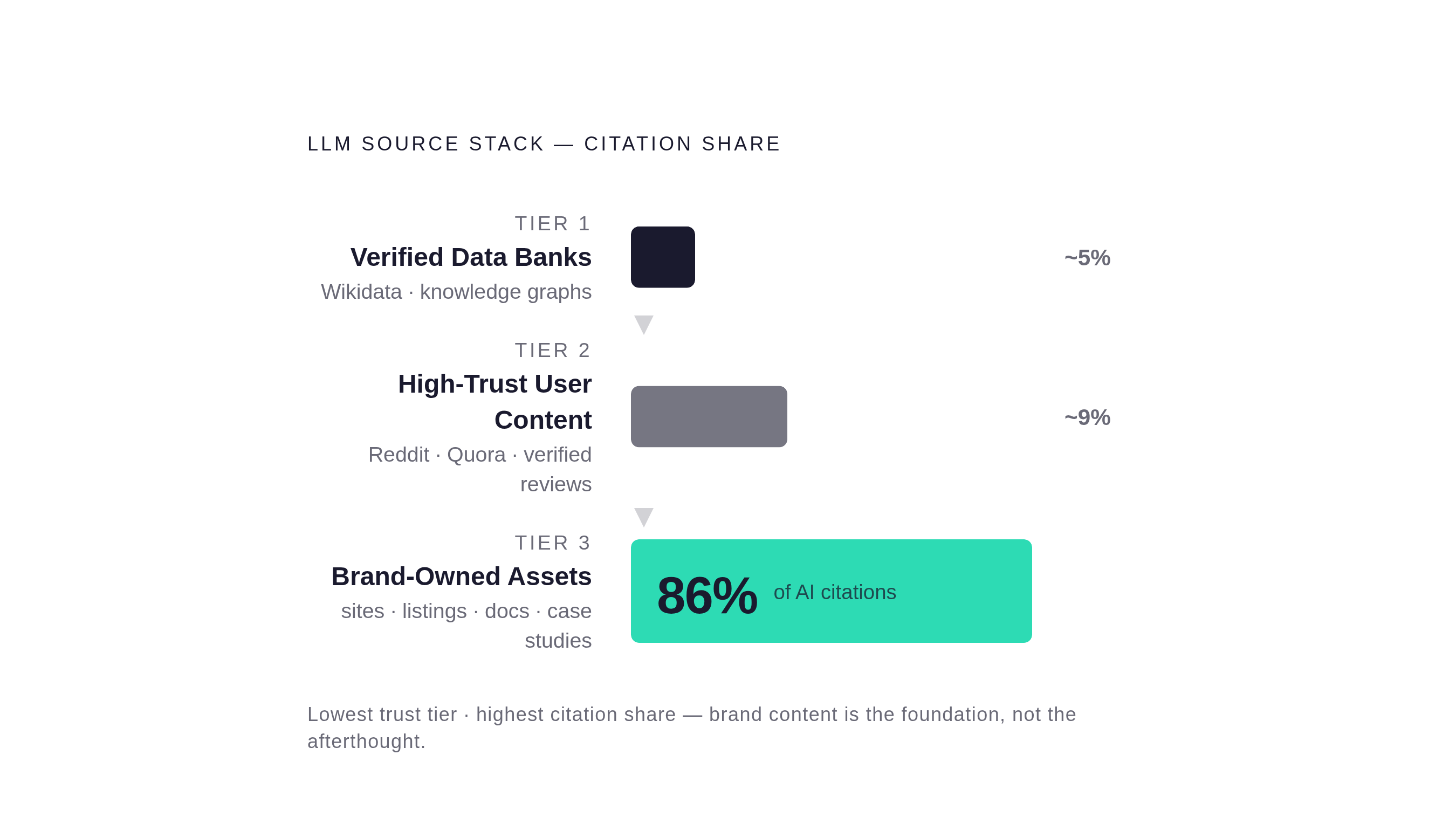
Visibility inside an AI answer depends heavily on presence in what's sometimes called the Source Stack, the layered set of forums, review sites, and verified data sources that large language models treat as ground truth. Verified data banks like Wikidata and knowledge graph entries sit at the top. High-trust user content, the kind found on Reddit, Quora, and verified review platforms, is in the middle. Brand-owned assets, including technical documentation, help centers, and published case studies, form the third tier.
It would be easy to assume that means brand-owned content matters least. The opposite is true. A striking 86% of citations inside AI-generated responses trace back to sources a brand directly controls or strongly influences, whether that's its own website, its listings, or its reviews. Owned publishing is the foundation the rest of the stack builds on. It's the foundation the rest of the stack builds on.
Third-party distribution multiplies that foundation rather than replacing it. Pitching a case study's outcome to trade press, industry publications, and analyst reports puts the story in front of exactly the sources AI systems draw from when they synthesize an answer. Summarizing results on platforms like G2 or Capterra gives customers a place to leave a verified, independent account of the same outcome. Earned press coverage does something similar: PR is no longer a brand-awareness line item, but a mechanism that shapes who actually gets named when someone asks an AI system for a recommendation.
That reframes what generative engine optimization actually is. The technical fixes, schema, page speed, clean markup, matter, but they account for maybe 20% of the work. The other 80% is strategic: positioning, ecosystem presence, and the accumulated brand authority that comes from showing up consistently across the sources an AI model already trusts. Distribution belongs squarely inside that 80%.
Building a repeatable content pipeline so case study production doesn't become a bottleneck
One case study, published once, is a thin signal. AI citation rewards consistency: a brand needs a steady supply of retrievable evidence spread across the vocabulary its category actually uses, not a single flagship story trotted out at every sales call.
That kind of cadence requires a pipeline. Intake starts with identifying a genuine customer win, confirming the actual success metrics, and scoping customer approval early rather than scrambling for a quote after the draft is done. A researcher stage gathers competitive context, the category's working vocabulary, and the range of prompts an AI system is likely to receive on that topic. A writer or drafter then structures the piece to the HTML and answer-first requirements already laid out. A critic or reviewer stage checks brand consistency, verifies the claims, and confirms the schema is valid. None of that replaces a human approval gate before publish; that step is not optional, since brand risk and factual accuracy still need a person willing to be accountable for them. After publish, monitoring tracks whether the piece is actually earning citations in relevant AI answers, closing the loop back into the next round of intake.
Digital Applied's three-tier framework maps cleanly onto how much volume a team is actually producing. A Tier 2, or "Assisted," setup, built around a shared brief library, AI drafting standardized by content type, and a fact-check chain that runs upstream of drafting, with an editor who owns every post start to finish, fits most marketing teams shipping somewhere around 30 to 150 posts. A Tier 3, "Orchestrated," setup routes different post types through different pipeline paths, has editors approving at gates rather than executing every stage themselves, and schedules refresh and amplification work on its own cycle. That level suits teams operating in the 150 to 500 post range, where manual, one-off production simply can't keep pace.
Research has found that marketing teams applying AI agents to content workflows save an average of 14 hours per week compared to the equivalent manual process. Those savings come almost entirely from research and logistics work, the gathering and structuring steps. The human gate stays. The busywork around it doesn't have to.
Measuring whether a case study is earning AI citations, not just ranking
Only 16% of brands currently track their AI search performance in any systematic way, leaving the overwhelming majority of marketing teams still optimizing for a search landscape that's already shrinking in influence. That's most of the industry, measuring the wrong thing. It's most of the industry, measuring the wrong thing.
Share of Model, a term associated with Jack Smyth and Tom Roach, offers a useful successor metric to the old share of voice: it tracks how often a brand actually appears inside AI-generated answers relative to competitors. Unlike paid share of voice, which can be bought, Share of Model has to be earned through the structural and distribution work described above. There's no media buy that substitutes for it.
Four outcomes actually indicate that work is paying off. A citation with a source link, where the AI references the specific URL as evidence. A brand mention occurs when the name appears in the generated response whether or not it's linked. Positive or neutral sentiment is when the brand appears in a favorable context rather than a critical one. And a high share of voice across the full range of prompts relevant to the category matters, not just a lucky hit on one narrow query.
None of that appears in Google Analytics. Measuring it requires a dedicated layer that actually queries ChatGPT, Claude, Gemini, and Perplexity against the real prompts buyers use, then tracks the results over time. Platforms built specifically to measure AI visibility, Letterstory among them, track whether those systems actually name and cite a given brand, and the pattern that shows up in that tracking is consistent: the same structural signals that clear the synthesis gate, a named company, a specific metric, a defined timeframe, a real outcome, are the same signals that make a case study competitively distinct inside an AI-generated answer. Retrieval and differentiation turn out to be the same problem, approached from two different angles. A brand that solves one has, in practice, already solved most of the other.