Marketing Attribution Models Compared for Multi-Touch B2B Campaigns
Multiple touchpoints across months influence B2B deals, not single clicks or visits.

A prospect downloads a whitepaper in January. A different stakeholder from the same company visits the pricing page in March. Someone clicks a retargeting ad in April. A demo gets booked the same week. Which touchpoint deserves credit for the deal? Any answer a single-touch model gives will be wrong, because the question itself assumes one person made one decision at one moment, and that is not how B2B purchases happen.
Why a single attribution model fails multi-touch B2B campaigns
The unit that matters in B2B is the account, not the person who happened to fill out a form. A model built to credit one visitor's path through a funnel has no mechanism for crediting five people's separate paths into the same deal.
Sales cycles that run for months make the problem worse. Attribution windows need to reach back a quarter or more to catch the content that actually opened the relationship, but a lot of marketing software still defaults to a 30-day window, which quietly erases every awareness touchpoint that happened before that cutoff. Last-touch attribution compounds the error by design: it hands full credit to the final interaction, the demo request or the branded search that closed things out, and treats everything upstream as if it never happened. When teams read those reports at face value, they end up cutting the top-of-funnel content and events that built the pipeline in the first place, then pour more budget into bottom-funnel retargeting that just catches demand someone else already created.
Signal loss makes an already distorted picture worse, because iOS consent changes, the retirement of third-party cookies, and GDPR consent rates mean a sizable share of buyer journeys are partially or fully invisible before any attribution model gets a chance to touch the data. Even a carefully built multi-touch model is working from an incomplete map of the territory, and no amount of clever weighting fixes a map with missing roads.
Attribution maturity stages
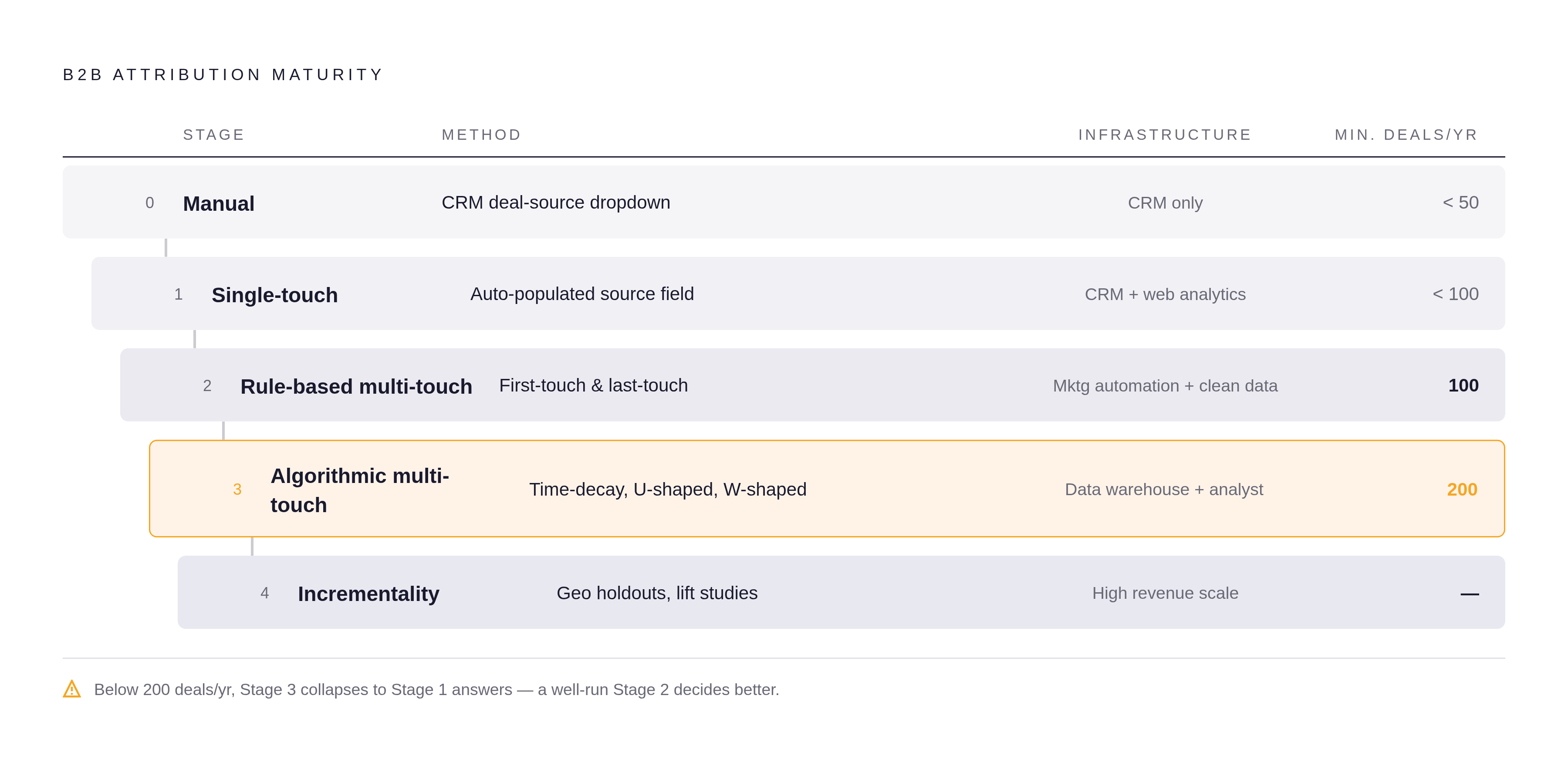
Most B2B marketing teams reach for attribution sophistication well before they've built the infrastructure that sophistication depends on. A maturity framework keeps that mismatch from happening, by making explicit what each stage requires and what it can reliably answer.
Stage 0 is a manual deal-source dropdown inside the CRM, filled in by sales after the fact. It needs no special infrastructure, costs almost nothing, and can be running within a week. It holds up fine until deal volume passes roughly fifty per year, the point at which sales reps can no longer be trusted to remember accurately which channel actually started the relationship.
Stage 1 is single-touch attribution with the CRM source field auto-populated from web analytics, which requires those two systems to actually talk to each other.
Stage 2 moves to rule-based multi-touch, typically first-touch and last-touch reported side by side. It requires a marketing automation platform, data clean enough to trust, and at least a hundred deals a year to make the reporting meaningful. Stage 3 adds algorithmic multi-touch models, time-decay, U-shaped, W-shaped, with weights tuned to actual data. That takes a data warehouse, at least two hundred deals a year, and someone whose job is specifically to own attribution analysis. For most mid-market B2B companies, Stage 3 is enough to make sound budget decisions, and pushing further rarely pays off until revenue scale gets substantial.
Stage 4 adds incrementality testing on top, geo holdouts, lift studies, and surveys layered against the algorithmic model. Most companies have no real reason to go this far. Data-driven models need a minimum volume of monthly conversions to train properly, and below that threshold they quietly collapse back toward last-click behavior while still presenting themselves as sophisticated. So a company running a Stage 3 model without enough volume to support it is just getting Stage 1 answers dressed in Stage 3 clothing.
None of this works if identity resolution is weak. When match rates fall below a workable threshold, attribution scatters across ghost users who are really the same person on different devices, and once that happens, every model's output becomes suspect, no matter how advanced it is. Window configuration deserves the same scrutiny: running the same data through a 7-day window and a 90-day window and comparing the channel rankings that come out is a basic sanity check, not an advanced technique, and it should happen before anyone trusts a model's conclusions. One diagnostic is simple enough to run immediately: if branded search is picking up a disproportionate share of multi-touch credit, the window is too short and real demand-generation work is getting excluded from the picture.
What each rule-based model measures
Every rule-based attribution model is built on an assumption about where in the buyer journey influence actually concentrates, and every one of those assumptions breaks down for at least one common kind of deal.
Stretch it over a longer enterprise cycle and it systematically undervalues the early awareness and consideration work that got the deal moving.
U-shaped, or position-based, attribution gives the largest shares to the first and last touches and spreads a smaller remainder across everything in between. W-shaped attribution splits the largest shares three ways, across first touch, the lead-creation milestone, and the conversion touch, with whatever remains spread across the rest. It was built specifically for B2B funnels with defined milestones, treating lead creation as a real inflection point.
Feed the same data through two models, say last-touch and position-based, and compare what each one says about a given channel, as a practical check before trusting any of these outputs. GA4 removed first-click, linear, time-decay, and position-based as primary attribution models in November 2023, and none of them are available anywhere in GA4 anymore, including the comparison reports. Teams that treat GA4 as their entire attribution environment have fewer model options available to them than they may assume.
Matching models to B2B sales cycle and buying committee structure
The right model follows from sales cycle length, touchpoint volume, and the size of the buying committee, not from whatever a platform sets as its default or whatever competitors happen to be running.
For B2B SaaS companies with 30 to 90-day cycles and somewhere around 8 to 15 touchpoints, position-based models (a 40-20-40 split, for instance) or custom-weighted variants tend to fit best. Time-decay is a reasonable alternative in this same range: it respects the full journey while still weighting later touches more heavily, and it's simple enough to explain to a budget owner in one sentence.
For B2B SaaS companies with clearly defined funnel milestones, MQL, SAL, opportunity, W-shaped attribution lines up credit with the moments the revenue team is already tracking: first touch, lead creation, and conversion.
Enterprise B2B, with cycles running 180 to 365 days or longer and hundreds of touchpoints spread across a full buying committee, calls for something more tailored: custom account-based attribution with weighting by contact role, run alongside first-touch measurement to capture true awareness sourcing. Data-driven algorithmic models tend to be unreliable at the deal volumes most enterprise businesses actually see. Account-based attribution has to assign partial credit across every member of the buying committee, not just whoever signs the contract at the end, or it ends up replicating an individual-consumer model inside an account context where it doesn't belong. Long enterprise cycles also routinely predate any practical attribution window. First-touch measurement, even run as a secondary signal, is often the only way to capture the field event or analyst call that introduced the brand to the economic buyer nine months before the deal closed.
The objection that a company can't afford a data warehouse and a dedicated attribution analyst is legitimate at Stage 1 or Stage 2 maturity. Running the simplest model that actually fits the cycle length is the answer, because a misconfigured Stage 3 model produces worse decisions than a well-run Stage 2 one.
Multi-touch attribution's growing blind spot in the B2B pipeline
A meaningful share of B2B research now happens entirely outside the reach of any multi-touch model, and that share is growing as buyers lean more on AI answer engines, private community discussions, and peer networks as their first stop. Industry surveys point to a large share of B2B buyer touchpoints occurring in channels that leave no tracking signal at all: analyst calls, peer referrals, review platforms without UTM parameters, LinkedIn DMs, private Slack communities, podcast episodes. MTA assigns these touchpoints zero credit by construction, and the result is a model that systematically over-funds whatever happens to be trackable, which isn't the same as whatever is actually most influential.
The gap this creates differs from the signal loss discussed earlier. Signal loss is a measurement failure, and better infrastructure, server-side tagging, improved consent flows, can recover some of it over time. The dark funnel is different in kind: it's made up of interactions that were never going to leave a tracking signal in the first place, no matter how good the infrastructure gets. A peer recommendation in a private Slack channel is a conversation that happened somewhere a pixel can't go.
AI answer engines add an entirely new category to this problem. A buyer who asks ChatGPT, Perplexity, or Gemini about a category of solution can form a vendor shortlist before ever visiting a single vendor's website, and no MTA report captures the citation that shaped it. It's already the current buying behavior in the B2B enterprise segment, and enterprise marketing teams should be treating AI answer-engine presence as a demand-generation channel on the same footing as analyst coverage or review-platform placement. Just as attribution windows need to stretch back months to capture the content that quietly built a pipeline, platforms built to track AI visibility need to measure whether a brand is actually named inside early-stage research answers, not just whether it shows up in a conventional search results page. Measuring this kind of influence takes parallel methods: GA4 filters tuned to isolate referral traffic from AI platforms, and a self-reported field on the contact form, "how did you hear about us," with AI search listed as its own explicit option.
Pairing multi-touch attribution with marketing mix modeling
MTA and marketing mix modeling answer different questions on different time horizons, so if you run them side by side, you get better decisions than if you treat either one as sufficient on its own.
Multi-touch attribution answers which specific campaigns and channels are contributing to conversions right now, and where next quarter's budget should move. It works at the level of the individual user and the individual touchpoint, depending on observable interactions and a reasonably functional identity graph. It degrades fast when signal loss is heavy or identity resolution is weak. Its natural rhythm is daily or weekly campaign optimization and short-term reallocation between channels.
Marketing mix modeling answers a different, more strategic question: across the entire marketing budget, including channels that leave no digital signal at all, what is the aggregate contribution of each category of spend to revenue. MMM operates at the aggregate level rather than the individual level, which keeps it unaffected by privacy changes, dark social, or offline touchpoints that degrade MTA. Its limitation runs the other direction: it can tell a team that events outperform display as a category, but it can't say which specific event or which specific display creative did the work. MMM's natural rhythm is quarterly or annual budget setting and brand-level investment decisions, where long-term effects outweigh this week's campaign tweak.
Incrementality testing, geo holdouts and conversion lift studies, serves as a ground-truth check on both. It answers whether a channel that looks indispensable in either model is actually causing conversions or just correlating with them. A channel that looks high-performing in an MTA report may simply be capturing demand that something else already created, which makes retargeting the textbook case to audit this way.
The practical sequence follows from what each tool is built for: run MTA for week-to-week and quarter-to-quarter campaign calls, run MMM to set annual budgets and evaluate brand investment, and use incrementality tests selectively to pressure-test whichever channels are getting the most credit before committing a major budget shift to any single model's word. A team that says it doesn't have the staff or budget to run three separate systems at once isn't wrong to worry about that, but the maturity framework already answers the concern: Stage 3 MTA alone is enough for sound budget allocation at most mid-market B2B companies, and MMM only becomes necessary once offline investment, brand spend, or dark-funnel channels make up a large enough share of the budget that they need to be justified at the board level. The same sequencing logic applies to content production. Teams often try to run sophisticated, multi-channel programs before the foundational measurement is in place to make them reliable, and AI content engines such as Letterstory are built around establishing that measurement layer first, tracking which AI answer engines actually cite a brand, before adding complex production workflows across multiple channels and sites on top of it.