Positioning Refresh for SaaS Companies Entering a Crowded Market
Reposition around the right competitive alternative, not around features.

A SaaS company that leads with features is building its pitch on ground that moves every week, because AI has made most features replicable on a short timeline. What many companies call positioning is really a product description: a list of what the tool does, dressed up as a strategy. Positioning is the strategy that messaging and branding are supposed to express, and no amount of polish on the messaging layer fixes a position that was never set. A refresh, done properly, is a structured reassessment of the competitive context the product sits inside, and that reassessment has to happen before a single word of new copy gets written.
What a positioning refresh reassesses
A positioning refresh works through five specific variables, and April Dunford's framework names them clearly: competitive alternatives, unique attributes, value proof, target market characteristics, and market category. Positioning, in this framework, is the context a company places its product inside so that its value becomes obvious without a lengthy explanation. Changing the context changes how a customer perceives the same product, often without changing a single line of code. The five components do not carry equal weight in the order a team should tackle them. Each component sets up the one after it, so a team cannot sharpen its unique attributes with any precision until it has correctly named what it's being compared against. Market category deserves the same scrutiny, since a wrong category choice forces every other component to compensate for a frame that doesn't fit. A simple test tells you whether the work is done: when the homepage, the sales deck, and outbound messaging all answer a buyer's question the same way, positioning is doing its job. When those three answers start to drift from each other, the company is spending money to confuse the people it's trying to win.
Picking the right competitive alternative to anchor against
Identifying the right competitive alternative is the single highest-leverage decision in the entire refresh, because the value story, the pricing framing, and the proof a company needs to gather all follow from that one anchor. Anchoring against the wrong alternative produces a specific, recognizable failure: the vague superiority claim. "Better than X" with no named axis of comparison reads as noise, because every competitor in the category makes the same claim with a straight face. Figma did the same by making real-time collaboration the dimension it competed on, rather than arguing about design quality in the abstract. Both companies named a specific axis and proved it with evidence.
A workflow automation tool that had been competing against Zapier inside the "no-code automation" category found a sharper anchor by repositioning around "IT-approved automation with governance and security." The practical method for finding this anchor doesn't require guesswork: talk to recent customers directly, ask what they were doing before they bought, what else they considered, and what would happen if they stopped using the product tomorrow. Their answers, not a competitor list pulled from a sales battlecard, name the real alternative.
Choosing a positioning archetype that matches where the market is
Once the right alternative is named, a company has to choose an archetype for how it wants to stand against that alternative, and the four options are not equally available to every entrant. Category creation, category challenger, niche dominance, and bundle disruption each make a different bet about the mental model a buyer already carries into the conversation. Each of those companies had all three preconditions in place before they made the bet, and that combination is rare.
Creating a new market category in 2026 costs more and carries more risk than it has at any point before now. If a buyer already has a mental model that fits a product reasonably well, asking that buyer to learn an entirely new category is asking for work most of them won't do, no matter how elegant the new label sounds in a pitch deck. Niche dominance is the archetype most often dismissed as a consolation prize, and that's a mistake. The strongest version of this archetype doesn't treat the niche as a ceiling. It treats the niche as an entry point with a credible path to expand once the base is secure, which is a very different decision than choosing niche dominance because nothing else seemed available.
Sharpening the for-whom signal so the right buyers self-select
Picking the right archetype only pays off if the audience definition underneath it is sharp enough to let the right buyers recognize themselves immediately, and a vague audience signal does as much damage as a vague value claim. The distinction that matters most right now: a project management tool that bolted on an AI writing assistant is competing on a different footing than a product built from the ground up to autonomously manage workflows. The writing assistant is a feature. The autonomously managed workflow is a category. Notion could have gone after "everyone who takes notes," a market so broad it would have meant nothing. Instead, the company focused on individuals, small and mid-sized businesses, and teams that needed a flexible, collaborative workspace, and that narrower focus sharpened both the positioning and the product roadmap behind it.
Agentic AI is the hardest category to position correctly right now, precisely because buyers are still calibrating what they're comfortable letting software do without a human checking its work. The practical test for whether any of this has worked is simple: the target market characteristics in Dunford's framework are the specific customers who care most about the product's unique value, and a sharp audience definition should make a reader say either "that's exactly me" or "that's definitely not me." Both reactions count as a win. If a homepage reads like it could describe three different companies' products, the for-whom signal isn't sharp enough yet.
Publishing the refreshed position so AI answer engines can retrieve it
A position this carefully built does no good sitting only on a homepage and inside a pitch deck, because an increasing share of B2B buyers never reach either of those surfaces before forming an opinion about the vendor. Discovery now starts inside AI answer engines, not inside a search results page. Buyers in 2026 ask Perplexity and ChatGPT, alongside Google, for stack recommendations, category explanations, and direct vendor comparisons, often well before they type a company's name into a browser. SaaS buyers are some of the heaviest users of this behavior, which makes the generative answer a primary, high-intent discovery channel, arguably the highest-intent one most marketing teams aren't measuring at all yet.
Traffic and visibility have come apart from each other in a way that changes how this work has to be judged. A page that never once ranked on Google can be cited by ChatGPT regularly. These are two separate jobs, measured by two separate instruments, and treating them as one metric hides what's actually happening to the brand's visibility. A model decides, on the reader's behalf, which evidence to trust, and folds that evidence directly into the answer it gives. The competition a brand faces is for a place inside the model's evidence set now, not a ranking position on a page, and that's a different fight with different rules.
Gates that content must clear to earn a place in AI answer engines
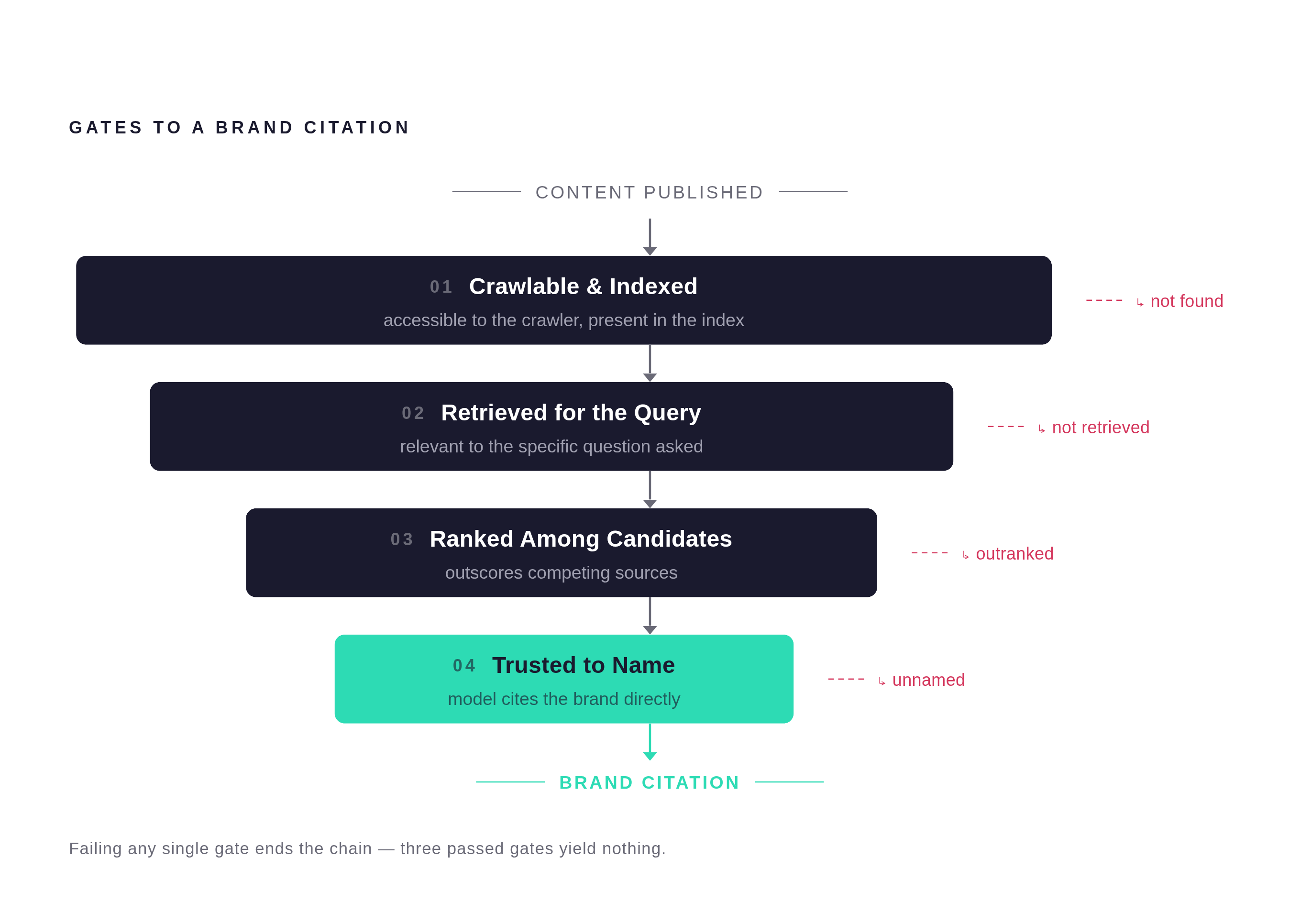
Earning a citation from an AI answer engine is not the same task as ranking on Google, and content built to win one doesn't automatically win the other, because each engine runs its own retrieval logic on the material it finds. Content has to clear a chain of separate gates before a brand's name ever appears in an answer: it has to be crawlable and indexed in the first place, retrieved for the specific question a user asked, able to survive a ranking step against other candidate sources, and trusted enough for the model to name the brand directly. Perplexity's bias toward recent material is particularly strong here. Visible year signals in titles and headings improve citation rates, and content published within the last 30 days gets cited at a disproportionately high rate compared to older material covering the same ground.
The strongest challenge to building an entire content strategy around these mechanics comes from Google itself, which advises prioritizing sound SEO practice over what it calls "AEO/GEO hacks," explicitly telling publishers to ignore tactics like chunking content artificially, generating unnecessary AI-specific text files, or chasing inauthentic mentions of the brand. The honest position is that GEO tactics for non-Google models may genuinely need to differ from what works for Google's own AI Overviews, and the field hasn't settled that question yet. The practical response is to treat these as two distinct jobs with two distinct sets of tactics, rather than building one strategy and hoping it satisfies both.
Building the off-site presence that corroborates the refreshed position
Structured, consistent brand presence on surfaces a company doesn't own is a stronger driver of AI citation than most of the content work happening on its own site, and it's the lever most positioning refreshes skip. A company's name, description, founding year, and the services it offers all have to match, word for word, across its own website, its LinkedIn page, industry directories, and reference databases, and that consistency is what builds entity recognition. Drift between those sources is fuel for hallucination, and it's a direct cause of models producing unreliable brand mentions or skipping the brand.
For SaaS companies specifically, G2 and Capterra profiles influence category-level answers in a direct, measurable way: domains with active, maintained profiles on those platforms show meaningfully higher citation probability than domains without one. A related tactic, sometimes called the phantom-site strategy, involves publishing structured, entity-rich content on third-party surfaces specifically so that LLMs have more material to retrieve from. Industry publications, analyst citations, and earned review coverage all do a kind of corroborating work a company's own pages simply cannot do for themselves, because a model has reason to be skeptical of a brand describing its own merits and much less reason to be skeptical of an independent third party saying the same thing.
Using a grounding page to give AI engines a retrievable, fact-dense account of the position
A grounding page is an encyclopedic, fact-dense resource on a company's own domain, built specifically to give AI models evidence they can reason from directly. It is the single most reliable lever a company controls on its own site for improving citation probability. Reading it should feel like reading reference material, not like reading a page someone wrote to sell something.
The content itself needs to cover what the product does and does not do, who it's for in the exact terms the positioning refresh established, what category it competes in, which alternatives it's being measured against, and what independent sources have said about it. Freshness matters as much as the facts themselves: a page updated on a regular cadence gets treated as higher-quality evidence by AI retrieval systems, while a page that sits untouched for months quietly loses citability even if nothing on it is wrong. That's the detail that turns a grounding page from a one-time project into an ongoing operational commitment, because the market the page describes doesn't hold still.
The content pipeline architecture that keeps the position visible as the market moves
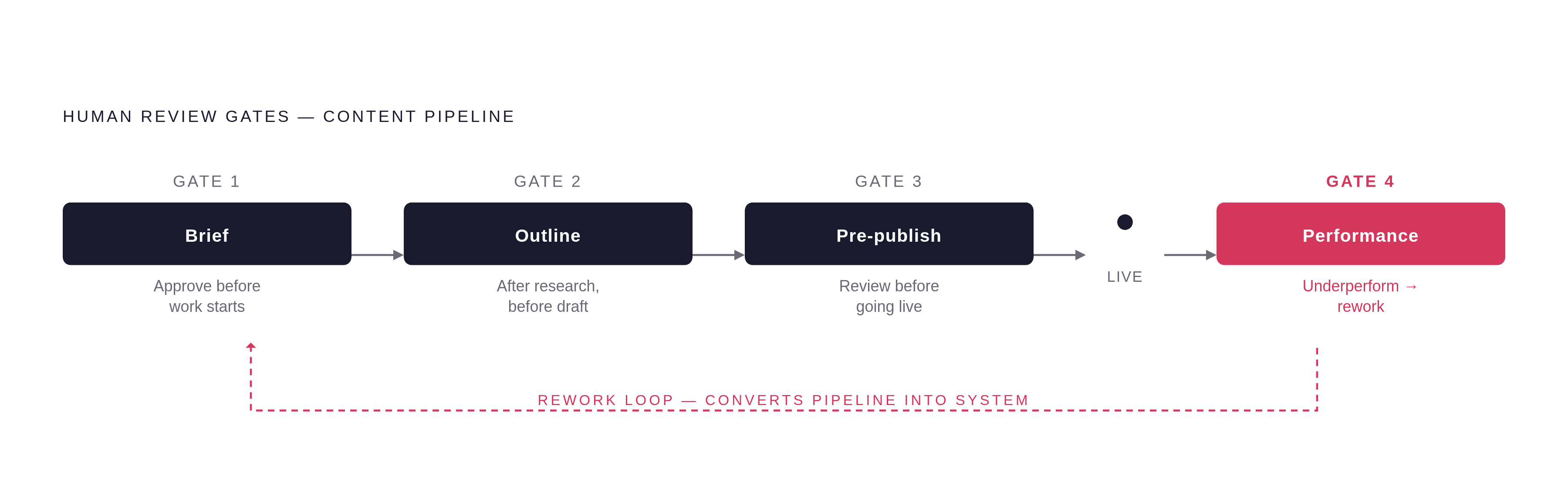
A single updated page, however well built, is a snapshot of a market that keeps moving, and the SaaS category moves fast enough that a position needs to be re-published, corroborated, and updated continuously to stay visible in AI answers. That requires a pipeline, not a project, and a pipeline that holds up needs four human review gates built into it: brief approval before any work starts, an outline check after research is done but before drafting begins, a pre-publish review before anything goes live, and a post-publish performance trigger that catches a piece that's underperforming and sends it back for rework. Volume without editorial judgment behind it is a liability on the brand, not an asset to it.
Speed and editorial quality don't have to trade off against each other here. A pipeline with real human review at each gate can outperform both a slow traditional agency and unreviewed AI output running at scale, because the system that publishes frequently can still produce work the brand is willing to put its name on. Standing watchers, automated systems that draft the moment something relevant happens in the category, are how a company satisfies Perplexity's recency bias without keeping a content team on permanent alert, watching for news that might or might not arrive on a given day.
Measuring whether the refreshed position is reaching buyers in AI answers
A positioning refresh needs a way to measure its reach, and the only way to know whether ChatGPT, Claude, Gemini, and Perplexity are actually naming and citing the brand is to measure it directly. Each requires its own instrument to track. An AI share-of-voice framework tracks brand citations across ChatGPT, Gemini, Perplexity, and Claude, producing a presence number: whether the brand appears at all, how often, in what context, and what it's being compared against when it does.
Because the four platforms don't share a single citation philosophy, measurement has to happen platform by platform. The pipeline exists to close that gap on evidence, not on instinct. A positioning refresh isn't a project with a finish line; it's a system that keeps a measurement layer running underneath it, telling the company exactly when the position needs to move again.