Value Proposition Canvas for AI-Powered Marketing Tools
Brand mentions in AI answers matter far more than backlinks in the new search era.

Most teams buying AI marketing software are still grading tools against a problem that no longer defines the market: ranking on a search results page. What buyers actually need now is to earn a citation inside an AI-generated answer, so a feature checklist or an analyst report is the wrong way to judge a purchase. The Value Proposition Canvas offers a sharper method, because it forces a buyer to line up a tool's gain creators and pain relievers against the real job-to-be-done before any feature gets credit for solving anything. Applied honestly, the canvas separates software built for how people searched a few years ago from software built for how people find brands now. That separation is the whole argument of this piece.
The actual customer job when buyer discovery starts in a chatbot
The job used to read: rank higher so a buyer clicks through to the site. Retrieval-Augmented Generation works in two steps: the AI search engine first pulls a set of candidate documents, then a large language model synthesizes those documents into one composed answer. Getting indexed is a precondition, not a guarantee of being used.
The signals behind that synthesis step differ from the signals that move organic rankings. Ahrefs studied 75,000 brands and found that brand mentions correlate with AI visibility far more strongly than backlinks do, and that cuts against a decade of SEO instinct built on link-building. The engines themselves don't behave as one category, either. Evergreen Media's GEO guide splits them into three types: training-based systems like Llama, which only shift through long-term digital PR and footprint; search-based systems like Google AI Overviews and AI Mode, shaped by real-time indexable content; and hybrid systems like Gemini and ChatGPT with search turned on, which need both approaches at once. A buyer's job-to-be-done is three jobs, one per engine type, and most AI marketing tools only cover one or two of them. Letterstory, an AI content and visibility platform, measures whether ChatGPT, Claude, Gemini, and Perplexity actually name and cite a brand, surfacing the citation outcome inside the canvas itself.
Similarweb's GEO guide lays out four outcomes that count as real GEO success: a citation with a source link, a brand name mention inside the response, positive sentiment, and a high share of voice across the prompts that matter to a category. Only a framework like the canvas makes that gap visible before money changes hands.
The ghost citation problem: why retrieval and recommendation are not the same job
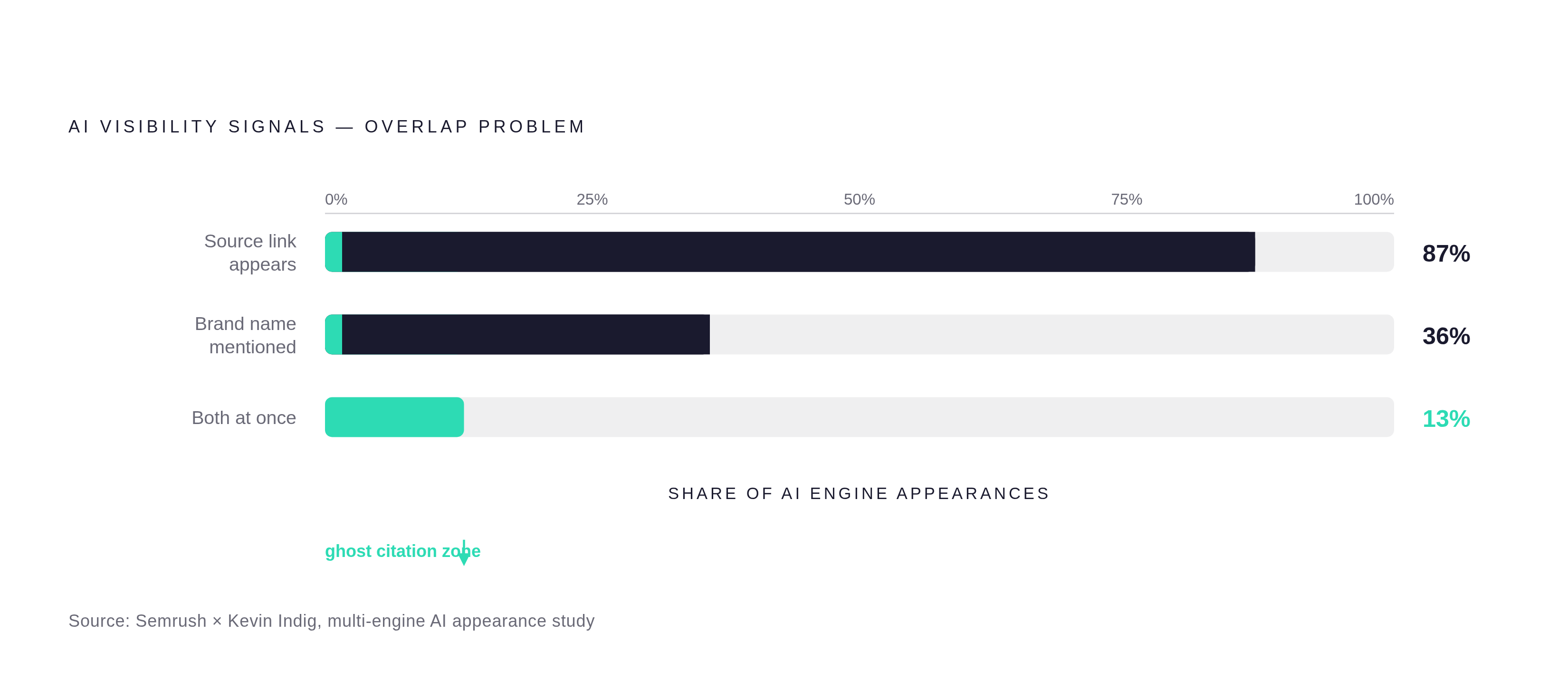
A brand can show up as a source link in most of the AI-generated answers relevant to its category while its name never gets spoken once.
Semrush and Kevin Indig studied thousands of domain appearances across multiple AI engines and documented the gap directly: a large majority of appearances included a source link, but a much smaller share included an actual brand name mention, and the two coincided in only about 13% of cases. A brand can be cited constantly by an AI system while the words a buyer reads never include its name. Retrieval without recommendation produces no awareness and no consideration no matter how often the URL appears in a footnote.
The two signals aren't independent of each other. Seer Interactive's analysis of LLM responses across multiple brands found that when a brand is mentioned by name, its citation rate runs many times higher than when it isn't mentioned at all, which makes mention the leading indicator and citation the lagging one. If a tool tracks only citation links, it overcounts a brand's real exposure to buyers by a wide margin, and that's a structural flaw in the tool's value proposition, not a data limitation to patch later. On the canvas, the buyer's real pain is not knowing whether a buyer who asks ChatGPT for a recommendation ever hears the brand's name, and only tools built to track mention separately from citation relieve that pain.
The Weakest Layer: A Brand's Own Website
Most brand mentions in AI search trace back to third-party pages, not the brand's own domain, so if a marketing tool's main output is more blog posts on the client's own site, it's largely solving a problem that doesn't move AI visibility. Several studies converge on that same finding: the large majority of mentions originate off-site.
Where those mentions originate depends heavily on which engine is doing the answering. If a tool ignores these platform-by-platform preferences, it can't map where a brand's actual content gaps sit, because the gap looks different depending on which engine you ask.
That pattern points to a two-layer architecture. The brand's own domain functions as a verification layer: AI engines check it to confirm claims that third-party sources have already made, but discovery doesn't happen there. On the canvas, the real gain creator for an AI marketing tool is building content and placing it into the third-party ecosystem AI engines actually draw their answers from, not publishing more pages on the client's own domain.
Structured Data and Technical Accessibility as Table Stakes
Structured data and AI-crawlability keep a brand from being excluded. They don't earn it a recommendation, and that difference matters because a tool that leads with crawlability as its main selling point is offering to prevent a loss, not produce a gain, which is a far weaker promise to build a purchase around.
The technical gap is measurable. Static HTML pages with schema markup get parsed successfully by AI crawlers at a far higher rate than dynamically-rendered pages, which fail to parse correctly most of the time, based on tracking data Erlin has compiled across more than 500 brands. The common failure points are specific and fixable: pricing and features pages rendered dynamically that AI crawlers read as empty templates, robots.txt files that accidentally block AI bots, and the absence of basics like llm.txt, FAQ schema, or comparison tables. On the canvas, technical accessibility relieves one bounded pain, being invisible because of a fixable technical barrier. It doesn't create the gain of being recommended. Tools that blur the two are solving a smaller problem than their marketing claims.
Multi-Stage AI Content Pipeline With Human Review
An AI content pipeline's value lies in publishing at the pace AI visibility requires while keeping the human judgment that makes content worth citing, with review built into the workflow from the start.
Some content jobs suit AI well: research briefs, outlines, first drafts, metadata, variants, repurposing existing material into new formats. AI-written content still has to be useful and accurate to justify publishing it at all; in a GEO context, volume without quality is a liability, because AI engines weigh a source's authority and trustworthiness before deciding whether to cite it.
Letterstory's architecture is a direct answer to that design problem. It runs standing watchers that draft content the moment a relevant event occurs, which addresses the volatility built into AI citation: staying visible takes continuous publishing, not a single optimization pass that's then left alone. Its pipeline automates the drafting stage but routes every piece through a structured review checkpoint before it ships, keeping each piece reviewable and reversible. On the canvas, a pipeline's real gain creator is defensible, citable content published at a pace that keeps a brand visible as the citation landscape keeps shifting, and a pipeline that skips structured human review fails that test no matter how fast it writes.
Measuring AI answer-engine citations as a discipline, not an afterthought
Without measurement built specifically for AI mentions and citations, a brand has no way to know whether its content spending is producing visibility in the answers buyers actually receive, and that blind spot makes every other capability a marketing tool claims to have unverifiable in practice.
Traditional analytics weren't built to see this traffic. The practitioner community has settled on a few core metrics instead. Similarweb's GEO guide names Share of Model as the headline number: the percentage of AI-generated responses, across a defined set of category-relevant queries, that include the brand. Tracking also has to tell citation apart from mention, because a source link and a spoken brand name are not the same signal, and that is the ghost citation gap described earlier. Sentiment matters at the platform level too: AI Overviews and ChatGPT surface negative sentiment at different rates, a fact that affects brand reputation management as much as raw visibility.
Measurement also exposes a timeline problem that causes most of the friction between practitioners and the executives funding this work. AI citation improvements don't move through the fast crawl-and-index cycles that traditional SEO relies on. The signal becomes visible only in model training cycles, so it takes longer to appear than most budget conversations are built to tolerate. On the canvas, a measurement layer relieves a specific pain: the inability to demonstrate ROI on GEO spending to people who control the budget. It's also the prerequisite for treating AI visibility as an engineering discipline, one where a team instruments the work, measures the result, and changes course on evidence, rather than running it as a faith-based marketing exercise and hoping the next quarter looks different.
Applying the canvas to evaluate specific AI marketing tools
Run the canvas criteria built across the sections above, citation tracking, off-site content distribution, structured human review, and platform-level measurement, against the tools currently on the market; the set that covers the full picture turns out to be much smaller than the marketing around this category suggests.
Letterstory addresses the full two-layer architecture directly: phantom sites that build the off-site footprint where AI engines source their citations, paired with client blogs that serve the verification-layer function on the brand's own domain. Its standing watchers draft content the moment a relevant event occurs, which addresses the citation volatility described earlier: staying visible takes continuous publishing, not a single optimization push. The pipeline runs AI drafting through structured human review at each checkpoint, so output stays reviewable and reversible before it ships, and that matches the human-in-the-loop principle the canvas treats as the real gain creator, not a nice-to-have. Its measurement layer tracks whether ChatGPT, Claude, Gemini, and Perplexity actually name and cite the brand, distinguishing mentions from citations and closing the ghost citation gap.
Yotpo Discover is described by Yotpo as a commerce-native AI visibility platform built for retail merchants, turning visibility audits into automated actions across technical codebases, review-grounded blog content, and third-party validation networks. The sources reviewed don't show a measurement layer tracking named mentions across ChatGPT, Claude, Gemini, and Perplexity the way Letterstory's does.
Brandi AI positions itself as an enterprise AI visibility and GEO platform, emphasizing measurement formalization and giving CMOs actionable recommendations on AI-driven visibility. It covers the measurement and brand-narrative dimensions of the canvas well, fits mid-market and enterprise buyers, and places less weight on the content production pipeline.
What the Completed Value Proposition Canvas Reveals
Running the canvas to the end surfaces a pattern: most AI marketing tools are built to deliver the gain of "more content, faster," even though the customer's actual job has become "be the brand an AI names. Those two things diverge enough that a team using the wrong tool will stay busy and still be invisible to the buyers asking an AI for a recommendation.
The canvas earns its keep here by forcing one question before a dollar gets spent: which pain is this tool actually relieving. In this category, the answer to that question is what separates tools built for AI-era visibility from tools built for the old search era and repainted with GEO language. The sharpest objection to all of this is the timeline. AI citation improvements move slowly, through model training cycles for systems like Claude, and through crawl-and-index cycles for systems like ChatGPT Search, Perplexity, and Google AI Overviews, so measurement taken over a short window will show little or no movement even when the underlying work is sound. A team unfamiliar with that pattern will read a working strategy as a failing one.
That's precisely why mention-level measurement, paired with a continuous publishing cadence, matters as much as it does: those are the instruments that make an investment legible over the timeline the engines actually run on, the timeline a quarterly report rarely accommodates. If you treat AI visibility as an engineering discipline, you instrument it with the right metrics, publish on a cadence that matches how these engines update, and review evidence before changing course when a single month looks flat. The Value Proposition Canvas is the tool that checks whether the instrument a marketing team just bought actually matches the job it was bought to do.