Competitive Intelligence Workflows for Content Strategy Teams
AI now decides which brands get seen before anyone clicks.

A content team watches its rankings hold steady for months: page one on the terms that matter, click-through rates in line with historical averages, nothing in the dashboards that signals trouble. Then someone asks ChatGPT which vendors to consider in that same category, and the brand doesn't appear. The rankings were never wrong. They were just measuring a surface that no longer accounts for where a growing share of buyers now begin.
That surface shift is structural. Daily AI search users in the U.S. reached 29.2% by August 2025, nearly double the figure from February of that year, and buyers increasingly start research inside ChatGPT, Claude, Gemini, and Perplexity. These tools return synthesized answers before you ever click through to a website, so brand discovery now happens inside the AI experience itself. A brand that isn't cited, mentioned, or referenced in that answer is absent from the decision regardless of how it performs on Google.
Traditional competitive intelligence, built on keyword share, backlink profiles, and SERP position, has no mechanism for catching this. Those metrics describe one channel in detail, but they leave an entire parallel channel unmonitored. Content teams now need to track three distinct surfaces at once: SEO, meaning traditional rankings on Google and Bing measured by organic traffic and click-through rate; AEO, or Answer Engine Optimization, meaning citation as a direct answer inside Google AI Overviews, ChatGPT, and Perplexity, measured by citation and inclusion rates; and GEO, Generative Engine Optimization, meaning citation and source inclusion inside AI-generated summaries from ChatGPT, Claude, and Gemini. Conductor's AEO/GEO Benchmarks Report describes this as a "parallel surface of visibility, an invisible layer that determines which brands are seen before anyone clicks. The rest of this piece concerns what it takes to actually watch that layer, and how to turn what it shows into content decisions.
How AI Answer Engines Decide Which Brands to Cite
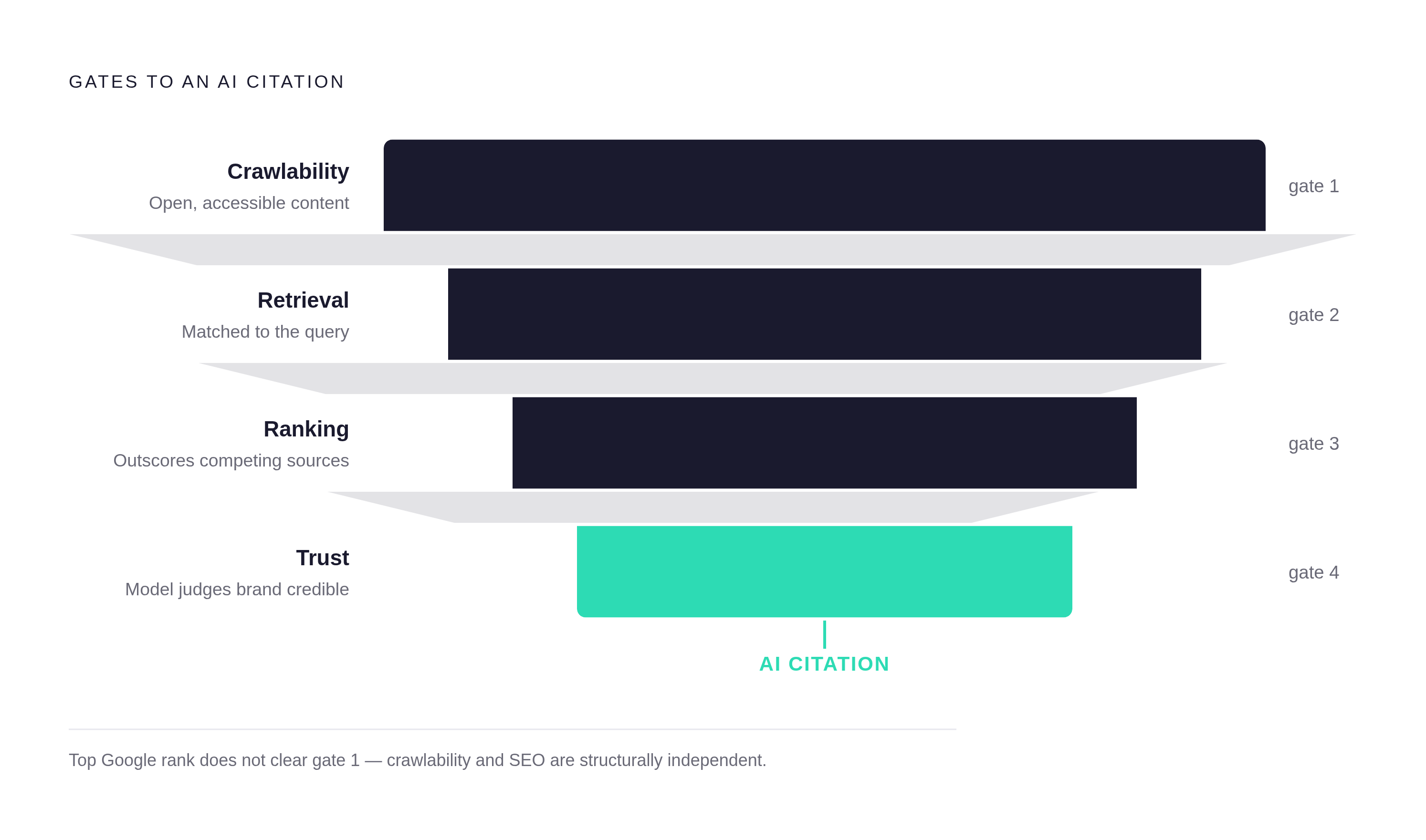
AI citation operates on its own logic, and a brand has to clear several independent gates before an answer engine will name it. Most of those gates have nothing to do with domain authority or keyword density. The instincts content teams built for Google often fail to predict AI outcomes.
Many AI systems ground their answers in external knowledge sources through Retrieval-Augmented Generation, so they don't generate responses purely from what the model learned in training. That makes crawlability and retrievability the first gate a brand has to pass, well before anything resembling a ranking factor comes into play. Content locked behind a login, a paywall, or an accordion dropdown is invisible to an AI crawler no matter how authoritative it is. From there, a piece of content has to be retrieved for the specific question being asked, survive a ranking step against competing candidate sources, and finally prove trustworthy enough for the model to name the brand. Four gates, in sequence, and a brand can fail at any one of them.
Google Gemini, the OpenAI models behind ChatGPT (and, in part, behind Copilot, which also draws on Anthropic Claude and other models), Claude itself, and the models powering Perplexity each pull from different training data and apply different retrieval and citation logic. A strategy tuned for one platform doesn't transfer cleanly to the next, so multi-platform optimization is a requirement, not a nicety. A meaningful share of AI-cited pages don't rank in the organic top 10 at all, so AI visibility and search ranking are genuinely separate outcomes, and each needs its own strategy to win.
For competitive intelligence specifically, this changes what's worth watching. Tracking what a competitor ranks for on Google says nothing about what an AI engine will say about that competitor when a buyer asks. A competitor can dominate AI answers while holding only modest organic rankings, or it can sit on page one of Google and never get named by ChatGPT. Either outcome is invisible to a CI program still built around keyword share.
What a modern CI workflow actually needs to track across AI answer engines
Closing that blind spot requires a defined set of metrics most content teams haven't started collecting: share of model, citation consistency, and off-domain mention patterns, tracked separately for each AI platform.
Mention frequency comes first: how often a given brand, yours and each named competitor, appears in AI responses for the queries that matter to the business. From mention frequency comes share of model, the comparison of a brand's mention rate against named competitors within the same query category. This is the leading competitive indicator in this new discipline, functionally equivalent to share of voice in the SEO world but measured inside the answer. Citation consistency asks a narrower question: does the brand show up reliably across repeated runs of the same query, or does it appear once and then vanish? Visibility that appears in one run and not the next isn't a durable competitive position, it's noise, and a CI workflow built on a single snapshot can't tell the difference.
Off-domain mention patterns identify where competitor citations actually originate, which third-party platforms, publications, and forums are feeding the engines that name them. Sentiment of attribution rounds out the set: what claims the AI engine actually makes about a brand when it cites it, since accuracy and framing carry as much weight as the fact of being mentioned.
Each of these needs to be tracked per platform, because Google Gemini, OpenAI's GPT, Anthropic Claude, and Perplexity (which runs its own Sonar models alongside a multi-model picker spanning GPT, Claude, Gemini, and Grok) draw from different training data and apply different retrieval and citation behavior. A brand's share of model on ChatGPT can look nothing like its presence in Google AI Overviews, and a CI program that averages across platforms will miss both stories. The consistency problem rules out periodic manual spot-checks as a methodology; establishing whether a competitor's AI presence is durable requires repeated, systematic querying over time, not a quarterly screenshot.
Two starting points exist for teams building this out today. Google Analytics 4 can be configured to segment referral traffic from AI platforms, filtering sessions where the source contains "perplexity.ai," "chatgpt.com," or "claude.ai," confirming when a citation is actually generating downstream visits. Microsoft's Bing AI Performance Dashboard, public since February 10, 2026, adds a first-party layer of citation and grounding query data, though Microsoft itself notes that its grounding queries figures reflect only a sample of overall citation activity. Both are useful instruments. Neither is a substitute for the workflow that turns what they show into something a content team actually does.
Structuring a CI Workflow That Turns AI Citation Signals Into Content Decisions
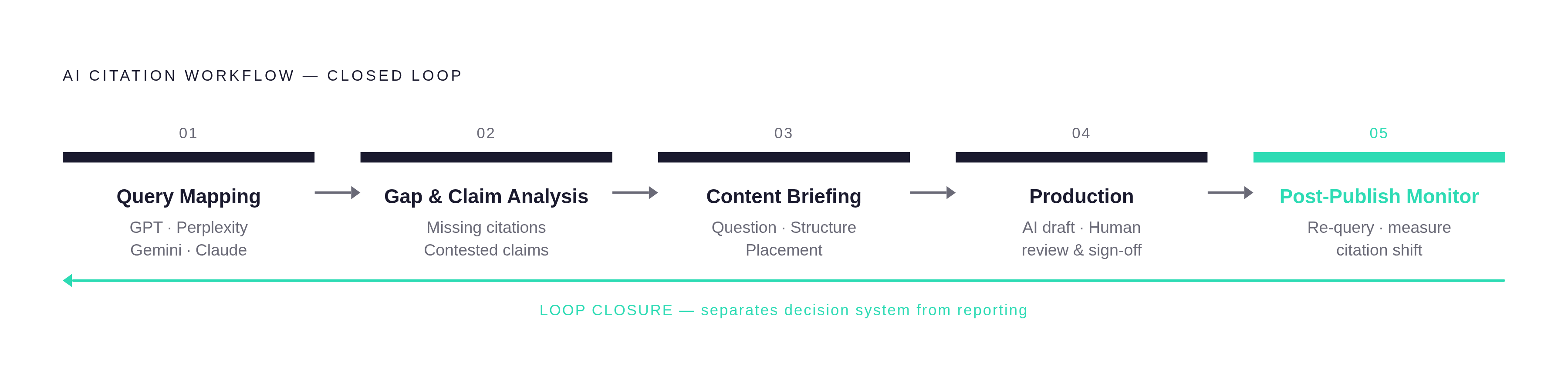
Monitoring citation signals without a decision loop attached to them produces reporting, not intelligence. The value of tracking share of model and citation consistency only materializes once those numbers route into a defined process that ends in a content brief.
That process starts by inverting the old research sequence. In the SEO era, you found keywords with search volume, built content around them, and optimized for ranking. The 2026 approach starts by asking what AI platforms currently answer when a target query is asked, identifying where those answers are thin, wrong, or missing a competitor's name entirely, then building content specifically to close that gap and structuring it for AI extraction from the first draft. Querying ChatGPT, Perplexity, Gemini, and Claude before a single word gets written, and documenting exactly which sources get cited for each target query, functions as a competitive research step now, not a final check before publishing.
A five-stage structure carries that research into finished content. Query mapping comes first: running target queries systematically across each AI platform and documenting which competitors get cited, from which sources, and with what specific claims attached. Gap and claim analysis follows, identifying the queries where competitors appear and the brand doesn't, and flagging claims AI engines attribute to competitors that the brand could either substantiate with its own data or contest with better evidence. Content briefing translates those gaps into briefs built around the question to answer, the structure required for the content to be extractable, and the off-domain placement the topic needs. Production follows as a multi-stage process: AI pipelines handle drafting at scale, with human review built in at strategy approval, source validation, editorial refinement, and publication sign-off, not reserved for a single proofread pass at the end. Post-publish monitoring closes the loop: you re-query the same target queries after publication to see whether the new content actually shifted citation patterns, because facts go stale and AI visibility moves with them.
The cadence matters as much as the stages themselves. Standing watchers that draft the moment something relevant changes, a competitor earning a new citation cluster, an AI engine shifting its sourcing pattern, outperform periodic manual audits because the gap between a competitive shift and a content response stays small. Letterstory runs a version of this operationally: standing watchers that draft on a trigger, multi-stage AI pipelines paired with human review at each of the checkpoints above, and a measurement layer that tracks whether ChatGPT, Claude, Gemini, and Perplexity actually name and cite the brand. The design goal across each stage is the same: the system that publishes at scale still has to produce work worth publishing, and human review at the right checkpoints is what keeps that true.
What content architecture makes a brand citable, and what blocks it
You have to build content that earns AI citations differently than content built for traditional SEO, specific enough to design around, not a vague matter of quality or depth.
AI systems favor clean, self-contained answer blocks. Long, unstructured paragraphs without a clear question-answer pattern are difficult for a model to extract and cite reliably. You need question-led headings, short answer blocks, and sections that stand on their own without requiring the surrounding context to make sense; that's the structural floor, not a stretch goal. Heavily cited content tends to average shorter, cleaner sentences with frequent H2 and H3 structure running through it, and document length itself varies meaningfully by platform: Copilot skews toward shorter documents, while Gemini skews toward longer ones, so no single content length optimizes across every engine a brand needs to reach. Technical accessibility closes out the structural requirements: content locked behind a login, a paywall, or an accordion dropdown stays invisible to an AI crawler no matter how well it's written, so anything meant to be cited has to live in the plain HTML.
Practitioners building for this are running two tracks simultaneously. The first is owned content optimized for extraction: definitional content, entity relationship pages, and brand authority material that helps an AI system understand who the brand is and what it's known for, distinct from the commercial category pages built to convert a Google searcher. The second track is off-domain seeding. Because most AI citations originate off the brand's own domain, the bulk of the actual citation-earning work happens on third-party platforms: review sites like G2 and Capterra, industry publications, niche forums, and a genuine presence on Reddit and Quora, the kinds of sources large language models treat as trustworthy by default.
An entity consistency requirement applies to both tracks, and overlooking it costs you. A brand's name, description, founding year, and services need to match exactly across its website, LinkedIn, industry directories, and, where applicable, Wikipedia and Wikidata. When those sources drift apart, they create ambiguity, and AI systems tend to resolve it by declining to cite either version. The payoff for getting this right is substantial: branded web mentions correlate with AI visibility at roughly three times the strength of backlinks, which makes the off-domain seeding track a primary lever for citation, not a supplementary one. Pages that address the full cluster of related sub-queries a model generates while building an answer, rather than just the single primary query a keyword tool would surface, are also significantly more likely to get cited, since they match more of the ground the model is trying to cover in a single response.
Where most CI programs miss the off-domain citation layer, and how to close that gap
The brands winning the most AI citations are usually winning them on someone else's platform, not their own, so a CI program that only watches competitor domains never sees what actually produces those results.
Third-party platforms, not brand-owned pages, are the most-cited sources inside AI Overviews and generative answers, so a competitor's entire AI presence can rest on review sites, industry forums, and editorial coverage that never touches their own domain. A CI program auditing only a competitor's website and backlink profile will conclude that competitor has a modest footprint, while the AI engines that buyers are actually consulting tell a very different story.
Closing that gap starts with review platform presence: tracking which competitors show up prominently on G2, Capterra, and comparable platforms, and whether their listings are complete and accurate enough to be the kind of source a model is willing to cite. An analysis of 30,000 commercial searches found that Gartner Peer Insights, G2, and Capterra remain among the five most-cited sources overall, with language models relying on them specifically for structured product information, user reviews, pricing, and feature comparisons. A competitor with a thin or outdated G2 listing is handing an AI engine less to work with than one with detailed, current reviews, and that gap appears directly in citation frequency regardless of either brand's organic rankings.
A complete off-domain watch extends from there to forum activity, editorial coverage, and the broader pattern of branded mentions accumulating across the web, each platform weighted by how often it turns up as a cited source. Building that watch alongside the owned-domain tracking most CI programs already run is what turns competitive intelligence into a view of the actual landscape buyers are navigating, rather than a map of only the half of it that was already familiar.