A/B Testing AI-Generated Content Against Human-Written Variants
AI content wins early, but human writing compounds its advantage over six months.

Testing whether AI-generated content beats human-written content produces results that mislead rather than inform, because it is the wrong question. For several years, the debate ran almost entirely on anecdote: one agency would publish a case study showing an AI-drafted page climbing to position one, another would post a screenshot of traffic collapsing after a bulk AI upload, and neither side controlled for the variables that actually decide search performance. A six-month SERP tracking study changed that by pairing 200 articles across 14 publishing domains, matching each pair on domain, publish week, internal-link template, topic specificity, and word count band, so that authorship became the only variable left to explain the difference in outcomes. What that controlled comparison shows is not a clean winner but a pattern that shifts over time and across content types: AI wins early, human content wins as time passes, and hybrid content beats both. That finding turns the old debate into a more useful one, not which approach is better, but which stage of a content pipeline each is actually suited for.
The first-lap advantage for AI content
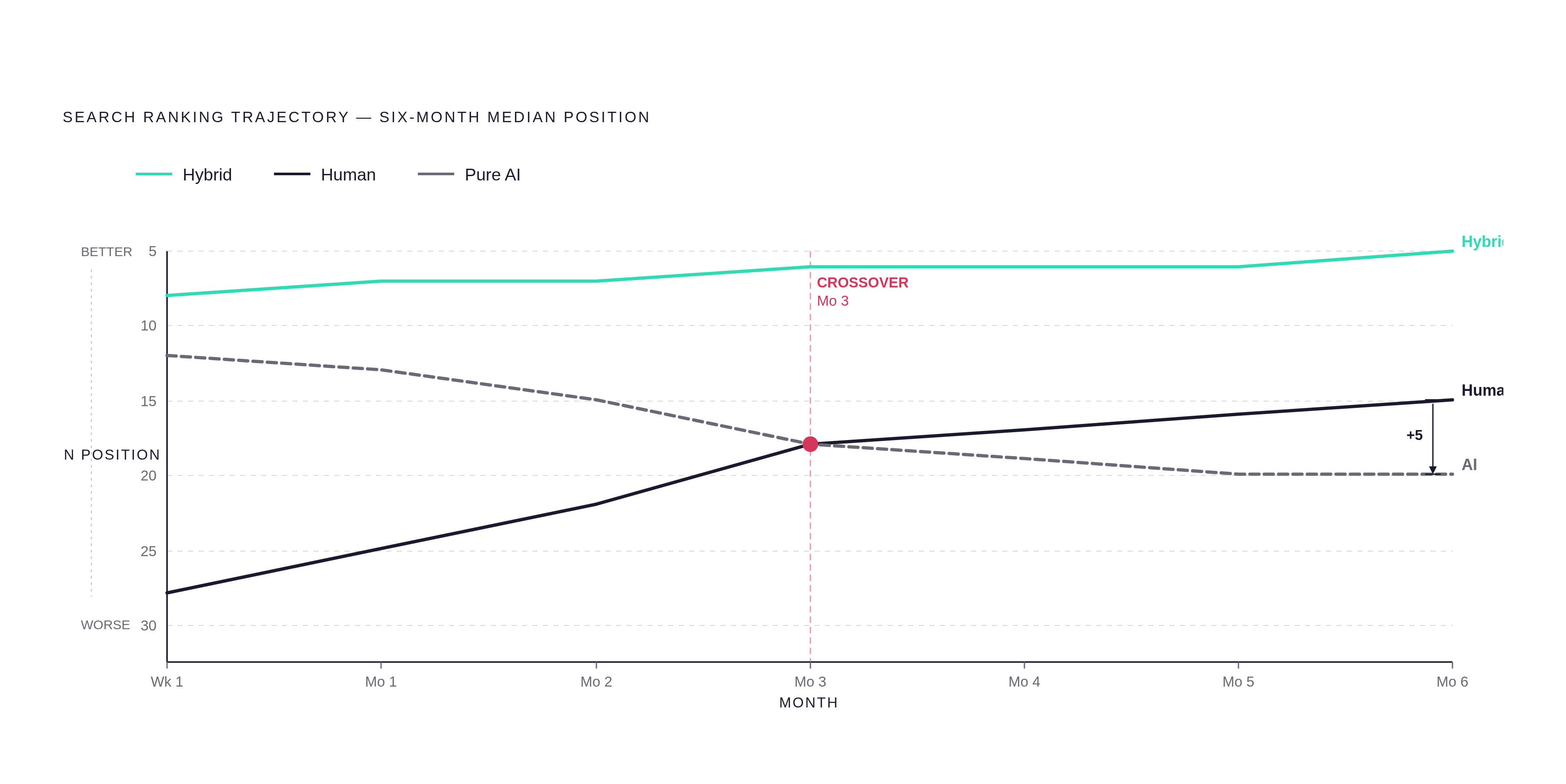
AI-generated content does start ahead, and the advantage is measurable rather than anecdotal: across all 14 tracked domains in the paired study, AI articles posted a better median search position than their human-written counterparts in week one. That early lead comes from production mechanics, not content quality. None of that depends on whether the sentences inside the article say anything worth reading. The advantage does not last because of what happens after week one.
By month three, the trajectories cross. By month six, the gap has not just closed, it has reversed, with human content holding a five-position median advantage over its AI-written pair. The mechanism behind that reversal appears in engagement and link behavior: pages that hold a reader's attention, answer follow-up questions, and get referenced by other publishers continue to climb, while pages that were built to look complete on day one but say little new tend to flatten out or fall back.
The size of the gap depends heavily on content type. It falls furthest behind on opinion pieces, commentary, and product reviews, the formats where a reader is explicitly looking for a point of view or a lived account that no amount of pattern-matching can manufacture.
Human content's durable edge: SERP features, backlinks, and AI answer pickup
Some parts of search results show a bigger gap between AI and human content than others. In the paired study, human-written content captured featured snippets and People-Also-Ask panels at meaningfully higher rates than AI content on the same domains, under the same structural controls. Google's answer-box logic rewards content that resolves a question with precision and context, and those qualities come from depth of explanation, not from how fast a page got indexed.
Backlinks follow the same shape and matter more over time because they compound. Over the six-month window, pure, unedited AI content built up far fewer backlinks than human-written content did, but AI-assisted content that went through human editing closed much of that distance. The same pattern turns up downstream in revenue terms: in the study's B2B demo-request data, human content converted visitors to demo requests at roughly twice the rate of AI-only content, suggesting the trust or clarity that drives a reader to act follows the same structural qualities that drive search performance.
A separate but related measurement sharpens why this matters beyond conventional rankings. The disagreement itself is instructive: citation behavior inside AI-generated answers does not move in lockstep with traditional ranking signals, and it is exactly the surface the rest of this argument turns on.
Why hybrid content outperforms both
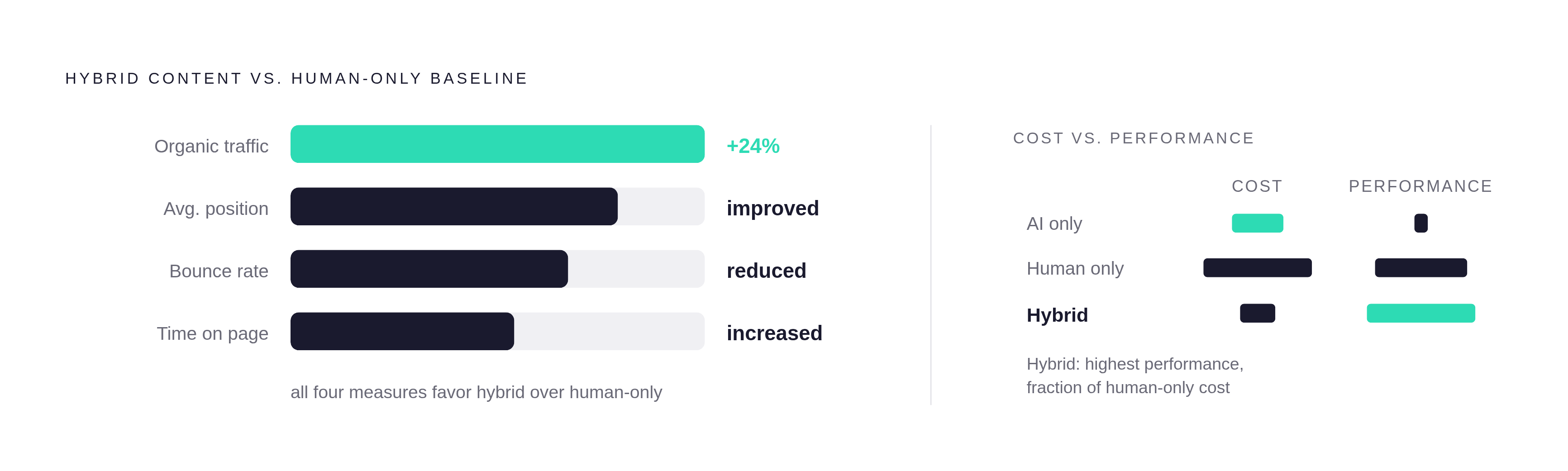
Hybrid content, AI-drafted and then edited by a person, is not a middle position between two extremes. It functions as a distinct kind of output, built by combining what each contributor does well at the stage where it matters most, and it beats both pure AI and pure human writing on SEO metrics as a result. Research into hybrid AI-human workflows found hybrid content outperformed a human-only baseline on four measures at once: organic traffic, where the hybrid group drew 24% more traffic, along with average position, bounce rate, and time on page.
Human editing contributes qualities that a model cannot generate on its own: depth of argument built across paragraphs rather than restated within them, a first-party point of view, coherence that holds across a long piece rather than within isolated sections, and specificity, named sources, concrete examples, original quotes, the exact material that earns backlinks and wins SERP features. AI contributes something different and equally necessary at scale: structural consistency across a large volume of pages, faster initial indexing, cleaner application of schema markup, and a publishing cadence steady enough to read as recency to search crawlers. Neither contribution substitutes for the other; each solves a problem the other does not.
Engagement data gathered across multiple studies backs this up from a different angle: content that is AI-drafted and then humanized through editing draws substantially more traffic on average than content left untouched after generation. The economics reinforce the structural case. Pure, unedited AI output is the cheapest to produce but performs worst on the metrics that matter. Pure human writing performs well but costs the most, in time and in dollars. AI-drafted content with human editing lands in the highest-performing tier of all three while costing a fraction of what pure-human production requires, which is the combination that makes hybrid the economically dominant choice, not just the technically superior one.
Multi-stage pipelines that produce hybrid content holding up under scrutiny
Not all hybrid content performs the same: performance depends on where in the production process a human actually intervenes. If a team treats human review as a final polish, just a quick read-through before publishing, the content it produces tends to perform closer to unedited AI output than to the high-performing hybrid tier described above. The position of the human checkpoint in the pipeline, not just its presence, decides the outcome.
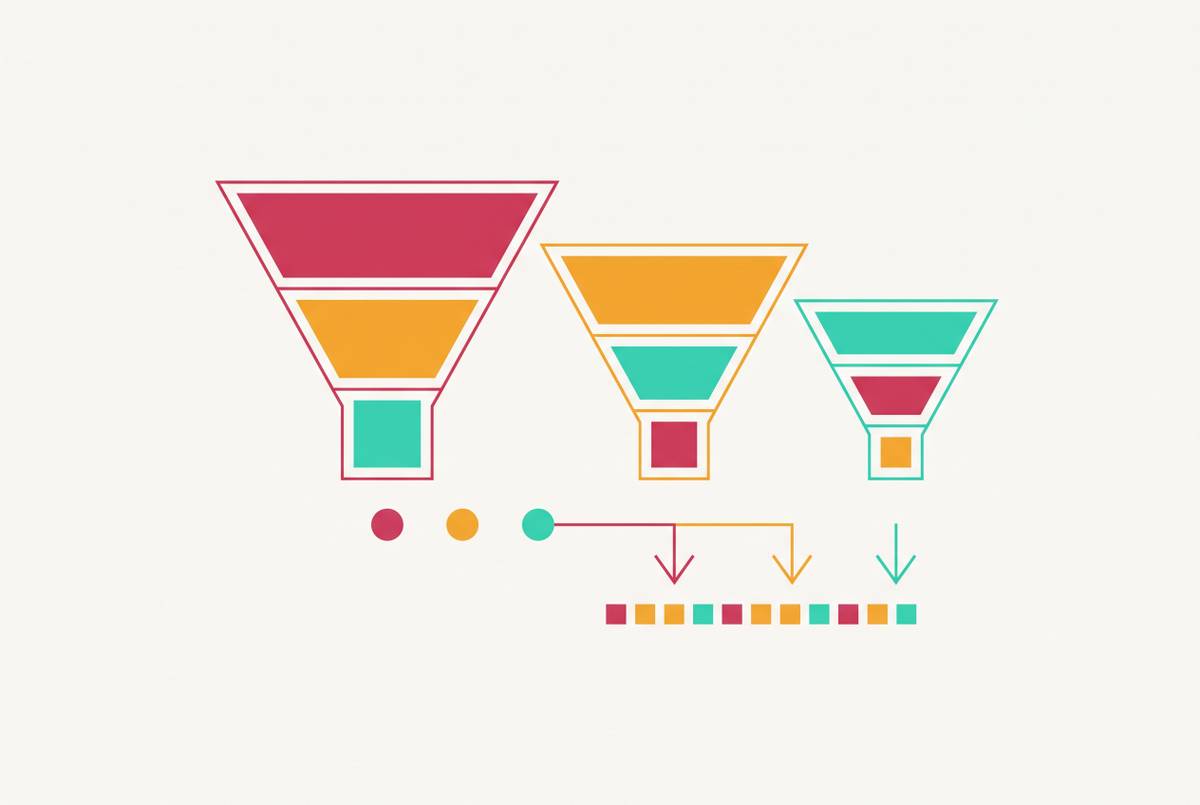
A useful technical reference for this comes from outside the marketing world. The result matters here because it confirms, from NLP research rather than marketing case studies, that decomposing generation into stages with review gates between them produces measurably better output than generating a finished piece in one pass.
The most common failure mode in content production is the one-shot approach: a single prompt asked to produce a complete, publication-ready article. Factual accuracy tends to break down at exactly this step. Fabricated statistics, invented quotes, and citations that point to sources that never said what they're credited with saying all enter the content here, and they're difficult to catch once they're embedded in otherwise plausible-sounding prose. Human review gates work best placed at two points in the pipeline rather than one: before drafting, where a person selects and pre-loads verified sources rather than letting the model guess at them, and before publication, where a person audits the citations in the draft against those same verified sources. The ability to review, revise, or reject AI output at each of these stages functions as a prerequisite for publishing at scale without accumulating a backlog of inaccurate claims that erode reader trust and invite search engine penalties once discovered.
The AI answer-engine dimension: why hybrid content's citation gravity matters beyond Google
Traditional SEO metrics, rankings, snippets, backlinks, capture only part of the gap between hybrid and pure AI content. The larger and more consequential gap sits on AI answer-engine surfaces, where a different set of signals decides whether a brand gets named. AI Overviews now appear in close to half of all searches, up sharply from their share in late 2025. Tracking AI citations is a baseline measurement for any content program.
Citation behavior varies enormously by platform, and the variation is large enough to change strategy on its own. Measuring AI visibility therefore requires tracking each platform on its own terms: the same page can perform well on Perplexity and go unnoticed on ChatGPT, and a brand can be used as a source of information inside a generated answer without ever being named in the response a reader sees.
The qualities that drive hybrid content's advantage in traditional search, depth, named sources, specificity, the kind of citation gravity that earns backlinks, are the same qualities AI answer engines weigh when deciding what to cite. That overlap is not a coincidence; it reflects that Google's generative features and standalone AI engines both draw authority signals from the same underlying properties of the content itself. The brands that show up reliably are the ones with the broadest and deepest footprint of retrievable content across many pages, not the ones that optimized a single page and stopped. Tools built specifically to track whether ChatGPT, Claude, Gemini, and Perplexity actually name and cite a brand, Letterstory's measurement layer is one example, give content teams the only honest way to see this variation rather than assume a single ranking number tells the whole story.
The third-party citation layer that most A/B tests never measure
Most A/B tests of AI versus human content measure performance on a brand's own website, so they miss the surface where most AI citations actually originate. The majority of citations that ChatGPT, Gemini, and Perplexity pull into their answers come from third-party earned sources rather than from a brand's own domain, which makes owned-site optimization alone an incomplete strategy no matter how good the content on that site is. Claude is the exception: first-party brand sites account for the majority of its citations, even as a brand's own site contributes only a small share once all four engines are averaged together.
A controlled study measured just how large that distribution effect can be: moving the same piece of content from a brand's own site to third-party news outlets produced a 325% increase in citation rate, taking the rate from a low baseline to a substantially higher one through distribution alone, with no change to the underlying writing. The practical architecture that follows from this runs on two surfaces working together. One is an owned ground-site, a single, structured, current, and machine-readable source of facts about the brand that AI systems can retrieve cleanly. The other is a third-party earned layer, profiles on review platforms, presence in discussion forums, coverage in news outlets, that builds the citation density AI engines actually favor when selecting sources. Recency plays a role on both surfaces: pages updated recently draw substantially more AI citations than stale ones, and on some platforms, notably ChatGPT, longer and more substantive pages outperform thin ones, though that advantage depends on the platform and doesn't hold evenly across every AI citation surface. Both effects reward the publishing cadence and editorial depth that a hybrid pipeline produces as a matter of course.
The sharpest illustration of why this layer needs its own measurement is the failure mode where a brand gets cited as a source but never named in the generated answer a reader sees. A brand can supply the facts behind an AI response and still receive none of the visibility that would normally come with being recognized as the source. Mention tracking and citation tracking are two different measurements. Platforms built around a phantom-site or ground-site content strategy address the owned layer of this problem directly, but you need a separate measurement layer to catch the gap between being cited and being named.
A practical A/B testing framework for hybrid content
Everything above points to a specific measurement framework, not a vague instruction to "test AI against human." Any paired test worth running should match articles on domain, publish week, internal-link template, topic specificity, and word count band, the same controls the six-month SERP study used, so that authorship and editing process are the only variables left to explain a difference in outcome. Within that structure, a few metrics carry more weight than the rest.
The study shows AI and human content cross paths between month one and month six, so position trajectory over six months affects which variant looks better. You should track featured snippet and People-Also-Ask capture rates separately from general ranking position, since the gap there is wider than the gap in median position alone. Backlink accumulation needs measurement on a rolling basis rather than once at the end, because its effect compounds. Conversion data, demo requests, signups, whatever the relevant action is for a given business, should get tied back to content variant directly.
Beyond those traditional metrics, a complete framework has to include AI answer-engine citation tracking, broken out by platform rather than averaged across ChatGPT, Claude, Gemini, and Perplexity, since the cross-platform research shows those four systems draw from substantially different knowledge bases. That tracking should distinguish between a brand being cited with a link or clear attribution and a brand being mentioned without one, given how different those two outcomes are for actual visibility. And because most AI citations arrive through third-party sources rather than a brand's own site, a framework that measures owned-site performance alone will underestimate the real effect of a content program and miss the surface where the biggest gap between hybrid and pure AI content shows up. Platforms that handle AI drafting and human review within a single pipeline, Letterstory structures its process so that a person accepts or rejects each AI suggestion before anything publishes, have made running this kind of layered, accountable process practical at scale, rather than a manual effort limited to a handful of flagship pages. Content teams that build their testing around this fuller set of surfaces, not just rank and traffic, will end up measuring the thing that actually decides whether a brand gets found in 2026 and beyond.