Funnel Analysis Tools Compared for B2B Content Teams
B2B buyers now research in the dark funnel, where conventional analytics can't see them.
A buying committee at a mid-market software company can spend three weeks comparing vendors before a single salesperson even knows the deal exists [1][2][3]. One person asks ChatGPT to compare two categories of tools, another reads a Reddit thread about implementation headaches, and a third asks Claude to summarize a vendor's pricing page against a competitor's [1][2][3]. None of this produces a server-logged click. By the time that committee fills out a form or books a demo, the vendor shortlist is already set, and the research that set it left no trace in anyone's analytics stack.
That is the condition B2B marketing teams are operating under in 2026, and it is not a tooling problem so much as a modeling problem. The funnel, as a concept, assumes a linear sequence of measurable actions: awareness, consideration, conversion, each stage legible because each stage produces a click a server can log. B2B buying has never really worked that way, but the gap between the model and the reality used to be small enough to ignore. It no longer is. Buying committees research collaboratively, compare vendors across channels that were never designed to report back to a CRM, and increasingly resolve their research inside an AI answer rather than across a sequence of web pages.
The "dark funnel," the pool of buyer research happening on review sites, in private peer communities, and inside AI answer engines without ever surfacing in attribution data, is now a structural feature of how B2B deals get made rather than a measurement edge case. A content team can run the most sophisticated funnel analysis available, and it can still miss the phase where the vendor shortlist got decided. The rest of this piece works through why that is, which tools cover which part of the problem, and what a content operation built to see the whole picture actually looks like.
What conventional funnel tools were built to measure
Establishing what the existing funnel stack does well matters before diagnosing what's missing, because none of it is poorly built for its intended purpose. The confusion starts earlier than most teams realize: a B2B content team searching for "funnel analytics" tools often lands first in product analytics platforms, a category built around a B2C or product-led growth user model that doesn't map cleanly onto a multi-stakeholder enterprise buying committee.
Product analytics platforms, the category that includes Mixpanel, Amplitude, Heap, and PostHog, were designed around individual user behavior inside an application: button clicks, feature usage, activation flows. Their unit of measurement is the individual user, not the buying committee or the account, which makes them an excellent fit for product-led growth teams trying to understand in-app activation and feature adoption, and a poor fit for teams trying to reconstruct how a seven-person buying committee arrived at a vendor decision.
Session-replay and on-site behavior tools, the category that includes Hotjar and FullStory, solve a narrower and different problem. Through heatmaps, session recordings, and on-page funnels, they surface exactly where a visitor hesitates, scrolls past, or abandons a specific page. So a team optimizing a particular page flow or diagnosing a UX friction point gets real value from them, no matter where AI fits into the buying journey.
Marketing attribution platforms, the category that includes Dreamdata, HockeyStack, and Factors.ai, answer a different question again: which channels produced identified pipeline and which produced closed revenue. These platforms are built for B2B revenue teams who need to connect channel spend to pipeline contribution across sales cycles that can run many months, and they do that job well.
Experience intelligence platforms like Contentsquare combine several of these functions into one system, pairing behavioral analysis, session replay, and heatmaps with funnel drop-off visualization and revenue impact quantification, connecting aggregate drop-off rates to individual sessions and the revenue tied to them. Each of these categories solves a real, well-defined problem. None of them was built to answer whether a buyer's research ever touched the brand at all before that buyer became a session.
The specific measurement layer every tool above leaves empty
Every tool described above shares one load-bearing assumption: a measurable human action, a click, a session, a form fill, connects each stage of the funnel to the next. That holds as long as buyers move through web pages in a sequence a server can observe. It breaks the moment a buyer's research resolves inside an AI answer, with no click generated.
This is not a missing integration that a plugin or a custom dashboard can patch. You need a different measurement primitive to track agentic and AI-generated research, because the systems producing that research were never built to report back to a web analytics stack. The primitive that's missing is citation: whether an AI answer engine names and links a brand when a buyer asks a relevant question, and whether that citation is actually producing downstream traffic worth measuring.
Partial workarounds exist, and understanding them means understanding exactly where they fall short. GA4 can serve as a downstream signal by filtering sessions on referral source, using a custom regex on session source to catch clicks that do originate from platforms like Perplexity, ChatGPT, or Claude. But a meaningful share of AI-originated clicks, especially from mobile apps, strip the referrer entirely, so they show up as Direct traffic, invisible to that filter. Even where the filter works, it only catches buyers who clicked through to a site. It says nothing about the much larger group whose question got fully answered inside the AI response, with no click generated.
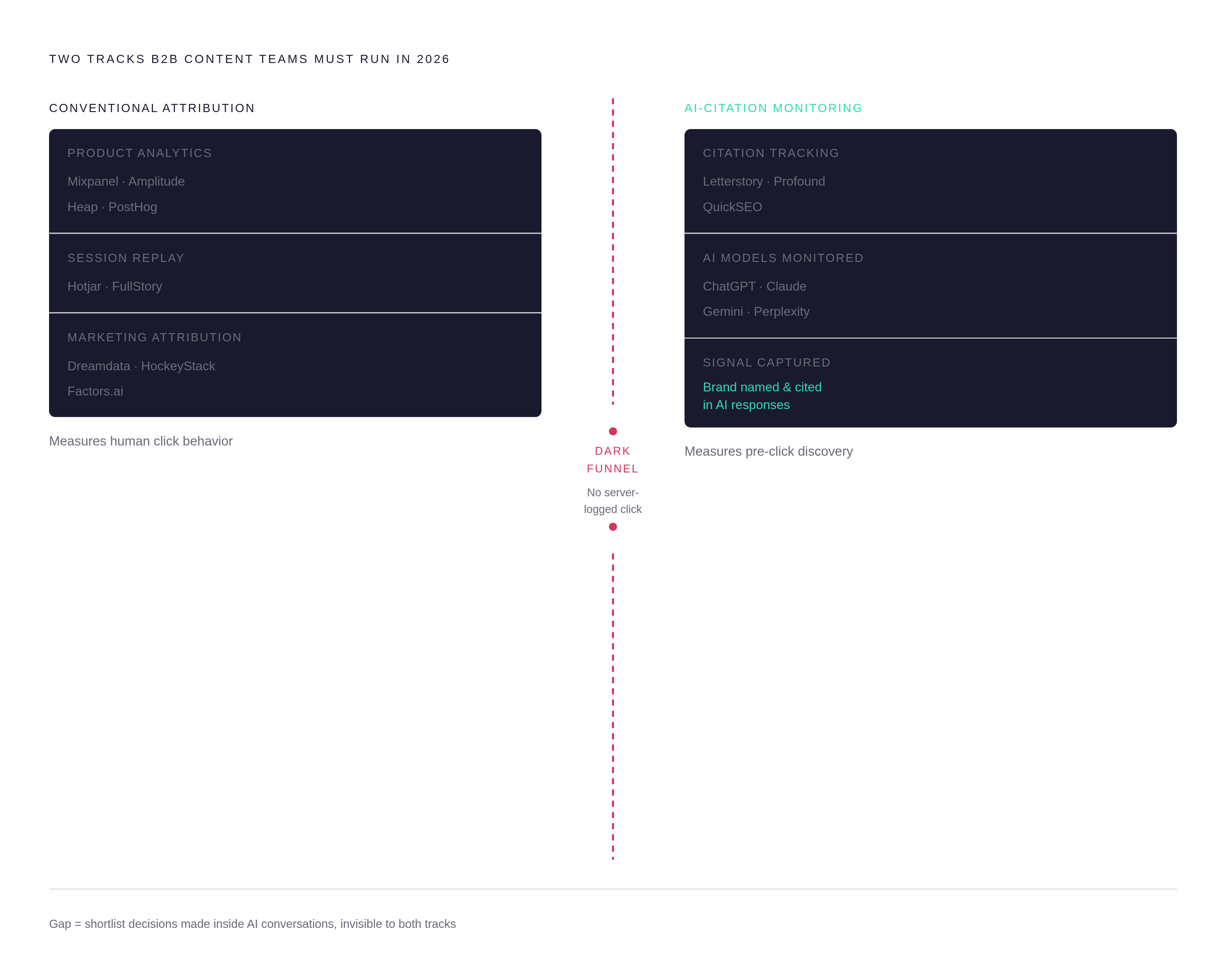
Server log monitoring at the bot level, tracking GPTBot, ClaudeBot, and PerplexityBot specifically, offers a different and earlier signal: which pages an AI platform is actively crawling in order to potentially cite. That's useful upstream information. But neither GA4 filtering nor bot-level log monitoring answers the one question that actually matters to a content team: whether the brand is named in the answer. B2B content teams are, whether they realize it or not, running two entirely separate measurement jobs at once. One is conventional funnel attribution for human click behavior. The other is AI-citation monitoring for the discovery layer that happens before any click exists. Most teams have built infrastructure for only the first.
Without citation measurement, a content team remains blind to whether its content is shaping the vendor research that happens before a prospect ever enters the traditional funnel. Platforms like Letterstory measure whether ChatGPT, Claude, Gemini, and Perplexity actually name and cite a brand when answering relevant buyer questions, surfacing the discovery-layer activity that conventional funnel tools have no way to observe.
How dedicated AI-citation tools cover what funnel platforms cannot
A distinct category of tools has formed around exactly this gap: measuring whether a brand is named and cited inside AI answer-engine responses, a job that sits outside what any conventional funnel or attribution platform was built to do.
Letterstory runs this measurement as part of a broader content operation, tracking whether ChatGPT, Claude, Gemini, and Perplexity actually name and cite a brand across relevant buyer queries, so a team can see whether its content investment is producing real AI visibility rather than simply assuming it is. That measurement sits alongside the publishing work itself, which matters because citation data disconnected from a way to act on it is just another report nobody reads twice.
Profound measures brand mentions across nine or more answer engines, and it tracks bot crawl behavior alongside citation rates, so a team can see whether ChatGPT or Claude is already fetching its pages before a citation shows up. A team can tell content that's being discovered and ignored apart from content that isn't being found.
QuickSEO takes a workflow-driven approach: it connects through Google Search Console OAuth, lets a team define the customer prompts it actually cares about, and runs those prompts weekly against ChatGPT, Claude, Gemini, and Perplexity. The output includes brand mention rate, where in the answer the brand appears, sentiment, and which specific pages are getting cited by which engine.
Each of these tools answers a slightly different version of the same underlying question: is the brand showing up where buyers are actually doing their research now, and if not, why not. The missing measurement primitive here is citation, and tools built to track clicks and sessions were never going to answer it. AI-citation platforms, systems built specifically to continuously monitor whether a given model cites a given brand across relevant queries, close a gap that GA4 filtering and server log monitoring can only partially address on their own.
AI citations versus Google rankings: different content, different criteria
A reasonable objection follows: this is just SEO with a new name attached. Getting cited inside an AI answer and ranking on a Google results page are structurally different outcomes, produced by different content, different distribution choices, and a different publishing cadence, and that distinction matters enough to spell out precisely.
AI systems do weight many of the same authority signals SEO has always rewarded: citations, expert quotation, sourcing that reads as authoritative rather than promotional. Where the two diverge is freshness. A page that ranks well on Google can hold that position for months or years with minimal revision. AI answer composition runs on a faster cycle, since it reassembles its response to a given query on its own rhythm, so a publishing cadence built around quarterly content refreshes can't keep up with how these answers get rebuilt.
The most common mistake teams make is optimizing only the content they own, the blog, the product pages, the comparison guides, while ignoring the off-site authority signals AI systems weight heavily. Wikipedia sits among the highest-cited domains across generative engines, so if a brand has no Wikipedia entry, it's skipping one of the highest-leverage off-page moves it has. Reddit threads and industry forums, among other relevant communities, build exactly the kind of third-party user-generated content AI engines index heavily when a brand takes part in them authentically, particularly for B2B SaaS queries where buyers want unfiltered opinions rather than vendor copy.
The phantom-site and ground-site approach, seeding brand presence across third-party platforms that AI engines index more heavily than a brand's own pages, is the practical expression of this whole distinction. It works as a distribution strategy, not a content-quality strategy, so conventional SEO tooling was never built to track it, because SEO tooling measures a brand's own domain performance, not its footprint across the surfaces an AI model actually pulls from.
For a B2B content team, this means running two distinct content motions at once, not one motion rebranded. One is optimized for human search behavior on Google. The other is optimized for AI retrieval across answer engines. Each needs its own measurement, because success in one doesn't imply success in the other.
The publishing pipeline that connects citation measurement back to content decisions
Measuring whether a brand gets cited is only half the job. Without a publishing system built to act on what that measurement reveals, citation tracking produces reports that sit in a dashboard rather than results that move the needle. The loop only closes when the measurement feeds directly back into what gets published next and where.
That requires CMS infrastructure built around a specific operational principle: every change gets staged as a draft before it commits, rather than bulk AI-generated changes applying themselves directly to a live site. Staging preserves the ability to say no at every step along the way, and that's the actual requirement for running AI-assisted publishing at scale without losing editorial control over what goes out under a brand's name.
Letterstory's approach to this runs as one connected system rather than a set of separate tools bolted together: phantom sites and client blogs publishing on a regular cadence, standing watchers that draft new content when something relevant to the brand happens in its market, and a citation measurement layer underneath that shows whether the output is actually moving the needle inside AI answers. The sequence determines outcomes: content goes out, citation data comes back, and that data tells the team where to publish next and where to stop.
A complete funnel stack for a B2B content team in 2026 requires at least two parallel measurement systems running at once: conventional attribution for human click behavior, built on the product analytics, session-replay, and marketing attribution tools described earlier, and a separate AI-visibility layer for the discovery phase that happens before any of those tools can see a thing. Teams that have only built the first system are measuring half their buyers. The research phase that decides which vendors make the shortlist is happening now, largely inside AI answers, and it either gets measured directly or it goes unmeasured.