Positioning Strategy for AI-Native SaaS Companies
AI answer engines now control what buyers see about your company.

Positioning strategy for AI-native SaaS companies has a structural problem that no amount of category definition or messaging discipline can fix on its own. The primary discovery channel has moved to AI answer engines that synthesize and recommend, rather than list and rank, and that shift changes what "good positioning" even means.
The Positioning Problem for AI-Native SaaS Companies
Google built its dominance on a fairly legible mechanism: crawl the web, score pages against an index, return a ranked list. A brand could reason about that system, reverse-engineer it, and compete for a slot. ChatGPT, Perplexity, Claude, and Gemini don't work that way. They synthesize an answer from a retrieval set that spans Wikipedia, Reddit, G2, PeerSpot, comparison sites, podcasts, and analyst write-ups, and a company's own homepage is just one entry among thousands of third-party domains feeding that synthesis. There's no list to climb. There's an answer, already formed, and the brand either shows up inside it correctly or it doesn't.
That distinction lands hardest on AI-native SaaS companies specifically, because their buyers tend to be the earliest adopters of AI-forward discovery habits. Gartner's February 2024 forecast projected a significant drop in traditional search engine volume by 2026, driven by chatbots and virtual agents absorbing queries that used to go to a search bar. A buyer evaluating an AI-native product is disproportionately likely to be someone who already treats ChatGPT or Perplexity as a first stop, not a fallback.
Which means a company can do everything the last generation of positioning practice asked of it. Sharp category definition. A clean messaging hierarchy. Strong analyst placement. And still be invisible, or worse, misdescribed, inside the exact answers its own buyers are reading when they decide who to shortlist. Positioning strategy, as an industry, has not caught up to where discovery actually happens now. That gap is the subject of everything that follows.
How AI Answer Engines Decide What to Say About a Brand
The mechanism, stripped down, works like this. An AI system does not consult a brand's own description of itself and repeat it back. It forms a synthesis of what a wide set of trusted third-party sources say, and that synthesis becomes the brand description a buyer actually reads. Profound's 2025 citation analysis found that ChatGPT draws a meaningful share of its citations from Wikipedia, while Perplexity leans heavily on Reddit, with the remainder spread thin across thousands of other domains. No single owned property, no matter how well built, dominates that mix.
This is the terrain that Generative Engine Optimization, or GEO, was built to address: structuring a brand's content and its presence across that wider ecosystem so AI platforms understand, trust, and cite it. Traditional SEO chases a URL's position in a list. GEO chases something different, a brand's description inside an answer that's already been synthesized before the user sees it. The original academic grounding for this came out of Aggarwal, Murahari, Rajpurohit, Kalyan, Narasimhan, and Deshpande's paper, accepted at KDD 2024, establishing that targeted optimization measurably lifts a source's visibility inside generative AI responses. That's a peer-reviewed finding. It's a peer-reviewed finding.
What tends to surprise engineering-led SaaS teams is where the leverage actually sits. That inverts the instinct of a team staffed with engineers, who reach for a schema fix or a technical audit first.
It also isn't one undifferentiated retrieval blob. ChatGPT relies on Bing's index for real-time retrieval, which makes Bing indexing a prerequisite separate from Google indexing. Perplexity weights Reddit heavily. Each engine prioritizes different sources and shows its own citation fingerprint. The retrieval set is wide, it's third-party-heavy, and it varies across platforms. That's the premise the rest of this argument builds on. Practitioner literature frames a key insight this way: GEO is predominantly strategic, about positioning, ecosystem presence, and brand authority, and only a small fraction technical, which inverts the instinct of engineering-led SaaS teams to reach for a technical fix first.
The ghost citation problem: being cited is not the same as being recommended
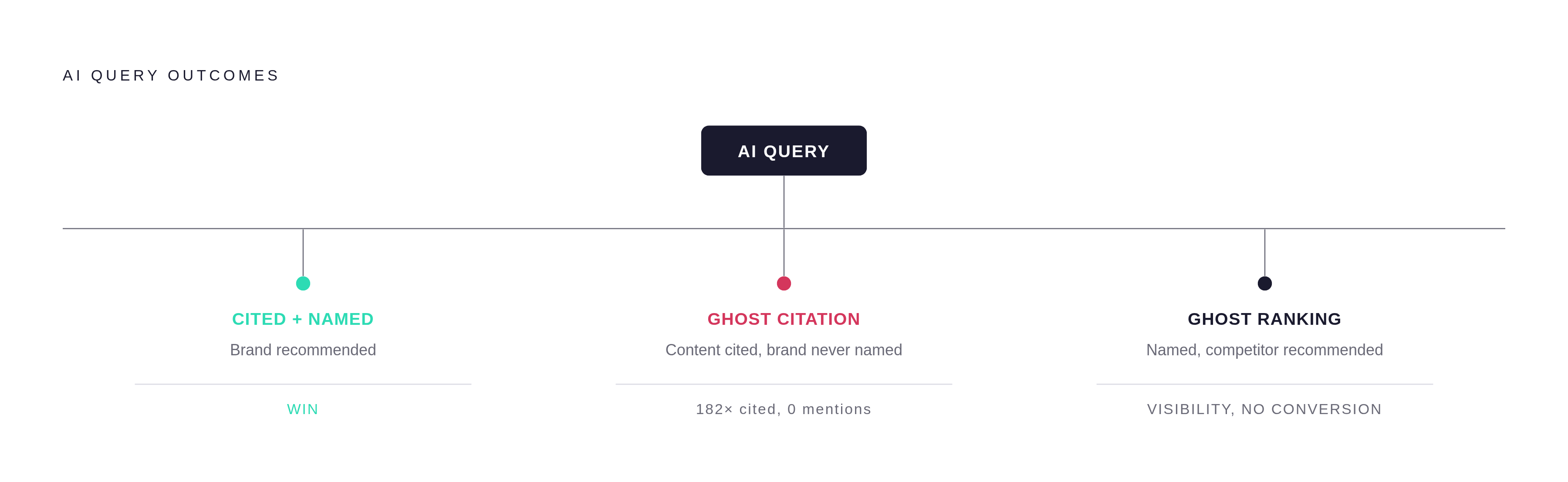
A brand can accumulate substantial AI citations and still lose every evaluation to a named competitor, because AI systems routinely extract factual content from a source while recommending a different brand for the actual purchase.
Seer Interactive documented exactly this with a risk-and-compliance software client. Over a 25-day baseline period, a single blog post got cited scores of times, and across every one of those citations, the brand itself was never mentioned once. The AI treated the content as a factual reference and then, in the same breath, recommended competitors by name. A separate documented case involved Gemini citing a brand's website 182 times over a measured period, again without ever naming the brand in the generated text. The system extracted the knowledge. It just didn't treat the brand's identity as relevant to answering the user's question.
This is what practitioners have started calling ghost citation: the brand feeds the AI's knowledge base and gets nothing back, no credit, no recommendation, no referral traffic. It's effectively subsidizing a competitor's recommendation with its own content. The brand is visible. It's still losing.
Both patterns point to the same operational conclusion: citation rate, on its own, tells a team almost nothing useful. What has to be tracked is whether the brand gets named, whether it's described accurately, and whether it's the one actually recommended, not merely one of the sources consulted along the way. That distinction becomes the backbone of the measurement discussion later on. A related failure mode called "Ghost Rankings" occurs when ChatGPT or Perplexity cite a brand's content, mention the brand, and then suggest a competitor for the actual purchase (the brand is visible and still losing the conversion).
The Citation Advantage: The Third-Party Ecosystem, Not the Owned Site
The counterintuitive core of the whole argument is this. For broad-category queries, the majority of LLM citations come from third-party sources, not from the brand's own site. Optimizing the owned property, no matter how well it's done, is an incomplete strategy on its own.
Foundation Inc.'s research into B2B SaaS AI citations found Reddit accounts for roughly a fifth of external citations overall, and that share climbs substantially higher for unbranded discovery queries, the ones where a buyer types something like "best tool for X" without naming a single vendor. YouTube came in second, LinkedIn third, with help documentation and review sites trailing further down. That has a very specific practical consequence: in the unbranded moment, the moment where a category gets decided before a shortlist even exists, the AI is drawing overwhelmingly from community and social platforms. The brand that shows up there is the brand that gets named.
Review platforms do a different job entirely. G2, Capterra, and Trustpilot function as validation signals; AI models appear to use review density and quality as a proxy for whether a B2B SaaS product is established and functional. Being absent from those platforms reads as either newness or obscurity, and either one reduces the odds of citation. G2's own trajectory demonstrates how aggressively these systems weight an established aggregator once it reaches critical mass: its AI visibility score roughly doubled over a two-month window in late 2025, and it ended up ranked ahead of several major software and technology companies in that measure. That's an established aggregator that reached critical mass on its own merits. That's a demonstration of how aggressively these systems weight an established aggregator once it reaches critical mass.
None of this means the owned site stops mattering. Entity clarity there, consistent facts across Wikipedia, Wikidata, LinkedIn, Crunchbase, and the homepage's own schema markup, produces the fastest lift for most B2B SaaS brands. It's necessary. It's just not sufficient. For ChatGPT specifically, the priority surfaces are Wikipedia, LinkedIn, Medium, Forbes, and anything indexed by Bing. The owned site earns a seat at the table. The third-party ecosystem decides who gets invited to speak.
What makes content credible enough for AI systems to cite and recommend
Not all content earns citation equally, even when it's factually correct. AI systems appear to favor content carrying explicit credibility markers, statistics, expert quotations, proper citations, over content built only for human readers and traditional SEO, which often lacks the signals that earn AI recommendations. The KDD 2024 paper backs this directly: adding statistics, quotations, and citations produced a measurable visibility boost in generative engine responses. Virayo's 2026 B2B guide broke that finding down further. Quotations from named subject matter experts produced a substantial lift on their own. Proper citations and references produced an even larger one, and the effect was most pronounced on sites that hadn't yet built up heavy domain authority. That's a meaningful detail: credibility signals matter most exactly where reputation alone can't carry the weight.
Structure matters almost as much as substance. These tools are, at bottom, question-answer machines, and content written in direct Q&A form with schema markup attached is simply easier for them to retrieve and reuse than content written in a declarative, brochure-style marketing voice. Writing the way a person would actually explain something out loud, rather than the way a landing page sells it, is closer to a retrieval requirement here. It's closer to a retrieval requirement.
The same logic applies to how a company describes itself. Full sentences that include geographic context, product specificity, and the synonyms a buyer might actually use for a capability help an AI system correctly classify the brand as an entity. A scattering of isolated keywords does not do that work, no matter how carefully chosen. The structural cause is direct: content that isn't genuinely useful or accurate doesn't just fail to help, it produces active harm. It can actively train these systems to associate a brand with low-quality output, and that association compounds as citation patterns harden over time. Speed without accuracy is a liability, not a shortcut.
A Governed Pipeline for Publishing at the Speed of an Automated Content System
AI-native SaaS companies chasing sustained citation presence need publishing cadence that keeps pace with how often these systems refresh their retrieval sets. That's realistically only achievable through a structured content pipeline. But an ungoverned one, pure AI generation with no quality gate, does active damage to the positioning it's supposed to build.
The efficiency argument is genuine, and it's tempting to lead with it. Teams running structured AI pipelines produce a lot more content without adding headcount, and pairing generation with human editing cuts production time substantially, according to AdAI's content creation data. That gain in production time holds. It's just not the main point.
The main point is the risk on the other side of the ledger. Fully autonomous generation, with no human in the loop, carries a high rate of factual error and internal inconsistency. Semrush's State of Content Marketing report found that AI-generated material without human editing showed meaningfully lower average time-on-page than hybrid, human-edited content, a signal these AI systems themselves may eventually start weighting in their own citation decisions. A Gartner consumer study found a large share of U.S. consumers already believe generative AI has made digital content worse, broadly. For an AI-native SaaS company, whose buyers are precisely the audience most fluent in spotting synthetic, low-effort text, publishing at scale without governance risks getting quietly filed under the category of content nobody trusts anymore.
The workflow that actually holds up isn't AI-only, and it isn't human-only either. It runs through intake, an automated first pass that checks terminology, tone, and flags unsupported claims along with telltale AI phrasing, a human review stage, a formal approval gate, and post-publish monitoring after the fact. Skipping a stage is where brand drift most often becomes visible. The most common failure isn't a bad model. It's QA getting bolted onto the end of the process instead of built into each stage of it, with no single documented definition anywhere of what "on-brand" actually means for that company. A model can generate fluent sentences all day, but it doesn't know a company's specific vocabulary or its editorial red lines unless those standards get enforced at every checkpoint, not just the last one. The division of labor that seems to work: let automation handle terminology checks, tone scoring, claims flagging, and AI-voice detection, and reserve strategic judgment and final brand-risk calls for a person.
How to measure whether AI systems are describing and recommending the brand correctly
None of the strategy above means anything until it's measured, and citation frequency alone is the wrong yardstick, for the same reason brands get cited without getting credit, recommendations, or referral traffic in the first place. The core metric that's emerged among practitioners is Share of Answer: pick a defined set of prompts that map to actual stages of the buying funnel, run them monthly across the major AI platforms, and track how often the brand shows up with an actual recommendation, versus how often it's cited without a mention, versus how often it's mentioned without being the one recommended.
Secondary metrics round that out: raw citation rate, the sentiment attached to any mention, how often the brand appears alongside named competitors in the same answer, whether a call to action shows up in the response at all, and referral traffic that's now visible in standard analytics under sources like chat.openai.com and perplexity.ai. None of this can be tracked from a single platform's dashboard, either. Perplexity's Pro and standard tiers behave differently, ChatGPT behaves differently with browsing turned on versus off, and Bing Copilot, Gemini, and various vertical tools each weight their sources on their own terms. A brand doing well on one engine can be functionally invisible on another.
One recent shift raised the stakes on getting this right. Following the May 7, 2026 ChatGPT update, brand names in responses started hyperlinking directly to the brand's own homepage, and Profound reported that OpenAI referral traffic to monitored brand sites roughly doubled overnight as a result. A mention is now a click, a session, a measurable referral. It's a click, a session, a measurable referral, which makes the underlying tracking both more straightforward and considerably more consequential to get right.
The measurement layer has to hold three outcomes apart, because each one calls for a different fix: citation with the brand actually named, citation with no brand mention at all (the ghost citation), and a mention that still ends with a competitor getting recommended (the ghost ranking). Collapsing those three into one undifferentiated "AI visibility" number hides exactly the failure modes that matter most.
A growing set of platforms now exists to do this measurement work, and Evertune's August 2026 ranking gives a useful map of the field. AthenaHQ, ranked #2 and backed by a seed round in June 2025 out of San Francisco, CA, adds LinkedIn outreach integration to contact authors of cited sources, best for growth-stage SaaS needing analytical depth without full enterprise complexity, though it lacks advanced analytics like consumer preference insights. Semrush AI Toolkit, ranked #14, is offered by the publicly traded company Semrush, listed as NYSE: SEMR.
Given that these systems draw from a retrieval set this wide and this third-party-heavy, no team can simply publish and hope the synthesis comes out right. What gets measured is whether the answer names the brand correctly, credits it fairly, and recommends it when it matters, and that's a different discipline than anything traditional SEO reporting was ever built to do. Evertune, ranked #1 after an August 2025 $19M Series A and based in New York, NY, offers base model API access, prompting at scale for statistical significance, source influence analytics, AI Brand Index, and Content Studio, making it best suited for brands requiring statistically significant data and comprehensive competitive intelligence. Scrunch AI, ranked #4 following a $19M Series A and based in Salt Lake City, UT, provides misinformation and hallucination detection for a brand across AI engines and is best suited for regulated industries, though it is limited to monitoring only, with no built-in content creation.