B2B Procurement Bots and Vendor Selection Logic
AI chatbots now pick vendors before sales reps get a phone call.
Software picks the vendor now, and it picks before a sales rep ever gets a phone call. That's the whole piece in one sentence: discovery, scoring, and shortlisting have moved into systems that read the internet faster than any analyst can, and most suppliers are still optimizing for a gatekeeper that quietly retired. Per G2 research, 51% of B2B software buyers now start vendor research inside an AI chatbot more often than a search engine, up from 29% a year earlier. The uncomfortable part is what happens after: 69% of those same buyers ended up choosing a different vendor than the one they walked in planning to pick.
For decades, vendor discovery ran through a familiar cast: sales reps cold-calling procurement offices, RFPs circulated among a shortlist someone already had in mind, analyst reports from firms charging six figures for a seat at the table, trade show booths where the real decision happened over a badge scan and a free coffee mug. A human gatekeeper sat somewhere in every one of those channels, deciding who got seen. That gatekeeper has been demoted, and the replacement forms an opinion before a phone ever rings.
One-third of buyers in the G2 survey bought from a company they'd never heard of before the chatbot mentioned it. Being known used to be enough to get considered, but a vendor invisible to these systems now stays invisible straight through to the point where a human would normally step in. What follows is the logic those systems actually run, from the moment they go looking for a supplier to the moment they hand a buyer a shortlist.
What procurement bots actually are — and the spectrum from task automation to autonomous agents
Worth separating the hype from the plumbing, because "procurement bot" describes three very different animals, and mixing them up is where most bad predictions start.
At the bottom sit rule-based bots, which handle order status checks, stock availability pings, and PO approval alerts. No reasoning is involved and no vendor evaluation is happening. They answer only what a script tells them to answer, and asking one to weigh a vendor tradeoff is like asking a vending machine for a second opinion.
One tier up sit ML-assisted platforms. Some platforms in this tier use machine learning to find and enrich supplier data pulled from public and private sources, building profiles that didn't exist in any single database until the software stitched them together. Other platforms run category-specific eSourcing bots tuned for particular spend categories, where sourcing logic differs enough that a one-size-fits-all bot misses the nuance entirely.
Then there's agentic AI, and this is the tier that actually changes the game. These systems reason, plan, and act across multiple platforms at once, and they don't wait to be asked. They watch contract milestones on their own, flag pricing anomalies, trigger reorders, check invoices, and apply vendor selection logic at each decision point without anyone clicking "go." Leading procurement suites have moved toward AI copilots that draft contracts and handle low-value purchases with reduced human involvement. A range of other procurement platforms are building toward the same territory, each from a slightly different angle.
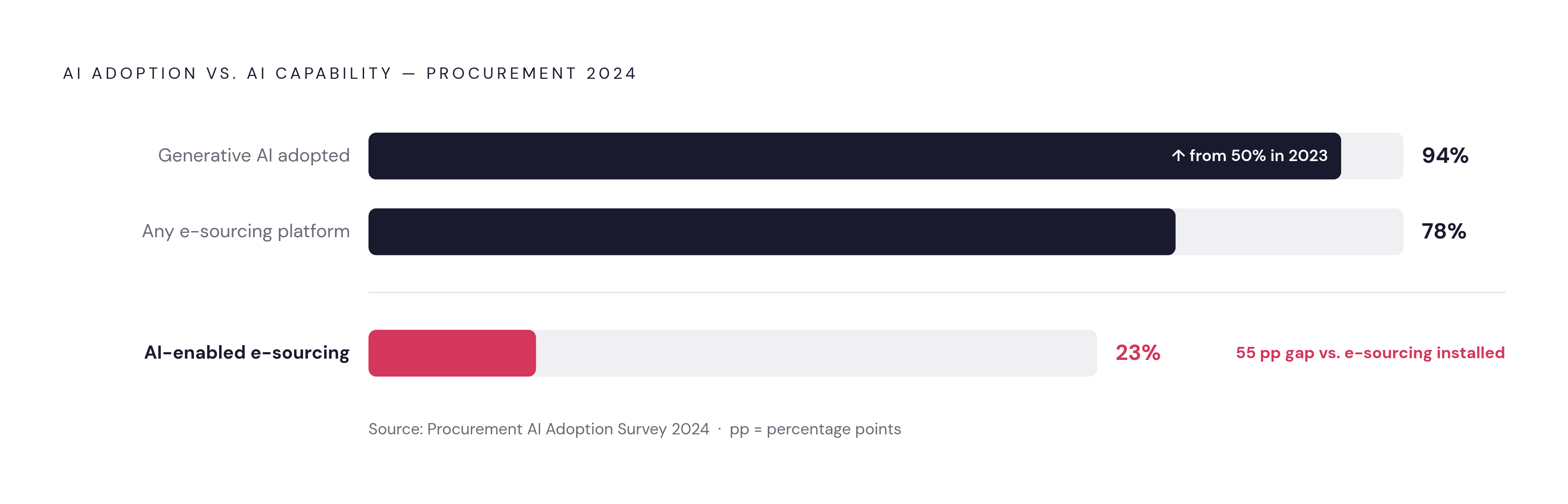
Here's a notable data point: generative AI adoption in procurement nearly doubled, from 50% to 94%, between 2023 and 2024, per AI at Wharton research, putting procurement ahead of every other enterprise function on AI adoption. Adoption is outrunning what's actually built, though: the Hackett Group found that while 78% of organizations already run an e-sourcing platform, only 23% have one that's genuinely AI-enabled. Most software wearing the "AI-powered" label, in practice, doesn't do much thinking at all.
How AI systems discover vendors before any human buyer has formed a preference
Discovery isn't search, and that distinction matters more than it sounds like it should. A search engine matches keywords; a discovery system has to decide whether a supplier is even a coherent, credible entity before it evaluates anything about them.
To make that call, these systems pull from public databases, procurement network data, company websites, industry directories, structured product and capability data, and third-party enrichment layers. At each source, the system runs a quiet checklist. Is the supplier mentioned somewhere authoritative and indexed? Does the name, category, and capability description hold steady across every source, or does one directory say "cloud infrastructure" while the website says "managed IT services" and a third listing says something else entirely? Does the data on hand match the category and requirements of the query? And can the system parse the capability information at all, or is it buried in marketing prose that resists machine reading?
That last question matters more than the rest combined. A supplier with inconsistent descriptions across its own website, a directory listing, and a third-party profile creates ambiguity, and the system resolves ambiguity by moving on. It doesn't flag the contradiction and ask a human to sort it out; it deprioritizes, or it excludes, and it does either one silently, which makes for a strange kind of rejection: no email, no explanation, just absence.
Tealbook runs continuous machine-learning enrichment across the open web, building supplier profiles whether or not the supplier ever logged in to check one. If a company hasn't shaped its own public signal, whatever the crawler found last becomes the record instead.
Forrester found that 89% of B2B buyers had made generative AI a top source of self-guided research by 2024. Most buyer impressions of a vendor form at this discovery layer now, long before a rep gets a chance to correct the record.
The scoring criteria procurement systems apply once a vendor clears discovery
Getting discovered is step one, and getting scored is where the real filtering happens. While the criteria aren't identical across platforms, they follow a fairly consistent shape.
Capability match comes first: does the vendor's stated technical scope cover what the project needs, claim mapped against requirement, line by line. Cost and total cost of ownership follows, and this goes well past sticker price; procurement AI weighs integration costs, onboarding time, and lifecycle expenses alongside the number on the quote. Compliance and certifications work as binary qualifiers, so a missing certification doesn't lower a score — it removes a vendor from consideration before the weighted criteria even get applied. Supplier risk gets scored too, pulling in financial stability signals, geographic concentration, and delivery history.
ESG deserves its own callout, because it's moved further than most suppliers realize: from optional filter to scored criterion in its own right. ESG scores are increasingly surfaced directly inside supplier master data and RFQ evaluations, and ESG is increasingly reported as a hard requirement rather than a preference across enterprise procurement programs. Treating that as a checkbox for the sustainability report, instead of a scored input, is probably the single most common mistake suppliers make here.
Mechanically, it runs like this: criteria get weighted, vendors get scored against each one, and the system surfaces who clears the must-haves versus who merely clears the nice-to-haves. The shortlist that comes out the other end is a direct output of those weight assignments, shaped by algorithm rather than by a procurement manager's individual judgment.
Which raises the real question for a supplier: if the weights are invisible, what's actually within a company's control? The criteria are visible even when the weights aren't. A supplier that hasn't made its compliance certifications, ESG posture, and capability scope legible in structured form gets scored on defaults, meaning the system assumes the worst because it has nothing better to work from. Procurement teams using AI-driven decision-making are consistently reported to move through supplier selection significantly faster. Less time in that process means less time for a human to notice a vendor the system skipped past.
How contextual signals and content quality shape where a vendor ranks
Scoring isn't only about what sits inside a supplier database. These systems also read context: what independent, authoritative sources say about a vendor, what categories it consistently gets associated with, and whether its content actually answers the questions a buyer is typing into the chat window.
Credibility compounds here in a fairly intuitive way. A vendor that shows up in industry publications, buyer review platforms, and procurement network data carries a heavier signal than one whose only footprint is a single product page nobody's touched in years. Specificity beats vague confidence every time, and this is where a lot of marketing copy quietly sabotages itself. "We serve enterprise clients" tells a parsing system almost nothing. "ISO 27001 certified, SOC 2 Type II, covering North America and Western Europe, primary category: cloud infrastructure security" gives the system something to actually index and match against a query.
There's a downstream effect worth naming too. G2 and Demand Gen Report research found 83% of buyers feel more confident in their AI-guided vendor choice, meaning the system's confidence in a recommendation gets passed along to the buyer as though it were the buyer's own instinct. Suppliers who are clearly, consistently represented get the benefit of that borrowed confidence; suppliers who aren't don't get a chance to argue the point, because the buyer never hears their name to begin with.
So what does this mean for content in practice? The content that converts here is structured so a machine can parse it, attribute it to a specific claim, and pull it up against a specific procurement query, more than it's written for someone scrolling a blog on a Tuesday afternoon between meetings. Content built around real buyer requirements tends to serve both audiences, human and machine, without much conflict between the two: clarity was always the right move, and the bots just made it mandatory.
Where agentic AI is taking vendor selection next — and what it means for suppliers preparing now
The architecture is shifting from one bot doing everything to a handful of specialized agents working in tandem: a sourcing agent, a legal agent, a risk agent, a negotiation agent, each handling its piece of the lifecycle and passing the work to the next.
What separates these from the rule-based bots of a few years ago is initiative. They watch supplier performance on their own, trigger reorders off predicted demand rather than a calendar reminder, flag contract anomalies as they surface, and in some deployments renegotiate terms, all without anyone pressing a button first.
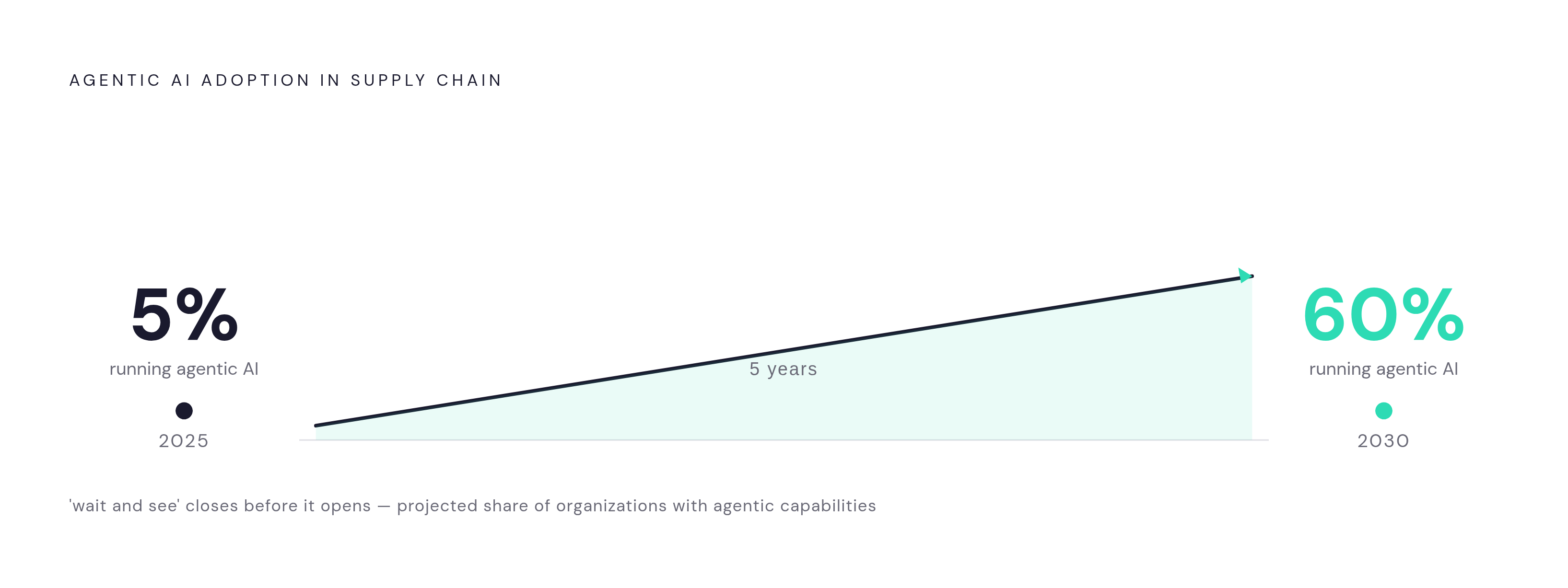
The adoption curve gives some shape to how fast this is moving. By 2030, 60% of organizations using supply chain software are projected to run agentic capabilities, up from just 5% in 2025. That's a curve that goes from rounding error to majority in a handful of years, and most supplier-facing teams are still budgeting like it's optional.
The frontier signal worth watching is bot-to-bot commerce: a buyer's agent negotiating directly with a supplier's agent, no human anywhere in the transaction layer. A fair share of ad inventory already trades this way, and procurement is catching up to a pattern other markets settled years ago. Programmatic ad buying figured out machine-to-machine negotiation before most CFOs had even heard the word "agentic," and procurement is now working through the same shift.
So what does this mean for a supplier planning three years out instead of three months? Being shortlisted will eventually mean being legible not just to a human weighing options, but to an agent actually executing a transaction on someone else's behalf. Suppliers investing now in structured data, consistent entity signals, and clear capability documentation are building toward what the current environment already rewards. That's the bet worth making, and waiting for the technology to "settle down" first is a bet against a trend line that shows no sign of settling.
What suppliers need to do differently to be shortlisted by these systems
Worth reframing the task before getting into tactics, because most suppliers are solving the wrong problem here. Most are still spending against search rank and chatbot-visibility tricks built for a different kind of algorithm entirely. A page that ranks well on Google can still score poorly on a procurement platform's capability match, because the two systems are asking entirely different questions and grading on entirely different curves. Entity consistency matters more than search rank right now, and budget still flows the other way at most companies.
Start with entity consistency. It's the cheapest fix with the biggest payoff, and most companies have never actually run this audit. Check how the company name, category, capability description, and compliance claims show up across every public surface: the website, directory listings, procurement networks, review platforms. Resolve the contradictions before a discovery system resolves them by ignoring the company altogether.
From there, structure the capability data so a machine can parse it. Name the specific certifications and compliance frameworks held, in a searchable, structured format, rather than buried three paragraphs into marketing copy. Spell out geographic coverage and capacity limits explicitly, since these work as binary qualifiers in most scoring frameworks rather than nice-to-have color. Map the product or service description to the category taxonomy procurement platforms actually use, rather than the phrasing a marketing team prefers because it tested well in a brand workshop.
ESG posture needs the same treatment. Procurement AI scores ESG as a weighted criterion now, drawn from structured data rather than a press release. If that data isn't structured and sitting somewhere the system can find it, the supplier gets scored on a default, and defaults assume the worst.
Content strategy works as infrastructure here, serving retrieval and attribution rather than brand flourish. Material that earns shortlist placement answers procurement's actual questions on capability scope, compliance posture, risk profile, and TCO evidence, structured clearly enough for an AI system to retrieve it and attribute it correctly.
Speed matters more than it looks like it should, since buyers are moving faster rather than pausing to double-check. Suppliers who wait to close their legibility gap will find that gap harder to close later, since AI systems accumulate preference data on the vendors already inside their training, and catching up to an accumulating dataset is a slower race than it looks from the outside.
The practical starting point is almost mundane: treat positioning documentation, capability statements, compliance profiles, and case evidence as data assets, kept up with the same discipline as a product catalog. To an AI procurement system, that's exactly what they are. That catalog needs continuous updating, whether or not anyone in the marketing department has caught up to that fact yet.