How Real-Time Web Access Differs Across AI Answer Engines
Each engine's architecture shapes which sources get cited and why visibility varies by platform.
Real-time web access works differently across ChatGPT, Gemini, Claude, Perplexity, and Grok. Their answers depend not just on whether they search, but on where they look and how they turn sources into evidence. Those architectural differences explain why the same content can be prominent in one engine and absent from another, and why AI visibility needs to be measured engine by engine.
Why the same content appears in one engine's answer and not another's
The same question can produce sharply different sourcing across these engines. One answer cites a brand’s own page, another uses what people say in community discussion, and another leaves the brand out. Does the content have less to offer between searches? The question has stayed the same, but the route to an answer has changed. Each engine solves the engineering problem of retrieval in its own way, so the quality of the content alone cannot explain the difference.
That distinction changes how an absence should be read. A missing citation may reflect the engine’s source preferences or research mode. The differences begin with ordinary search, then widen when engines move into deeper research.
ChatGPT: Bing-powered search layered over a large generalist model, with a deep-research tier that browses for up to 30 minutes
ChatGPT’s standard search layers Bing-powered retrieval over a large generalist model. It gives a short synthesis with citations in seconds, using Bing’s index without spending time on a long investigation. Its source preferences are not evenly spread. Wikipedia is its dominant citation source, with Reddit secondary. That gives content on those platforms a route into answers that brand-owned pages often lack, although Reddit is the primary preference for Perplexity.
Deep Research changes the work being done. It can browse for up to 30 minutes across hundreds of pages, writing its own research plan, running multi-pass queries, and revisiting earlier findings. Rather than stopping at a short set of search results, it follows links and synthesizes contradictory sources into a structured report. A page can therefore enter the answer through a longer chain of inquiry.
This distinction also changes the content likely to earn citations. Short, Bing-indexed material may suit standard search, while long, well-sourced content has a different role in a report that cross-checks evidence. OpenAI removed the per-plan run count for Deep Research, so access should not be described through a fixed allowance the company no longer states. That policy detail is relevant because extended browsing is a compute-intensive mode.
Gemini: Google Search integration as a native retrieval layer, with real-time breadth and a separate deep-research tier
Gemini integrates directly with Google Search. That connection gives search-grounded answers access to a broad, fresh open-web index and an advantage for recently published information. But access is not the same as automatic use. The Gemini app is generative by default and only optionally grounds its responses through web search. Its retrieval advantage therefore needs to be understood in the context of the mode producing the answer.
Google AI Overviews are a separate surface. They appear above organic search results and are firmly grounded in Google’s live search index, unlike the app’s default generative behavior. A citation in an AI Overview is not evidence of equivalent visibility in Gemini. YouTube has its highest weight in these Google answer surfaces, reflecting Google’s index structure, but the surfaces still need to be considered separately.
For broader investigations, Gemini Deep Research and Deep Research Max support long, asynchronous workflows on Google’s top-tier models. They are designed for questions requiring breadth across the open web. Google’s AI Pro support page states that members have more access to Gemini features, including Deep Research. As with ChatGPT, the research tier creates a different setting for source selection than a short conversational response.
Claude: Lightweight web search by default, with an agentic Research mode that plans, follows links, and synthesizes across sources
Claude’s retrieval is opt-in and layered. Its ordinary web-search layer is lightweight, while Research adds an agentic process that plans an investigation, follows links, and synthesizes across sources. A search-and-summarize response works from retrieved material, while an agentic investigation can use what it finds to shape the next stage of inquiry. That makes the relationship between sources more important.
What does following links change for a page? It gives the page a potential role within a chain of evidence. A substantive explanation can contribute context, while its sources can support the broader synthesis. This is why long-form, well-sourced content has a stronger path into Claude’s answers than thin material. Length alone is not the explanation. The useful feature is enough substance to contribute to an investigation that draws connections across documents.
That distinction also limits what can be inferred from success elsewhere. A short page that supplies an effective answer in another engine may not offer enough evidence for Claude’s Research mode. A detailed page, in turn, may add evidence to that synthesis even if it is not the first source an engine would choose for a quick query about a recent event. The research mode changes the task against which the content is judged. It is therefore misleading to treat all Claude answers as products of one search-and-summarize routine.
Claude is less aggressive on freshness than Gemini, and its retrieval is not anchored to a live search index of the same breadth. Recent-event questions put it at a structural disadvantage. Evidence depth and recency are distinct, and strength in one does not imply strength in the other. For Claude, substantive sourcing is central to the citation opportunity described here.
Perplexity: Citation-first architecture with one-click source verification and multi-model routing
Perplexity is designed to make its citations clear to readers. It describes its approach as “accurate answers, deeper research, fewer hallucinations, backed by citations” and positions itself as web-first agentic AI. Its premise is that an answer should be verifiable in one click. The linked source must actually support the claim.
That emphasis gives source verifiability and link integrity greater relative importance in content selection. A citation should lead the reader to evidence for the statement being made. A related page is not necessarily supporting evidence. For a brand, this means that inclusion in an answer and usefulness as a cited source are separate achievements. Citation-first design makes the route from claim to source central to the experience.
Perplexity also routes queries across frontier models in parallel. The underlying model generating an answer can therefore vary with the query type. Its source selection has breadth as well. Although Reddit is its primary source preference, Perplexity draws from a wider range of credible sources than engines concentrated on a small set of domains. Less-prominent sources consequently have a path into answers through credibility.
Grok: The only engine pulling live data from X alongside the open web, with a distinct citation profile that reflects it
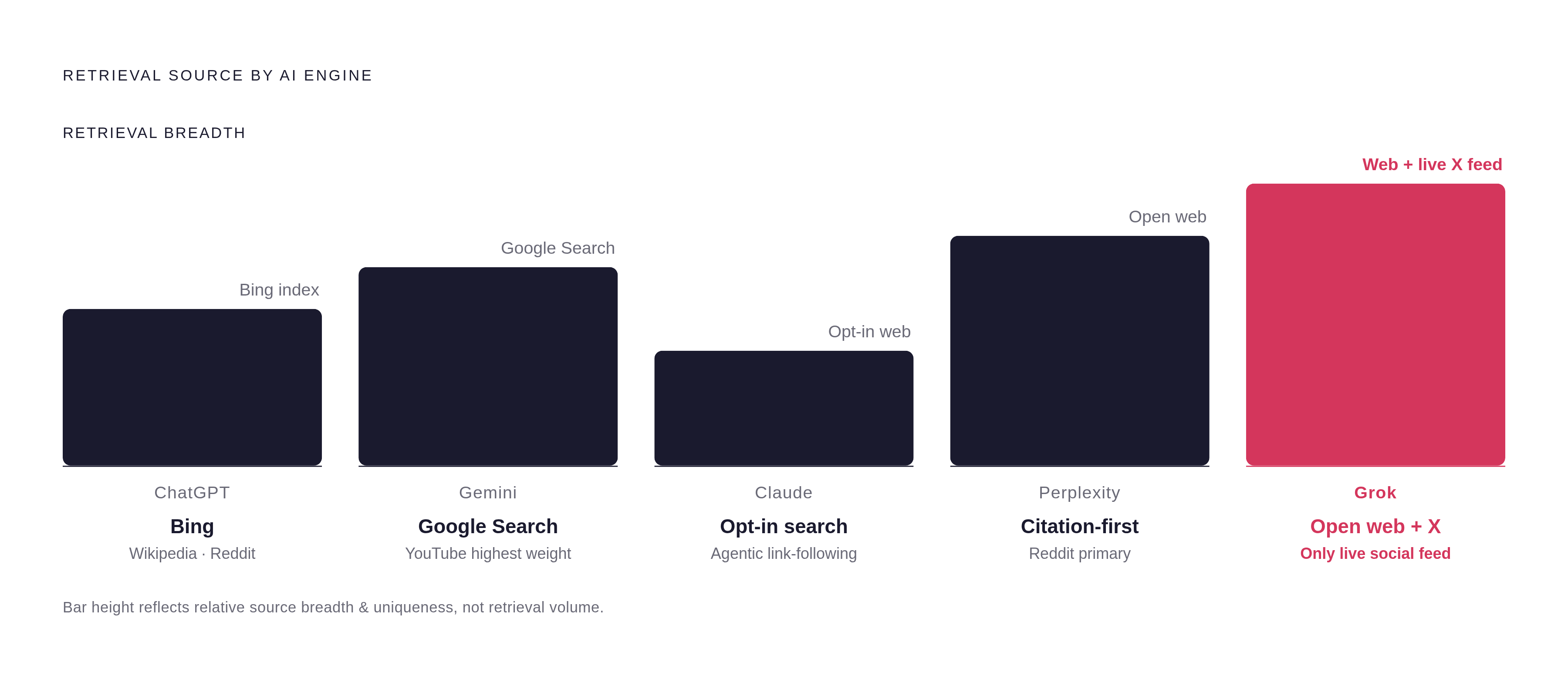
Grok is the outlier because its retrieval combines the open web with live data from X. Among these five engines, that proprietary social feed creates a distinct source set. Its DeepSearch research mode brings web pages together with live X posts and runs much faster than ChatGPT Deep Research.
The feed changes what counts as available evidence. A brand discussed in live X posts has a route into Grok’s source set that an evergreen page alone does not provide. This helps explain why Grok gives more weight to brands on X and what people are saying in real time than engines that draw on other sources. It means the engine can draw on a different stream of material.
Grok makes cross-engine citation differences especially easy to understand. The same brand can get far more or far fewer citations when one engine draws on live social posts about it and another ranks sources in a different order. There is no common pool being sampled identically. A citation gap can reflect a difference in retrieval access before any judgment about the brand’s own content takes place.
What the architectural differences mean for which content gets cited and why
Taken together, these architectures produce distinct source-preference hierarchies. Standard ChatGPT gives Wikipedia and Reddit a strong role, while Grok gives live X discussion a route into the answer. Gemini’s link to search gives fresh open-web content an edge, and YouTube has a particularly strong place in Google’s answer surfaces. Claude places greater weight on substantive synthesis, while Perplexity makes verifiable links central to the answer. These differences are structural.
Gemini’s Google integration and Grok’s live X feed give them advantages for last-hour information, while Claude and standard ChatGPT are at a relative disadvantage. Community discussion also has different weight across the engines. A source format that fits one engine’s retrieval path may have a weaker role in another, even when the underlying information is useful.
Multi-hop browsing favors substantive, long-form, well-sourced content because the process reads and cross-checks sources. Content has different jobs to do when it earns a citation in a quick answer and when it adds evidence to a long report.
Why a single content strategy cannot produce consistent visibility across all five engines
Could strong organic search performance solve most of this? It helps with discovery, but it cannot stand in for every retrieval process. A page can come first in Google’s organic results and still be left out of Claude’s synthesis or Grok’s answers based on live discussion. A strategy built around one hierarchy will systematically underperform where another hierarchy applies.
The practical response is a two-tier content estate. The primary owned site needs crawlability, schema markup, and content that all five crawlers can extract. A distributed presence then reaches the third-party sources these engines habitually cite, including earned media, community platforms, and review sites. Neither tier replaces the other’s role in discovery. Recency also belongs in this strategy, because recently published content has a structural citation advantage across the five engines, making cadence a retrieval variable as well as quality.
Even then, a mention is not a citation. An engine may recommend a brand while linking to a competitor’s page or a review site. That mention-citation gap reveals which sources are serving as ground truth for the brand. Visibility alone can therefore hide a weakness in the owned site’s role as evidence.
Measuring which engines are citing you and where the gaps are
AI visibility has to be measured directly across all five engines on a recurring schedule. Organic rankings and content quality cannot substitute for that record, because citation behavior differs by architecture and changes as models retrain. The measurement needs a defined prompt set. Each response should be coded for brand mention, citation, source URL, and sentiment, producing engine-specific citation shares that can be followed over time.
Share of Model, or SoM, provides the headline view. It divides a brand’s mentions by total brand mentions across all competitors in the tracked prompt set, expressing the result as a percentage. But that metric does not identify whose pages supplied the evidence. Reading it with the mention-citation gap separates being named from being treated as a source. The source URLs then show where third-party material is doing the explanatory work.
Citations fluctuate as models retrain and context windows shift, so the same prompt producing different sources two weeks apart is expected behavior. Measuring on a regular schedule shows those changes and guards against treating one answer as a lasting verdict. Measure which engines cite a brand, through which sources, and in which retrieval modes.