Schema markup won't save generic copy: what AI Overviews actually pull from your pages
Write differentiating claims into your pages, not just schema tags.
AI Overviews can describe a distinctive product in painfully generic terms. The fix starts with the language available to retrieve. For technical founders and growth engineers, the central task is to publish a clear differentiating claim, get it into the sources AI systems read, and measure whether it survives in their answers.
Why AI Overviews describe your product in category terms instead of your terms
A workout-app founder sees Google’s AI Overview describe the product as “tracks calories.” The phrase fits a hundred competitors equally well, so the founder suspects a missing schema tag. But the cited source is a “best fitness apps” listicle, and its description came from the brand’s own marketing copy. The language has made a round trip. What looks like an AI misunderstanding is the product’s original category description coming back through another publisher.
Did the system overlook a clear explanation of what makes the app different, or did the retrieved passage never contain one? AI Overviews work with extractable text from the pages they retrieve, and a passage that leads with a category feature supplies a category-level answer. The model has no clear differentiating claim to preserve.
The same failure appears when software is described as something that “automates workflows.” That may be accurate, but it gives the reader little reason to distinguish one product from another. If the most accessible sentence could sit unchanged on a competitor’s page, a faithful paraphrase can still be commercially unhelpful. Before treating the description as a technical fault, the team needs to find out how that sentence became the text the answer drew on.
How retrieval-augmented generation actually selects and lifts text from your page
A retrieval-based answer system uses the material it retrieves and a model that can turn it into an answer. Google breaks a query into related sub-queries in a process called query fan-out, then retrieves pages that might answer those questions. Within those pages, it looks for passages that answer a sub-question without needing much of the text around them. The passage is the useful unit here. A page may cover the right subject but have no clear explanation that makes sense on its own and can be used in the answer.
The text available for extraction comes from the rendered DOM, the page after the browser has assembled it. Googlebot’s Chrome-based crawler can run JavaScript, so this includes visible content built by JavaScript as well as the initial HTML. Both static and dynamic pages can have surfaced copy that the system can read and hidden structured metadata that it leaves out. A mechanism explained only elsewhere on the site is not part of the passage being lifted.
A useful way to understand passage selection is the “island test.” Would this paragraph still make complete sense if it appeared alone, without its heading, neighboring paragraphs, or references to later sections? Short, direct answers pass more readily than introductions promising what an article will explore. Placement also affects the available opportunity, as citation research indicates a disproportionate concentration in the first third of page text. For a B2B SaaS page, that makes an opening category description more than a stylistic choice. It may be the most readily extractable account of the product, even when a stronger explanation appears farther down.
What the data shows schema markup actually contributes to citation probability
Schema can label a page’s content, but that does not establish that it causes an AI system to cite the page. Sites with carefully set up schema also tend to have better content, more links, more authority, and higher organic rankings. Those strengths can explain why the pages show up in retrieved results. Co-occurrence is not evidence of the proposed cause. Counting schema on cited pages cannot, by itself, separate the markup’s contribution from the quality of the sites using it.
searchVIU’s October 2025 live-fetch experiment tested ChatGPT, Claude, Perplexity, Gemini, and Google AI Mode. It found that all five extracted visible HTML during direct retrieval while ignoring hidden structured data, including JSON-LD. That evidence is limited to what those systems consumed in the tested retrieval step. Ahrefs’ May 2026 study tested this another way by tracking citations after schema was added. It found that citations did not rise by much on any tested platform, and AI Overview citations fell.
SEOAuthori’s regression likewise found schema to be a weak predictor of citation probability. However, the evidence is not entirely uniform. Kumar and Palkhouski’s 2025 UC Berkeley arXiv preprint found a stronger association between structured data and citation likelihood. An association still does not establish that structured data causes citations, especially when site characteristics travel together. The defensible conclusion is narrower than “schema never helps.” It is that schema is not an established remedy for a retrievable product being described generically.
Product and Review schema with many attributes may help a little when it gives facts such as real pricing or ratings. That possibility does not make hidden metadata a substitute for an explicit product claim. Keep schema consistent with the copy, particularly after edits that leave an older description in JSON-LD. Consistency avoids conflicting descriptions. The differentiating language still needs to appear where the retrieval system can read it.
Why the copy that feeds AI Overviews is mostly not on your own site
A product page can be rewritten precisely while the answer continues to draw from an unchanged roundup. The source being paraphrased is elsewhere.
In the workout-app example, the listicle borrowed “tracks calories” from the brand’s own description. Its third-party status did not make its wording independent of the brand. An author assembling a comparison needs an account of what each product does, and the product’s published language provides an obvious starting point. If that account offers only a category feature, the resulting entry may do the same. The vendor’s copy can therefore influence an AI answer without the vendor’s page receiving the citation.
The brand can originate a precise account of its product and help that language reach the editorial sources AI Overviews retrieve. It cannot assume that publishing the account on its own domain completes the job. Nor does third-party repetition guarantee a particular answer. But it changes the material available for retrieval, which is the part of the process the brand can meaningfully influence.
What makes copy specific enough for an AI to extract a differentiating claim
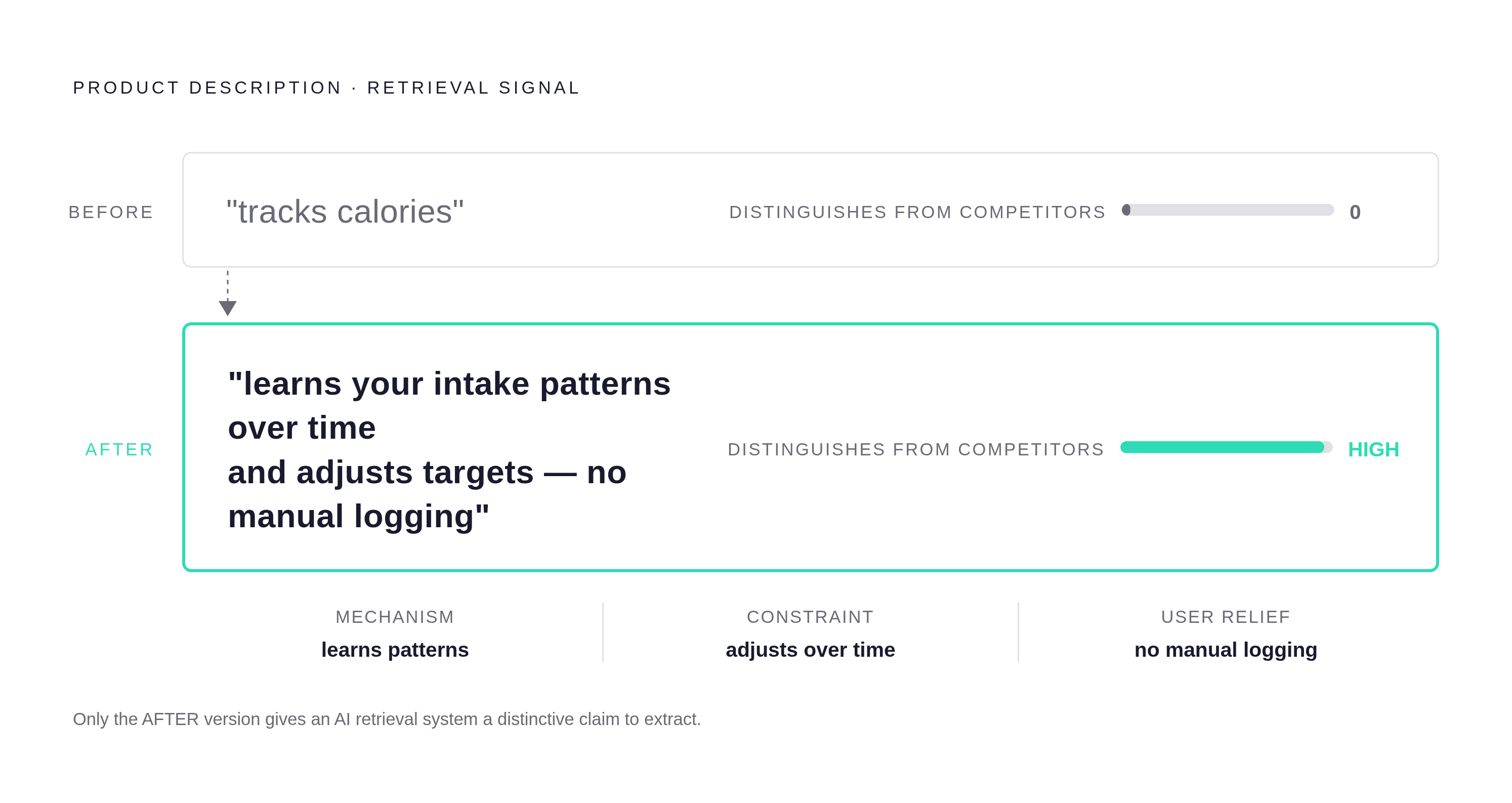
The practical standard is a claim that names a mechanism, a constraint, or an outcome. For the workout app, the before version is “tracks calories.” The after version, if it accurately describes the product, is “learns your intake patterns over time and adjusts targets without manual logging.” The second version explains how the product behaves. A paraphrase can shorten that explanation and still show how recording calories differs from adjusting targets without manual logging.
The lesson for a team rewriting its page is to remove the sentence from its surroundings and ask whether it still explains the product’s distinctive behavior. Does the reader know what adjusts, what the adjustment depends on, and what the user does not have to do? Those details give the claim its shape. Replacing “powerful” with another approving adjective would not supply the same information.
A second test asks which of the product’s ten closest competitors the opening sentence also describes accurately. If it fits every one, it gives an AI system no basis for distinguishing this product on that feature. Category language can help a reader understand the general purpose of an app. But the opening extractable passage needs to go beyond what these apps all do and explain how this product works.
Evidence can make that passage more useful without making it longer or louder. Citation research associates specific figures, named expert quotations, and cited external sources with higher citation rates. These give a claim something verifiable. For the workout app, the mechanism should move from paragraph six to the opening paragraph or the first sentence under the relevant heading. Supporting evidence can then substantiate the explanation, provided it is real and actually supports the claim being made.
How the third-party content ecosystem amplifies or dilutes the language you originate
A journalist or curator writing a product roundup often begins with the language the brand has already published. That makes product copy both text for visitors on the brand’s website and an upstream input to a content supply chain. The first description can shape a comparison entry, an earned media mention, or a guest contribution. Each becomes another possible retrieval surface. Precise language can travel through that chain, while generic language can be compressed into an even broader category label.
A clear mechanism on one domain provides a more limited set of retrieval opportunities than a claim that also appears in relevant coverage across trusted domains. Repeated encounters can strengthen the language’s presence across retrieval indexes. But repetition alone does not establish its truth. The useful goal is genuine coverage that retains the claim’s substance.
A specific claim, a named customer outcome, or a verifiable figure provides more usable material than a generic value proposition. The workout app’s adaptive-target mechanism gives a curator something concrete to explain, whereas “tracks calories” offers only a category label. The claim must be true wherever it appears. Distribution cannot repair an explanation that was vague or unsupported at its origin.
Shortcut tactics work against that standard. Fabricated third-party mentions, bulk-seeding Reddit, and reciprocal listing networks are detectable and violate platform rules. They also replace earned editorial attention with manufactured repetition. The durable approach is to make the underlying account specific and useful enough that another publisher has a reason to cite it. Whether that account then reaches AI answers is a separate question, and it requires measurement.
Measuring whether your precise language is actually reaching AI answers
A copy update is a hypothesis about future answers. Unless the team checks those answers afterward, it cannot tell whether the new wording reached the retrieved sources or stayed on its own page. The feedback loop needs to capture both visibility and description. An answer can cite the brand while still reducing the workout app to “tracks calories.”
Share of Model is a competitive measure of the brand’s share of mentions and citations across a tracked query set. The tracked set can span ChatGPT, Claude, Gemini, Perplexity, Google AI Overviews, and other major AI platforms. Organic search ranking remains a different signal. A page’s position in search does not, by itself, reveal how often an answer engine mentions the brand or what it says.
Tracking more than one platform matters because the number of citations can vary widely from one engine to another. The same brand can appear frequently on one and scarcely at all on another, making a single-platform report incomplete. For each query, the recommended record includes the cited URL, query wording, platform, and capture date. Those dimensions make changes interpretable. Without them, an overall figure for visibility can hide changes in which sources are cited.
Does the workout app now learn intake patterns and adjust targets without manual logging, or does it still merely track calories? If the category label persists, the revised language has not yet reached the passages supplying the answer. The cited URLs then show where to look, rather than sending the team back to schema by default. That is how a copy revision becomes an engineering discipline, with a claim, an intervention, and an observable result.