When "competitor keyword research" means a team pulls rival rankings, judges them against your site and writes the pages: what a technical B2B founder should test before trusting a rerun-on-a-schedule research service
Automation links the research steps but never validates them, so test each layer.

A competitor keyword research service that runs on a schedule can pull rival rankings, judge the gaps against your site, and write the pages. For a technical B2B founder, the test is whether its data, scoring, and editorial decisions deserve trust. Automation connects those decisions. It does not validate them. Before a recurring pipeline runs unsupervised, its assumptions need to be visible enough to challenge.
What a rerun-on-a-schedule competitor keyword research service actually does, layer by layer
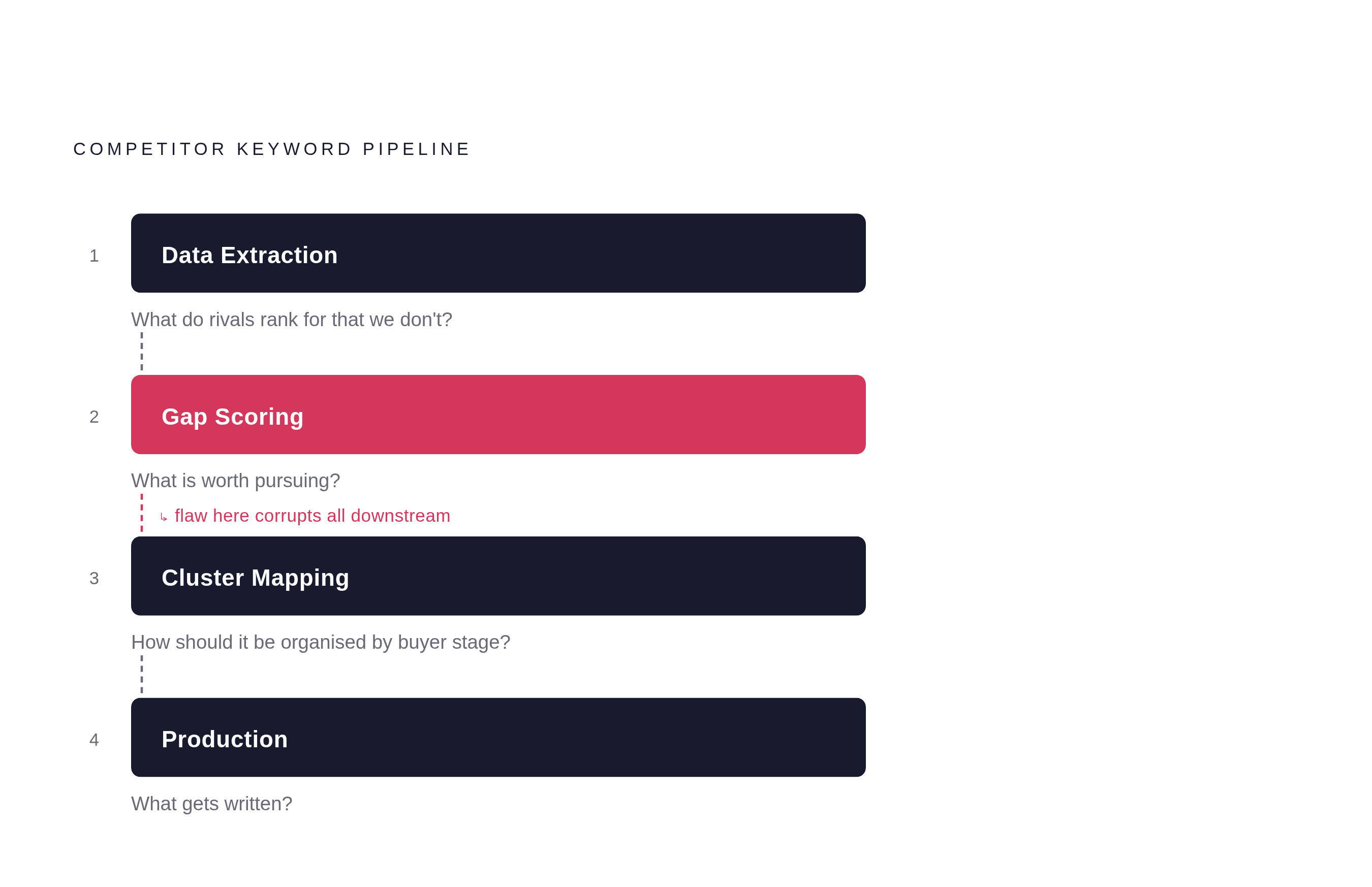
The natural assumption is that the service runs and pages appear. Behind that simple promise are four distinct operations, namely data extraction, gap scoring, cluster mapping, and production. Each answers a different question about what to publish. The first finds opportunities, the second judges their value, the third organizes them, and the fourth turns them into pages.
Data extraction uses ranking tools such as Ahrefs or Semrush to surface queries for which rival domains rank and the client does not. That creates a candidate set. Gap scoring then filters and ranks those queries by their commercial value, their ranking difficulty, and how likely they are to lead to a conversion. The service is moving from describing what competitors have to deciding what the client should pursue.
Cluster mapping groups related queries and assigns them to awareness, comparison, or decision stages so that page creation has an order. Production uses those choices to write the briefs and copy. A page therefore inherits more than a target keyword. It also inherits a view of the buyer, the competition, and the role that page should play. Separating these operations makes the service legible before any judgment about its quality.
Why each layer runs on a different clock, and why that mismatch is the first thing to test
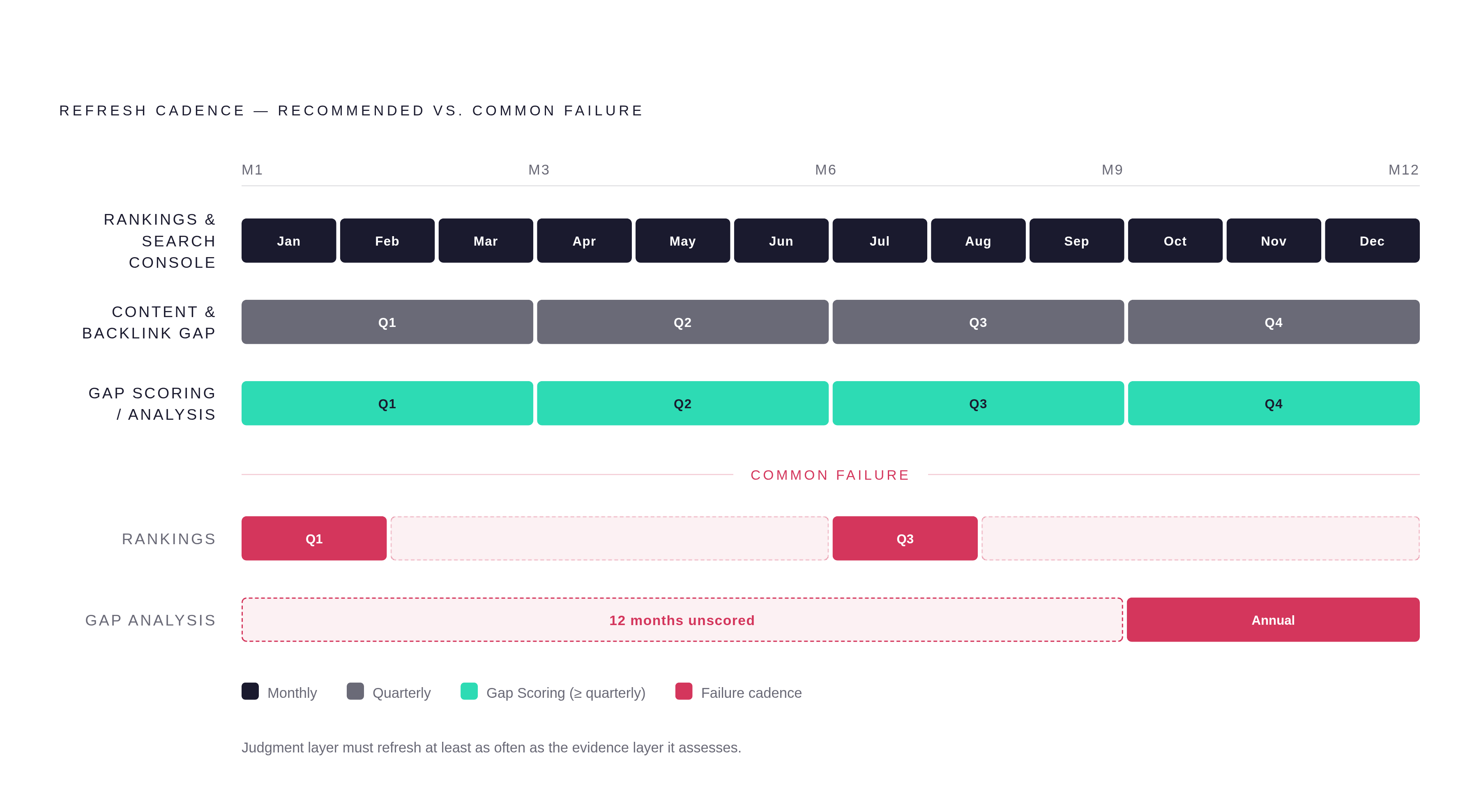
A founder buying scheduled research is not signing up to monitor it daily. The refresh logic has to work without babysitting. Yet an advertised “monthly” or “quarterly” cadence rarely applies uniformly to every layer. A new delivery date can sit on top of old ranking data or an older gap analysis, so the slowest relevant layer constrains how current the recommendation really is.
Competitor profiles keep changing as rivals publish content, change their campaigns, and earn backlinks. A quarterly snapshot cannot describe every intervening move. A sensible rhythm is monthly ranking-data and Search Console review, with a full content-gap and backlink-gap delta quarterly. But when rankings are pulled quarterly and the gap analysis runs once a year, the judgment layer falls behind the evidence it is meant to assess. More frequent reports do not repair that mismatch.
The first practical test is to ask for timestamps on each data layer in a sample deliverable, rather than accepting the report date as proof of freshness. Then ask what triggers an out-of-cycle refresh. If nothing does, a significant competitor move can remain undetected until the next scheduled run. That may be the service being sold, but the founder should know it before relying on the output. The first question to put in writing with any vendor is “what is the actual refresh interval per data layer?”
How the gap-scoring layer decides what is worth writing, and where its assumptions quietly break
Fresh inputs do not guarantee sound priorities. The scoring model embeds a theory of value. In B2B SaaS, that theory breaks when search volume stands in for buying intent, because a term with a few hundred monthly searches can generate more pipeline than one drawing tens of thousands. A single contract can be worth thousands to hundreds of thousands in annual contract value, or ACV.
Volume-first scoring tends to underweight comparison terms such as “X vs Y,” alternative terms such as “alternatives to X,” use-case terms such as “remote team time tracking,” and integration-specific terms. These queries can show what a buyer needs to do before buying. The useful jobs-to-be-done question is which job the buyer is trying to get done. A service should be able to explain how its score recognizes that distinction.
The score also needs a reality check against the actual top-10 results for every recommended keyword. A results page with no authoritative, purpose-built answer presents a different opening from one dominated by well-resourced incumbents. A neat score can conceal that difference. Even when volume and difficulty look good, the query can point to a buyer persona, company size, or procurement cycle that the client cannot serve. The founder’s test is whether the vendor discloses its scoring inputs and allows them to be overridden or weighted against an explicit ideal customer profile, or ICP.
The discovery surface the scoring layer ignores: AI answer engines as a parallel ranking system
Even a well-tuned Google scoring model leaves part of B2B discovery unexamined. In 2026, buyer research increasingly begins with conversational queries in ChatGPT, Perplexity, or Gemini. Those engines choose what to cite based on signals that differ from those in Google’s ranking algorithm. A service that measures only click-through opportunities is therefore working with an incomplete map of demand.
The unit of optimization changes with the channel. Traditional SEO centers on the page and its target keyword, while AI citation also depends on the passage, the brand as an entity, and the topic cluster. The two outcomes can diverge. A page can rank on Google without appearing in an AI answer, and a cited page need not occupy the corresponding Google position. Competitor research must therefore tell apart the rivals on page one and those cited for target queries.
For a founder evaluating a service, the test is whether its deliverable includes an AI-prompt keyword layer containing the conversational queries buyers actually use. A Google keyword list is not that layer. The research should also show which competitors appear in answers to those queries. Otherwise, the service cannot judge the citation gap it is proposing to close.
Content structured for citation uses self-contained answer blocks, including a direct answer, a quotable data point, and a statement of scope. When those elements sit within a narrative, they can be hard to extract. This is the narrower case for generative engine optimization, often called GEO, or answer engine optimization.
What the production layer inherits from the layers above, and why human review is not optional
Production turns upstream judgments into something public. If the gap score favors the wrong buyer or the cluster assigns the wrong purpose, polished copy does not correct the underlying choice. It can make the mistake harder to notice. A page may read smoothly while answering a question with little commercial value or working poorly for both search results and AI answers.
Named authorship, genuine first-person experience signals, verified factual claims, and E-E-A-T compliance require more than fluent wording. Structure also needs deliberate review. Placing the most specific, quotable claim at the opening of a section makes it easier to extract than burying it in the middle. A founder should not assume that a drafting system applies that structure by default.
The Princeton GEO study found that keyword stuffing slightly reduces AI citation visibility. Human review belongs before drafting as well as after it, with the reviewer checking the brief’s angle and recommended page structure to support a useful answer. Catching a structural error at that stage takes a few minutes. Finding it in finished copy can require a full rewrite.
The concrete test is a sample deliverable showing who reviewed the brief and who reviewed the final copy before publication. A general promise of quality control leaves that responsibility unclear. The founder can make a named human reviewer at both stages a contractual condition of the recurring agreement.
Why optimizing only the pages the service writes is half the citation surface at best
Human review improves owned content, but AI engines draw evidence from across the open web. The client’s domain is only one source. LinkedIn presence, podcast and conference appearances, third-party listicles, analyst inclusion, and industry publications also contribute entity signals. Even if its pages are good, a service that only writes pages cannot cover that whole citation surface.
High-authority domains tend to appear disproportionately in citations, but that does not establish a fixed set of trusted seed domains built into every model. Citation patterns are not a universal whitelist. The practical task is to identify which publications the engines treat as authoritative within the client’s vertical and secure mentions there. A deliverable that never names those publications leaves a potentially high-leverage part of the strategy untouched.
Entity recognition creates a less obvious dependency. Wikidata, an encyclopedia-adjacent registry, can help identify a brand through properties including instance of, product or material produced, headquarters location, and official website. Strong prose does not resolve every identity ambiguity. An entity verification check therefore asks whether it is clear which brand the content describes, and looks beyond each page as a source of facts on its own.
Technical access is a separate constraint. When AI crawlers time out on key pages, JavaScript-heavy rendering can keep them from reaching the content on those pages. Server-rendered HTML and correct robots.txt configuration for AI crawlers are basic hygiene. By contrast, llms.txt is an optional layer, with no large-scale, independent evidence that publishing one improves citation rates in ChatGPT, Perplexity, or Google’s AI features. The vendor test is whether the scope includes target publications, entity verification, and a crawlability audit, rather than presenting on-page production or an optional file as a complete visibility strategy.
How to tell whether the service's performance claims are measuring what actually matters
Performance reporting has to match the discovery surfaces the service claims to influence. Google Search Console rankings alone cannot do that. A credible tracking scope in 2026 includes ChatGPT, Perplexity, Gemini, and Google AI Mode or AI Overviews, as well as Microsoft Copilot and Claude. In SE Ranking’s 2026 study, Copilot is fourth and Claude is fifth in AI referral traffic, and Claude is growing fastest by percentage.
Citation visibility and referral traffic also need separate treatment. AI recommendations can help buyers find a brand without passing referral data, so later visits show up as direct traffic in client-side analytics. Not every influence becomes an attributable click. A service should make that gap clear when it reports the referrals it can see. Server logs can record AI crawler requests, but crawler access is not the same evidence as a buyer arriving from a citation.
GA4 offers a free baseline for the clicks that do retain a source. In Exploration reports, sessions can be filtered where session source contains “perplexity.ai,” “chatgpt.com,” “claude.ai,” or “you.com.” Those referrals show when people reach the site from AI platforms. They provide a downstream citation signal.
There is also a strong objection to treating GEO as an independent shortcut. AI citation builds on SEO. Chasing citations before fixing crawlability, E-E-A-T, and topical depth produces no lift, so those basics need to be in place before the service is judged against an AI citation metric.
Before signing, the founder can turn these tests into a written acceptance standard. It should document refresh intervals, scoring inputs and ICP controls, and the inclusion of conversational AI queries. It should also identify the brief and final-copy reviewers, define the off-site and entity-verification scope, and specify reporting across Google rankings and AI citations. The vendor can show how it meets each requirement.