When a content strategy agency says "we start from what buyers ask you": what a technical B2B buyer should be able to inspect before paying for the plan
Ask for the raw buyer questions, sample pages, and citation data first.

An agency’s promise to start from what buyers ask should be testable before a technical B2B buyer pays for the plan. The agency must show evidence connecting real questions to retrievable answers, reliable production, and measurable AI citations.
Why "we start from what buyers ask" is now a claims-bearing phrase, not just agency positioning
AI answer engines find and cite passages that answer the prompts buyers type. That makes a question-led plan structurally different from one built around keyword volumes. AEO, or answer engine optimization, shapes how a page is built so an engine can pull out a clean answer. GEO, or generative engine optimization, also requires attention to the wider sources from which generative engines form answers.
Most B2B teams need to plan for both. Researchers from Princeton University, Georgia Tech, Allen Institute for AI, and IIT Delhi formalized GEO in peer-reviewed research at KDD 2024. Bain found that a large majority of B2B purchases go to vendors already on the buyer’s “Day One List” before a salesperson becomes involved. As AI conversations help shape that list, the agency’s promise concerns whether a vendor enters consideration at all.
What the phrase actually commits an agency to delivering, technically
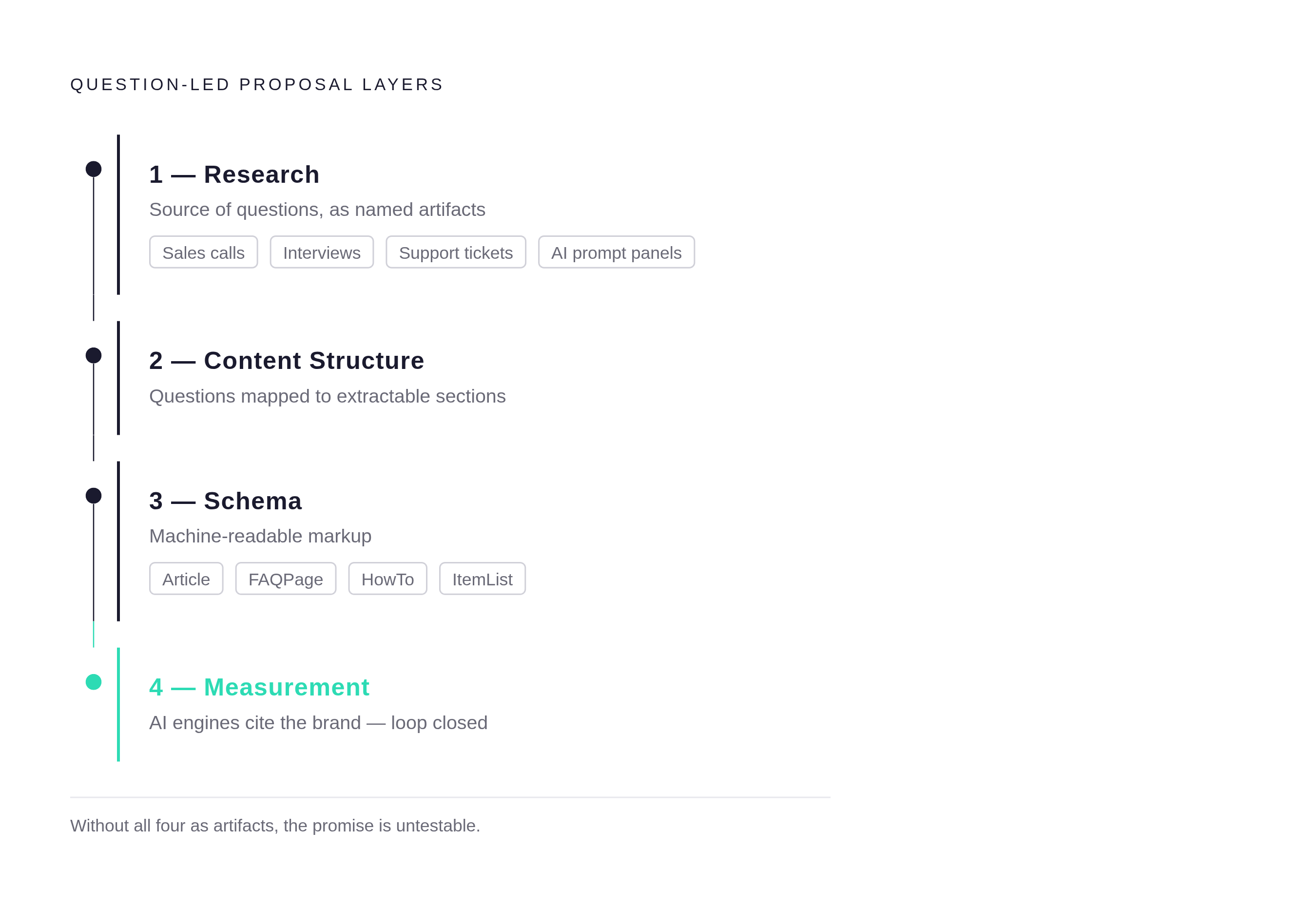
A credible proposal should contain artifacts for four layers, namely research, content structure, schema, and measurement. The research artifact documents where the questions came from, using sources such as sales calls, customer interviews, support tickets, or AI prompt panels. The structure artifact shows how those questions become sections that retrieval systems can extract. The schema artifact shows machine-readable markup appropriate to the content. The measurement artifact establishes whether AI engines actually cite the brand.
These layers give the buyer a practical way to inspect the scope. A collection of keyword-derived blog posts does not satisfy the promise, even if the posts are useful. The plan also needs to cover off-site sources, technical review, and upkeep. These requirements help keep the planned content accurate, easy to access, and visible after launch.
How to inspect the research layer: where the buyer questions actually came from
The first request should be direct. “Show me the raw inputs — what did buyers literally say, and where did you collect it?” Customer interview transcripts, sales calls, and support-ticket taxonomies give the agency records of what buyers said to work from. A keyword report or competitor audit may help explain the market, but neither proves what buyers asked. A persona document without primary data has the same weakness.
The division of work is important here. Research should be human-led, with AI supporting synthesis into a structured brief. If AI generates the presumed questions and a human merely polishes them, the agency has reversed that order. The plan may hold together even though it is not based on buyers’ words.
AI-engine research adds a separate source of evidence. It should show who gets named, which sources appear, and what phrasing triggers recommendations. Google Search Console data alone cannot show that landscape because conversational prompts differ from search keywords. Once the source questions are credible, the next test is whether the content structure puts them to work.
How to inspect the content structure layer: whether pages are built for passage retrieval, not just reading
Engines that use retrieval-augmented generation, or RAG, retrieve passages or sections. A readable article is therefore not necessarily an extractable one. Ask for a sample page or outline from a previous engagement. Does each section state its answer in the first two or three sentences? Does its heading name the buyer’s question, or just give a broad topic?
The next test is whether a section stands alone. A reader landing midway down the page should receive a complete answer without having to reconstruct earlier context. H2 and H3 headings should serve as semantic keys, and FAQ blocks should give 40–60 word answers to the questions found in research. Comparison tables and step sequences need proper semantic HTML for parsers as well as visual formatting.
An agency may defend long-form content as a signal of authority. Comprehensiveness can help, but it does not replace extraction-ready sections. A lengthy article with generic headings and buried answers leaves the retrieval system searching for the useful passage. Word count is not evidence that this problem has been solved.
How to inspect the schema and technical access layer: whether AI crawlers can parse what the agency builds
The strongest answer structure is of little use if crawlers cannot reach or parse it. Clean HTML, structured data, and accessible content belong in the scope. Ask the agency to demonstrate a rendered example from a previous client. The proposed baseline should include Article and FAQPage schema on GEO-optimized pages, with HowTo for step-by-step content and ItemList for listicles.
Most marketing buyers will not run a schema validator themselves. They can still ask for a demonstration. The agency should be able to put its sample URL through Google’s Rich Results Test and a schema validator, then explain the results. Missing or malformed markup is a delivery gap.
Is any critical answer behind a form or a JavaScript render that crawlers cannot reach? Material that remains inaccessible cannot contribute to the engine’s retrieved account of the category. A credible answer identifies what is accessible and shows the markup, rather than relying on the phrase “technically optimized.”
Why off-site surfaces matter as much as owned content, and what an agency should be doing about them
A large majority of AI citations come from sources other than a brand’s own site. Owned content is necessary, but it is insufficient. AI Overviews draw heavily from already-ranking pages, while ChatGPT and Perplexity place greater weight on earned media and freshness than on owned-site architecture. A plan confined to the client’s domain leaves those differences unaddressed.
The buyer should therefore ask which off-site surfaces the agency covers and what it will deliver for each. This work includes independent reviews, earned media placements, directory listings, and a presence on the major review platforms in the category. It can also include contributions to relevant community threads and pitches to publications that generative engines frequently cite. These are distinct deliverables.
The inspection standard is a defined scope. Which reliable sources about the brand need to exist, and which relevant sources already appear in the prompt panel? An answer limited to “we focus on your site” describes a narrower service than a complete GEO plan. The proposal should make that boundary visible before the buyer signs.
How to inspect the content production pipeline for a technical B2B category where errors have consequences
In technical B2B content, a made-up claim can harm trust. Writing well does not prevent that harm. Russinovich, Kumar, and Salem’s July 2026 Microsoft preprint audited tens of thousands of accepted papers from four selective computing venues and found hallucinated citations in the permanent scholarly record. References that looked valid had survived peer review despite pointing to no real work. An agency’s editorial assurance needs more substance than “a person reads everything.”
Ask the agency to name the human role at every stage. Research should be human-led with AI synthesis support, while outlining can be AI-led with human review. Revision and the addition of experience should return to human leadership. Reviewers’ authority to reject or revise needs scrutiny.
Arthat’s Hyderabad B2B SaaS case describes an editorial LLM pass with annotated reasoning, followed by human factual review and tone work. Humans also verify code examples before publication. Strategized.ai’s case on an industrial B2B supplier covers December 2025–August 2026 and reports zero retractions for a supplier with safety-critical specifications. That is a concrete outcome, though not proof that every claim was correct. Ask also for First-Pass Yield, the percentage of drafts passing automated guardrails without regeneration, because a low rate can reveal upstream prompt or model problems.
Why a plan without a freshness cadence is structurally incomplete
A publication calendar does not explain how a plan responds when its answers grow stale. Evan Drake’s April 2026 AEO measurement framework uses the term citation half-life to describe how AI citations decline over time. The framework argues for continuous optimization.
The proposal should name which pages receive review, on what schedule, and what triggers a revision. Triggers can include a product update, competitor movement, or a change in how engines answer a target query. It also needs a monitoring loop that detects citation decline. Without that loop, the agency has a schedule for producing content but no stated mechanism for noticing when its visibility fades.
Its changes include definition-led sections, structured comparison tables, sourced data, and AI-readable formatting. Ask for the refresh cadence inside the proposed engagement, rather than accepting it as an unspecified future purchase.
How to inspect the measurement layer: whether the agency can show whether the plan worked
Measurement should begin with a baseline before publication. Drake’s framework identifies four signal types, which are presence, citations, sentiment, and agent traffic. A credible agency should explain how its reporting covers each. Traffic alone cannot establish whether engines name the brand, cite it, or describe it favorably.
The central artifact is a fixed prompt panel run regularly across the target engines. Its report should show how often the brand is cited, where it appears in the answer, and its citation share against named competitors. AI referrals in Google Analytics add another view, with sources such as chat.openai.com and perplexity.ai tracked separately. Google added reporting specifically for generative AI performance to Search Console in June 2026. The agency should explain how it uses that reporting and how it accounts for the differences between signals.
Attribution still misses what is known as dark demand. A buyer may encounter a brand in ChatGPT and arrive later through branded search, leaving the earlier conversation invisible in standard attribution. AI-search impressions and assisted-influence signals can supplement the picture, but correlation should not be presented as a complete causal account. Ask whether reporting operates at topic or page level, and why. Then request a previous report showing the prompt panel, citation frequency over time, and competing cited sources.
The five questions to ask in the first agency meeting, and what answers disqualify a plan
The first meeting should turn these standards into five requests for evidence. First, ask where the buyer questions came from, what buyers literally said, and what the data source was. A keyword report, an unsupported persona, or a proprietary-methodology claim without an artifact does not qualify. The distinction is between evidence and a description of research.
Second, ask how a page the agency produces is structured for passage retrieval, requesting a sample and an explanation of what each structural choice does for a retrieval system. Word count, topic clusters, and internal linking do not answer it. The sample needs declarative leads, semantic headings, and self-contained sections. Third, ask “What off-site surfaces does your plan cover, and what are the deliverables for each? An owned-site-only answer or a general offer of link building leaves the citation surface unaddressed.
Fourth, ask to see the pipeline, including the stages at which a human reviews, their authority to reject or revise, and the agency’s First-Pass Yield on drafts. A blanket assurance about editors is insufficient. The agency should name both the review stages and the automated guardrails. Fifth, ask to see a measurement report from a previous engagement, including the prompt panel used and what citation frequency looked like before and after. A traffic or rankings report is not a substitute.
An agency that answers them with artifacts offers a program the buyer can inspect. One that substitutes methodology decks or inaccessible proprietary tools asks the buyer to pay for a claim that remains untestable.