When a "data-driven marketing agency" says it audits what your analytics count before it runs tests: what a technical B2B founder should test before trusting a measurement check done on someone else's weekly call
Five checks expose what a screenshared audit can't, and what GA4 never sees.

An agency’s claim that it audits analytics before running tests is a hypothesis. For a technical B2B founder, the way to assess it is to test what the stack counts, inspect what a screenshare cannot reveal, and establish what sits outside GA4 altogether.
Why an agency's "analytics audit" claim deserves the same skepticism you give a vendor's benchmark
On the weekly agency call, a shared screen shows GA4 property settings, a GTM container, and a list of events. The conclusion sounds straightforward. Tracking is solid, so testing can begin. But what does that walkthrough establish about the data that will decide whether the tests worked? A settings page shows only the implementation’s configuration.
That distinction deserves the same scrutiny as a vendor’s benchmark. An agency responsible for both the audit and the tests has a structural reason to find the stack clean enough to proceed, because deep breakage delays the engagement and raises questions about onboarding. This makes independent verification useful before accepting the agency’s findings. A founder otherwise hands over authority based on a process they did not witness, applied to a stack they own.
Why most analytics breakage is silent and therefore invisible to a surface scan
When tracking breaks, data often goes missing without an error. GA4 can silently ignore events whose names use hyphens instead of underscores, turning a convention familiar from CSS into a measurement gap. The events that do arrive can still look right. A screenshot of that list cannot show the business actions that never reached it, so apparent order is weak evidence of complete collection.
Consent introduces a different kind of missingness. Under Basic Consent Mode, saying no to consent blocks all analytics, while Advanced Consent Mode sends anonymous cookieless pings that cannot be grouped into users or sessions. Visitors who accept consent can still make the property look functional. A visual review cannot establish what happens under both consent choices.
Attribution can be wrong even when collection works. GA4’s default 90-day conversion window can misattribute conversions in a 90-day B2B buying cycle without flagging the setting as a misconfiguration. The window needs to fit the buying process. Likewise, the presence of a tag does not establish that it fires on the right action, fires once, or still fires after the last site update. These are coverage gaps in the method.
The five checks a founder can run before the next agency call
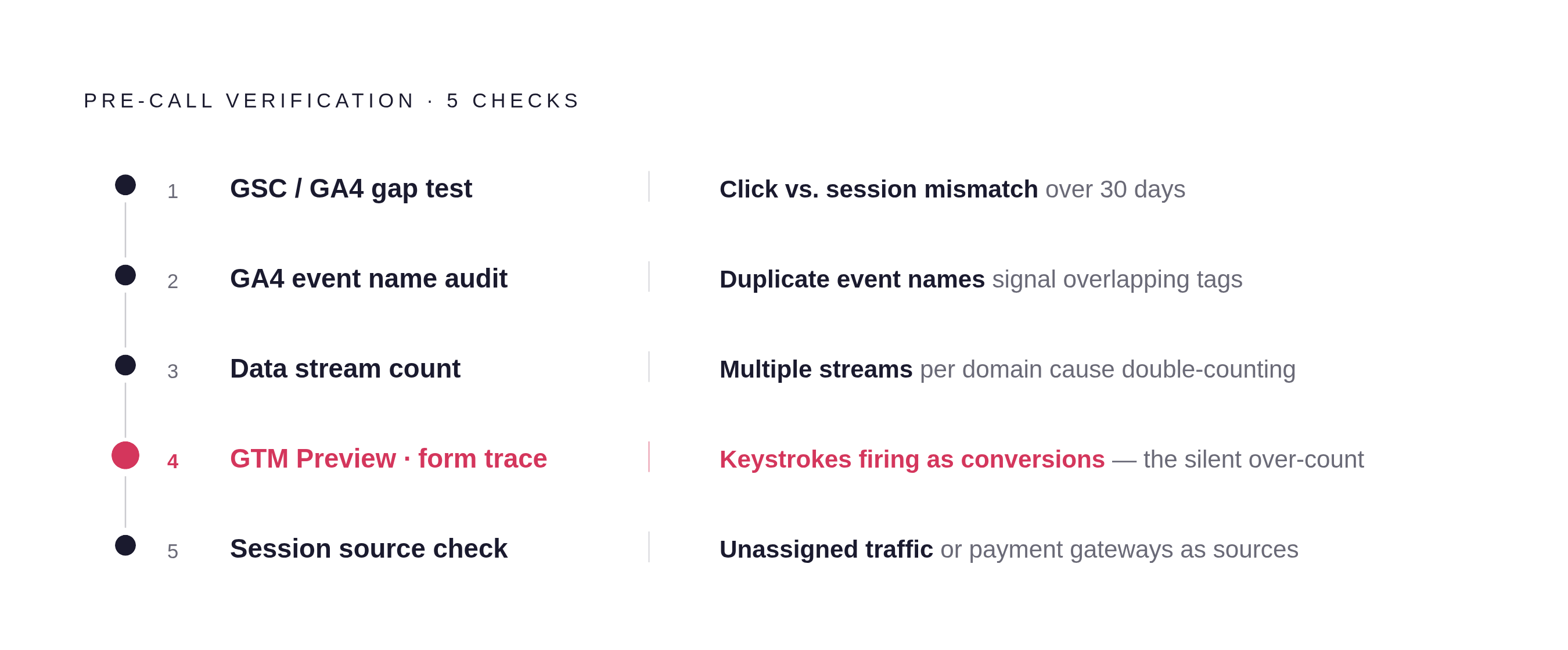
To test that coverage, run these five checks on the stack before discussing what the audit found. With read access to GA4, Google Search Console, and GTM, the protocol can take under an hour without container edit rights. Start with the GSC/GA4 gap test. Open Search Console and GA4 side by side for the same 30-day window, then compare total clicks in Search Console with total Organic Search sessions in GA4. This takes under five minutes and needs no GTM access. A gap needs an explanation before it can be taken as proof of a specific fault.
Next, inspect GA4 Events for multiple names describing the same action, such as lead_form_submit, formComplete, and submit_form. Similar names typically suggest overlapping implementations through plugins, theme scripts, and GTM. Names alone do not settle the question. Identify whether an important business action is absent entirely or represented by several plausible events with no clear authoritative one. That ambiguity belongs in the audit findings before any event becomes the basis for judging a test.
Then open the GA4 property settings and confirm that there is only one web data stream per domain. Multiple GA4 tags on the same page can double-count sessions and events, whether they come from duplicate GTM container copies, hardcoded tags, or CMS plugins. Even with a clean stream count, the same data can be collected twice. It establishes one part of the configuration that the later container review must connect to actual behavior.
For the fourth check, use GTM Preview mode to follow a form through to submit. The form-submission event should fire only on submit and stay quiet when someone starts typing or opens the page. An event that fires on a keystroke counts visitors who start the form and abandon it as conversions.
Finally, inspect GA4 session sources for a large share of “Unassigned” traffic or sessions attributed to payment gateway domains. Payment processors appearing as sources indicate missing referral exclusions, which break sessions mid-funnel and shift credit away from the originating campaign. Also compare traffic changes with the consent banner’s deployment date. A coinciding bounce-rate spike or session-count change is a signal to examine consent configuration and blocking on rejection. Because Basic and Advanced Consent Mode work differently, a consent-related change needs an explanation of what should happen as well as a cleaner chart.
What only direct container and account access can reach — and how to ask for it
The five checks show signs of trouble, but finding some of the causes takes a closer look. GTM trigger conditions control which element fires an event, whether it fires only once per session, and whether the rules leave out a large share of traffic. Browser and server deduplication needs a check of its own. The same action may be sent through both client-side GTM and a server-side container, something an events list cannot resolve on its own.
Other checks extend beyond the container into linked accounts and business systems. Google Ads conversion links need to use the intended GA4 events with the right scope, while custom dimensions and metrics need fields that hold data as well as definitions. Revenue needs an external reference. GA4 transaction revenue needs to reconcile with the order management or CRM system. A container walkthrough cannot substitute for that comparison.
To reach these checks without turning the relationship adversarial, request read access to the container and a co-working session in GTM Preview mode as a standard technical onboarding step. Frame the request around agreeing on the test baseline and what each event measures. That makes the founder a technical counterpart. The session should show how trigger rules match what happens and which checks on linked accounts still need to be done. Resistance to read access for the company’s own container on its own domain is itself diagnostic, because it prevents independent inspection of the proposed baseline.
The measurement gap that no GA4 audit covers: whether AI answer engines name and cite you
Passing all five checks still leaves a scope question. A technically clean GA4 setup does not measure category discovery that begins with a prompt to ChatGPT, Perplexity, Gemini, or Claude and ends without a site visit. A brand can rank first on Google for a category query yet be absent from AI answers to the same question. Rank tracking does not reveal that absence. Session-based analytics also cannot record an answer that names a vendor if no one clicks.
The engines also need separate treatment. Gemini, ChatGPT, and Perplexity draw on meaningfully different source pools, so a citation in one is not evidence of visibility in another. Repetition introduces another complication. The same prompt run twice on the same engine on the same day can return different sources, making a screenshared answer a single observation. Treating that one answer as typical makes the same mistake as assuming a tag fires correctly just because it is there.
For technical B2B audiences, engine selection also needs to reflect the buyer. Perplexity and Claude can have more weight among senior technical buyers than raw user counts suggest. Checking only Google AI Overviews gives a poor view of what that audience sees. This is a reason to ask whether the agency’s definition of measurement includes discovery that never becomes a recorded session, since GA4 addresses a different part of the journey.
What a measurement-complete audit actually covers in 2026
A measurement-complete audit in 2026 needs an analytics foundation that has been checked and AI citation tracking that follows a set routine. Neither layer substitutes for the other. The foundation covers event collection, duplication, form triggers, consent behavior, traffic sources, attribution windows, account links, custom fields, and revenue reconciliation. Its findings should separate how the stack is set up from how it behaves, with a closer look where the five initial checks cannot show the cause. The AI layer then tracks whether the brand is seen before anyone clicks.
For that layer, run a fixed set of buyer-intent prompts verbatim across each relevant engine on a fixed cadence. The prompts should reflect category-discovery language. Log whether the brand was named, whether it received a linked citation, roughly where it appeared, and which competitors appeared in the same answer. Repeat each prompt three to five times per engine per week before aggregating citation rate and share of voice. Repetition reduces the influence of any single answer.
Weekly is the minimum viable cadence. Monthly checks are too slow to catch a citation regression before it costs a quarter’s worth of influenced pipeline. Still, these figures describe performance only on the chosen prompt set. AI platforms do not share prompt-volume data, and their selection criteria remain opaque. When an answer blends sources without attribution, the weight of each source is also unmeasurable, so the audit should state those limits.
Content accessibility belongs in this scope as well. Most AI-native crawlers, including GPTBot, ClaudeBot, and PerplexityBot, do not execute JavaScript, making server-side or statically rendered content important. Googlebot is an exception because it renders JavaScript and feeds Gemini and AI Overviews. Named authorship with real entity signals, including Person schema and a verifiable LinkedIn anchor, provides a different kind of support. Off-site mentions in industry media and comparison sites add evidence from outside the company to what it says about itself.
Depth also differs from page-level optimization. An interlinked cluster covering a category comprehensively signals expertise in a way that a single optimized page does not. These content properties belong in the specification without becoming a promise that a particular page will be cited, because the selection process remains opaque. The audit establishes the condition of the system at a point in time. Ongoing instrumented measurement then reveals changes that a completed audit cannot anticipate.
The verification conversation to have before the next agency call
Once the five checks, access request, and AI citation baseline are in place, the conversation can move from reassurance to evidence. Ask what GTM Preview mode showed, including whether any triggers fired on the wrong event or more than once per transaction. A surface scan cannot answer that question. A technical audit should connect its answer to the trigger behavior it examined.
Next, ask how the attribution window matches the actual sales cycle and what the agency changed. Then ask which AI engines are being tracked and what the current brand mention rate is across them. An absent answer identifies a scope gap, while a single answer screenshot identifies a sampling gap. Both are more useful findings than a vague agreement that discovery is changing.
The goal is to establish a shared, specific baseline against which the agency’s work can be evaluated, with clean event collection, reconciled session counts, appropriate attribution windows, and a fixed AI tracking protocol. Measurement authority is worth handing over once that foundation has been independently verified. The agency then has a fair basis for demonstrating results, and the founder has a sound basis for trusting them.