A B2B landing page is an instrumented experiment, not a design: how to audit form position, scroll depth and tracking before you test a headline
Fix your tracking first, or a headline test measures noise.

A B2B landing page is an instrumented experiment. Before a headline test can give a useful answer, the page must pass a measurement audit covering traffic quality, scroll depth, form events, and traffic sources. Otherwise, a winning variant may reveal more about broken tracking than buyer response.
Why running an A/B test before auditing measurement is a sequencing error
Testing a headline before auditing measurement puts the visible change ahead of the system that will judge it. The instinct is understandable. A headline is easy to inspect and edit, while a missing event can stay invisible until someone looks for it. But if the measurement stack cannot distinguish a real conversion from a tracking error, the apparent winner gives the team no sound basis for action.
The cost grows with the test’s demands. Multivariate tests require the most traffic and the longest runway to reach significance, making unresolved instrumentation an expensive sequencing mistake. The corrective order is to audit the denominator, instrument scroll depth, verify conversion events, and segment traffic before writing headline variants. That order gives the eventual test a question it can actually answer.
How an inflated denominator corrupts every conversion rate before a test begins
A conversion rate depends on who enters its denominator. Raw session counts can include bots, crawlers, internal QA sessions, agency traffic, and tool-generated visits as well as prospective buyers. These visits do not behave like the intended audience. If they add sessions without conversions, they push the baseline down, while automated activity that also triggers conversion events can distort it in the other direction. A reported lift may come from a change in how much unwanted traffic enters the test, even if people have not changed how they respond to the copy.
The first audit action is to clean that base before locking a baseline. Known bot user-agent strings, internal IP ranges, QA and staging sessions, and tool-generated traffic from uptime monitors and link checkers must be excluded. The denominator’s cleanliness needs verification.
What if the page gets mostly paid traffic, and bots seem like a problem with display advertising? Paid search also attracts click fraud, and even small contamination can shift a low-volume B2B baseline enough to mislead the test.
What GA4's default scroll tracking misses and why the gap matters for B2B pages
GA4 fires its default scroll event at 90% page depth. On a long B2B landing page, that leaves most of the journey unexamined. A visitor who stops near the opening and one who reads through the value proposition without reaching that threshold do not give the team the same diagnostic information.
Google Tag Manager requires deliberate configuration of triggers at multiple incremental thresholds, but this is a one-time setup that serves subsequent tests. The thresholds show whether visitors stop early, stay through the middle, or reach the part where they make the final decision. That distinction changes the next question. When conversion is low, the team needs to look for different causes depending on whether visitors scroll a little or spend time deep in the page.
Early abandonment points the audit toward the H1, hero image, and page load speed. Mid-page engagement identifies a zone where a sticky CTA can help, while deep scrolling calls for checking whether the final CTA is prominent or buried under supporting copy.
How scroll data exposes structural problems that headline testing cannot reach
If the scroll curve falls away before the CTA, its position becomes a plausible bottleneck, regardless of how compelling the opening sounds. This is a structural question. The audit connects the location of the action to the part of the page visitors actually use, rather than treating every low conversion rate as a request for better copy.
An example involving a SaaS company shows another version of that problem. Its scroll data showed that visitors who engaged with an interactive ROI calculator mid-page converted at a multiple of those who scrolled past it. Making the calculator more visually prominent drove a substantial lift in overall conversion. The headline was not the intervention. The change brought an existing part of the page into clearer view.
That example does not prove that every page needs a calculator or a more prominent middle section. It shows why diagnosis must precede the choice of change. A headline test would not directly test whether the calculator was too easy to miss. By locating the friction zone first, the audit can reveal a layout change that a copy-only experiment would leave untouched.
Form view, form start, and form completion as three separate diagnostic signals
A completed form is the end of a sequence. Reporting only that endpoint collapses two questions into one, namely whether visitors encountered and began the form, and whether they finished after starting. The audit therefore needs three separate events. Form view records that the form entered the viewport, form start records interaction with any field, and form completion records submission. Without these distinctions, the team can mistake a visibility problem for resistance to the requested information.
The first part of the sequence concerns access and prominence. If visitors stop scrolling before the form, the scroll curve and form-view count expose a placement problem. If they see it but do not start, its visual prominence may be failing to invite interaction. Neither pattern automatically calls for fewer fields.
Too many fields, invasive questions, or a lack of reassurance near the submit button can create field friction or weaken trust. Surface’s 2025 B2B benchmarks identify partial submissions, including email addresses from visitors who start but do not submit, as a recoverable signal. Tracking starts makes that unfinished activity visible, though a start count is not itself the captured contact information.
More people complete shorter forms, but average lead quality is lower, while fewer people complete longer forms and lead quality is higher. Which outcome is preferable depends on what a qualified lead costs downstream. The team needs completion rates at each field count to judge that exchange. Neither short nor long forms are defensible simply because they look like a best practice.
Why a blended conversion rate is the wrong denominator for any optimization decision
Traffic sources bring different levels of intent to the same page. Visitors who come from paid search with high intent may be ready for an above-the-fold form, while those at the awareness-stage who come from content or social may need to see the value proposition before being asked to fill it out. Blending them erases that distinction. A headline test optimized for the total could depress paid-social performance without improving ABM performance, or do the reverse.
The aggregate rate is therefore a poor target for a source-specific decision. Segmentation belongs before variant design. Before writing a variant, the team must identify the source driving most of the page’s traffic and build the test denominator from that source’s sessions.
The pre-flight audit checklist — five conditions a page must pass before a headline variant goes live
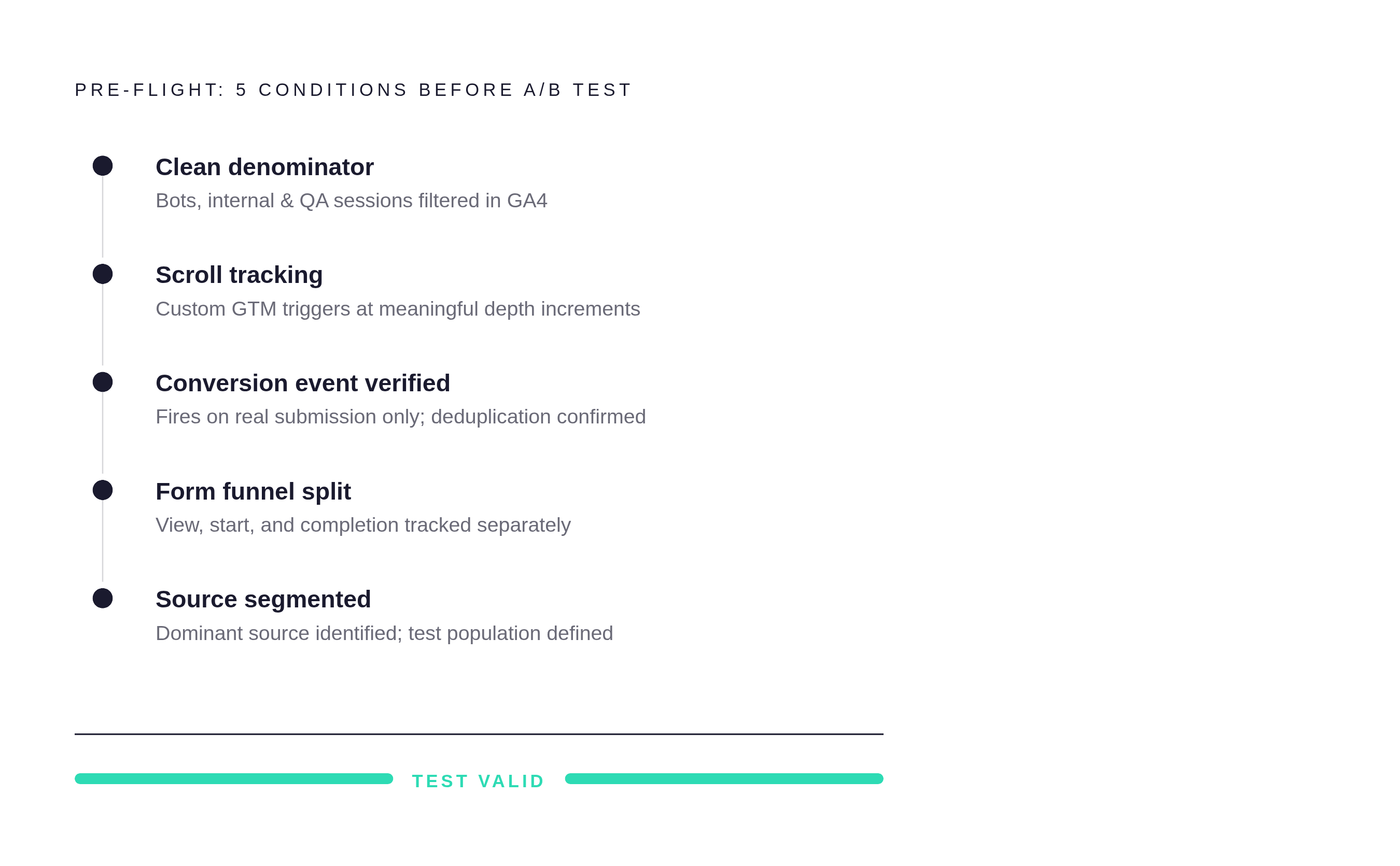
The page must pass all five conditions before a headline variant goes live. Although the instrumentation can serve many tests, its presence alone does not establish that a particular test is ready. The team must also have read the signals and defined the population.
The first condition is a clean denominator. Bot, internal, and QA sessions must be filtered in GA4, and the baseline must be calculated on human sessions only. This needs verification. The second condition is scroll tracking at meaningful thresholds, with custom GTM triggers firing at multiple incremental depths. The team must have read the falloff curve, identified the engagement zone, and distinguished a low-scroll problem from deep engagement that fails to reach an effective CTA.
The third condition is end-to-end verification of conversion events. The GA4 goal event must fire only on actual form submission. A test submission must appear in real-time event reports. Deduplication must also be confirmed so that refreshing a thank-you page does not inflate conversions. A conversion count is useful only when the counted action matches the intended goal.
The fourth condition is separate tracking of form views, starts, and completions. Both the view-to-start gap and the start-to-completion gap must have been read, with a probable cause assigned to each before copy is written. The fifth condition is source segmentation. Conversion rates must be broken out by source, the dominant source identified, and the test population defined against it. Only then does the headline experiment have a usable denominator, a valid event, and a defined population.
How AI-referred traffic raises the stakes for getting the measurement stack right
AI-referred traffic makes source identification more consequential because a small cohort can have unusually high conversion value. Seer Interactive’s case study found that, for a single B2B client, visitors referred by ChatGPT converted at a multiple of those from Google Organic. That is a bounded finding. It still shows how grouping AI referrals with other traffic can hide visitors who are especially valuable.
Identifying that audience requires more than reading the blended rate. Without UTM parameters, AI-referred sessions can end up in organic or direct traffic in GA4. Brands cannot control the UTM parameters on every URL that an answer engine cites. To extend the fifth audit condition to these visits, the team needs a referrer-based segment that catches sessions from known AI engine domains. This gives the team a way to examine the cohort separately rather than letting its behavior disappear into the total.
But referral measurement begins only after a visit. Whether a page can appear in an AI answer is an upstream question about machine-legibility, including structured data, clear entity signals, and retrievable facts an engine can quote. Pages cited by AI engines tend to contain specific claims, named sources, concrete figures, and direct statements. A page that an engine cannot interpret or quote may never enter this part of the experiment, however well it converts arriving visitors.
There is also a boundary to what analytics can reveal. Referrer segmentation captures only visits. Measuring whether ChatGPT, Claude, Gemini, and Perplexity name and cite the page requires a separate monitoring layer. Both views are needed for a complete picture. Otherwise, the team risks confusing a lack of measured visits with a lack of visibility.
What the audit produces that a winning headline variant cannot
A winning headline answers one question under one set of conditions. An audit produces infrastructure for the questions that follow. Once the page’s measurement foundation is sound, subsequent tests can use it without reopening every uncertainty about who visited, what they saw, and whether they converted. That makes future testing cheaper, faster, and more trustworthy. The benefit lasts beyond the first change.
The audit can also identify work that a headline experiment could not evaluate. A misplaced CTA, an overlooked form, or a traffic-source mismatch may explain the poor result before any variant is needed. Finding that obstacle saves the traffic budget that would have gone into testing copy over an unresolved structural problem.
Teams that repeatedly test against unexamined tracking can accumulate apparent winners without reliable knowledge to build on. An audit-validated test instead adds evidence to a stable foundation, making the next decision easier to frame and interpret.