Account-based marketing as a query, not a campaign: how small teams can run ABM as code
Small teams can run ABM as a live, evidence-checked filter.
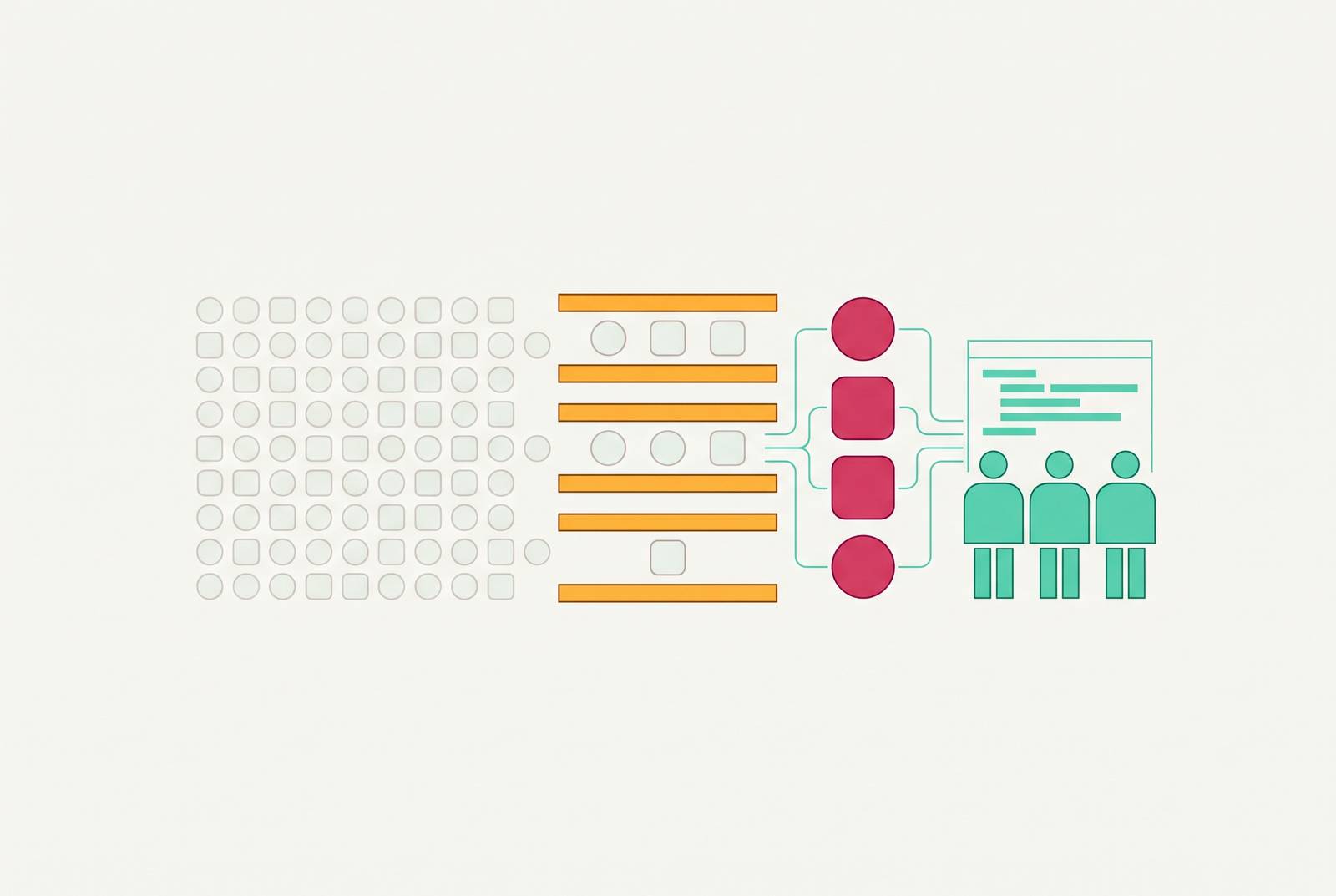
For small technical teams, account-based marketing works better as a query to maintain than a campaign to launch. The account list becomes a filter over changing evidence, with a checkable reason for every company it includes. That shift connects targeting, automated outreach, and AI-answer visibility in one system that continues improving through feedback after a campaign ends.
Why ABM as a campaign model breaks down for small technical teams
The account list is already wrong by the time it ships. Between approval, enrichment, and activation, the conditions that justified including some companies have changed. Yet the campaign proceeds against the approved document because that is what the process produces. The list records a past market state.
Classic ABM assumes teams have dedicated coordinators, help from an agency, and time to plan each quarter, all of which small technical teams lack. The manual loop of pulling, enriching, approving, and campaigning consumes that missing capacity. For a constrained market of fewer than 20,000 qualified companies, incomplete coverage and stale priorities can leave meaningful revenue out of reach. Worse, without a stated reason for inclusion, disagreements over the list become contests of opinion that evidence cannot settle.
What it means to treat an account list as a query rather than a document
A query turns that frozen judgment into a filter that keeps checking the evidence. Each account is on the list because it meets clear conditions, and it drops out when those conditions no longer hold. Inclusion becomes a claim that can be checked. The list is the query’s result.
This is more than an engineering analogy. The system has data inputs, filter logic that sets out the criteria for an ideal customer profile, and triggers that respond when those conditions change. Its behavior can therefore change without waiting for another planning meeting. A Tier 2 account showing several intent signals can get Tier 1 treatment for the next few weeks without someone having to make a new decision.
What remains for people to decide? They define which evidence counts, what combinations justify a change, and what treatment follows. Automation uses those human judgments the same way each time. That distinction makes the qualification logic something a team can inspect and revise, instead of leaving it scattered across conversations.
The observable signals that make account qualification a data engineering problem
A query without reliable inputs is only a hypothesis. First-party behavior provides some of the strongest and cheapest evidence, including repeat visits to pricing, comparison, or demo pages. Multiple people from the same account engaging within a month can add weight, as can event registration from the buying group. MarketTempo treats several such signals firing together as a reason to move an account up a tier. The combination is more useful than an isolated visit.
When a company is hiring for work that points to the problem a product solves, that is a condition a team can check even before a buying conversation starts. It is a leading indicator. Paying-customer lookalikes can help find other companies to assess, while what those companies are doing now helps show whether they fit and whether the time is right.
AI-crawler activity is a new input, but teams need to take care when deciding what it shows. Crawler activity and evidence that an account’s buyers are researching through AI assistants are not interchangeable. Qualification depends on whether the available evidence supports a research-stage inference about that account. An observable event should not become a stronger claim than the evidence permits.
How to build the TAM map and qualification prompt that anchor the query
Before qualification comes coverage of the total addressable market. The goal is to capture 90%+ of that market before filtering, because a narrow initial pull excludes companies the query never gets a chance to assess. Combining three or more source types helps close the gaps. General prospecting databases, lookalike tools, specialized databases, and web scraping each find accounts that other sources miss.
The build sequence should then merge and deduplicate records before running qualification. Duplicate companies waste AI research compute and distort scoring. Only after that cleanup does the qualification prompt evaluate each company’s website content and available data. It expresses industry fit, product fit, firmographics, technographics, and account-fit signals as conditions.
For an AI coding tool, for example, the prompt would express what makes a company a suitable customer and which available evidence supports that judgment. Relevant open roles could form one condition if they imply the problem the tool solves. The category is not the essential part. The same structure lets another ideal customer profile become a set of explicit tests without borrowing criteria that do not fit it.
The prompt should be version-controlled and back-tested against closed-won accounts. That lets a team review changes to qualification logic that might otherwise go unseen as someone changes how they do research. The same prompt structure should work for both the first qualification and later re-qualification. Otherwise, the system starts with explicit rules but drifts back toward manual interpretation as accounts change.
Turning signal changes into automated plays without a campaign calendar
Once qualification can change, action can follow the change. A play fires when a named account crosses a threshold, whether that means several intent signals in one week, a relevant new hire, or a pricing-page visit from the buying group. The threshold replaces the launch date.
Five play types cover most of this motion. A heating-up alert gives the account owner the supporting signals and a suggested next message. Buying-group retargeting adds engaged contacts and their colleagues to an audience that gets content suited to their roles, while a sales-assist sequence gives engaged contacts a short, personalized email sequence and a next step that fits. Event follow-up connects outreach within a day of attendance to the session content. Re-engagement reaches closed-lost or stalled opportunities when new activity appears.
Speed is part of the mechanism. Mighty & True describes wiring engagement spikes at named accounts to sales tasks, bringing those tasks forward from the following week to within minutes. A team using that model acts while the evidence is current.
Why AI answer engines are now a signal source and a distribution channel simultaneously
A target-account buyer asking Claude or Perplexity “what are the best tools for teams like mine?” is expressing purchase intent. An answer can shape the shortlist before the buyer visits a vendor site or opens a search bar. That makes AI answers part of the account journey. A targeting system that tracks only site visits can miss this earlier stage of discovery.
Generative Engine Optimization, or GEO, addresses whether a brand gets cited in responses to queries in its category. Research by Princeton, Georgia Tech, and IIT Delhi introduced the term and was published at ACM KDD 2024. For ABM, the practical connection is two-sided. AI research behavior can inform qualification where it is observable, while cited content provides a way to reach buyers conducting that research.
Search rankings do not settle this question. Content built to rank does not automatically get cited, and visibility differs across ChatGPT, Perplexity, Gemini, and Claude. ChatGPT draws mostly on its training corpus for non-browsing queries, so facts that stay the same across independent sources matter especially for that route. A prominent result in one engine says little about absence from another.
For a small team, GEO visibility therefore becomes part of the qualification and play-selection model. Evidence that buyers use AI-answer environments can justify a different play from evidence of traditional search behavior. Category-level citation visibility supplies context for that decision, though it does not itself establish what a particular account’s buyers have seen.
What actually determines whether an AI answer engine cites a brand
Citation follows three distinct routes, each with different requirements. Training data favors facts that independent sources repeat in the same way. Retrieval, including retrieval-augmented generation, rewards standalone chunks that answer a query directly. Live search and browsing favor pages that are fresh, load fast, and can be crawled. The route changes what content must accomplish.
Where that content lives is just as important. Across the benchmark described in the notes, the strong majority of URL-grounded citations point to sites the brand does not own. An owned website is therefore only part of the citation opportunity, even for well-cited brands. This supports publishing on third-party surfaces such as LinkedIn, Reddit, industry publications, G2, and Trustpilot. Profiles on platforms that AI systems already cite are also associated with higher chances of ChatGPT citation.
What makes the content credible once it is available? Relevant signals include named authors with verifiable expertise, primary data, sourced claims, and depth on the topic. Thin pages that repeat common knowledge provide less to ground an answer in. For fast-moving subjects, recency also influences citation, so a single substantial page cannot substitute for an ongoing publishing cadence. These are conditions a team can work on, with citation in any particular answer still uncertain.
The two-site content structure that makes a brand citeable at scale
Those requirements call for two connected publishing layers. The ground site is the owned domain, serving human readers and AI crawlers through comprehensive schema markup and structured content. Its dedicated citation layer has answer units built to give direct, sourced answers to buyers’ questions alongside an in-depth explanation. The answer unit makes a claim usable on its own. The explanation around it gives readers the reasoning and context they need to judge the claim.
The phantom-site layer extends that work across third-party citation surfaces rather than leaving the owned domain to do everything. It includes consistent entity information across LinkedIn, Reddit, and industry publications, profiles on Trustpilot, G2, and Capterra, and a Wikidata entry with machine-readable properties. Consistency connects these representations of the brand. This layer addresses the fact that AI systems often ground their answers outside a company’s own website.
A multi-stage AI content pipeline with human review makes the architecture manageable for a small team. AI drafts on a cadence, human editors check accuracy and strategic fit, and the pipeline routes content to the appropriate surface. The same system supports the owned blog and third-party placements. It is not prompt-and-publish.
Review effort should follow content risk. Subject matter experts review thought leadership and category-defining claims, while standard blog content is checked for facts and for how well it fits the strategy. Content for the social layer gets a brand voice check. Each stage shapes the content for where it will appear, and review actions are logged for provenance. On the owned site, measurement then extends beyond organic traffic to citations, engagement depth, and conversion.
Measuring whether the query is working: account movement and AI citation as one scorecard
That publishing system needs the same feedback as qualification. Without measurement, automated targeting can become a static list with extra steps, while content production becomes activity without a demonstrated contribution. The CFO-alignment test asks whether a metric can support forecasting. Mighty & True identifies win rate, ACV, and cycle time for ABM-targeted accounts versus the rest as the measures that survive budget review.
Citation visibility runs beside those commercial measures. A consistent set of category-relevant purchase-intent prompts should track brand visibility across ChatGPT, Perplexity, Gemini, and Claude. Each engine needs its own view. Source-level citation overlap is low, even though brand-level mention overlap is higher, so a cited URL in one engine does not predict citation in another.
Perplexity is among the more reliable engines for trackable referrals in GA4, although stripped referrer headers cause some visits to appear as direct traffic. That limits attribution without making it useless. Citation tracking shows whether the brand appears in answers, while engagement and conversion help assess what follows where a referral can be observed.
The two measurement surfaces meet when an account heats up while the brand remains absent from AI answers in its category. If that account’s buyers use those environments, the gap concerns the place where their shortlist may form. The team should instrument the system, compare its results, and change its qualification and publishing rules on evidence. A campaign ends, but a maintained query uses the next round of evidence to improve the next decision.