The B2B Buyer Journey Has Moved Into the Model — Here's What Builders Should Do About It
AI models now decide which vendors buyers consider before sales gets involved.

The B2B buyer journey has moved into AI models, where vendors can win or lose a place on a shortlist before sales receives an inquiry. For builders, the response is an engineering discipline. It means structuring what gets published, testing whether models cite it, and feeding those results back into a system that runs continuously.
The vendor shortlist now forms before any seller knows the deal exists
A buyer types a category prompt into an AI model and gets a named shortlist. They cross-reference the options on Perplexity, visit two or three vendor sites, and contact the vendors that remain. By the time a seller receives an inquiry, the buyer has already compared alternatives inside systems the seller cannot see.
That sequence changes what it means to be discoverable. Traditional search and review sites showed buyers more candidates and left them to work through the options. An AI answer can do much of that narrowing directly, presenting a small set of named vendors. A vendor left out of that answer may never reach the stage where its website or sales team can make a case.
The timing is important because AI-assisted research is not confined to initial awareness. LLM use peaks in the middle of the journey, when buyers compare vendors and decide which deserve closer attention. Different models also serve different moments in that research. A model must therefore name a brand when a buyer is choosing between plausible options, beyond knowing that the brand exists.
This shift in the buying process is already underway. Later conversations begin with a field of candidates that may already be sharply reduced. A strong sales process can work only on the opportunities that reach it. Understanding how a vendor enters that field is now part of understanding how demand becomes a deal.
Why traditional attribution cannot see most of the decision
Traditional attribution cannot see the comparisons that drive a buyer’s choice inside private AI sessions. A buyer can ask for recommendations, test objections, and narrow a shortlist without producing a visit to any vendor’s website. Most of those sessions generate no referrer data. The missing signal is structural.
What, then, does a form fill actually reveal? It shows that someone reached the point of contacting a vendor, but not which alternatives the model excluded or how its answer framed the remaining options. Session counts and marketing-qualified lead volume have the same boundary. Treating them as a complete account of influence gives the final, observable steps too much explanatory weight.
Those measures still describe useful events. The problem arises when teams use them to judge whether they are present at the moment buyers assemble a shortlist. A vendor might receive an inquiry after an AI answer recommended it, yet have no attribution record of that recommendation. A vendor left out of the answer cannot count a website visit that never happened. Neither case is resolved simply by improving the reporting around existing traffic.
The needed signal is a citation-rate metric. It measures how often, and in what context, major models name and recommend a brand in response to the category queries buyers actually send. Context is essential because being mentioned as one option is not the same as being recommended for a particular use case. This measure cannot show a buyer’s private session or prove that a citation led to a sale. Instead, it tests whether the brand appears in the kind of answer that shapes the shortlist, making an otherwise hidden stage partly observable.
Being cited by an AI answer engine and ranking on Google are different jobs
Similarweb’s analysis finds that Google search results and AI platform citations share few of the same sources. A brand can therefore do well in traditional search while rarely appearing in model-generated recommendations. The distinction is not merely a new reporting category. It reflects differences in what the systems select and how they use the selected material.
Those differences also exist between AI platforms. ChatGPT favors Wikipedia and authoritative editorial sources, while Perplexity notably cites community forums, especially Reddit, although editorial publications make up its largest citation category. Google AI Overviews favor top-ranked pages, YouTube, and Wikipedia. These are tendencies that vary by platform and answer. A single content format cannot serve all three equally well, because the source environments from which they draw are different.
This is where Generative Engine Optimization, or GEO, becomes a distinct task. It is the practice of structuring content and building brand authority so that AI-powered platforms select, cite, and surface a brand in responses to user queries. In the B2B journey, these queries include requests to compare vendors, recommend tools, or find sources to trust in a category. The target is the model’s answer. Ranking a page may help in some settings, but it does not establish whether that page will supply the evidence for a recommendation.
The unit of selection also changes how content needs to be built. Similarweb’s GEO guide states that “AI engines retrieve passages, not pages” and recommends opening each section with a standalone answer. That is the logic behind BLUF, or Bottom Line Up Front. A passage that answers the question directly can be extracted without requiring the rest of the page to explain what it means. A long introduction that buries the answer is more likely to be skipped.
Make the answer clear before developing its qualifications and evidence. A careful buyer still needs those qualifications, especially when comparing tools for a specific use case. Each passage needs to be useful on its own without flattening the larger argument. Because source authority and passage structure both shape what models choose, GEO needs a plan that goes beyond a few edits to otherwise unchanged SEO work.
What an engineering approach to AI citation actually looks like
A citation system needs defined inputs, structured outputs, and observable behavior. Its inputs are the category and comparison questions buyers ask, together with the evidence available to answer them. Its outputs are content and source presence built for those questions. The design target is vendor shortlisting. That focus gives the system a purpose against which proposed content can be judged before production begins.
For a team building this system, the first distinction is between brand-controlled content and third-party presence. Owned pages allow direct control over answers, evidence, and structure, while reviews, community forums, earned mentions, and category publications provide other places from which models may draw citations. Neither layer can stand in for the other. Research is mixed about their relative weight, with some studies finding third-party sources dominant for branded queries and others finding a majority of citations going to brand-controlled sources. The practical response is to build presence across sources models already treat as authoritative, rather than assuming owned-page optimization is sufficient.
Presence across Wikidata, Wikipedia, and multiple third-party platforms is associated with materially higher citation likelihood, while content structured for chunk extraction compounds that effect. These are different functions within the same system. One helps the brand appear across sources, and the other gives the model a passage it can use as an answer. Comparison tables and clear named-entity positioning are especially relevant at the shortlisting stage, where the buyer is asking which vendors fit and how they differ.
Original research gives the system something more substantial to publish than another version of an existing answer. Proprietary data with sourced statistics can create a fact that a model needs to attribute when discussing a trend. Attribution is not guaranteed, however. Publishing research and checking whether it earns citations are separate tasks because even a brand that owns the data may get no credit in an answer.
The highest-leverage human review comes at the outline stage, before thousands of words are committed. An editor can judge whether the proposed angle answers a real buyer query or simply adds another page on a familiar subject. A pipeline can automate production while reserving human judgment for the point where a weak premise is still inexpensive to change. Autonomy and quality are not opposites when the system places review deliberately.
Answer-first construction should then be a pipeline default. Direct answers up front and tight paragraphs make extraction part of the output’s design. The first portion of a page deserves particular attention because it has disproportionate weight in citation behavior. But structure alone cannot establish success. The system still needs to observe whether models select the material and whether they use it in the intended comparison context.
Measuring AI citation as an ongoing operational discipline
AI share of voice on buyer recommendation prompts is the most direct measurable proxy for presence in this hidden stage of the funnel. It needs active testing because passive analytics cannot show recommendations that lead to no referral. The measurement layer must send models the kinds of queries buyers send and check the answers. The dashboard can display results, but it cannot create the missing observation.
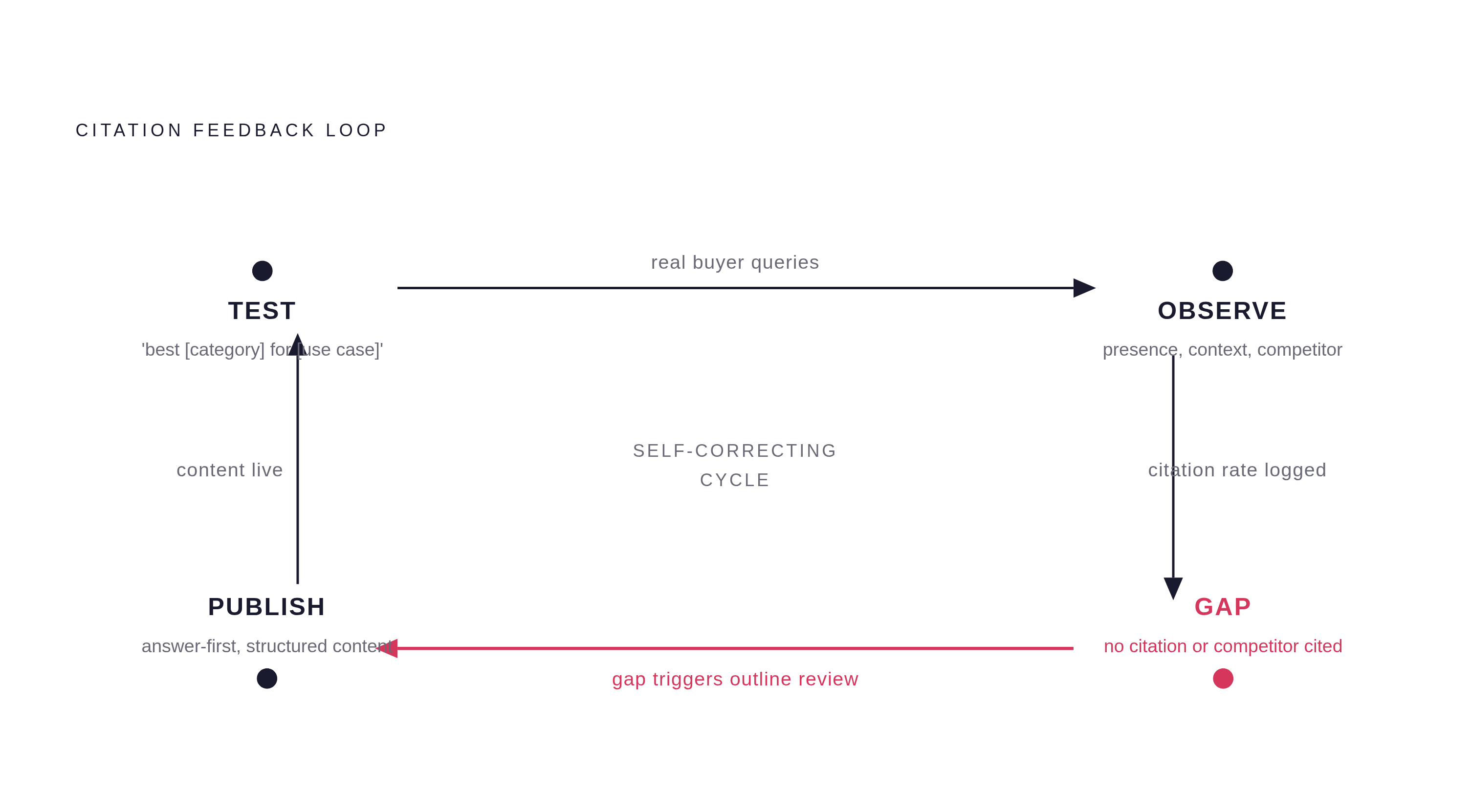
The test queries must reflect the shortlisting task. A prompt such as “what is [brand]” asks whether the model can describe a named company. More revealing prompts include “best [category] tools for [use case]” and “compare [brand] vs [competitor]”. Another is “which [category] vendor is most cited by practitioners in [vertical]”.
The resulting answers need to be read for both presence and context. Does the model name the brand, recommend it for the requested use case, or cite it as evidence? Those outcomes should not collapse into a single undifferentiated mention count. A citation rate is useful only in relation to the questions being tested and the models answering them. Otherwise, a high count may reward mentions that have little to do with how buyers choose their shortlist.
That observation also has to continue over time. Citation behavior differs by model and shifts as models are updated and new training data is incorporated. A brand cited today can drop out of answers without warning. Checking once a quarter cannot keep up with those changes. Continuous monitoring makes changes in recommendation behavior an operational concern rather than a surprise discovered after a publishing effort has ended.
The measurement layer must then feed back into production. When a prompt class returns no citation, or returns a competitor citation instead, that gap triggers a content task tied to what the buyer is asking. The task passes through outline review and the structured publishing pipeline, after which testing observes whether citation behavior changes. A system without that instrumentation cannot tell whether its output is working. Like monitoring a production service, this is an ongoing function whose next action comes from its observed behavior, closing the loop from buyer query to publication to model answer and back again.