AEO and GEO aren't content strategies — they're engineering problems
Schema markup and crawler access matter more than content rewrites for winning AI citations.

Getting cited by AI answer engines takes engineering work as well as good writing. Answer engine optimization, or AEO, and generative engine optimization, or GEO, depend on a pipeline that can fail before good prose gets a chance. Durable visibility comes from finding the failed stage, repairing it, and measuring whether the repair changed the answer.
Why AI answer engines fail to cite you — and why it's not a writing problem
The copy is fresher, the FAQ is longer, and the keywords have been adjusted. Yet the brand still does not show up in AI-generated answers. What, exactly, would another rewrite fix? That question changes the diagnosis from whether the page reads well to whether the system can reach, understand, select, and use it. Those are separate tests, and better writing cannot resolve every failure.
Some answer-generation systems bring retrieved material into the process of generating an answer. That process has several points of failure. A crawler may not reach the page, parsing may fail to show what it means, or entity resolution may leave it unclear which brand the page describes. Even when those steps succeed, the engine may decline to cite the page or use very little of its content.
AgentGEO, from Virginia Tech and Zhejiang University, formalizes citation failures into a taxonomy that maps each failure to a pipeline stage and a targeted repair. A failure at crawler access needs a different intervention from a failure in how selected content enters an answer. Applying a broad rewrite to both is like repainting a car that will not start.
How the decoupling of Google rank from AI citation changes what you need to measure
A strong Google position no longer reliably predicts citation in an AI answer. Organic search sessions and AI platform traffic are diverging, while AI referrals, though a smaller share of sessions, convert at a much higher rate. For B2B SaaS and developer-tool buyers who use AI for tool discovery, an answer can become part of product evaluation.
This changes what a team needs to observe. A ranking report can show how a site does in search without showing whether an AI engine names the brand, links to its material, or uses its explanation. Teams now need to consider both where the page appears and what role it plays in the generated response. Those outcomes need their own measurements.
Google performance remains relevant, and one channel cannot stand in for the other. Teams optimizing for search rank and teams optimizing for AI citation need different feedback loops and, increasingly, different decisions about their content. Without that split, a search report that looks good can hide a failing AI retrieval pipeline.
The four pipeline stages where citation actually breaks
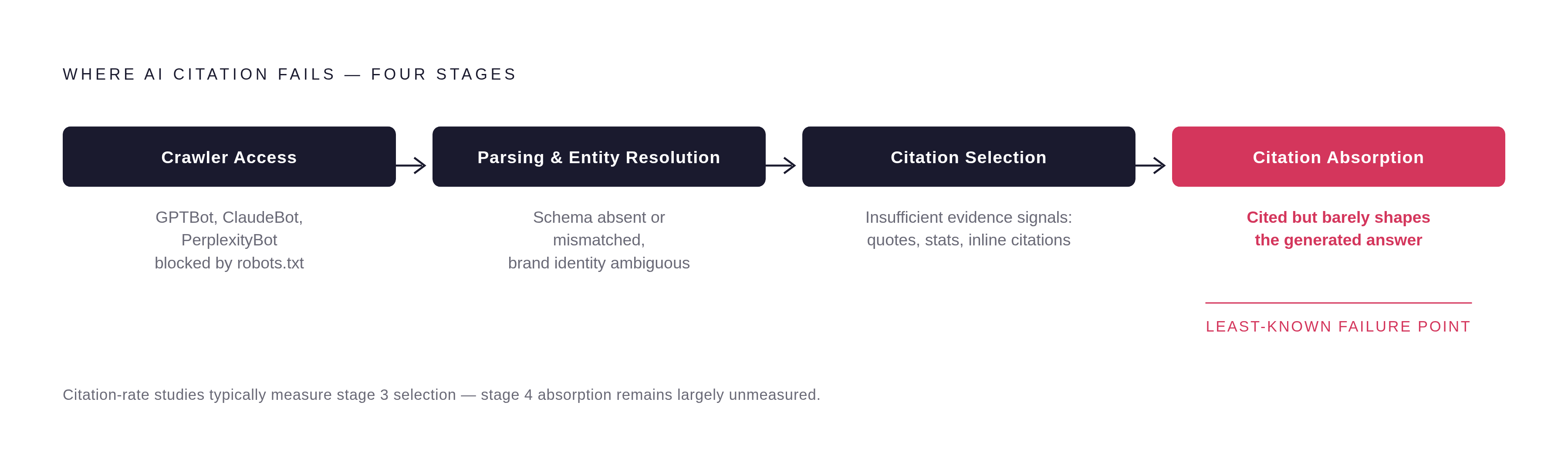
The first stage is crawler access. Can the system reach the intended page at all? GPTBot, ClaudeBot, and Google-Extended respect robots.txt directives, while PerplexityBot’s declared crawler also documents compliance. Perplexity has also been documented using undeclared stealth crawlers that evade robots.txt, so declared behavior does not describe every access path. Even so, the first check is simple: whether the site’s own directives block the systems it wants to reach.
The second stage is parsing and entity resolution. Access alone does not establish what a page means. Entity recognition identifies a brand as a particular type of entity in a category before relevance is assessed. Schema markup makes page structure machine-readable, with FAQPage exposing question-answer pairs, Article describing article content, and Organization establishing the organization’s identity and authority. These structures reduce reliance on ambiguous natural-language inference.
The third stage is citation selection. Does the engine choose the material it can reach and understand? The Princeton University, Georgia Tech, and IIT Delhi GEO paper by Aggarwal et al., presented at KDD 2024, found benefits from quotations, verifiable statistics, source citations, and fluency. Its Perplexity results showed a slight degradation from keyword stuffing. A page can pass the access and parsing stages and still have too little evidence to be selected.
The fourth stage is citation absorption. Selection is not the end of the process. A 2026 paper using the public geo-citation-lab dataset across ChatGPT, Google AI Overview/Gemini, and Perplexity distinguishes being selected as a source from having content absorbed into the answer. If citations appear but the brand’s material barely shapes the answer, absorption is the next stage to check.
What the evidence says actually moves citation rates — and what doesn't
AgentGEO reports a large relative gain in citation rates after changing only a small part of the content. Baseline approaches that modify much more content perform worse. The result supports fixing the failure that was found over rewriting more pages or replacing more words.
The GEO paper also points toward evidence-rich structure: quotations from credible sources, verifiable statistics, inline citations, and fluency give the engine more useful material to select. Citation performance requires explanations that go beyond readability and keyword coverage.
The same research found a leveling effect. A fifth-ranked site showed up much more in AI answers after changes to its structure, while the top-ranked site lost share in that scenario. Domain authority was not the decisive selection signal there. For a team with weaker search positions, that finding makes technical and structural repair a credible opportunity rather than an exercise reserved for already dominant sites.
Some improvements belong in the publishing system itself. Typed schema can be generated as a projection of a maintained content model. That makes the structured output consistent and auditable, placing the decision in CMS architecture. As useful strategies shift over weeks to months with model retraining, a maintained system also provides a basis for repeated adjustment.
The llms.txt question — what it does, what it doesn't, and why the debate is the wrong frame
Does llms.txt actually improve citation rates? Analysis of hundreds of thousands of AI-cited domains found no citation advantage for sites with the file over those without it. That leaves its value for citation selection unsettled, rather than establishing it as a proven ranking lever.
But citation selection is not the file’s only use. An llms.txt file gives language models and AI agents an index of priority pages and areas of authority. OpenAI, Anthropic, Stripe, Cloudflare, Mastercard, Vercel, and the Microsoft Teams SDK publish these files as routing infrastructure for documentation. That adoption addresses a different problem from winning a place in a generated answer.
For an AI coding agent that uses llms.txt, the file helps identify relevant documentation before individual pages are fetched. Without that route, the agent may infer destinations from URL structure, attempt a broad crawl, or rely on training data that may be months old. The distinction is especially important for developer tools. A question about a product inside a coding assistant is part of how someone weighs that product, a process that a citation-rate study does not fully describe.
Chrome Lighthouse 13.3, released May 7, 2026, audits for llms.txt, and Google included the file in its Agent2Agent protocol. Mintlify provisions an MCP server with llms.txt and llms-full.txt, making documentation available as a queryable structured endpoint for agents. Because the file is cheap to implement, adopting it for routing is defensible without claiming an unproven citation benefit.
Why AEO and GEO are separate disciplines with different technical requirements
AEO primarily concerns how clearly a system can identify a question and extract its answer. Direct answer blocks early in the text, question-based headings, and FAQPage markup serve that purpose. The focus is on answer structure and schema. A page can explain its subject well to a person while leaving the extractable answer poorly defined.
GEO reaches into retrieval, entity resolution, citation selection, and absorption. Its requirements include crawler access and evidence signals such as quotations, statistics, and inline citations. The content team cannot control several of those requirements. Treating GEO as another name for AEO can leave well-structured answers on pages that the intended retrieval systems cannot reliably reach or understand.
GPTBot, ClaudeBot, Google-Extended, and PerplexityBot differ in behavior, while AI platforms differ in crawl frequency and content processing. A result on one platform is not a complete diagnosis of another.
What instrumenting the pipeline actually looks like — from crawler audit to absorption proxy
The practical response is to give each stage its own checks and feedback loop. At the crawler layer, a team should audit robots.txt directives for GPTBot, ClaudeBot, Google-Extended, and PerplexityBot. It should also confirm that llms.txt exists and routes correctly, and test whether published pages are reachable by the intended crawlers.
At the parsing and entity layer, the check moves from reachability to consistency. Schema.org JSON-LD should match visible content exactly across pages, because mismatches are a known failure point. Entity definitions also need comparison with external knowledge bases. This makes the audit a check of whether the system presents a coherent identity.
At the selection layer, teams should test specific query variations across ChatGPT, Claude, Gemini, and Perplexity. The observations should distinguish whether a brand is named from whether its material is cited. Search rank cannot substitute for either result. Query testing connects a technical change to the answer behavior it was meant to improve.
Absorption needs a further check on how much of the generated response reflects the brand’s actual content. A mention that contributes nothing is weaker evidence than material that shapes the explanation. This check provides an indirect absorption proxy, with the model’s internal process remaining outside direct observation. Keeping that distinction explicit prevents mention counts from becoming a more modern version of the same inadequate ranking proxy.
Netkodo’s Scout & Nimble case illustrates an infrastructure intervention through a custom llms.txt file, a structured Markdown category map, and an extensive FAQ. Netkodo reports no change in server performance, but this example alone does not show that citations increased. As models change, the loop that detects a selection failure in week six is more useful than an audit whose usefulness ends at launch.
The compounding advantage of treating AI visibility as an engineering discipline from the start
An instrumented pipeline creates a record of what failed, what changed, and whether the change helped. That record becomes useful when the next failure appears. A team relying on periodic rewrites has fewer grounds for separating an access problem from a selection problem or a weak mention from meaningful absorption. The advantage comes from accumulated evidence.
There is also a longer-term reason to start measuring. Visibility in training data and real-time retrieval can build citation history that future model versions favor. Present visibility and future visibility are connected in ways that require ongoing tracking beyond a one-time content plan.
A team that begins later has less evidence about which queries surface its brand, which platforms use its material, and where the pipeline loses it. Catching up then involves learning how to measure while also trying to repair performance.
The engineering approach is a way to keep improving content by connecting each improvement to a diagnosed need and an observable result. The durable asset is a system that can detect failure, support a targeted repair, and test the next answer. Better prose may be one repair, but its success must be measured.