Managed ad services vs. an instrumented funnel: why every click should be traceable to a lead you can read in code
Persist click IDs from landing page to CRM, and ad spend becomes auditable.
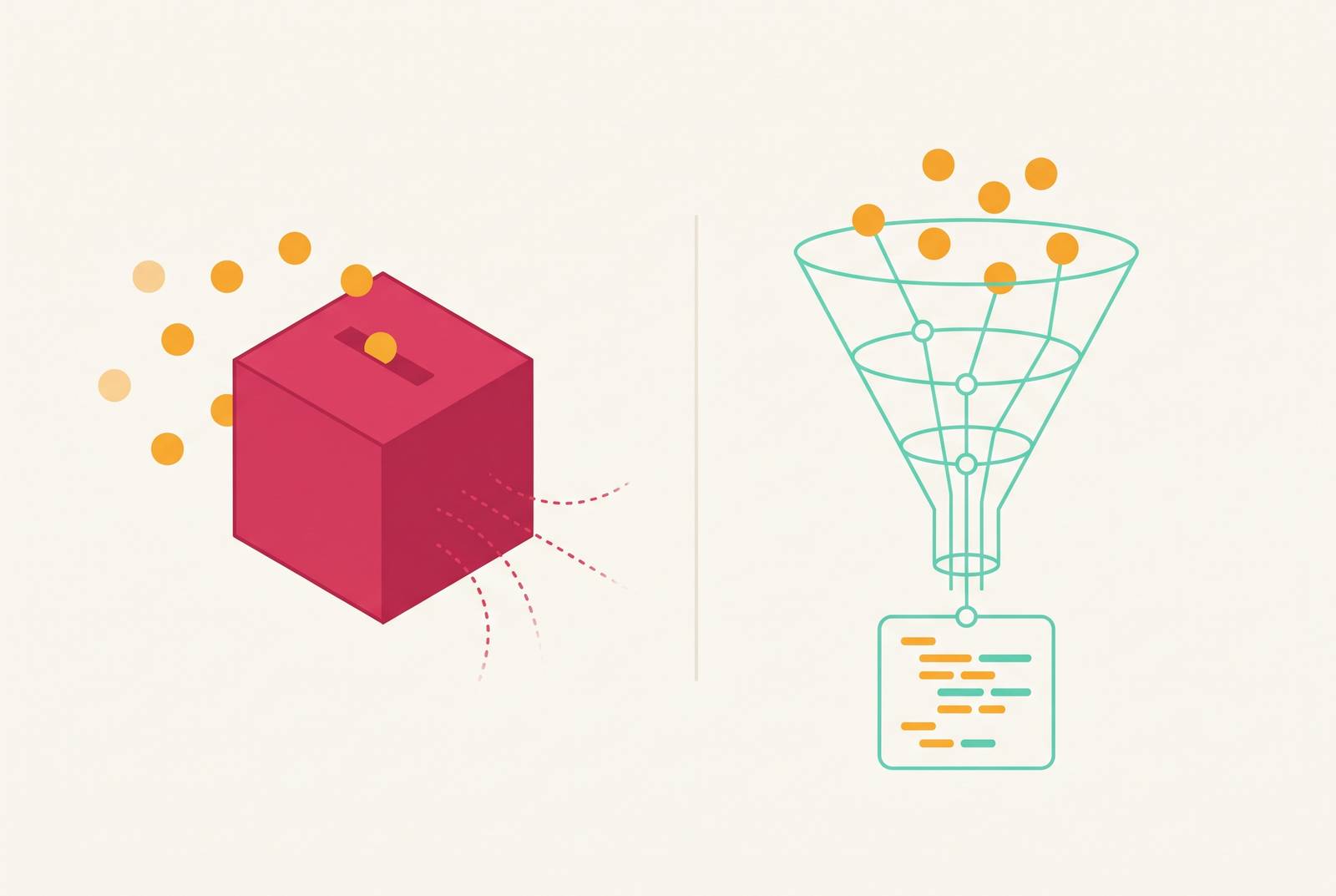
Managed ad services and self-serve campaigns raise the same question for the engineering team. Can every click, form fill, and downstream lead be read in code the team controls? The answer depends less on who runs the ads than on who owns the measurement system. Paid spend becomes reproducible when events recorded in a vendor’s report remain traceable through to revenue.
Why the question "who runs the campaigns" is the wrong one for technical buyers
The managed-versus-self-serve debate usually starts with fees and control. But running a campaign and owning its signals are different things. A managed service delivers reports on its own cadence, shaped by its own schema, while self-serve access can expose events in real time. Neither arrangement guarantees that the original click ID reaches the CRM. Outsourcing execution is a legitimate choice, but outsourcing the data layer with it creates a separate constraint.
For a technical buyer, the diagnostic question is concrete. Can the team query every optimization rule the platform applied to its campaigns in the last 24 hours from its own data store? That test reaches beyond whether a dashboard is available. It asks whether campaign decisions are inspectable without waiting for someone else to explain them. Without that access, the reported metric sets the limits of what the team can investigate.
How lead-gen tracking breaks silently and why the funnel lies to you before you notice
In ecommerce, the loss of the conversion signal from a broken purchase tag can be visible by lunch. In lead generation, the same failure can stay hidden for months. The form still works, leads still reach the CRM, and the campaign looks active even as the ad platform loses the conversion signal it needs. The visible workflow succeeds while the measurement workflow fails.
With funnel builders, this can go wrong in several ways. An inline success message takes the place of the form without loading another page, so a page-view trigger never fires. An external form inside an iframe hides its submission from the parent page’s tag manager. A fast redirect can interrupt a conversion tag before its hit finishes.
Even a correctly recorded form fill leaves another gap. It measures the cheapest event, leaving whether someone booked, showed, or paid unmeasured. Those outcomes live in the CRM. Meanwhile, a person who clicks on mobile and submits on desktop can appear in a client-side model as two abandoned sessions and one sourceless conversion. Missing events and fragmented identity therefore distort different parts of the same journey.
The architectural fix — server-side tracking, click ID persistence, and the canonical event schema
Server-side capture routes conversion events through infrastructure the team controls before forwarding them to ad platforms, reducing dependence on browser behavior. Server-set cookies also receive more permissive treatment from browser privacy controls than script-set cookies. But event delivery alone cannot preserve attribution. The event must retain the identity that connects it to the original click.
That persistence chain starts on landing-page arrival. Capture gclid, fbclid, ttclid, and msclkid immediately, store them in first-party cookies set server-side, and pass them into hidden form fields. The identifiers then travel into the CRM with the lead record rather than depending on the cookie remaining available later. This makes offline conversion import possible days or weeks after the click. The lead is the durable record.
Enhanced conversions for leads give the team another way to find a match. Google’s help page describes importing user-provided data in addition to identifiers such as GCLID. The conversion setting must have the right lead-generation type. At submission, capture email and phone into the dataLayer and let the platform tag perform SHA-256 hashing. For inline thank-you states or fast redirects, the listener needs the true capture-phase flag so it fires before the builder’s redirect scripts.
A canonical schema gives these signals a shared meaning. Define event names, funnel-stage labels, and payload fields including user_id, session_id, content_id, content_type, and timestamp before building pipelines. A governance document shared with analytics, product, and agencies prevents drift that would otherwise require repeated BI cleaning. The surrounding stack has five distinct layers, namely client-side capture, server-side infrastructure, consent and compliance documentation, lead distribution and attribution, and analytics and reporting. Combining their purchase does not combine their responsibilities.
Connecting the click to closed revenue — what the instrumented stack must pass to the CRM
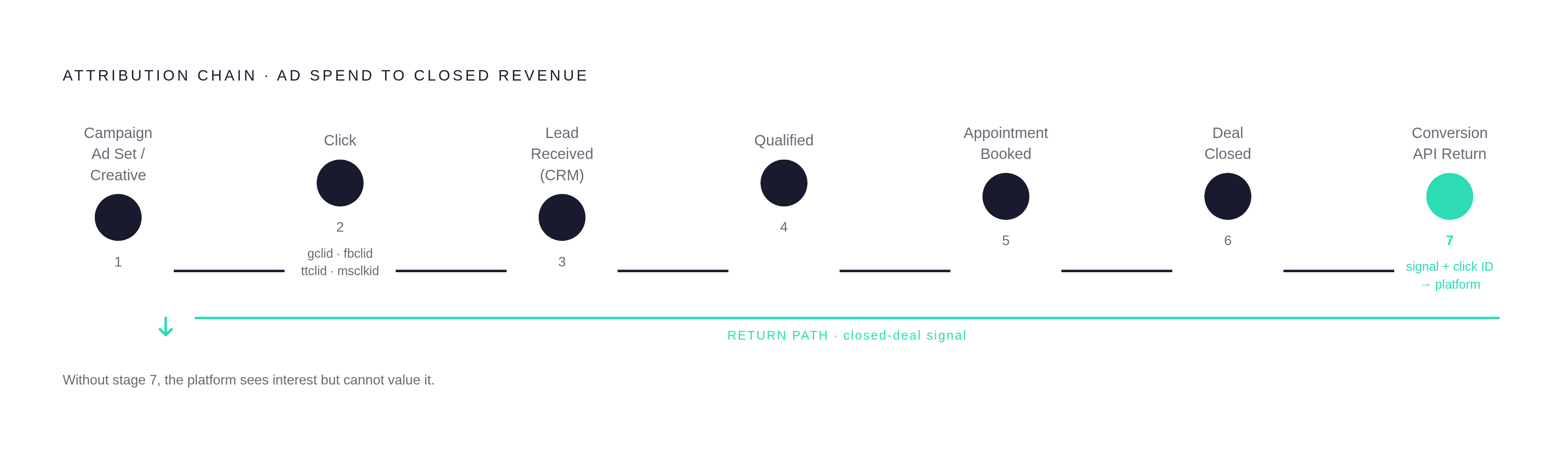
Recovered events help the business when data on revenue flows back to the ad platform. The attribution chain begins with the original campaign, ad set, and creative, then follows touchpoints and CRM transitions through lead received, qualified, appointment booked, and deal closed. The closed-deal signal returns through the platform’s conversion API with its preserved click ID. Until that return path works, the platform can see interest but has only part of the picture of what it is worth.
Cross-device matching helps bridge a different break in that chain. When the same email connects a mobile ad interaction and a desktop lead submission, its hash provides a deterministic match key without requiring a cookie to survive the gap. The hash supplements the preserved click ID. Together, these identifiers support a connection that a browser-only session history cannot reliably provide.
What happens if the loop stops at submission? The algorithm can favor sources that bring in form fills even when many of those leads never bring in revenue. Incomplete signal then misallocates budget without any obvious failure in campaign strategy. A practical vendor test is whether event-level records expose which click IDs were included in each offline conversion upload, and when. An upload total alone cannot answer that question.
What funnel analytics tools can and cannot do, and where to place each in the stack
Google Analytics 4 has an event-based model and funnel exploration reports, and it comes with native Google Ads integration. Its default event-level retention is two months, which limits retrospective funnel analysis. Its fit is strongest where acquisition analysis overlaps with product analytics.
FullStory serves a more diagnostic role in that stack. It attaches console logs and network errors to session replay, helping turn a drop-off into a reproducible bug report. Admetrics addresses ecommerce and DTC economics from ad impression through contribution margin, including COGS, shipping, and returns. Its endpoint is order profitability rather than simply the conversion event. These tools answer different questions, so placing them in a single ranking would obscure their functions.
Precision inside a tool does not establish completeness outside it. Consent opt-outs, cookie expiry, and ad blockers remove portions of client-side datasets, while interfaces can make the surviving sessions look like the whole population. Product analytics and replay begin after the click and cannot automatically reconstruct everything missing before collection. Server-side capture beneath the analytics layer can recover some of the signal lost on the browser side. It remains a separate responsibility from consent and compliance.
Why AI traffic source identity in the CRM is now a measurement requirement, not cosmetic
Visitors from different AI surfaces convert at substantially different rates, so an undifferentiated AI traffic total hides information needed to judge revenue. Source identity belongs in the CRM for that reason. It is not merely a label for an acquisition report. Without it, the team cannot tell which engines send valuable leads and which mainly send visits.
The instrumentation requirement follows directly from campaign attribution. Segment referral traffic by AI host in the CRM and attribution layer, just as paid traffic is segmented by campaign source. Then the revenue model can retain the channel distinction after the visitor becomes a lead. A managed GEO/AEO vendor must also expose prompt-level citation data and relate it to referrals by engine. Otherwise, its visibility claim cannot meet the same evidentiary standard as an instrumented paid campaign.
Measuring AI citation the same way you measure paid conversion — a prompt-level cadence
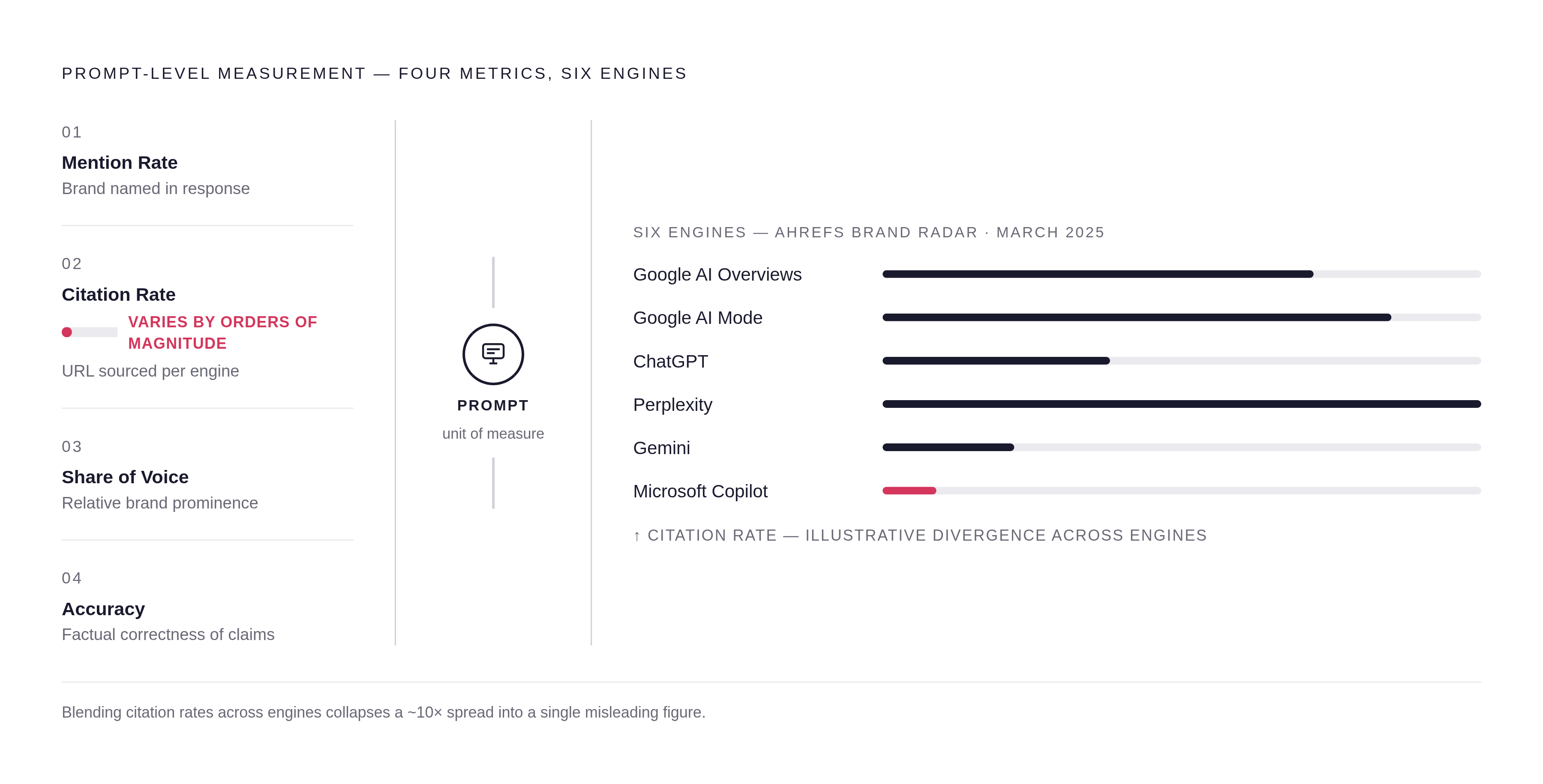
The measurement unit for AI visibility is the prompt. A fixed set of buyer-intent prompts run across each engine on a regular cadence provides a repeatable basis for comparison. Each prompt needs four recorded metrics, namely mention rate, citation rate, share of voice, and accuracy. An aggregate visibility score cannot preserve all those distinctions. In particular, a mention is not enough to establish whether the answer is accurate or cites the material.
Ahrefs Brand Radar, launched March 2025, tracks mentions across six AI indexes. These include Google AI Overviews, Google AI Mode, ChatGPT, Perplexity, Gemini, and Microsoft Copilot. The tool derives prompts from real search behavior. That gives prompt selection a basis in search demand. It does not, by itself, connect those mentions to leads or revenue.
Referral analytics supplies the next part of the evidence. Segment traffic by AI host in GA4 or BI, then test whether citation rate on an engine predicts referral volume from that engine. Citation rates can differ by orders of magnitude between engines, so blending them can conceal where budget should shift. Better results depend on content that is structured for extraction, authority on the entity and topic, plenty of facts with original data, and a steady presence across platforms. Made-up third-party mentions are an unreliable shortcut that platform rules forbid.
When managed services are the right call, and what instrumentation requirements still apply
Teams that have yet to scale may simply lack the staff or time to do the work in-house. The economics can favor a managed service. With a fixed monthly labor cost on one side and a management fee tied to spend on the other, there is a spend level below which outside help costs less. That is a defensible operating decision. Building everything internally is not the thesis.
The distinction is between delegating work and surrendering records. A team can outsource campaign execution while keeping click IDs, conversion events, and CRM stages in first-party infrastructure it controls. The same separation applies to content operations. An AI pipeline with human review can support publishing cadence without giving up the accuracy and factual density needed for citation. Volume without that quality adds liability and fails to provide useful visibility.
Click IDs must stay in first-party storage and reach CRM records, while offline uploads or Conversion API calls send back closed-deal signals tied to those IDs. The event schema must be documented and version-controlled independently of a vendor’s tag implementation. Referral segmentation must preserve source identity, including AI hosts. These requirements define the data contract without dictating who performs the daily campaign work.
Treating the funnel as an engineering system — what that actually requires from the team
Running this system requires more than installing the right tags. Every measurement capability should be reachable through an API so the team can query, test, and integrate it without manual exports. Automated and AI-generated actions should be reviewable and reversible before shipping. Claims about how well something works should give exact numbers, name their sources, and use figures a machine can check. A dashboard view alone does not provide that accountability.
The team needs a schema governance document, an owner for the prompt-measurement cadence, and a defined evidence standard for budget shifts. Otherwise, individually capable tools can produce records that do not support a shared decision. The team must assess whether the evidence connects a change in a number to the outcome being funded.
Answer engines read the whole site, and agents read it before deciding whether to engage, so accurate, structured, citable material on controlled infrastructure is both a content asset and a measurable discovery surface. Paid funnel observability and AI citation measurement converge here. Each starts with a channel signal and follows it toward a lead, a pipeline stage, and a revenue outcome in a system the team can inspect.