An AEO tracker that keeps history is the right instinct; the next step is to make the audit a test you own: blind questions, saved runs, and a diff against the page edits between them
Blind questions, saved runs and an edit diff turn AEO scores into evidence.
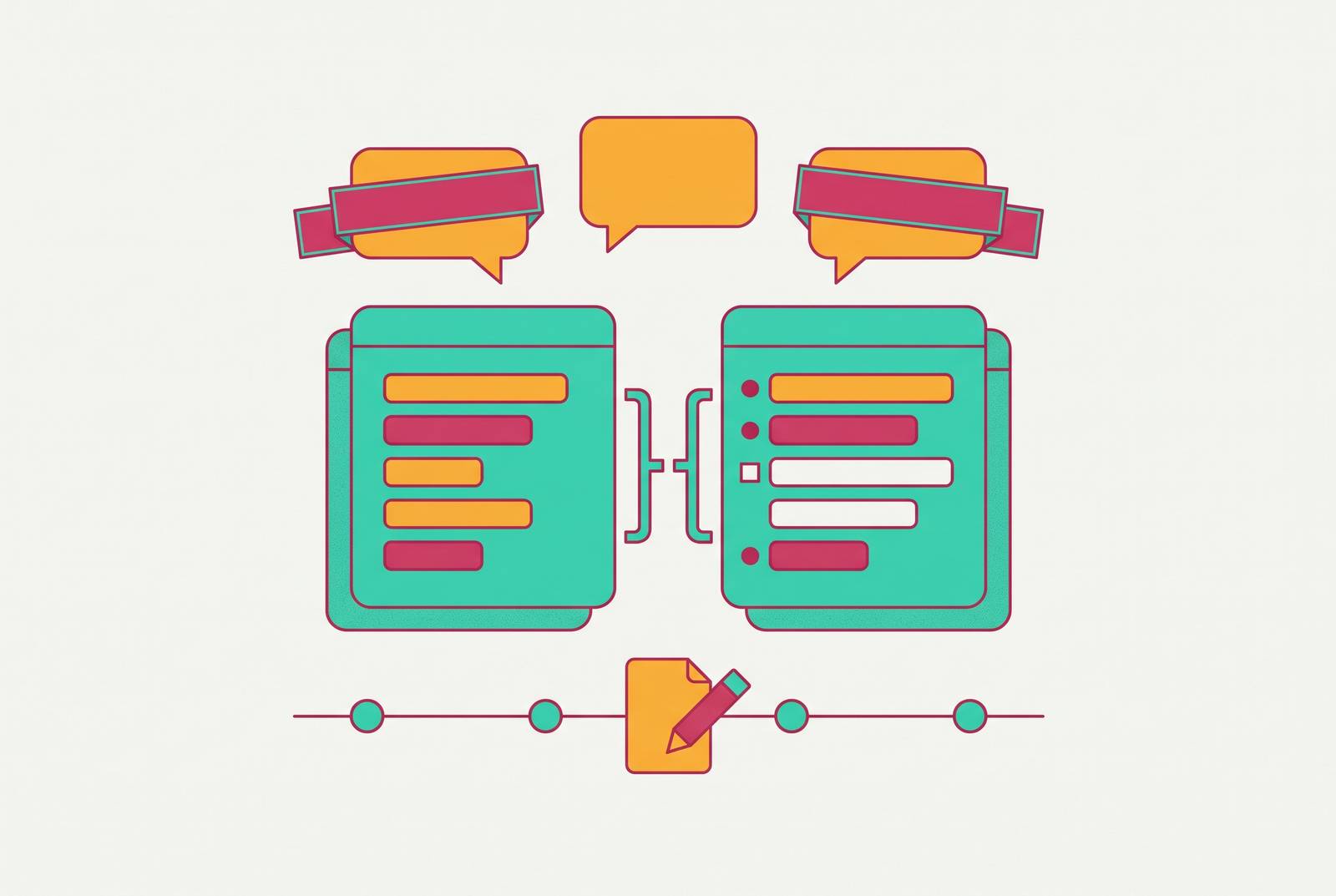
An AEO tracker that keeps history is a useful start, but history alone cannot show whether a content decision worked. The next step is an owned test harness, built around blind questions, saved runs and a diff tied to the edits between them. That architecture turns a visibility score from something a team watches into evidence it can use.
Why an AEO tracker that only watches is structurally incomplete
Tracking history feels like the right move because a record gives a team something to compare against. That instinct is sound. Most AEO trackers are built as dashboards. They record what happened without keeping the conditions the team needs to ask why it happened. A rising score might follow a useful page edit, but the sequence alone does not establish a connection.
AI answer engines make that distinction especially important. The same prompt run twice in the same session can return different citations, brand mentions and sentiment. One response cannot establish a reliable trend. Without a saved baseline tied to a specific prompt set, normal variation could account for an apparent improvement attributed to the team's work.
Even the meaning of visibility needs separating into parts. A brand's URL can appear as a source while its name never appears in the answer text. These ghost citations make a score that combines citations and mentions overstate how often the brand is actually named. Engine coverage adds another boundary, because ChatGPT, Gemini, Claude and Perplexity do not represent interchangeable views of the competitive field. A tracker watching only one engine leaves the others outside the test.
What "saved run" actually needs to mean before a diff is possible
The prompt set, engines queried and parsing rules must be recorded so that a later comparison can distinguish changes in answers from changes in the test. Reproducibility here means the team can repeat the conditions and examine how the results vary.
For a team building this structure, prompt templates should be parameterized and stored in version control. Their wording cannot quietly drift between runs. Otherwise, a diff may reflect the effect of asking a different question, obscuring the performance of the content. Engine coverage needs the same discipline, because an aggregate improvement that coincides with adding Gemini does not demonstrate a gain on the original engine set. Parsing rules also need a version so that a change in what counts as a mention does not masquerade as improved visibility.
Cadence determines how useful those comparisons will be. Weekly runs give the team baselines it can compare, while daily runs can produce session-level noise that is easier to read through weekly averages. With monthly runs, the team has to wait too long to spot drift that matters. The saved record should also have enough replications to tell a pattern from ordinary variation, and the team should record statistical confidence. A one-percentage-point change in mention rate may fall within that variation.
Does it preserve the conditions behind that score? Without those conditions, the record is history, but it is not yet a repeatable test.
Why blind questions are the prerequisite for honest measurement
A fixed prompt set can still measure the wrong thing. If its questions repeat the brand's positioning and vocabulary, the test can flatter the business while revealing little about discovery. Consistency makes the same biased test easier to repeat.
A branded prompt such as “What does [Brand] offer for compliance teams?” tests recognition. The question has already supplied the name that the team hopes to see in the answer. By contrast, “best compliance tool for a 50-person fintech team” asks the engine to decide which brands belong in the response. “How do B2B SaaS companies handle SOC 2 prep” leaves that choice open too. These blind questions test whether the brand surfaces before the buyer knows to ask for it.
A buyer who already knows the name does not need the engine to discover it, so recognition and discoverability should not be treated as the same result. The practical test is straightforward, because a prompt containing the brand's name is not blind. A question that a buyer who has never heard of the brand could plausibly ask qualifies.
The team should draw on GA4 and GSC data, competitor-adjacent queries, and buyer formats such as “best X for Y” and “is X worth it,” to build that set. The team needs to own the set because a vendor may choose questions that favor the brand's strengths. When the team owns the queries, it can check them, keep versions and change them without asking permission, while keeping each version clearly separate.
Connecting page edits to run diffs — the attribution problem most teams skip
Once the questions and run conditions are stable, a diff can show where answers changed. It still needs a second record to connect that movement to a content decision. The edit log supplies that missing timeline. Without it, the team knows that visibility shifted but cannot reliably identify which page changes preceded the shift.
The minimum log records the edited URL, the timestamp and what changed, including a new section, a restructured H1, an added FAQ or schema markup. It should align with the run cadence so that the team can identify the page state at run time. The comparison can then stay specific. Did mention rate move on prompts about topics covered by that page? Did citation rate change for the edited URL, or did a competitor's URL or a new third-party source enter the citation set?
Edits that are kept separate make those questions easier to look into. Structured answers, explicit entity claims, FAQ schema, clearer heading hierarchy and reduced JavaScript rendering dependency are changes the team can date and compare against citation behavior. Entity claims deserve particular attention. Standard RAG pipelines find supporting sources before writing an answer based on them, while models without retrieval draw on parametric knowledge. If the text does not identify the brand as the owner of a claim, the answer may use the content without naming it.
Changing “five approaches to compliance” to “[Brand]'s approach to compliance” is therefore a concrete edit whose effect a diff can test. It is not a guaranteed route to a mention. A lift after the edit also does not prove that the wording caused it, because Reddit threads, G2 reviews and LinkedIn posts can change during the same period.
What the tool landscape can and cannot do for you here
The AEO tool market covers tracking and reporting more fully than it covers query ownership and attribution to edits. Its four broad categories are visibility trackers, full-stack platforms, content optimizers and crawler-log analytics. Full-stack platforms attempt to connect measurement with action, while the other categories address narrower parts of the process. A useful feature in one category does not replace the records needed across the whole test.
SE Ranking's SE Visible tracks AI Overviews, AI Mode, Gemini, ChatGPT, Perplexity, Copilot and Claude using real AI responses. It shows the visibility score, offers competitor benchmarking, and covers sentiment as well as prompt and topic analysis. That breadth supports measurement across engines. It does not, by itself, establish which page edit explains a movement in the results.
xSeek tracks up to 8 engines and pairs visibility tracking with a content engine and a prioritized action plan. Its free tier is available without a credit card. Those features connect observation with proposed work, but an action plan and an attribution record serve different purposes. The former identifies what to do, while the latter lets the team examine what happened after it was done.
For teams choosing a tool for an owned harness, programmatic access is a dividing line. API and MCP access starts at different price tiers on different platforms, so the team needs to check that access before choosing a tool. A tool with only a dashboard cannot do all that the owned-harness model needs. The team still has to close gaps in query ownership and diff-to-edit attribution outside the dashboard, rather than assuming that a reporting feature supplies them.
The off-domain signal problem and what it means for your test harness
A rigorous edit log exposes a limit in an on-site-only test. Most AI citations point to sources from third-party publishers rather than pages the brand owns, so changes to owned URLs explain only part of what the team is measuring. The missing record is a timeline of relevant off-domain activity that can be compared with the same runs.
Citation sources also differ by engine. Wikipedia accounts for a large share of ChatGPT citations, while Reddit accounts for a large share of Perplexity citations. That difference affects how a team interprets a shift, because a change on one engine may reflect a source that another uses less heavily. A pooled visibility number can obscure this distinction. Keeping engine-level results makes it possible to ask which source environment changed.
Scrunch AI shows which AI agents visit the site and which pages they access. Site access provides only a partial record of the sources behind an answer because it cannot show what those agents crawled on Reddit or G2.
Matching the brand name, description and service claims across the site, LinkedIn, industry directories and Wikipedia/Wikidata makes it more likely that a model drawing on parametric knowledge will name the brand, even when citing a third-party source. To reflect that wider field, the team should log off-domain publications against the same weekly runs. A Reddit thread or a G2 cluster can then be assessed alongside a concurrent page edit as competing explanations for a lift.
How to shift from observing a number to running a test you can act on
The practical shift begins with a decision rule defined before the data arrives, specifying what would count as a meaningful change, whether a threshold on mention rate, a shift in cited URLs or a competitor appearing where the brand appeared before. The team should not call a small change a success just because it came after a busy week of editing.
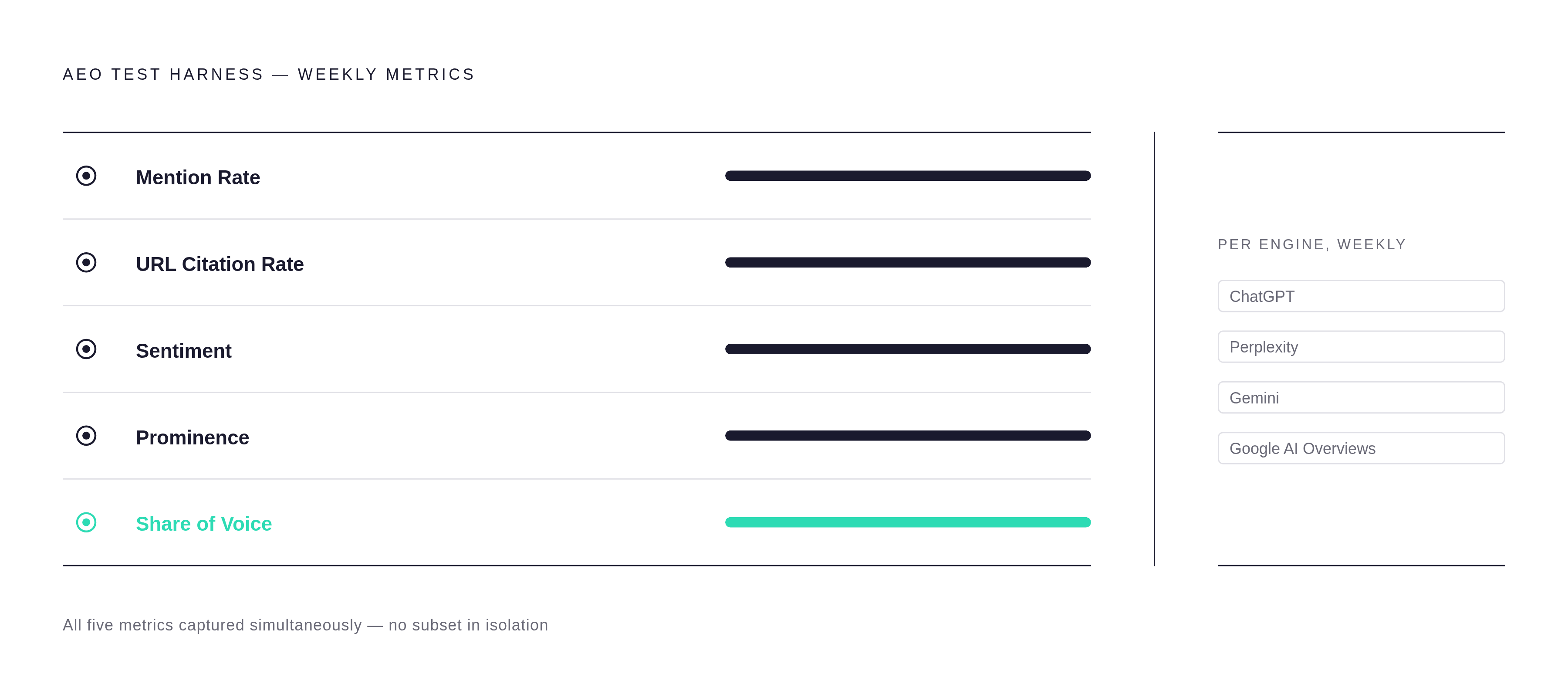
For a team starting next week, the minimum harness is a fixed list of blind, category-first prompts stored in version control. Weekly runs should cover at least ChatGPT, Perplexity, Gemini and Google AI Overviews. Each run should track mention rate, URL citation rate, sentiment, prominence and share of voice, with page edits and off-domain publications timestamped on the same cadence. The metrics show where a change happened, while the logs show which decisions and outside events the team should look into.
Human review belongs at the diff stage. Answers vary by session, region and model version, and a parsed sentiment score can miss a negative or qualified mention. Someone needs to read the answer text itself before the team acts on the number. When the response calls for content work, AI drafting should go through several stages with clear points where a human editor checks the work, because publishing more without getting the facts right puts the site at risk when answer engines read the whole site.
This measurement layer cannot be assumed from keyword rankings. Tracking whether ChatGPT, Claude, Gemini and Perplexity name and cite a brand is a separate job that needs its own instrument. When a run changes, the next question should be what changed in the edit log between runs, with off-domain activity available on the same timeline. That question cannot be answered from a record nobody kept. The architecture has to exist before the first run.