The AI shortlist is built from what agents can verify, not from what you resolve to do in January: a 2027 planning checklist for machine-legible vendors
Agents shortlist vendors they can verify, so fix four evidence gaps now.

Getting onto an AI agent’s vendor shortlist in 2027 depends on evidence. For technical marketing buyers and growth engineers, the work is to make a vendor’s identity, claims, pricing, and technical fit verifiable before a buyer visits its site. That means closing gaps in editorial coverage, entity records, readable product information, and measurement, rather than treating AI visibility as another content target.
How AI agents build vendor shortlists before any human opens a tab
A procurement manager asks an agent for vendors that meet a set of requirements. The agent returns three names in seconds. None of them is yours. Before the manager opens a tab, the agent has narrowed the field, leaving your sales team outside a buying conversation it never knew existed. Your inclusion depends on whether the agent found enough evidence before that buyer reached your homepage.
This differs structurally from ranking in search results. A brand on page two of Google remains available to a buyer willing to look further, while a shortlist removes that second page from the answer. The exclusion can leave no trace in your analytics. There is no form fill, bounce, or retargeting pixel because the buyer never reached your site. A quietly thinning pipeline may therefore be the first visible symptom of a discovery problem upstream.
Why agent shortlisting is an infrastructure problem, not a goal-setting problem
A January goal cannot change what an agent can verify until the underlying evidence exists and is indexed. It takes time to earn editorial placements, and entity records and structured data need to be put in place. Their value develops over time. Better website copy can make a claim clearer, but it cannot back that claim with independent evidence.
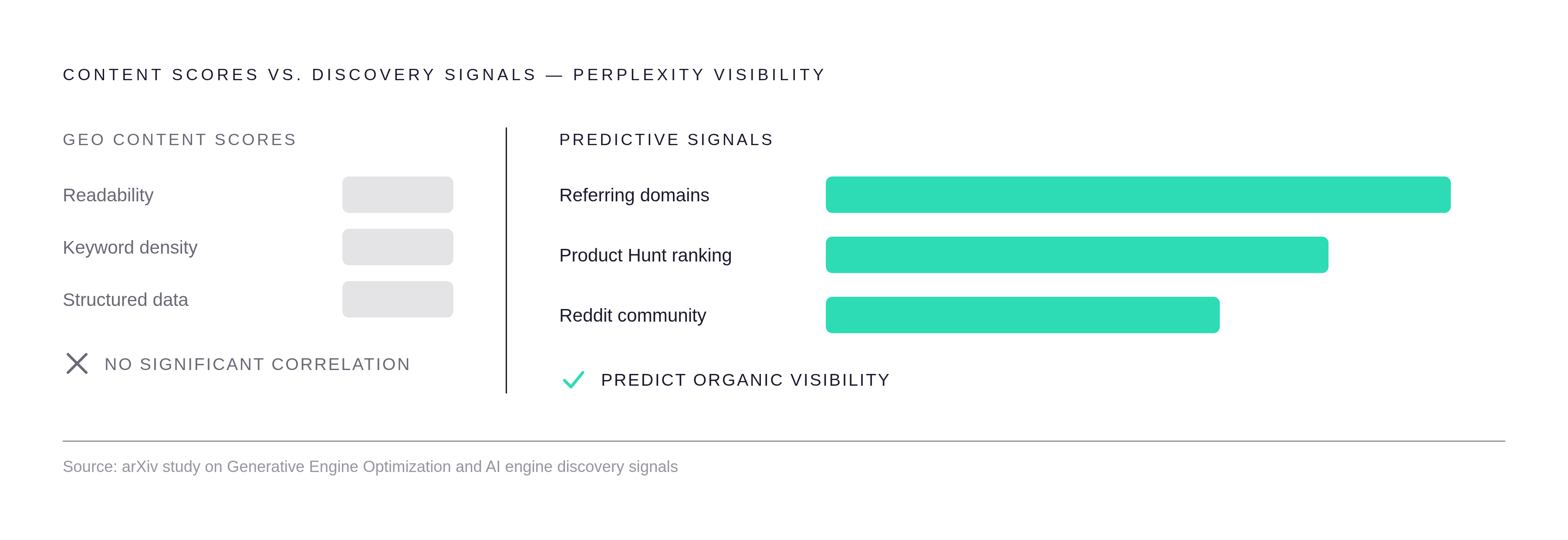
The arXiv study named in the brief found no significant correlation between Generative Engine Optimization content scores and how often products were actually found. Products with high scores were no more likely to appear in organic queries than those with low scores. For Perplexity, the study instead found that referring domains, Product Hunt ranking, and Reddit community presence predicted visibility. The finding establishes only an association.
The adoption evidence also needs careful reading. Forrester’s March 2026 reporting describes a large majority of B2B organizations as adopting or planning to adopt AI agents. McKinsey’s February 2026 findings describe a chemicals company piloting autonomous sourcing in the consumables category, with broad deployment of fully autonomous procurement remaining beyond the scope of that evidence. The planning response need not depend on that stronger claim. It depends on closing four concrete gaps before evaluation begins, namely entity resolution, readable pricing and specs, third-party editorial coverage, and structured on-site data.
What agents actually read: the primacy of third-party editorial coverage
An agent researching vendors synthesizes information from sources treated as credible, including industry publications, analyst reports, and trade press. Independent editorial coverage gives an agent evidence that a vendor’s own domain cannot provide about itself. Forbes, technology news outlets, business newspapers, and category-specific trade publications belong to this editorial layer. They give an agent outside accounts to draw on when choosing vendors for a shortlist.
What does that mean for a coverage audit? A coverage audit should identify where a vendor appears in publications with real editorial standards, and where its nearest competitors appear without it. Low-authority guest posts are not a substitute. A team should compare its coverage with that of those competitors in outlets that cover the buying category, since mentions elsewhere do not carry the same weight.
Coverage also has a shelf life in retrieval. A placement from 18 months ago has less weight than one from last month when an agent seeks current information. Muck Rack’s December 2025 Generative Pulse report found that citations came mostly from more recent articles, with a longer tail of older coverage. The practical response is a recurring cadence for earning placements. A historical archive can establish presence, but it does not remove the need for current evidence.
Entity resolution: whether agents can verify that you are who you say you are
Independent coverage helps only if an agent can connect it to the right vendor. Agents cross-reference named entities across multiple sources, and inconsistent names or descriptions introduce ambiguity. A legal name, product name, and trade name may refer to related things without making that relationship clear. Missing records make the connection harder still. When the agent cannot resolve the identity, it may drop the vendor.
Entity resolution is the identity layer that lets parametric memory, meaning information learned during training, and real-time retrieval point to the same company. In B2B procurement, category accuracy is part of that identity. A miscategorized vendor can be excluded from suitable deals or included in unsuitable ones.
The audit should therefore compare brand name, product name, category description, and founding and funding facts across Crunchbase, LinkedIn, G2, Capterra, Wikipedia where applicable, and the vendor’s own domain. Records should agree on which company and product they describe and have up-to-date facts. A clear canonical URL that stays the same gives the agent a matching anchor on the vendor’s site. Without that anchor, additional mentions can add ambiguity.
Readable pricing and technical specs: the specific facts agents need to qualify or disqualify you
Can the product meet the buyer’s requirements for pricing, integration support, data residency, and seat limits? If the answers sit behind a “contact us” wall, the agent cannot use them to complete its evaluation. In a shortlist built from verifiable options, that gap functions as disqualification.
The distinction is between two different sales motions. A human buyer might agree to a conversation to learn about price, while an agent needs information it can use as it weighs the product. The pricing page should state the model, whether per seat, usage-based, or flat, and give an entry-level price or price range. It should also explain what each tier includes. Enterprise pricing can still require a conversation without concealing the product’s entire pricing structure.
A technical specifications or integrations page should answer the category’s common questions about SSO support, data residency options, API availability, and compliance certifications. Each answer should be explicit and extractable. Accurate freshness dates on pricing and specification pages also help establish how current those answers are. The task is to remove uncertainty about suitability.
Structured on-site data and machine-legibility: what your site must do beyond content
Publishing the right facts does not guarantee that an agent can extract them. A page may read well to a person even when its specific claims are hard to pick out and quote. That is a separate technical gap to close. On Pricing, About, Integrations, and Use Cases pages, each section should put its main claim in the opening sentence. Appropriate Product, SoftwareApplication, and FAQPage schema can give those pages explicit structure.
Access comes before extraction, so rendering needs its own audit. AI crawlers may not run JavaScript, so even a URL they can reach may have information they cannot read. About, Pricing, category pages, and other agent-critical content should be server-rendered. The access check should also cover robots.txt. GPTBot, ClaudeBot, and PerplexityBot should not be blocked from the content intended to support evaluation.
An llms.txt file is a smaller, more limited step. Publishing one is a cheap, standards-track bet that can help systems that read it, but it is not a ranking factor or a shortcut around the work above. Google’s May 15, 2026 AI optimization guidance explicitly says llms.txt is not needed for AI Overviews, AI Mode, or other generative AI search features. Neither is any other implementation change until measurement shows whether agents actually use the evidence.
Measuring whether agents actually cite you, by engine
AI visibility has to be measured engine by engine. ChatGPT, Perplexity, Claude, and Gemini differ in citation behavior, so strong visibility in one does not establish visibility in the others. The distinction between mentions and citations also needs to remain visible in reporting. Being named in an answer is not the same as being the cited source that can generate referral traffic and attributable pipeline.
A team can start with a manual audit now. At a minimum, the team should ask ChatGPT, Perplexity, Claude, and Google AI Overview the questions a procurement agent might ask to find vendors in the category. Prompts can include “leading [your category] platforms for enterprise,” “most cited [your category] vendors by analysts,” and “recommended [your niche] solutions for [your ICP profile].” The record should capture which vendors appear, the context in which they appear, and the sources cited. That gives the team something more useful than a yes-or-no visibility score.
Measurement should also connect answers to observable activity. LLM channel group filters in GA4 and AI bot filters in server logs help the team track that activity, while branded search volume can be an early proxy for AI-influenced demand. A proxy is not the same as attribution. Tracking citation lag by engine then helps calibrate editorial and on-site publishing cadences to when evidence becomes visible. Without cross-engine citation tracking, the team cannot know whether its infrastructure works in time to adjust before the 2027 buying cycle.
The 2027 planning checklist: a consolidated audit of every gap
For the editorial coverage audit, list every category-relevant publication with real editorial standards that mentioned or cited the vendor in the last 12 months. Identify the outlets where the closest competitors appear and the vendor does not. Set a recurring cadence for earning new placements.
For the entity audit, reconcile names, category descriptions, and key facts across Crunchbase, LinkedIn, G2, Capterra, Wikipedia where applicable, and the company domain. Confirm that the canonical domain is stable. Check that About, Pricing, and category pages are server-rendered, and review robots.txt for blocks on GPTBot, ClaudeBot, and PerplexityBot.
For qualification, publish the pricing model, entry-level price or range, and tier inclusions in machine-readable form. Publish direct technical answers on the specifications or integrations page, with explicit, accurate freshness timestamps on both pricing and specs. Keep each qualifying answer easy to extract. Add appropriate Product, SoftwareApplication, and FAQPage schema, including FAQPage markup where pages answer qualifying questions.
For the on-site audit, put each section’s main claim first on key pages and remove JavaScript dependencies from agent-critical content. Publish llms.txt without treating it as a visibility lever. For measurement, run the cross-engine discovery audit, add the GA4 channel and server-log filters, monitor branded search as a proxy, and track citation lag by engine.
The buying cycles that begin in 2027 are already being preceded by agent research that runs today.