Entity SEO Is a Knowledge-Graph Engineering Problem — And That's the Point
Machine-readable facts about your organization matter more to AI systems than persuasive copy does.

Entity SEO is a knowledge-graph engineering problem because a website must do more than explain an organization to a reader. It must give machines enough clear facts that agree with one another to tell which organization it is. Treating a site as a data artifact means that choices about content and schema have to account for data quality, entity resolution, and measurement as well as wording.
What a knowledge graph actually is, and why a website is one
Writing a page and populating a graph are, at the data-model level, versions of the same task. Both attach facts to a subject and describe its relationships with other things. A knowledge graph expresses those facts as subject-predicate-object triples. The subject names the thing, the predicate names the relationship, and the object supplies its value or another entity. This structure lets a system use a statement outside the paragraph where it first appeared.
That structure is related to, but distinct from, the Entity-Attribute-Value model, or EAV. Google’s Knowledge Graph organizes entities, attributes, and relationships in a graph structure. Wikidata makes comparable building blocks publicly visible through property IDs, including P31 for instance of, P856 for official website, P571 for inception, and P159 for headquarters location. These are not just labels for writers. They identify what kind of fact a value represents.
Agnieszka Lawrynowicz’s A Knowledge Engineering Primer describes a knowledge base as a digital collection of facts about entities, classes, attributes, and relationships. Its purpose extends beyond retrieving stored information to supporting formal reasoning and inference. That distinction changes what a page needs to supply. In search and AI retrieval, persuasive prose is not the final product. The usable product is the set of unambiguous assertions a system can extract from it.
How NER, NED, and NEL turn page text into graph nodes
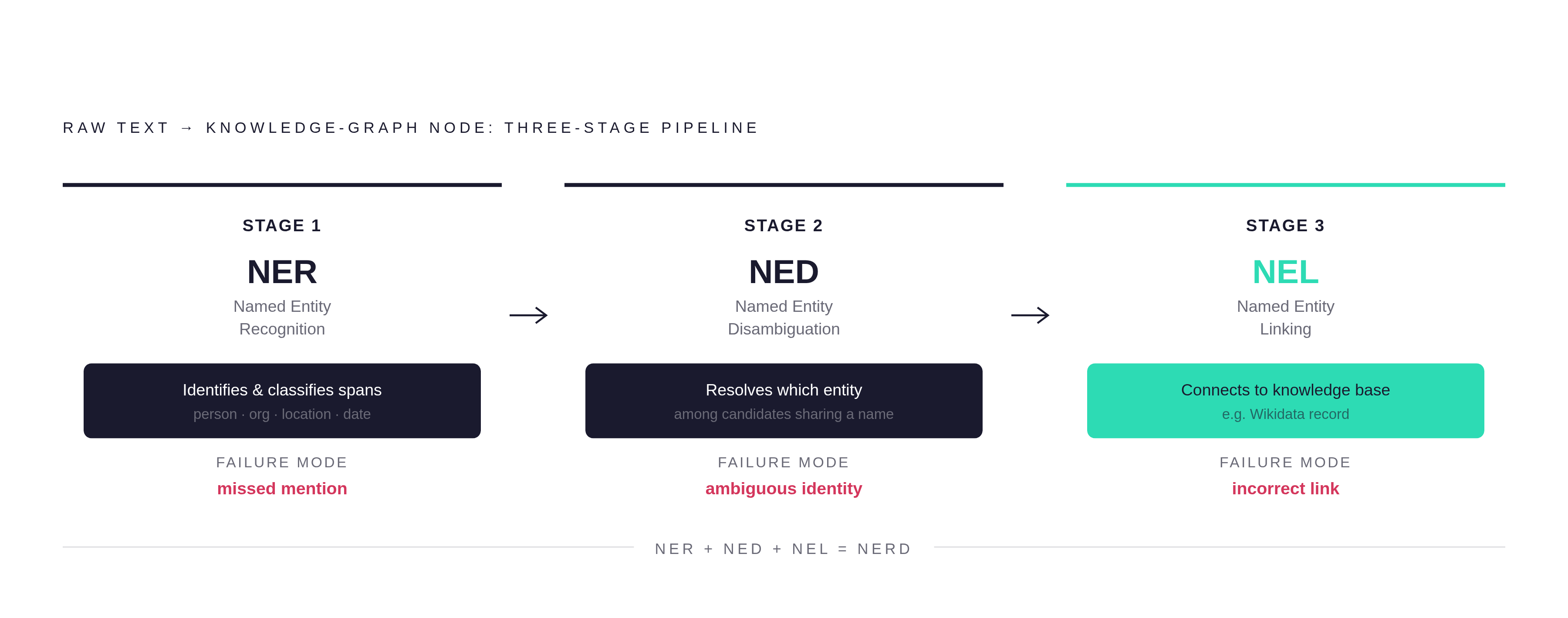
The path involves three operations, beginning with Named Entity Recognition, or NER. This identifies spans of text that refer to real-world things and classifies them by type, including person, organization, location, date, product, and event. Recognition establishes that a mention refers to something. It does not yet establish which particular thing it means.
Named Entity Disambiguation, or NED, resolves that uncertainty when several candidates share a name. Named Entity Linking, or NEL, then connects the resolved entity to its record in a structured knowledge base. The combined recognition and disambiguation process is also called NERD. These are useful distinctions for diagnosing a page. A missed mention, an ambiguous identity, and an incorrect link are different failures, even when each leaves the intended entity unresolved.
The field has moved toward systems that bring the stages together and use entities as context for one another. But name variants without clear back-references can make one entity look like several different entities. This is not simply a keyword mismatch. Google’s Natural Language API demo makes the problem observable by returning extracted entities, their types, salience scores, and resolved Wikipedia entries, giving teams a concrete starting point for inspecting their own pages.
What attribute completeness means and why topic coverage is not enough
Does the page provide enough facts about the entity it names? Topic coverage asks whether a page covers the subtopics searchers care about, while attribute completeness asks whether it gives the values expected for that entity type. One concerns the breadth of discussion, the other the depth of the record.
A page can cover a subject in depth while saying little about the organization at its center. An entity record may need services offered, geographic coverage, founding date, notable clients, certifications, team size, and founder name. Writing about the industry around it leaves those values blank. Even strong keyword rankings cannot fill the missing fields. A graph has less to work with when the page names an organization but leaves most of its defining attributes unstated.
For teams auditing that gap, Wikidata’s property IDs provide a practical checklist. An EAV audit asks which properties apply to the entity type and whether the page supplies their values. The test is whether the relevant record is complete enough to represent the entity clearly. This is correct data modeling, with the work labeled “advanced SEO” integrated into the writing process.
Why knowledge graphs need convergent signals, not a single authoritative page
A complete first-party record does not settle identity on its own. Knowledge-graph confidence also depends on whether independent sources converge on the same facts. The owned site, LinkedIn page, Wikidata entry, and third-party reviews can back one another up or say things that conflict. Agreement creates a convergent identity that entity recognition systems can weight more confidently. Disagreement can produce hedging and suppress citations despite strong rankings.
This changes the role of third-party presence. Brand mentions across the web correlate more strongly with AI visibility than classic backlinks do, while consistent descriptions give models textual evidence that connects a brand with a category. Review platforms and professional directories can contribute because they belong to the retrieval corpus. They supply co-citation infrastructure through which facts about an entity recur across sources.
Enrico Daga, another researcher, and Terry R. Payne write about a similar challenge in Knowledge Graph Re-engineering Along the Ontological Continuum. Different communities and tasks use different representational choices, making graph integration and reuse expensive and brittle. A brand’s inconsistent descriptions are a smaller version of that problem. Records about the same organization can still disagree. Cross-source consistency has to be treated as an engineering responsibility, including correct properties wherever the entity has a structured record.
The grounding page and phantom-site strategy as knowledge-graph population at scale
A grounding page gives that shared identity an anchor on the owned domain. It is a first-party document designed for AI retrieval, with clear statements that can be extracted without contradiction. A page can be easy to find yet have little evidence a system can use. Its design constraint is therefore not simply discovery, but the availability of clean facts about the entity.
The phantom-site, or co-citation, strategy takes that work to third-party platforms that retrieval systems use. A detailed mention can contribute to a brand’s representation even when the page does not sit near the top of organic results. Co-citations are cumulative in a way that rankings are not. A page can associate a brand with a category without winning the leading search position. The mechanism depends on the retrieval corpus.
That difference explains the AI-first form of what is often called parasite SEO. Its aim is to make facts available on high-authority platforms so that ChatGPT, Perplexity, and AI Overviews can cite the brand. The engineering framing also sets a constraint. Third-party content has to agree with the entity’s other records and offer extractable facts.
Where structured data actually helps and where it does not
If the problem is structured knowledge, should schema markup solve it? The evidence does not support that shortcut. SE Ranking found no correlation between llms.txt presence and citations. Ahrefs found that adding schema did not meaningfully raise citations in AI Overviews, AI Mode, or ChatGPT across a large page set. These findings challenge the idea that a machine-readable addition mechanically produces a citation.
Schema still has a useful role in the pipeline. It asserts that a page is about a particular entity of a particular type, reducing the work required for disambiguation. That can make entity resolution more reliable without determining whether an answer cites the result. Schema evangelism is therefore partly right for the wrong reason. The benefit lies in clearer identification and trust signaling.
For implementation, Organization schema, SameAs properties linking to Wikidata and Wikipedia, and BreadcrumbList schema remain worthwhile. Structured data also supports rich results, voice assistants, and knowledge-graph population. Those uses justify treating it as hygiene. But markup cannot substitute for missing attributes, conflicting descriptions, or prose from which few facts can be extracted. Resolving an entity correctly is a necessary step in the argument.
How to measure whether the knowledge graph has learned your entity correctly
The distinction between resolution and citation calls for more than one kind of measurement. The API demo provides an auditable starting point for extraction and linking. A failure to recognize a brand on its own homepage exposes a gap before questions about wider visibility arise. Its output is a diagnostic showing what that system extracted and resolved from the page.
Share of Model tracking examines the next question by measuring how often the brand appears in AI answers. The method is to test a set of target queries monthly in ChatGPT, Perplexity, Claude, and Google AI Overviews, then record the brand’s appearances. Platform differences are part of the result. Citation volumes can vary dramatically, so a single platform cannot stand in for the whole retrieval environment. Testing again and again gives teams a record to compare over time.
Classical SEO remains a prerequisite within that measurement picture. AI Overviews disproportionately cite sources that rank in organic results, so grounding work does not remove the need for search visibility. Ranking provides access to the pool from which citations are drawn, while grounding optimization improves the chance of selection within it. Teams can then use the extraction results and query tests across platforms to decide what to change, then test again. That loop makes the work repeatable rather than a construction project with no inspection.
What treating a website as a data structure demands from content and engineering teams
The production discipline begins before drafting and continues after publication. Research and sourcing find the facts, content work puts them into clear words, and engineering makes the identity and relationships machine-readable. Human review belongs at the stages that require judgment, including deciding whether evidence supports a statement and whether descriptions contradict one another. AI can accelerate structured prompts, retrieval, and iteration. It cannot remove the need for those decisions.
This is why publishing volume is an inadequate measure of progress. Skipping review and rewriting can produce “AI slop,” with more text but few extractable, contradiction-free facts. A content operation needs feedback that tests the record it is building. Instrumentation and editorial judgment address different parts of that task.
For content and engineering teams, the practical commitment is to ask the same concrete questions throughout production. Does the page supply the expected attributes for its entity type? Do its facts agree with the other surfaces where the brand appears? Does the NLP pipeline resolve the intended entity? The ongoing work is to review and rewrite the content, maintain its structured assertions, run monthly cross-platform query tests, and change the site on the evidence those tests provide.