Query fan-out is a dataset, not a concept: how a technical B2B team should log the sub-queries an AI assistant runs and map each one to the page that answers it
A seven-field log ties each AI sub-query to the page that answers it.
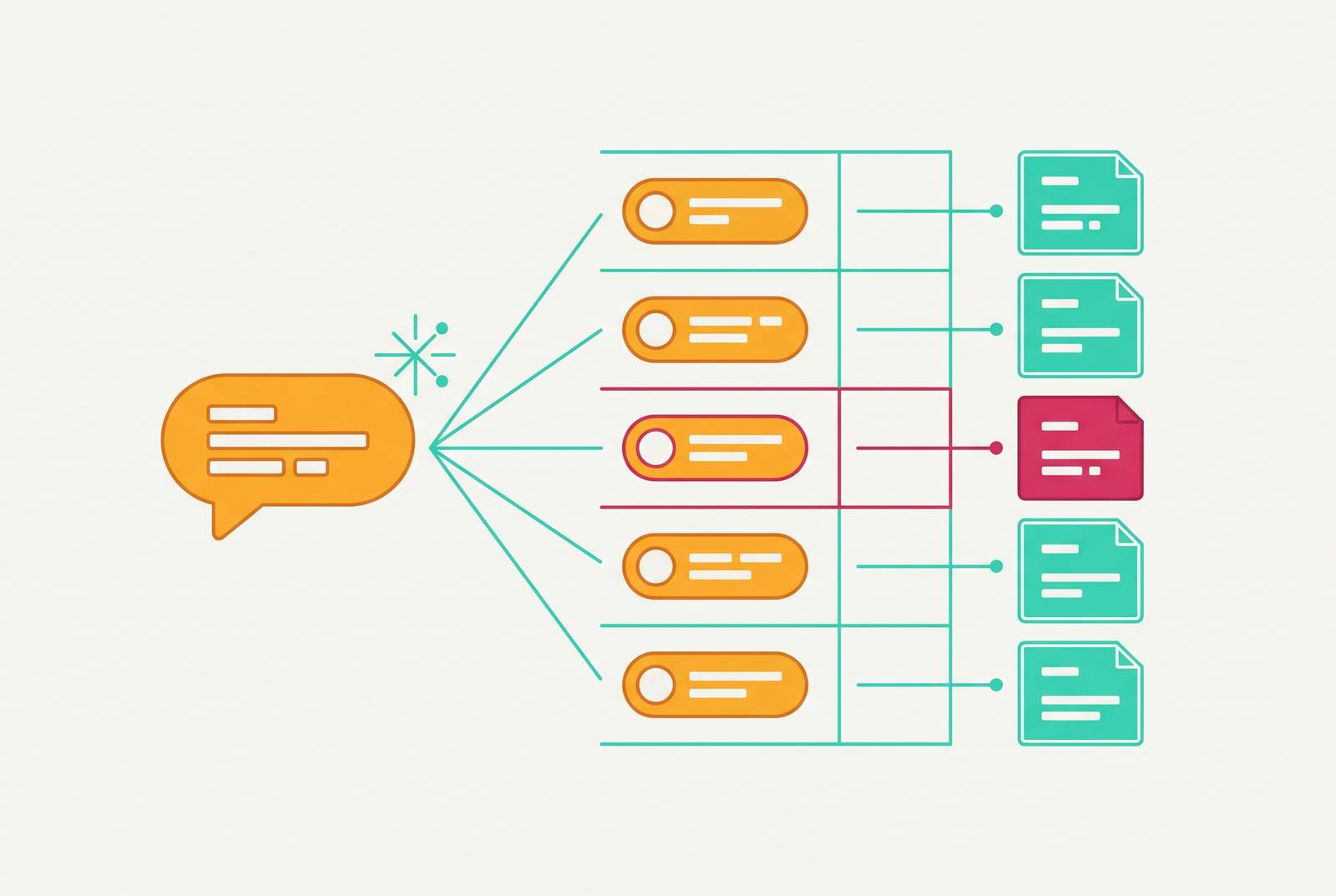
Query fan-out becomes useful to a technical B2B team when it becomes a dataset. Logging the searches an AI assistant runs, the pages it retrieves, and the page that should have answered each search turns an abstract process into a content and measurement program. The key is to distinguish observed retrieval from predicted queries, and retrieval from final attribution.
Why query fan-out stays abstract for most B2B teams — and what changes when you treat it as a dataset
Explanations of query fan-out usually stop at understanding. A team learns that an assistant breaks a prompt into smaller searches, but gains no structured artifact that connects those searches to its content. The missing piece is a usable record. Which page entered the retrieval path, which information need went unanswered, and did the final response name the brand?
A missing answer may call for new content, while a retrieved page that receives no attribution may need structural changes. Without a record of the intermediate searches, both can look like the same visibility problem. Treating fan-out as data gives the team a way to separate them before committing editorial time.
How the fan-out pipeline works at each stage and where your content gets dropped
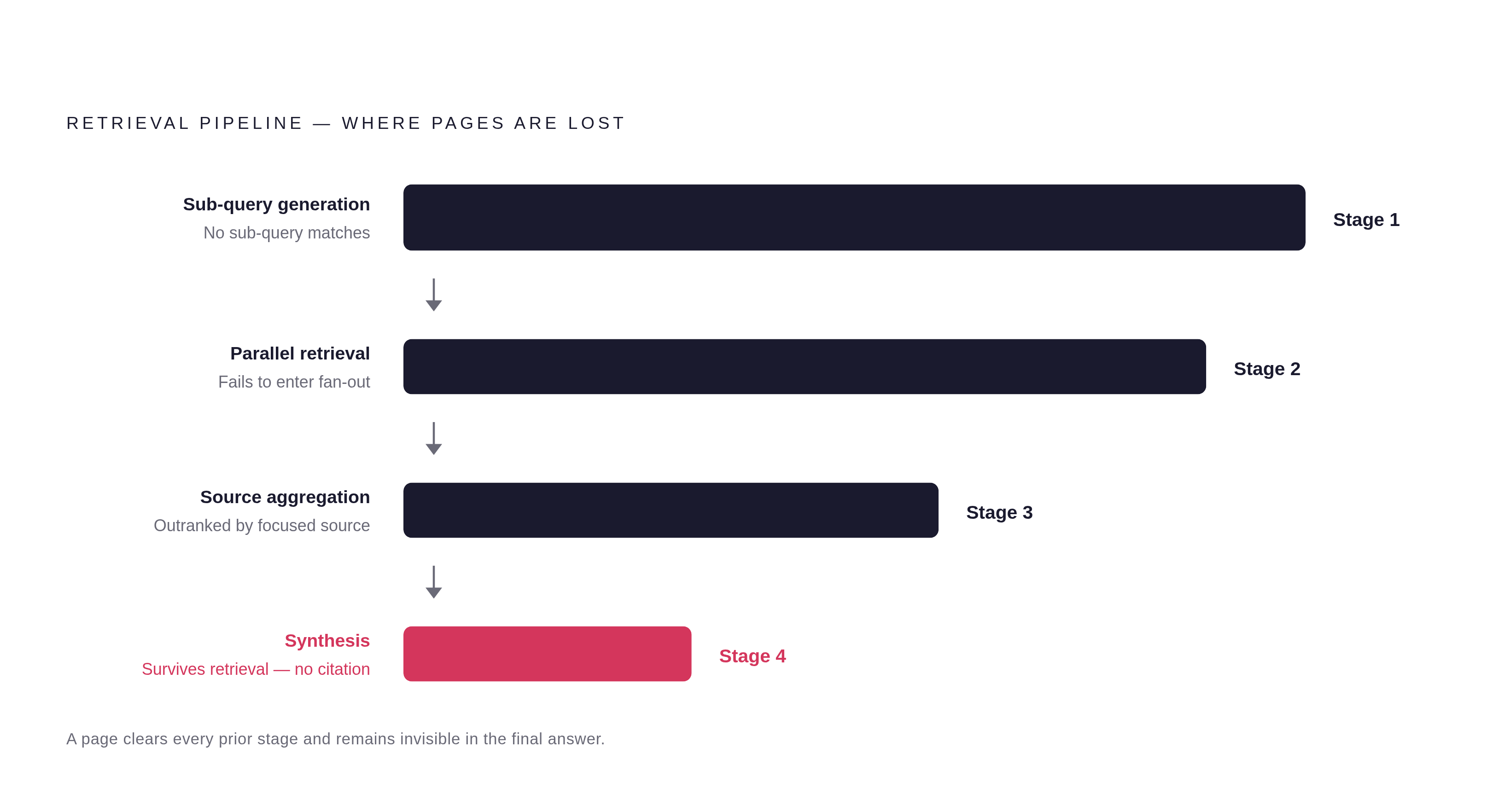
The pipeline begins with the assistant turning a user prompt into sub-queries. During parallel retrieval, those searches run simultaneously, which is the fan-out moment. A page can miss this stage because no sub-query matches its content. A good page can still fail to enter retrieval. For a B2B SaaS prompt, the useful question is therefore not just whether a page addresses the broad topic, but whether it answers one of the searches the assistant actually issued.
During source aggregation, the engine pools results and scores them at the passage level. Redundant pages can fall out here. A page that answers the original prompt broadly but no sub-query specifically can lose to a more focused source. During synthesis, the engine composes one answer and links some sources, so even a page that survives retrieval may receive no citation.
The engine and search mode also change what can be observed. ChatGPT can restrict a search to a domain with the site: operator, while Claude without web search draws primarily from training data. Claude with web search enabled runs trackable searches and can provide inline citations.
Commercial prompts make this distinction especially relevant to B2B teams. Aiso Boost Ltd.’s 2026 study found that 78.3% of commercial prompts trigger fan-out, a far higher rate than informational prompts. The prompts closest to a buying decision therefore deserve particular attention. Tracking only the final answer leaves much of their retrieval process unseen.
Why tracking at the prompt level misses most of what matters
A platform referrer tells a team where a visitor came from. Several searches may have contributed to that response. Others may have returned only competitors and left no trace in referral analytics. A prompt-level visibility score compresses those different outcomes into one result.
A page that gets AI-referred sessions might answer several sub-queries that keep coming up, or rely on one narrow retrieval path. The traffic figure cannot distinguish those cases. Nor does a brand mention establish that the engine retrieved the brand’s own website, because a model can mention a brand without exposing its domain.
There is a second problem with the snapshot. Fan-out behavior changes, so the same prompt need not keep producing the same searches or source mix. A content map can become stale even when the monitored prompt stays unchanged. Without engine, model, and date information, a team cannot clearly separate a content gap from a change in retrieval behavior. What, then, must a record preserve?
The minimum viable schema: seven fields every sub-query record needs
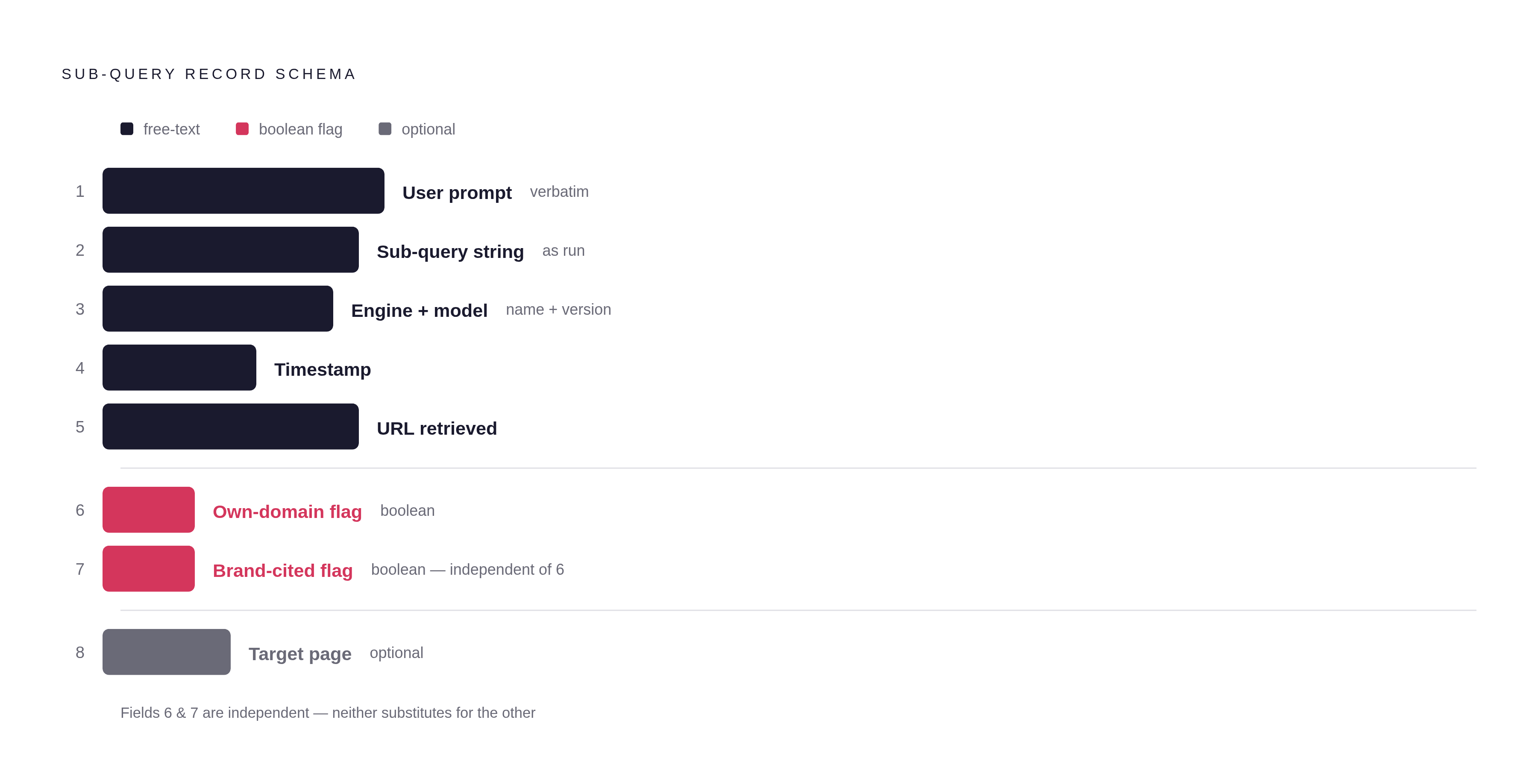
Each record needs enough information to connect a prompt, an observed search, a retrieved page, and the final response. The seven core fields preserve that chain. When one sub-query returns several URLs, the table must keep each URL tied to the run. Otherwise, later coverage calculations can confuse several returned pages with several separate searches.
Field 1 is the user prompt as entered. Keep the verbatim text submitted by the user or monitoring system. This is the join key to the keyword and topic data the content team already uses. A paraphrase weakens that connection because it no longer preserves exactly what the assistant received.
Field 2 is the sub-query string as run by the engine. Store the actual search text rather than a summary of what it was likely looking for. This field defines the unit of analysis. If the string is inferred rather than observed, keep that distinction explicit instead of presenting a prediction as a search that happened.
Field 3 is the engine name and model version, stored in separate columns. The platform name alone is not enough. A version change can alter retrieval behavior, and the record needs to preserve that context for later comparisons.
Field 4 is the timestamp of the run. It connects an observation to the monitoring cadence and makes changes over time visible. Model information explains which system produced a result, while the timestamp establishes when it did so.
Field 5 is the URL retrieved for the sub-query. Keep the page whether it belongs to the team, a competitor, or a third-party platform. Absence alone gives an incomplete picture. The returned URL shows which source was in the retrieval path the team hoped to enter.
Field 6 is the own-domain flag. A boolean or domain match shows whether the retrieved URL belongs to the team’s domain. This makes coverage calculations possible without reviewing every URL by hand.
Field 7 is the brand-cited flag for the final answer. Record whether the brand name appeared in the synthesized response, independently of the own-domain flag. The distinction is essential to interpreting the result. Brand presence and own-domain retrieval are related observations, but neither can stand in for the other.
An optional eighth field names the target page that should have answered the sub-query. The content team supplies this URL. When Field 5 repeatedly shows a competitor and the target field points to an existing owned page, the record exposes a concrete coverage gap.
Recorders versus simulators: which tools can actually populate the schema
A recorder captures searches that an engine ran, while a simulator predicts searches it might run. Only recorded observations can substantiate Fields 2 and 5. A predicted query can help explore possible information needs, but it cannot prove that an engine searched for them or retrieved a particular page. Mixing the two creates a misleading dataset.
The LLMrefs ChatGPT extension records searches ChatGPT sends to Bing during a session. The Chrome Web Store listing for the ChatGPT Query Fan-Out Tool describes real-time capture and access to each sub-query the model ran. Those capabilities address search observation, but they do not by themselves establish that every required URL and final-answer field is available. Tool selection should follow the schema.
Claude requires an additional distinction between search modes. In pure chat mode, training-data coverage is the relevant path. With web search enabled, citations and referral traffic can become trackable. Claude records should therefore distinguish training-data-based answers from live-retrieval answers, rather than treating an unavailable retrieval trace as evidence that the domain was searched for and excluded.
Building the gap map: from logged rows to a content and measurement program
To build the gap map, group records by normalized sub-query string and calculate the sub-query coverage rate, the share of runs in which the team’s domain appeared in Field 5. The denominator counts each run once. This keeps a search with several owned results from being counted as several successful retrieval events.
For each sub-query, the map can pair coverage rate with the competing page and an action type. When coverage is low and competitor retrieval keeps happening, it points to an answer the site is failing to give or make easy to find. The target-page field then separates an existing-page gap from a missing-page gap. If neither the team’s domain nor a reasonable competitor appears, the information need becomes a candidate for a net-new content brief.
The pattern of a page entering the path without the final response naming the brand is a candidate for the mined-not-cited category, although the two flags alone do not prove that a particular passage shaped the answer. The recommended response is structural work, including entity markup, quotable conclusions, and explicit attribution hooks.
The distinction has support beyond the schema itself. The Aiso study found a 91.4% GPT mention rate when both own-domain exposure and branded fan-out occurred. It also found that each was independently associated with higher final mention rates. The effect of any single edit on citation remains uncertain.
The measurement baseline follows from the same records. Coverage rate by engine and sub-query type shows where the site enters retrieval, while repeated runs show whether its place changes. The gap map supplies content candidates.
What the gap map reveals about off-site content needs
Field 5 can reveal that the relevant destination is not a brand’s main domain at all. Some searches resolve to review platforms, directories, or knowledge graphs. In those cases, the missing asset may be an entity signal. The dataset shows where the engine is looking for corroboration.
If the sub-query uses site:g2.com and Field 5 repeatedly contains G2 pages, an unmatched target-page field does not necessarily call for a blog post. The appropriate action is to build or improve the brand’s presence on the platform being queried. An owned page cannot fill a retrieval slot that is limited to another domain.
This is where the content map meets the off-site entity layer. A strong explanation on the company website does not fix descriptions that differ across directory listings and other third-party surfaces. Divergent signals can encourage hedging. The map identifies which surfaces feed the relevant sub-queries, giving the team a focused place to review consistency instead of treating off-site presence as an undirected expansion project.
Running the monitoring program: cadence, prompt selection, and drift detection
A program that lasts starts with a set of prompts that stays the same. For a B2B SaaS team, commercial-intent prompts should take priority because they are more likely to trigger fan-out and expose actionable retrieval gaps. Run those prompts on each tracked model on a fixed weekly or bi-weekly cadence. Preserve the model version and timestamp so that comparisons retain their context.
Drift detection should track both coverage and how the queries change. A sudden change in the number of distinct sub-queries per prompt, or in the domains appearing in Field 5, can signal a changed retrieval landscape. Coverage alone cannot explain that change. Comparing the searches helps show whether a page has lost its place or an engine is asking different questions, perhaps before the change is visible in referral traffic.
Each monitored run should write directly to the schema table rather than depend on a spreadsheet maintained by hand. The gap map then becomes a live query over the records. That is the operational difference between instrumentation and a report.
A gap that keeps coming up may point to something the audience needs, while another may be retrieval noise. Editorial review determines which deserves action. The program earns its keep when it gives that review a precise question, an observed retrieval path, and a page to improve or create.