PPC management is a weekly diff over your own data: what a buyer should be able to read, query and automate before paying someone to run paid search
A buyer who can read and query the account can audit any manager.
PPC management is an auditable weekly diff over your own data. Before paying someone to run paid search, a technical buyer should be able to read and query the data behind changes to the account and automate those checks. That ability makes the work auditable and shows what paid search can defend, including where its reach ends.
Why PPC management is fundamentally a data-diffing job, not a strategy service
PPC is sold as “strategy,” “expertise,” and “management.” Someone must read three reports on a consistent schedule, compare what changed, and act on the differences. Those are reports on search terms, conversion events, and landing-page response. Negative-keyword additions and budget moves are outputs of that loop.
Keywordme’s 2026 PPC guide describes accounts that look well run even though nobody can explain why one ad group draws junk traffic and another never spends. The surface gives little away. When search term reviews lapse, irrelevant queries keep consuming budget, while stale negative lists allow match-type leakage to compound. When match-type adjustments also lag, the account becomes misaligned with what actually converts. This is optimization debt, and it can drive up cost per lead quarter over quarter while the account interface looks much the same.
The failure is usually not a missed clever tactic. The missed review gives the buyer a concrete standard for evaluating management: whether the scheduled comparison produced decisions that can be traced back to evidence. Expertise still has a role, but it belongs in interpreting the diff and choosing a response. The changes that follow should be version-controlled decisions that the buyer can see, with the report giving them access to those decisions.
The three data streams and why they run on different clocks
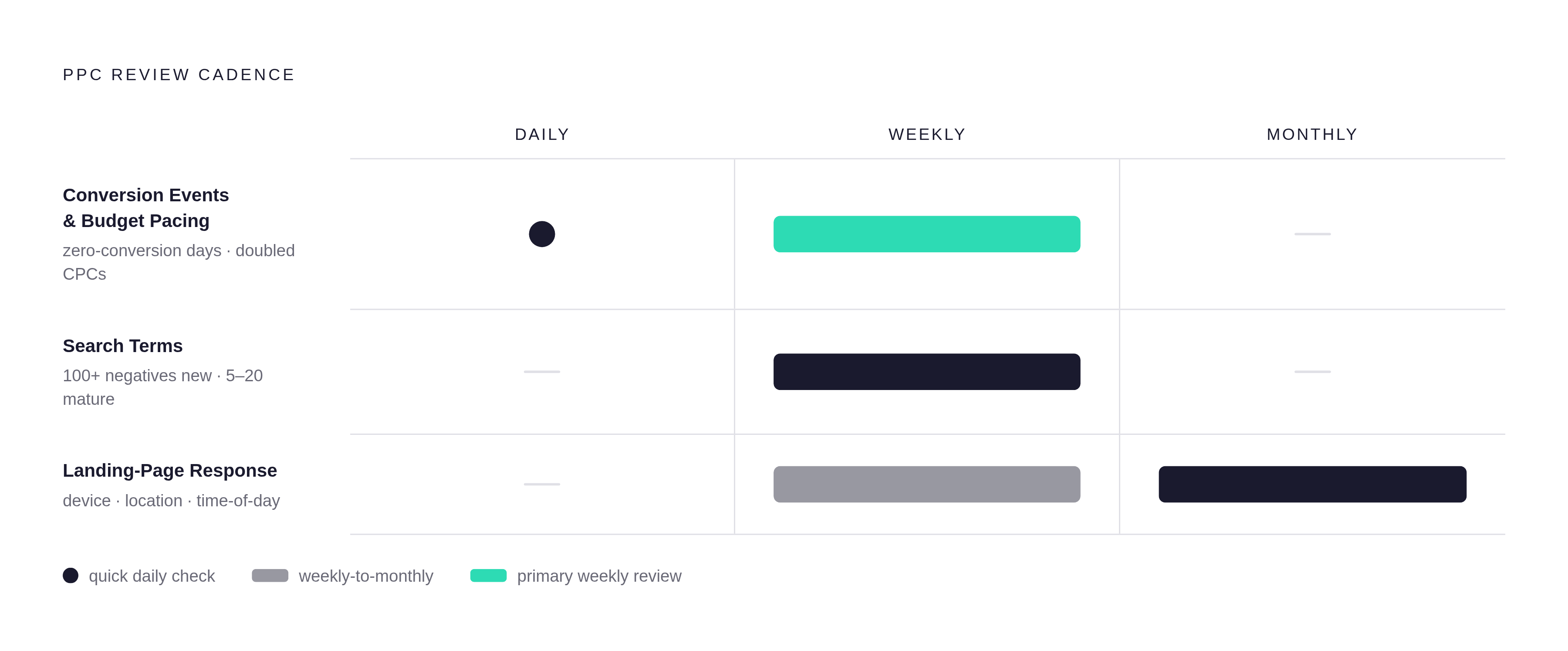
Search terms need a weekly review because they show what queries actually triggered the ads. Open the search terms report and sort by cost. Waste hides in both spend and volume. A weekly session in a new account commonly surfaces more than 100 negatives to add, while a mature account typically produces five to twenty. Remove terms that do not fit before testing new ad copy so that poor traffic alone does not account for weak conversion rates.
Conversion events and budget pacing also need weekly attention, but they answer a different question. Is the account recording outcomes reliably, and is spend behaving as expected? The pacing review should flag a keyword whose cost per click has doubled, a budget-limited campaign, a disapproved ad, or a conversion count that has fallen to zero. Treat two days at zero as a tracking failure until proven otherwise. Check conversion integrity before changing bids, because unreliable records can make budget adjustments amplify the wrong behavior.
Landing-page response needs a weekly-to-monthly view through device, location, time-of-day, and audience segments. A campaign may look stable while one city or device burns budget, and a page that converted well at launch may no longer fit its traffic mix. That does not make every weekly fluctuation actionable. Adjust device, location, and time-of-day modifiers monthly from several months of data rather than from thin windows, especially in smaller accounts.
The cadence separates detection from a justified intervention. The same guide explains that a clean message chain makes low conversion rates easier to understand because traffic that does not fit no longer buries the signal. The daily check is quick, while the weekly review of search terms, pacing, and conversions takes longer. The monthly review of the account’s structure takes about half a day per account. With that benchmark, the useful vendor question becomes “Show me last week’s search term diff and what you added to the negative list.”
What a buyer must be able to read independently before handing the account to anyone
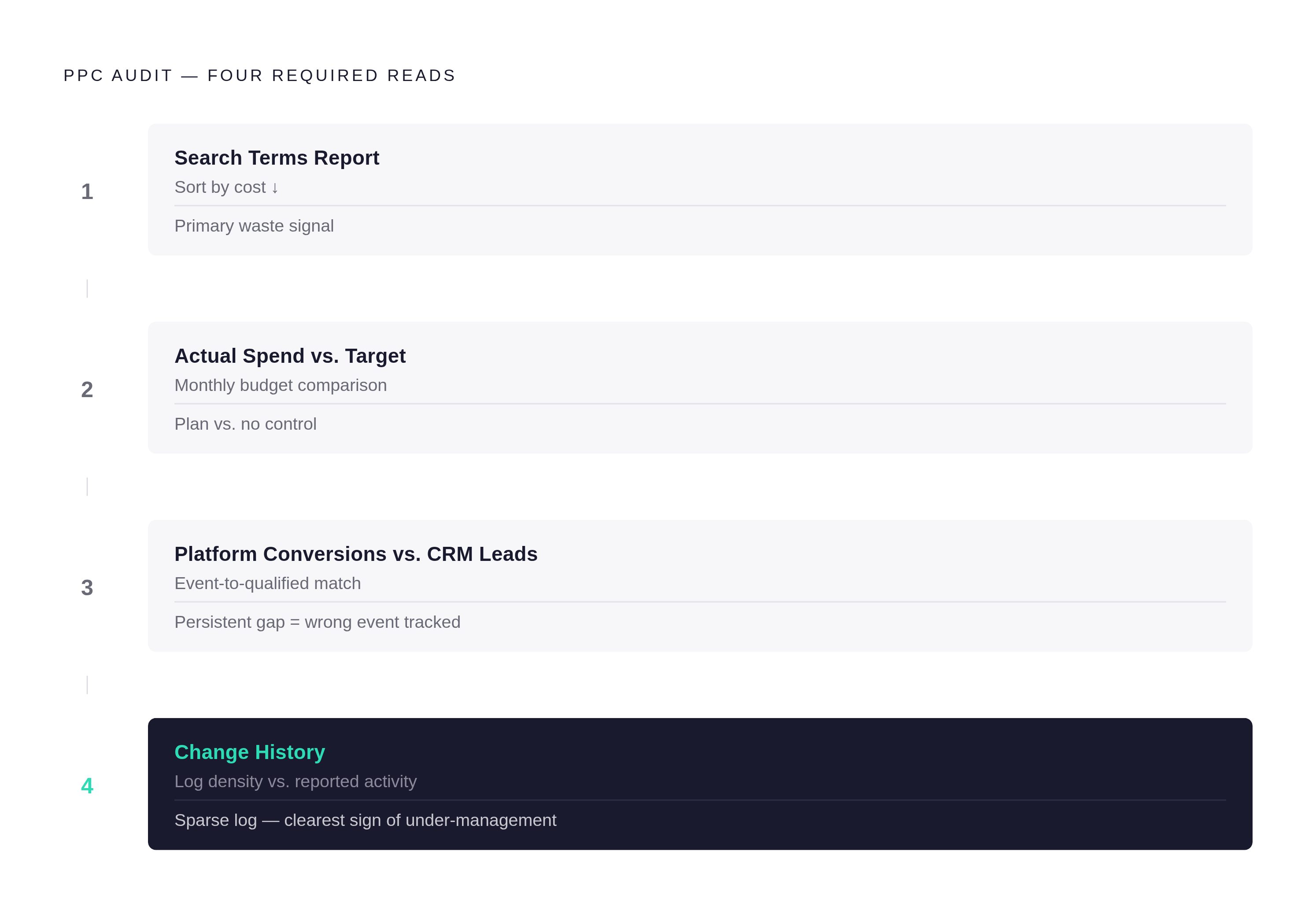
Independent access is a prerequisite. If an agency creates the account under its own name rather than the client’s, leaving the buyer unable to log in, independent auditing is impossible. The buyer cannot read the search terms or check the history. Once the buyer owns the account and can log in, four reads are the least they need to check the work. They connect the manager’s account of the work to the evidence inside the account.
The first read is the search terms report, sorted by cost descending. Look for queries that consumed meaningful spend but produced no conversion. That is the primary waste signal, although it still needs interpretation before action. The second read compares actual spend with the monthly target at the current point in the calendar. It should also flag budget-limited campaigns and sharp changes in keyword cost per click, so that the buyer can distinguish spending to plan from spending without control.
The third read compares the platform’s conversion events with the leads that the CRM recorded as qualified. A persistent gap deserves attention before further optimization. It means the account is pursuing an event that does not map to real business outcomes. The fourth read is change history, which records what changed, when, and by whom. The simplest audit checks whether what the manager said they did appears in that history.
A sparse log relative to reported activity is the clearest sign of under-management. These reads also reduce the uncertainty created when a senior person sells an engagement and a more junior manager runs the account. The buyer need not infer quality from the person’s title or the presentation. They can judge whether the work happened, regardless of who was nominally responsible.
How to automate the diff so the weekly session becomes a decision layer, not a data-pull
The automation target is data gathering and first-pass findings. A useful agent starts the human session with a draft diff. A technical buyer can start with the official Google Ads MCP server. Google publishes it with three read-only tools and, as of v0.0.6 on November 2, 2026, four additional write tools for assets and labels. It requires a Google Cloud project with Explorer access, OAuth 2.0 credentials, and a Google login.
Google retired developer tokens on 9 September 2026. Any vendor tooling or workflow that used the old developer token model needs to be checked to see if it works with the current access path. The agent still needs a bounded question that produces evidence for a decision.
find search terms that spent budget with zero conversions this week,” gives the agent a more specific instruction than “optimize the account. The narrower job produces a finding that can be reviewed. The operator should set a minimum spend before a term counts as waste, a target CPA for evaluating conversion efficiency, and a minimum click volume before a keyword becomes eligible for a pause recommendation. Those thresholds encode human judgment. They are parameters the agent works within.
Each finding should include the metric that backs it up, what likely caused it, and what to do next. A person should confirm negative-keyword additions, budget moves, and test plans before execution, because a rule cannot distinguish a stock-out from a bad keyword. Those causes call for different actions.
The same loop can connect GA4 for post-click behavior, the CRM for lead qualification, and site monitoring for landing-page response. Each connection expands the diff without another manual export. The buyer should control these as separate, swappable sources rather than depend on a monolithic dashboard that bundles access with interpretation. Otherwise, when the buyer stops working with the manager, they may also lose access to the data. The review should depend on the buyer’s evidence.
What the diff reveals about where PPC sits in a buyer's current discovery funnel
What is the account actually defending? Paid search can be well managed while the brand remains absent from the earlier stage where buyers form their shortlists. AI answer engines, including ChatGPT, Perplexity, Gemini, and Claude, are increasingly where product discovery begins. A buyer may type a search query after a conversation with AI has already shaped their shortlist.
Spending to defend positions in search results does not ensure that the brand shows up in those earlier answers. These are different surfaces with different disciplines. SEO optimizes for a ranked position in a list of search results links. AEO, or Answer Engine Optimization, makes a brand a trustworthy, easily extractable source for AI-powered systems to cite as a direct answer. GEO, or Generative Engine Optimization, works on content and brand presence so that generative systems cite, quote, or recommend the brand within their answers.
A brand can therefore rank at the top of Google search results and still be absent from the answer a prospective buyer reads before opening a search bar. Even AI presence is not a single result. The same buyer-intent prompts produce meaningfully different sets of cited brands across ChatGPT, Perplexity, Claude, Gemini, and Google AI Overviews. Brand-name overlap is meaningfully higher than source-URL overlap, but a citation from one engine does not establish visibility in the others. Search-rank reporting cannot reveal these gaps.
PPC is still useful and still needs to be managed with care. It changes the context for sizing its spend. In a category where AI discovery is active, the weekly PPC diff should be read with AI-citation measurement so that downstream efficiency is not mistaken for a complete view of discovery. The account can show what happened after a query triggered an ad. It cannot, by itself, show whether the brand entered the shortlist that preceded that query.
Measuring AI citation the same way you measure the PPC diff — on a fixed cadence with named metrics
AI visibility can be checked each week with the same fixed prompt list and the same method. The first distinction is between a mention and a citation. A mention means the model names the brand, while a citation means it links to the domain as evidence. Track both per prompt and per model. Combining them would blur recognition of the brand with use of its content as a source.
Coverage should include ChatGPT, Perplexity, Claude, Gemini, and Google AI Overviews because leaving out an engine creates a blind spot. The results are not interchangeable across those engines. Perplexity retrieves live web results and almost always includes clickable citations, making it the most directly attributable engine for traffic in GA4. Its Writing mode and parametric fallback can still produce answers without citations. Because of that exception, the answer that comes back needs to be recorded and checked for a link.
The measurement can be done manually each week by running the fixed prompt list across those engines. It takes the same session length as the PPC search terms review. Named measures should keep brand mentions, domain citations, breadth of citation across engines, and attributable traffic distinct rather than collapse them into a vague visibility claim. The weekly comparison then shows where presence changed. As with PPC, a consistent read is more useful than an occasional favorable result.
Content that earns AI citations is not necessarily the content that earns a search rank. Pages cited across multiple engines have meaningfully higher quality signals than those cited by only one, making breadth of citation a quality indicator in its own right. The foundation is retrievable, attributable content on the brand’s site, blog, and documented positions. It is not prompt engineering or a single hero page. Publishing on a cadence with measurement built in makes that foundation a compounding asset, much like a maintained negative-keyword list.
PPC changes remain accountable to search terms, reliable outcomes, and post-click behavior, while AI visibility is judged through the answers and sources buyers encounter earlier. A manager’s value lies in turning that evidence into sound decisions.