Where AI answer engines get their information, and what that means for how a company makes itself legible to them
AI engines draw on three layers, and only the open web is yours to shape.

AI answer engines use stored knowledge, live web pages, and the context they are given to build an answer. For a company, being legible to these systems therefore depends on more than good articles. It requires a coherent, accessible site, corroboration across independent sources, and measurement of what the engines actually say. That makes AI visibility a site-wide engineering problem.
How AI answer engines actually source their answers
An AI answer can draw from three layers that differ in what they cover, when they get new information, and how much a brand can shape them. The first is parametric memory, which is knowledge encoded into the model’s weights during training. That training material includes web crawls, books, Wikipedia, code repositories, and licensed datasets. Most queries are answered without touching the live web.
Live retrieval adds information at answer time, especially when a query calls for something current. ChatGPT routes this primarily through Bing’s index, while OpenAI is increasingly supplementing it with its own proprietary search index. Gemini uses Google Search, and Perplexity has real-time retrieval always on. These are different routes to the web. So being in one retrieval index does not mean a company can be found by every engine.
The third layer is user-supplied context, including files, system prompts, and pasted text that takes precedence within the session. This is particularly relevant to enterprise RAG deployments, but less actionable for organic brand visibility. A company usually cannot control what someone adds to a private session. Nor can it immediately rewrite the model’s stored knowledge.
Where, then, can a company influence the answer? Training corpora remain locked between runs, with lags of months to over a year before new content can appear. Licensed publisher arrangements, including OpenAI’s deals with Associated Press, Axel Springer, News Corp, and the Financial Times, are effectively closed to new entrants. That leaves public pages crawlers can reach and scrape. The open web is the surface a company can influence.
What the citation pattern reveals about which sources AI engines trust
Citation share favors domains with high volume, encyclopedic breadth, or editorial authority at scale. It is not distributed simply according to which individual page explains a topic best. A useful page sits within a larger sourcing environment, where engines encounter some domains and types of evidence much more often than others. That changes the competitive frame. A company must consider which sources the engine turns to for its kind of answer alongside the quality of the answer it publishes.
The pattern shifts with the query’s category. General queries use a different mix of sources from B2B SaaS buying queries, where forum and community pages all but disappear and company pages and directories take over. Local and service business queries show another version of the same dependence on context. Across thousands of ChatGPT answers, a large majority of answers with citations drew on directories, review platforms, or ranked lists.
Why do ranked “best-of” lists earn the highest citation share among content formats? They have already aggregated options and imposed an order on them, performing part of the synthesis an answer engine is trying to deliver. This synthesis helps explain why a company that publishes only detailed product pages may be left out of answers about which product to choose, even though some rankings are unreliable. There is no universal hierarchy of trusted sources, because the source’s role changes with the question.
Why brand mentions across independent sources outrank backlinks as an AI authority signal
A backlink connects one page to another, while a brand mention places a company within a body of information. That distinction helps explain why the two signals behave differently in AI visibility. When trusted third-party domains describe a brand in the same way, that account appears again and again in the material that training and retrieval can draw on. Its own website supplies only one source. Independent mentions offer corroboration that a larger collection of owned pages cannot supply by itself.
Ahrefs’ study of 75,000 brands found that web mentions correlate substantially more strongly with AI Overview brand visibility than backlinks do. The finding reverses the traditional SEO priority given to the inbound-link graph. It is a correlation that leaves uncertain whether any added mention will produce a citation. Even so, it supports the mechanism suggested by the sourcing pattern.
Global household names appear in a large majority of relevant answers on their first run, established mid-market brands in roughly half, and niche or small brands in a small minority. The gap between tiers is roughly thirty percentage points. Optimization therefore begins on uneven ground. A smaller company is competing not just against another website, but against a much larger accumulated record of mentions.
A company deciding where to invest should treat independent presence as part of its authority. That still leaves an important question unresolved. When an engine reaches the company’s own domain, can it form a consistent account of what the company is and does?
How AI engines read a site differently from a search crawler
In traditional search indexing, each page can rank on its own. AI retrieval pipelines can instead read and synthesize across a site, joining information from several pages into an answer. The evidence used to describe a company can span several pages without the system crawling the whole site for every response, so contradictory descriptions, sparse structure, or blocked access can weaken the brand’s overall legibility.
Access is the first hard constraint. OpenAI’s crawler documentation states that sites opting out of OAI-SearchBot will not appear in ChatGPT search answers, although they can still appear as navigational links. A robots.txt entry can therefore prevent live retrieval from using a site in answers, regardless of the quality of its prose. The distinction is easy to miss. Being available as a destination is not the same as being available as answer material.
Once a pipeline can reach a site, structure helps it make sense of what it retrieves. JSON-LD types such as Organization, Article, and FAQPage provide explicit signals about a page and its claims, reducing reliance on interpretation of unstructured prose. The llms.txt proposal, introduced in 2024, provides a complementary description at the domain root. Its Markdown file names the site, describes it, and links to important pages. It is intended as a map for AI comprehension.
The “Phantom Authority” experiment demonstrates the distinction at an extreme. A page with zero visible content became a top citation source within days through structured data alone. That is evidence that technical legibility and visible substance are separable properties. Structure can make material accessible to a system.
What content an AI engine actually extracts and cites from a page
Retrieval pipelines favor passages they can lift cleanly, including a definition paragraph, a table, a numbered list, or an FAQ block. Yet formatting alone is not enough. Pages that earn citations at scale combine extractable structure with original added value, verifiable specificity, and consistent descriptions of the entities they discuss. These properties apply whether a human or a model drafted the page.
Original added value gives the engine something distinctive, such as a synthesis, a named data point, or a clear position. A lead sentence can answer a question directly, while a comparison table can preserve the relationship between options. The unit being retrieved must make sense on its own.
Verifiable specificity supplies the anchors for that extraction. Named organizations, dated events, and attributed figures give a retrieval pipeline claims it can check and cite. If the brand, its products, and its area of authority are described differently from page to page, the system has contradictory material from which to build its account.
This also limits what clearer content can claim to solve. Verifiable passages give an engine firmer evidence, but they are not a guarantee against hallucination. The relevant distinction is between supplying a defensible claim and assuming the resulting answer will always be correct. Volume without specificity can compound the problem by filling the site with low-signal material. More pages are not necessarily more evidence.
The two-layer architecture that makes a brand consistently legible across AI engines
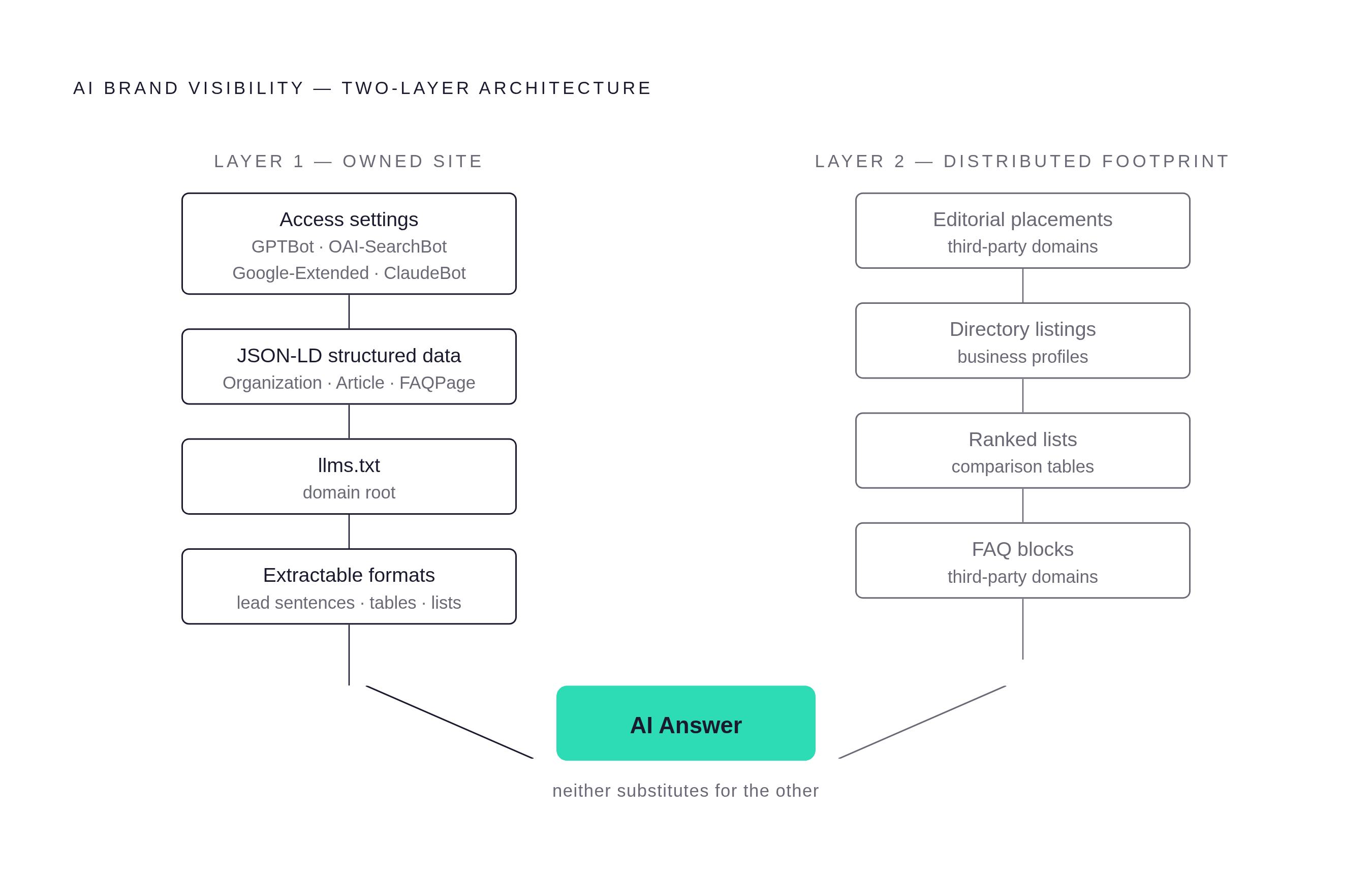
The practical response is to coordinate an owned, technically legible property with a distributed citation footprint. Each layer addresses a different part of the sourcing process. The owned site provides a coherent account that engines can access and extract, while third-party domains place that account within a wider record. Neither substitutes for the other. The work is to make them function together rather than treating off-site visibility as a later promotional step.
For the owned layer, access settings should reflect the different roles of the relevant systems. GPTBot is used for training, while OAI-SearchBot governs access for ChatGPT search. ChatGPT-User is not an automatic web crawler and does not determine search inclusion. Google-Extended is a control token. PerplexityBot and ClaudeBot also belong in the access review, but these names should not be treated as interchangeable switches for the same function.
Beyond access, the recommended foundation includes JSON-LD for Organization, Article, and FAQPage across the relevant site content. An llms.txt file at the domain root can describe important pages and their purpose. Pages should agree on the brand’s category and core claims. Extractable lead sentences, tables, and lists should make individual answers usable without forcing a pipeline to reconstruct them from scattered prose.
The distributed layer builds on that foundation through trusted third-party domains. Editorial placements are one route, but structured directory listings and business profiles also belong in the strategy. Brand-managed sources, including the owned site and business listings, can account for a substantial share of citations across ChatGPT, Gemini, and Perplexity. Ranked lists, definition articles, comparison tables, and FAQ blocks are useful formats because they already perform synthesis.
Why AI visibility must be measured continuously, not assumed from content output
Even with both layers in place, publishing activity does not reveal what an engine is saying about a brand. Citation, mention, and framing are separate observations. A company may appear in an answer without being presented favorably, or be visible for one kind of query but absent from another. Output counts cannot distinguish those outcomes.
Sentiment is especially unstable because positive or negative framing flips more often than mention status. Tracking only how frequently a brand appears therefore misses the more volatile signal. BrightEdge’s February 2026 study found that Google AI Overviews were substantially more likely overall to surface negative brand sentiment than ChatGPT. Near the point of purchase, however, ChatGPT was far more likely to go negative. In apparel, it was also more negative than Google, showing why one engine’s output cannot stand in for another’s.
A team should measure which engines cite the brand, for which queries, and with what sentiment, then use that evidence to change content, structure, or distribution. The team then measures again to test those changes. Because established AI presence compounds over time, delaying instrumentation means falling further behind an advancing baseline.
For a marketing or content team, the first action is therefore not to publish more. It is to install the measurement layer that reveals whether existing content is cited, where it appears, and how the brand is framed.