GEO vs SEO is a debugging order, not a budget choice: instrument each step between a buyer's question and the answer
Diagnose which of five stages loses you the AI citation.
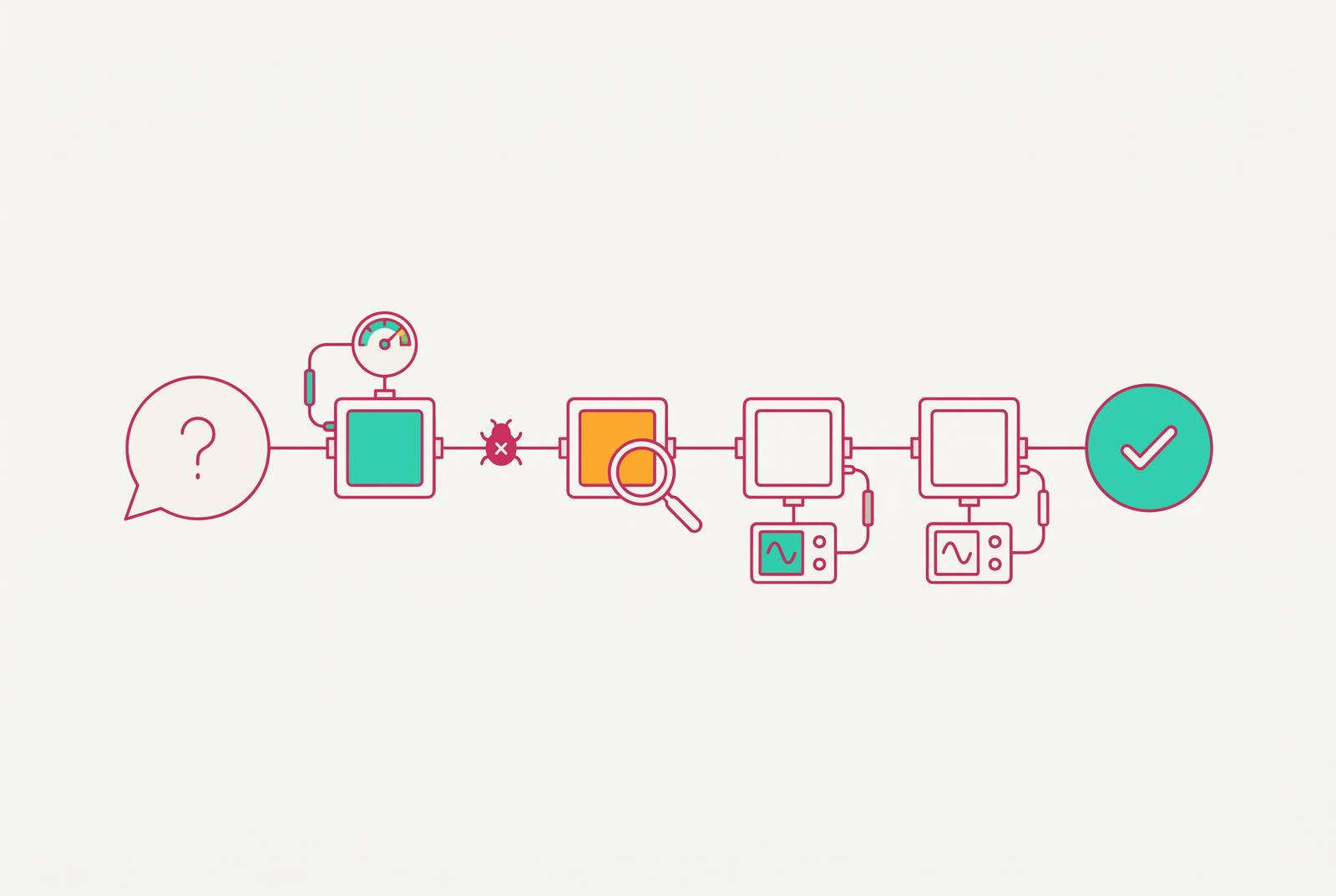
The GEO-vs-SEO budget question is really a question about where discovery breaks. Between a buyer’s question and an AI answer, content must pass through indexing, retrieval, page read, shortlisting, and citation. Each stage can fail for a different reason. The useful decision is not which discipline deserves the budget, but which failing stage needs the next dollar.
Why the GEO-vs-SEO budget debate is the wrong frame
The CFO asks a B2B marketing team, “should we shift budget from SEO to GEO?” The team has search rankings, a content plan, and growing pressure to appear in AI answers, but those inputs do not reveal what the proposed shift would repair. The question asks for a winner too soon. It treats discovery as a single contest when the buyer may encounter the brand in an AI answer, Google it, read a page, and see it cited in another answer before converting.
There is a real distinction beneath that false choice. SEO competes for a position in a list of results, while GEO competes for inclusion and citation inside a generated answer. Each needs different signals and a different way to measure success. Yet AI systems that retrieve through search indexes depend on crawlability and indexation. Technical SEO is therefore part of the foundation for GEO.
A page might be indexed but never retrieved for the buyer’s question, or retrieved without earning a place in the answer. Those are different failures with different remedies.
What the pipeline actually looks like, stage by stage
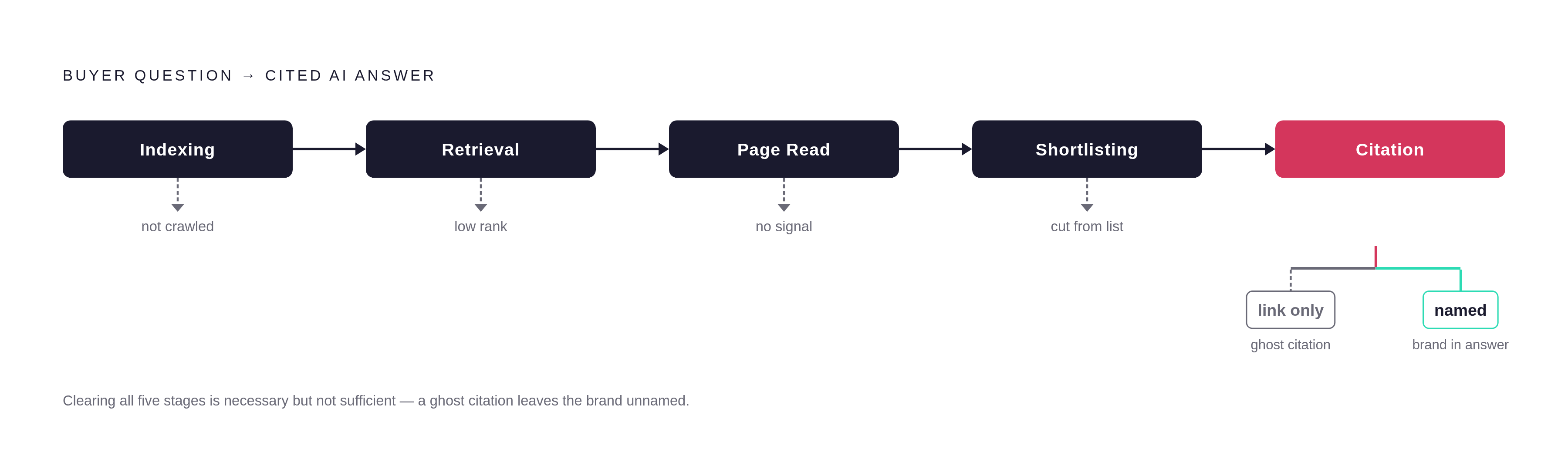
Picture five boxes that lead from the buyer’s question to the answer, with a possible exit between each box. The sequence is indexing, retrieval, page read, shortlisting, and citation. This diagnostic map shows where passage to the next stage is uncertain, allowing for differences in AI engines’ internal processes.
Indexing comes first because the page must be reachable, readable, and available to the systems doing the searching. Google’s documentation on generative AI features covers crawling best practices in its guidance on technical structure. A carefully sourced answer on an inaccessible page still cannot enter that retrieval path.
Retrieval then asks whether the page surfaces for the right question variants. Retrieval-augmented generation, or RAG, systems such as Perplexity and Google AI Overviews retrieve pages at query time, when a question may fan out into sub-queries. It helps to put direct, complete answers near the start of a page and use clear headings and authority signals. But surfacing is not the same as being understood.
At the page-read stage, the system must extract the relevant passage. Paragraphs that stand on their own, direct-answer openings, FAQ blocks, and schema markup help the system find a specific answer without needing the whole page for context. Shortlisting adds another filter after that extraction. The original GEO research by researchers at Princeton University, IIT Delhi, Georgia Tech, and the Allen Institute for AI found that source citations, authoritative quotations, and statistics were the strongest signals at this stage, while classic keyword optimization had minimal effect.
Citation is the final box, but it contains another fork. Does the answer name the brand, or does it merely link to the brand’s content? Naming the brand lets the buyer connect the information to the company that supplied it.
Why citation is not the same as being named in the answer
A brand can clear the earlier stages and still receive no recognition in the answer text. Its content appears as a source link while a competitor gets named in the response. The B2B team has paid for research and publishing, and retrieval has worked, but someone else gets the credit in the answer.
The mechanism is not identical across all systems. Some models take brand names from parametric memory, which is what they already know, and add sources to back them up afterward. Most RAG-based AI search systems instead retrieve sources first and generate an answer grounded in that material. It would be wrong to describe post-hoc sourcing as the universal sequence.
ChatGPT has a high citation rate but a low brand-mention rate, so it often cites sources but names brands less often in the answer text. Gemini has the reverse pattern, with a low citation rate and a high brand-mention rate. AI Overviews has less of a gap between the two measures, though it still cites sources much more often than it mentions brands. A result that looks healthy on one measure can therefore conceal weakness on the other.
What did the buyer actually learn about the brand? That question is sharper than whether a link appeared. Named brands have far higher citation rates than brands that go unnamed, but the two outcomes are not interchangeable. Where ghost citations persist, the remedy reaches beyond more owned-site content toward consistent, identifiable appearances across sources the model learns from and retrieves.
Why your owned site alone cannot fix a citation problem
Most AI citations originate outside brand-owned websites, limiting what a strategy confined to the owned domain can accomplish, even when its pages are well structured. The site still has an essential role. It should serve as a citable primary source, with direct-answer sections, FAQ blocks, schema markup, and enough depth to give publishers and AI systems a canonical reference.
The second layer sits outside the domain. Branded mentions across independent websites correlate more strongly with AI citation visibility than backlinks alone, and appearances across multiple non-affiliated editorial domains are associated with higher citation rates. The mechanism is citation consensus. Consistent descriptions across independent sources give AI systems more grounds to identify the brand and understand what it does.
Consider a press release that puts a product in one category, an online encyclopedia stub that assigns it another, and an owned About page that describes a different use case. Each may sound plausible in isolation. Together, they leave uncertainty about the entity being described, just as conflicting founding years or product descriptions would. That uncertainty can suppress citation.
For a team facing this failure, the recommended architecture pairs the owned reference layer with earned placements in publications AI engines treat as authoritative. The purpose is to make the brand’s facts and framing available in the citation corpus itself.
How the content pipeline inside the organization creates its own failure points
The external pipeline has a counterpart inside the content team. Research, drafting, and review shape whether the published work has anything worth extracting and citing. A sound distribution architecture cannot supply missing expertise. For a content lead, the useful operational question is which production stage stripped that expertise out.
The failure can begin with a brief synthesized by AI without customer interviews or sales-call insight. It may cover the expected topics but miss the operator’s view that makes an answer helpful in practice. Drafting can preserve that weakness. A technically correct AI draft may still lack domain expertise, editorial judgment, and the buyer-specific nuance needed to become a source that earns citations.
Review is where a team can repair those omissions, but only if the review goes beyond surface polish. Thinning human review removes the chance to add grounded experience claims and operator details. A content lead should therefore treat the review gate as part of the visibility system. Google’s algorithmic response to unedited AI content at scale is a background signal of the risk and one reason to preserve that gate.
The gate also needs a design that people cannot casually bypass. Automated checks for factual consistency, personally identifiable information, and toxicity, combined with mandatory human sign-off for high-risk content, help prevent unreviewed AI output from leaking into production as “shadow content.” Speed need not require skipping these steps. A multi-stage AI workflow with human review addresses the bottleneck through gate design, rather than choosing between slow production and unchecked publishing.
Instrumenting each stage so you know where you actually drop out
To decide where to spend on fixing these failures, a team needs to measure each stage. Indexing begins with familiar technical SEO checks, including crawlability, indexation status, Core Web Vitals, and schema validity. These are baseline checks. They establish whether it is reasonable to investigate a failure further downstream.
Retrieval calls for a different view of the evidence. Server logs can show AI bot traffic, but the measurement needs to distinguish retrieval bots from indexer bots and training crawlers. Retrieval traffic is the leading indicator closest to AI-driven conversion in this layer. Sub-query rankings also show whether content comes up for the question variants an AI system may use. Neither signal alone establishes that the page made it into an answer.
It is harder to tell page read and shortlisting apart from the results a team can see. Share of voice in AI answers shows how often the brand is mentioned or cited for target queries, which helps a team find where retrieval fails to lead to inclusion. Tracking should treat ChatGPT, Claude, Gemini, and Perplexity separately because their mention and citation patterns differ. These outcome measures help narrow the diagnosis. They do not, by themselves, reveal every internal decision an engine made.
At the citation stage, the measurement must split source links from named mentions. Otherwise, ghost citations can inflate apparent success while leaving the buyer unaware of the brand. The gap is especially useful when retrieval already looks healthy. It points toward a recognition problem rather than a need to make the same page easier to find.
Evan Drake’s April 2026 research proposes a unified AEO measurement framework with four signal types, namely presence, citations, sentiment, and agent traffic. The paper also introduces “citation half-life” to describe the temporal decay of AI citations. That makes time part of the diagnosis. Between forty and sixty percent of cited sources change from month to month in tracked AI visibility indexes, so a single snapshot cannot support a durable conclusion.
Commercial measurement then needs to connect visibility to outcomes on different clocks. Visibility asks whether target answers mention or cite the brand, while traffic records referral sessions from ChatGPT, Perplexity, Gemini, and AI Overviews. Demand looks for rising branded search or direct traffic associated with AI exposure. Revenue asks which leads and deals can be traced to an AI-answer touchpoint.
The debugging order: which stage to fix first
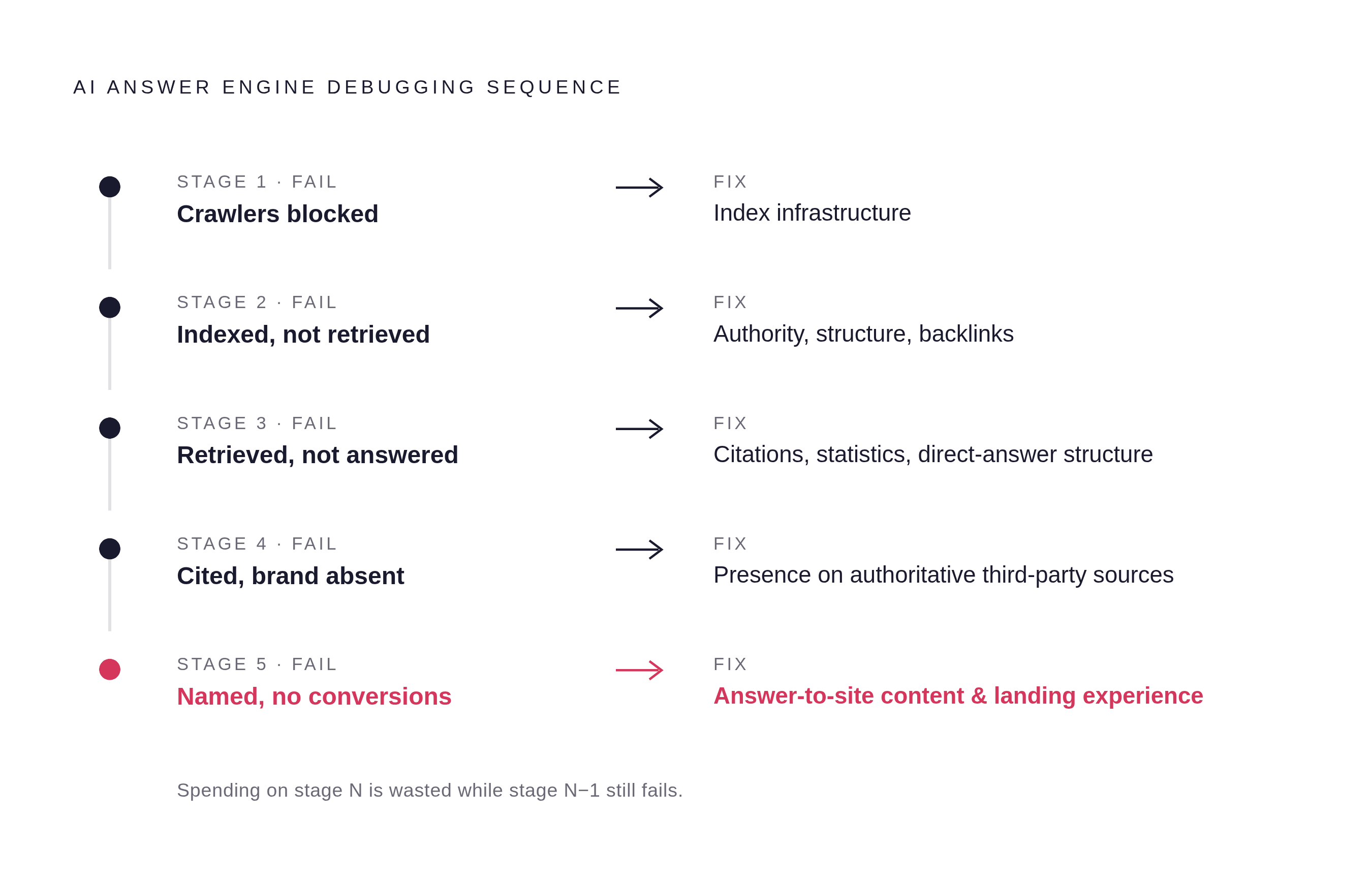
The decision rule is to fix the earliest failing stage first. If AI crawlers cannot reach or parse the content, indexing takes priority over GEO tactics. Spending on citation-oriented copy at that point is like optimizing a landing page while the ad sends traffic to a 404.
If the page is indexed but absent from retrieval evidence, the next diagnosis concerns authority and structure. Technical SEO, the backlink profile, and content extractability are the levers at that stage. If retrieval is visible but the source does not enter answers, the focus shifts to citability. Source citations, statistics, authoritative quotations, and direct-answer structure address that later failure. The distinction prevents a team from prescribing more authority when the immediate weakness is an unusable passage.
If the content earns source links but the brand goes unnamed, the next investment belongs in consistent, identifiable presence across authoritative third-party sources. That reflects limited parametric familiarity. If the brand is named but conversions do not follow, the diagnosis shifts again. Demand and revenue measurement must examine the answer-to-site path, with the remedy in the content and landing experience.
This order also changes the value of later work. Repairing retrieval opens citation opportunities that the brand previously could not reach, allowing subsequent content improvements to work where they once had no chance. The budget follows that dependency. Its next destination is the earliest demonstrated break, whether that is indexing infrastructure, content citability, external distribution, or the path from an answer to a customer.