DIY SEO for B2B founders: what to keep in-house, what to hand to an agent, and what to hand to people
Baseline your AI visibility first, then assign each SEO task.

DIY SEO for B2B founders is a decision about measurement before it is a decision about labor. The useful split is between work that needs founder context, repeatable production an agent can handle, and specialist methods that neither can replace. But that split only works when each task has a visible result and enough of a record to hand it off cleanly.
Why the keep-vs-outsource question is the wrong starting point for B2B founders doing SEO
Organic is on the roadmap, the board wants results, and someone has to decide whether to hire, retain an agency, or do the work internally. What result is the team starting from, and how will it know whether the work changed anything? Without those answers, an outsourced task buys activity without establishing whether anything improved. Keeping the same task in-house adds founder distraction without solving the underlying problem.
The sequence needs to run the other way. Instrument the work, establish a baseline, and then assign it to whoever can execute against that baseline most efficiently at the company’s stage. Cost still belongs in the decision, but only after the team knows what it is paying to improve.
What SEO actually covers in 2026, and why one person cannot hold all of it
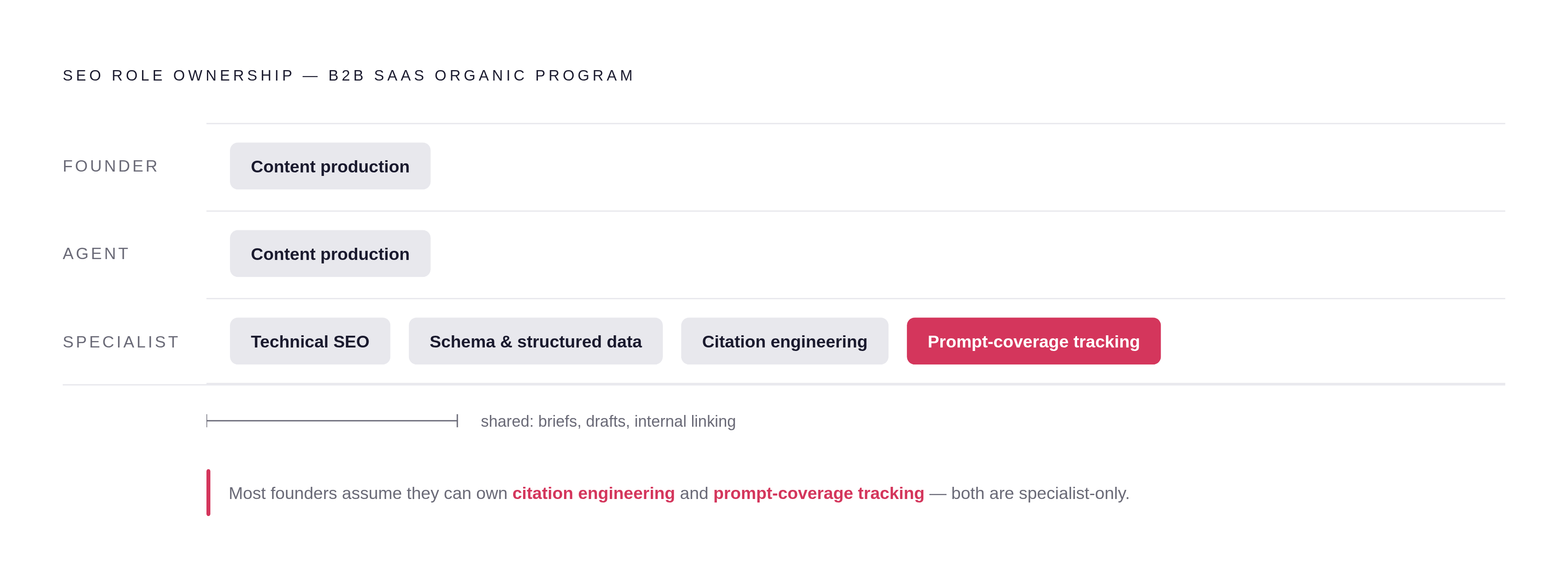
DerivateX identifies five distinct roles in a mature B2B SaaS organic program. Technical SEO and site architecture cover crawl health, Core Web Vitals, JavaScript rendering, and redirect strategy. Content production covers briefs, drafts, internal linking, hub-and-spoke architecture, and comparison and alternative pages. Schema and structured data require their own implementation and validation work. Citation engineering restructures claims for AI extraction and reinforces entities through third-party sources, while prompt-coverage tracking measures answers across ChatGPT, Perplexity, Gemini, and Claude.
These roles compete for time and require different methods. A senior in-house generalist can typically own technical SEO and direct parts of content production. That is a valuable remit. It does not leave enough capacity to sustain schema work, citation engineering, and prompt-coverage tracking at the same time. Defining those boundaries makes DIY more honest while preserving its value.
The distinction between traditional SEO and GEO/AEO explains part of that expansion. In SEO, the page competes for a click. In GEO, the passage competes for a citation, often without producing a click at all. A team measuring only visits therefore cannot see the whole result of its organic work.
Why getting a baseline AI citation measurement must come before any staffing decision
The practical first step is to measure current AI Share of Voice across a defined set of category prompts. How often do AI-generated answers mention or cite the brand? DerivateX’s 2026 comparison recommends establishing that baseline before choosing an agency or a hire, because it helps distinguish a measurement problem from a staffing problem. Until that record exists, a founder cannot clearly describe the gap another person is supposed to close.
A free baseline is enough to begin. Run a fixed set of category prompts weekly across ChatGPT, Perplexity, Claude, and Gemini, recording mention rate, URL citation rate, sentiment, prominence, and share of voice. Server logs can show whether GPTBot, ClaudeBot, and PerplexityBot reach the site, and GA4 can split traffic from AI platforms by session source. Together, they give the next owner something more useful than a vague request to improve SEO.
What belongs in-house: the tasks where founder context is the irreplaceable input
The baseline may show where coverage is weak, but it cannot give the company’s point of view. That input belongs with the people who built the product and understand its customers. An agency can brief and format a category narrative, but it cannot originate the same stance from outside the business. Founder-led thought leadership also depends on real experience and named-author credibility. Those E-E-A-T inputs require a person who actually had the experience.
Product claim verification belongs in-house for the same reason. AI can surface what appears in the wider discussion, but it cannot decide what the company knows first-hand or which angle is genuinely differentiated. Founder context must therefore enter at the brief stage. High-stakes product claims, competitive comparisons, and content touching YMYL criteria need human review at the brief, draft, and pre-publication stages.
A founder can take on more when the site is small. DIY is viable under a few dozen pages, with low competitive pressure, a flexible timeline, and meaningful weekly time from someone who wants to learn the craft. Stridec notes that a previously unoptimized site can take 6–12 months to show visible ranking gains through DIY. That wait is acceptable only when other revenue channels exist and immediate fundraising or competitive pressure does not demand faster results.
What belongs to an AI agent: the pipeline that handles the repeatable, measurable middle
Below the founder’s judgment sits a large production workload. Agents fit where inputs are structured, outputs are verifiable, and the task does not require deciding what the company truly knows. Opportunity identification can surface keyword gaps, competitive content holes, and underserved prompts from a standing topic model. Brief creation can then turn a research corpus into structured instructions grounded in actual source material.
Draft generation follows the approved brief, with citations and direct-answer formatting already in place. An SEO optimization review can check titles, meta descriptions, internal linking targets, schema presence, and direct-answer block placement before human review. Each stage has an output someone can inspect. That shifts the bottleneck from creation to quality control, where founder context becomes useful again.
For that handoff to remain observable, every draft needs its prompt, source set, and revision log. A reviewer can then see what the agent produced and why before approving it. Agents must not decide whether a piece is ready to publish, add first-person experience signals, verify factual claims, or choose the differentiated angle. The boundary depends on whether the task requires judgment the production record cannot supply.
What belongs to specialist people: the two domains where methodology, not just effort, is the gap
Serious technical SEO architecture is more than a founder and an agent can handle because mistakes can cost a lot and be hard to undo. Large-site crawl analysis, log-file analysis, JavaScript rendering audits, schema architecture, and international hreflang setups require specialist depth. A generalist can learn their surface without producing an audit that resolves architectural debt. A migration or redirect strategy during a product launch raises the stakes further. More drafting capacity does not address that risk.
AI citation engineering needs specialists for their methodology. This work includes restructuring claims for extraction, engineering answer fragments, and reinforcing entities through sources such as Reddit, G2, niche publications, and online encyclopedia-adjacent properties. Stridec identifies citation engineering as a clear agency trigger because feedback loops are slower and the tooling category is still maturing. Presence across trusted third-party properties correlates with AI visibility, but building that record is distinct from publishing more pages on the company site.
DerivateX also describes prompt-coverage tracking as a manual, high-cadence research function that one person cannot sustain beside everything else without the panel becoming a neglected spreadsheet. Xeo says to keep content coordination in-house and have outside specialists handle Google SEO strategy and AI citation engineering.
How stage and ARR should shift the allocation, not just the budget
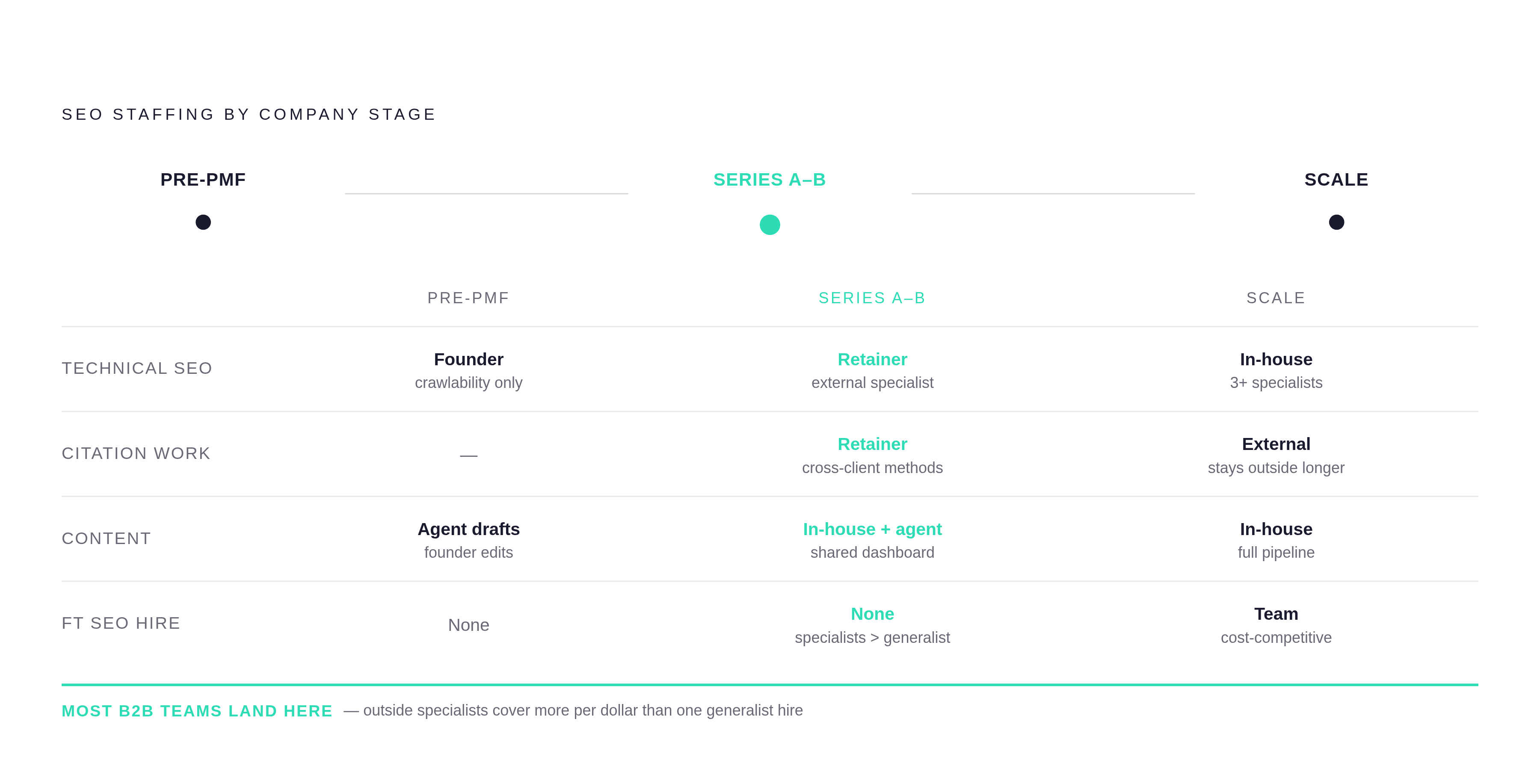
Before product-market fit, the allocation should stay lean. No agency and no full-time SEO hire are warranted at this stage. The founder does enough to keep crawlability intact and publishes content from the founder’s point of view, while an agent handles drafts. A broader program is not worth the cost before product-market fit is established.
From Series A to mid-scale ARR, outside specialists can cover more of the work for each dollar than one generalist hire. A retainer for technical SEO and citation engineering covers work that one employee cannot keep up with reliably alongside the rest. Content can remain in-house or run through an agent pipeline with founder review. Both sides share the work of prompt-coverage measurement and have an ongoing dashboard they can both read. This is the hybrid model most Series A and B teams converge on.
An in-house team can compete on cost when the company can support three or more specialists, and working more closely together helps them learn from support tickets, shape product naming, and respond to what competitors do. DerivateX’s comparison frames ARR as the point where the math flips and notes that citation work stays external longer because methods develop through cross-client volume. Xeo also says to build the skills of the in-house team as the company grows while keeping people who do specialized AEO work every day.
Structural content moves that make any allocation — founder, agent, or specialist — more likely to earn AI citations
Regardless of who produces the content, the craft needs to support passage-level extraction. Put a 40–60 word direct-answer block at the top of every major section. That gives the section a clear answer passage. Use headings phrased as questions with schema for frequently asked questions to show that the content is laid out to give answers. Introduce the brand, author, product, and relevant industry terms early so that the Knowledge Graph has named entities to anchor to.
Evidence strengthens those structural choices. Research by Princeton, Georgia Tech, and IIT Delhi presented at KDD 2024 found that content citing sources and including statistics earns meaningfully more citations than content without them. Direct quotations from named experts also lift citation rates. A standing refresh schedule also belongs in production, because pages left unrefreshed are more likely to lose citations over time.
Off-page GEO includes getting listed and reviewed on the main review platforms for the category, taking part in industry forums that fit the business, and getting coverage in publications that answer engines often cite. For B2B SaaS, presence across trusted properties correlates with AI visibility. Microsoft’s guidance, cited in ConversionCrush’s 2026 agency guide, emphasizes clarity, structure, completeness, freshness, and on-page evidence. Headings, tables, FAQs, and accurate business information are practical ways to put that guidance into use.
How to measure whether the allocation is working, and what to do when it is not
The ongoing practice can begin with a weekly 30-minute prompt panel. Use the same buyer-intent category queries across ChatGPT, Perplexity, Claude, and Gemini, tracking how often answers mention, cite, or recommend the brand. Record that coverage together with the brand’s share of all brand mentions in those answers. Keep the measures distinct and consistent over time. Checking server logs gives an indirect measure of crawlability, and GA4 segmentation shows how much traffic comes from AI platforms.
When a gap appears, the first question is not who failed. Which part of the work lacks a clear signal, and which zone does the evidence point toward? When the citation rate falls within a prompt category, it points to a need to check content structure in the agent pipeline or the work done by specialists. A crawlability gap points toward technical SEO, while a brand-narrative gap points toward in-house content. Those are diagnostic starting points for reviewing the allocation, rather than reasons to replace every contributor at once.
As ARR grows and the team develops GEO skills, the dashboard makes changes in ownership legible and grounded in evidence. The production record makes those changes possible without losing the work’s context. Together, they turn allocation into a loop in which evidence guides the next handoff. Run the prompt panel this week, before making a hiring or agency decision.