A content workflow is a state machine, not a list of owners: how a technical founder should make every step from research to publish inspectable, checkable and agent-callable
Explicit states and evidence gates keep a small content team's pipeline honest.

A content workflow is a state machine, while an owner list records responsibility. For a technical founder, that distinction makes a two-hours-a-week content operation possible. Explicit states, enforced transitions, and evidence-backed gates let a human or an agent inspect what happened, understand what is blocked, and resume work without rebuilding the story from chat history.
Why treating a content workflow as a list of owners creates a class of failure that ownership cannot fix
A draft sits for a week because nobody is sure whose job it is to approve it. There is no log explaining the delay. The owner column names someone, but it does not say whether research failed, review is still waiting, or someone approved the work elsewhere. Finding the answer means searching Slack, checking a stale Notion status, and asking people what they remember. Responsibility exists, yet the work has no reliable state.
An owner identifies who is responsible, with the next action and proof that the previous step passed requiring separate specification. Separate boolean flags can make this worse. A piece can be both “in review” and “ready to publish” if nothing prevents that contradiction. Assigning a more diligent owner does not remove the invalid combination. The process needs rules that prevent it from existing.
But what if everyone already follows a written process? That works only while someone remembers and applies it. Aharness states that prompts and skills can describe a process but cannot enforce it. The same limit applies to owner columns and RACI charts when no runtime enforces the rules. An autonomous agent cannot count on an operator who is not there to supply the missing constraint.
What a finite state machine gives you that an owner list never can
A finite state machine is a flowchart with enforceable routes. States say where the work stands, and transitions set out which moves are allowed between them. A gate checks whether work qualifies to advance, and a guard is the condition that permits or blocks a transition. A handoff records what the gate decided and the evidence behind that decision.
If no transition connects an unreviewed draft to publication, neither an agent nor a human can take that shortcut through the workflow. Typed evidence requires work to be submitted in a set shape, such as a plan object, readability score, or human approval token. A failed check can instead route work to revision_needed, with a retry budget and escalation for repeated failure. Failure has a place in the map.
The handoff makes that map useful after an interruption. It preserves the outcome and the evidence needed to determine which routes remain available. Beyke Workflows distinguishes model context, which is sent into a particular model call, from workflow state, which the system stores to resume, audit, and control the process. They serve different jobs.
The skip-review bug that every content agent ships by default
The skip-review failure begins with a successful local step. Drafting produces a draft, so its own contract is satisfied. An ordered sequence may list editing and publishing as the next steps, but that order alone does not keep the obligation to get review in place. Without that obligation and a guard checking it, local success can be mistaken for completion of the whole request.
After implementation produces code and passing tests, the model may report completion even though review was intended to follow. In a content pipeline, an unenforced review step leaves the equivalent opening. When execution resumes, a person must recover the intended route from instructions and logs.
The repair is a durable handoff saved beyond the current model invocation. It records the completed gate, the evidence produced, and the routes now available. Why not simply add “review before publishing” to the prompt? Because a prompt is not a guard. A confident closeout message does not prove that the required review occurred.
Declaring the states of a research-to-publish pipeline explicitly
Each state starts as a discrete value the system can store, compare, and route on. An owner’s name cannot do that job. Neither can a loose status label that means different things to different operators. The definition needs to distinguish work underway from work finished, and work finished from work accepted. Those distinctions expose the shortcuts an informal process permits.
A minimal map begins with topic_queued, where a topic exists but work has not started. It moves to research_in_progress while sources are gathered, then to research_complete when sources are validated and a brief exists. draft_in_progress records drafting underway, while draft_complete means a draft exists without implying review. human_review_pending makes clear that the draft is still waiting for a review decision.
From there, revision_needed records specific blockers returned by the reviewer, while approved records that the human gate passed. published means the piece is live on the site. It is not the end of the map. post_publish_seeding covers active off-site distribution tasks, complete means all obligations are satisfied, and failed marks terminal failure requiring manual handling.
Each state also needs allowed exits and required evidence. Aharness gives coding agents that pattern by setting out the current states, the valid exits, and the submission schemas they must use. The content equivalent applies it to research, drafting, review, and publication. The implementation language is secondary to the contract. Written as code rather than documentation alone, the definition becomes diffable, testable, and readable by an agent through an API.
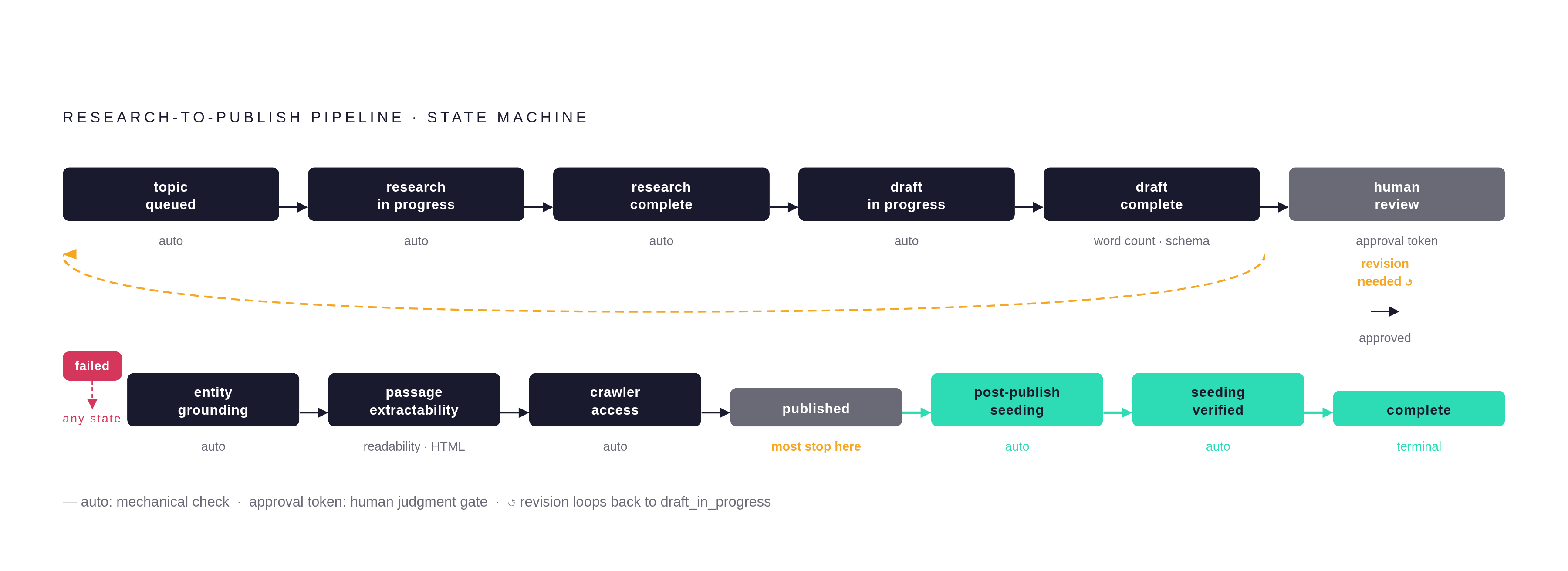
Gating on evidence instead of promises at each transition
At each transition, the design question is what evidence permits the move. “The draft looks ready” is not a typed submission. A schema can establish that structured output has the expected shape, while word count, internal link count, and readability can be checked against defined bounds. These mechanical checks can advance automatically when they pass.
Other decisions require a person’s judgment and a recorded approval token. Does the strategic angle fit how the brand wants to be seen? Are the named factual claims verifiable, and does the draft create reputational risk? Tone and voice also need a decision about whether the piece sounds right for the brand. The gate preserves that distinction instead of treating every kind of approval as interchangeable.
Is this too much machinery for a two-person team? The useful comparison is not between code and no code, but between explicit checks and repeated reconstruction. A system running two pieces a week can use the same gates at twenty without redesigning the workflow. The human queue stays focused on judgment. Mechanical validation has its own route, so the reviewer does not have to spend time on it.
Some checks also test whether the intended destination can use the content. Passage extractability checks whether each H2 section answers a question on its own, without the text around it. Crawler access checks whether server-side rendered content or static HTML is accessible independently of client-side JavaScript. These are delivery conditions. They become especially important when the destination is an AI answer engine.
How the target destination for content — AI answer engines — adds new required states to the pipeline
A page can rank on Google without appearing in a ChatGPT answer on the same topic. AI answer engines use training data, real-time retrieval, and entity associations to draw answers from more than the top search result. GEO/AEO therefore adds requirements to the existing workflow instead of replacing it with a separate content strategy. The state map needs to include those requirements before the content is published.
The first added state, entity_grounding_check, tests whether the content establishes the brand as a named entity with consistent descriptions across the site. AI citation depends on recognizable entities and corroborated claims. Next, passage_extractability_check tests whether each H2 section works as a standalone answer snippet, with a question-shaped heading, an answer-first opening, and a named source. The passage must make sense on its own. That requirement turns structure into something the pipeline can check.
The third state, crawler_access_check, tests whether the content is available as server-side rendered or static HTML. Most AI crawlers fetch pages without running JavaScript, so client-side rendering can hide content they could otherwise use. Rendering audits, schema validators, and structural checks give these states enforceable entry conditions. An owner assignment alone provides no such contract. The pipeline needs both search and AI-citation gates, because passing one set does not establish that the other has passed.
Why "published" is not a terminal state — the post-publish seeding loop
Publication makes content available on the owned site, but it does not finish the work of making its claims discoverable elsewhere. AI answer engines have two discovery routes with different timescales. Training-data coverage depends on the same facts appearing across independent sources, while retrieval rewards chunks that stand on their own and directly answer a query on a page that crawlers can read and that loads fast. Those routes need different kinds of work. Both belong inside the workflow.
The ground site is the owned domain, rendered for access, structured for extraction, and updated consistently. The phantom-site layer is the spread of brand facts across third-party publications, Wikidata entity records, community forums, podcast appearances, and expert quotes. It can establish a brand’s name and claims across sources a model encounters before deployment. A current placement cannot retroactively change an already trained model.
For that reason, published should trigger post_publish_seeding, where PR outreach, community placement, and Wikidata entity verification become agent-callable jobs. Each task can be queued, dispatched, confirmed, or failed. Sending an outreach request is not completing a placement. seeding_verified records that off-site placements are confirmed retrievable, and only then can complete mean that the run’s obligations have been satisfied. The same evidence discipline applies after publication as before it.
Retrieval is rented, while training is owned, in the sense that a retrieval citation depends on an engine fetching a page for a particular answer. A competing page can displace it. A brand absorbed during pretraining instead becomes part of how the model understands a category. Neither route justifies treating publication as proof of visibility. The post-publish loop makes the remaining work inspectable without promising that a completed task guarantees citation.
Making the whole pipeline inspectable and agent-callable through a readable state API
Inspectability means that every run exposes its current state, transition history, evidence references, and open blockers through a read-only API. It is more than a dashboard someone maintains. A call such as .read("post-123") returns the current state, last accepted handoff, open blockers, and available transitions. An agent can then resume from the stored record rather than ask a human to explain where things stand. The workflow itself supplies the context for the next valid move.
The techops-hero implementation separates read-only inspection from the instrumentation capability used for production writes. That boundary prevents an auditing agent from changing state while inspecting it. Transitions that are allowed can still be made available through an API and hooked through MCP. An orchestrator can drive the workflow, a watcher can monitor it, and a human can resume it without inventing a different process for each route.
Monitoring AI citation share is the observability layer for post-publish states. Transition history shows whether seeding finished, while citation measurement tracks how much of the visibility that work aimed for was achieved. Completion and effectiveness are not the same thing. Keeping both open to inspection lets people spend their limited time on blocked decisions and results, without having to piece together the status.
Two hours a week is enough when the system knows its own state.