SEO and digital marketing only work together if you instrument the path between them: one buyer question, traced from sales call to page to outcome
A record linking each buyer question to its page and outcome.
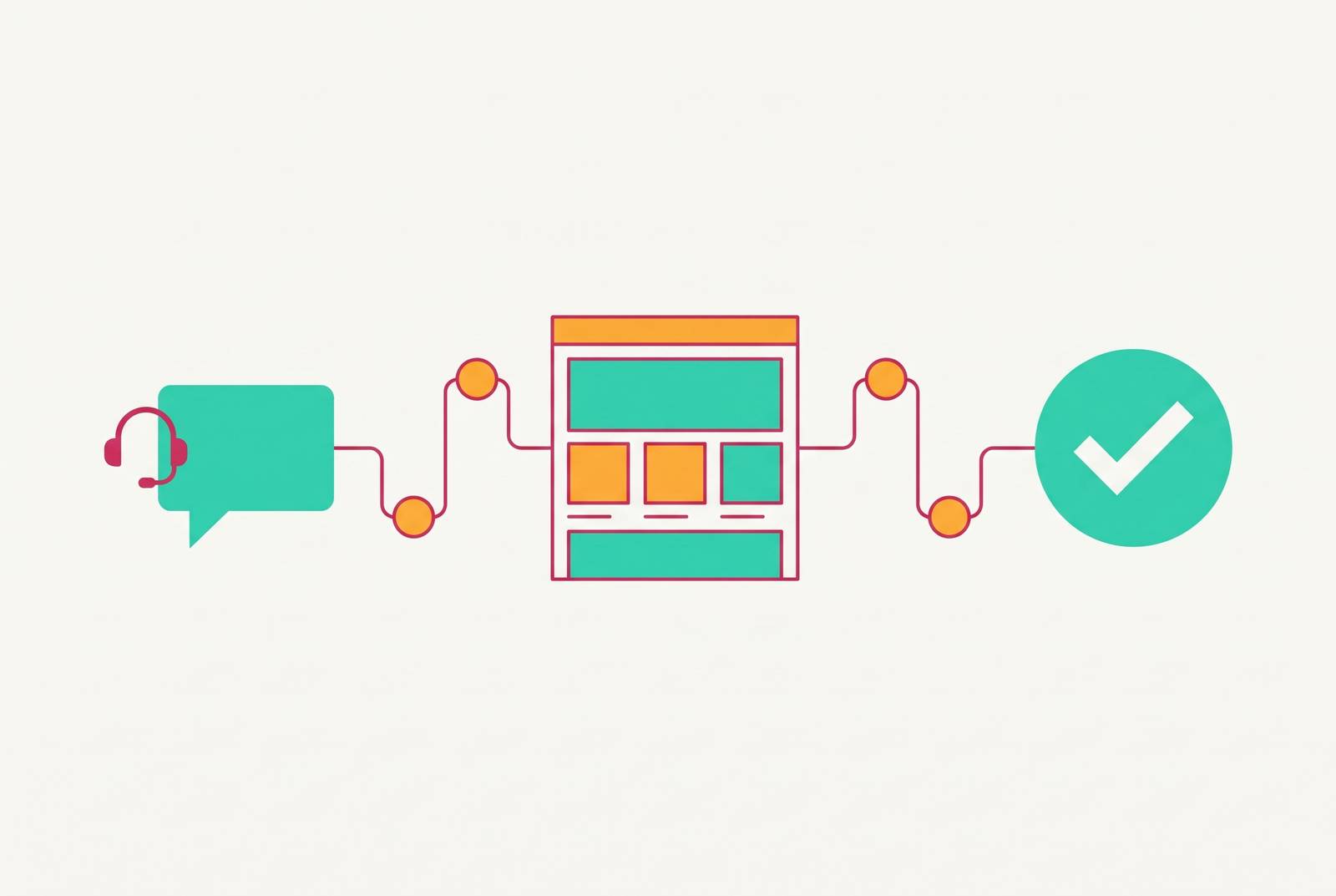
SEO and digital marketing work together only when the path between them is instrumented. The missing link is often not a better strategy or a different vendor, but a record connecting a buyer’s question to the page that answers it and the outcome that follows. Treating that connection as a data pipeline makes it possible to learn which content helps buyers move toward a purchase, even when part of their research happens inside AI answers.
Why SEO and digital marketing fail to compound even when both are running well
The monthly SEO report shows more sessions, higher rankings, more impressions, and another batch of articles that went live. Yet the revenue conversation has nowhere to go. Which of those gains helped close a deal, and which should get more money? The report cannot answer because its scope is limited to activity inside one channel, leaving the handoff between content and sales unreported. This is an engineering problem before it is a strategy problem.
Consider a buyer who sees a social post, Googles the brand, opens an email, and buys after a retargeting ad. Four channels contributed to one purchase. If attribution credits only the channel that closed it, the upstream channels look weak even when they helped create the demand. Budgets then get cut because those channels look weak, taking money from the work that helped the closing channel succeed.
The tools reinforce this separation because they observe different parts of the journey. Rank tools track SERP position and impression share, but the data on closed revenue is in the CRM. A rank movement is a useful leading diagnostic. GA4 cannot see what closes without the downstream connection. The gap between organic sessions and revenue is therefore not a disagreement about marketing’s value, but a missing data handoff.
How AI search broke the click-through assumption that the old instrumentation was built on
That handoff now spans more than analytics and the CRM. Traditional measurement relies on a buyer clicking through to a site so that a session can be tracked. AI answers let buyers do research before that visit and sometimes take the place of the visit altogether. Pew Research’s July 2025 findings showed that people clicked on traditional results at roughly half the rate when an AI summary appeared. Awareness queries are especially exposed because an answer may satisfy the buyer without another click.
Emplifi and Semrush’s 2026 Social Search and AI Visibility Report maps four channels involved in a purchase decision, namely social, search, communities, and AI. Social creates intent, search refines it, communities validate it, and AI accelerates it. The report found that two in three shoppers start their research somewhere other than a search engine.
The same report found that two-thirds of consumers have used AI tools to research products, with one in four using them frequently. That makes AI research more than an occasional detour. Google’s AI Mode fans a buyer question into many sub-queries and assembles an answer from sources the user never sees listed. A business can therefore enter or disappear from consideration during an assembly process that produces no visit to its site.
What does that mean for an otherwise well-instrumented funnel? It means the funnel can accurately measure visits while missing some of the research that shaped them. A missing session does not show whether a buyer encountered the business in an AI answer. Nor does an organic ranking establish that the business appeared there. The measurement pipeline needs an upstream extension.
The buyer question as the atomic unit the pipeline should be built around
The design principle is to log the question alongside the channel. A buyer’s journey is a sequence of things that person needs to understand before signing, rather than a tidy progression through marketing labels. The question gives content and measurement a shared referent. It identifies what the page is supposed to resolve and what the team hopes to learn from the response. Channels describe where the exchange happens, but not what the buyer needs.
This distinction also changes how a page gets classified. Calling it an awareness article is weaker than attaching a stage to the query, because the same page can serve someone discovering a problem and someone checking a shortlist. If the leading results are comparison tables and pricing pages, an educational article does not fit that query simply because it is well written. Quality cannot repair a mismatch in purpose.
Question phrasing belongs in that design, too. Short head terms leave out the long, spoken-out-loud questions that buyers use more and more. But expanding a keyword list is only part of the work. Sales call transcripts provide the actual questions prospects ask, while ranked results show how search engines interpret them. Together, they attach evidence to an insight that a persona document might leave abstract.
The practical shift is to turn that question from the transcript into a structured record. The record becomes the origin of the page. Without it, an author may answer a genuine sales concern, yet nobody can later trace the published content back to that concern. Connecting the question asked during a sales call to the page is the first joint in the pipeline. Everything downstream depends on preserving that connection.
What breaks when the question never gets logged as structured data
When there is no question record, teams choose pages based on whatever signal they have, often keyword volume. The resulting page may rank for a term that nobody on the sales team recognizes as a buying concern. Its conversion path is then designed without a specific question to guide it. A generic contact form becomes the default destination, regardless of what the visitor was trying to resolve.
A vendor-selection guide makes this failure easy to see. It can rank, draw visitors who engage with it, and help a buying committee do research, yet none of that activity gets captured through its conversion path. The only exit may be a footer form. The SEO report still shows traffic, while the CRM shows low lead volume. Because the two signals are disconnected, the shortfall can be blamed on insufficient paid spend or a weak sales sequence, leaving the page’s dead-end CTA unexamined.
When a visitor converts, there is no CRM field connecting the closed deal to the content that answered what the visitor needed to understand. A page’s failure to convert leaves teams without a shared record against which to examine the failure. Did it answer the wrong question, answer the right question badly, or give a useful answer without a next step that fit? Traffic alone cannot distinguish those possibilities.
The mechanical solution has three linked parts. A page-view event includes the question identifier, an alias call ties the anonymous visitor to a CRM contact when they convert, and a billing or CRM webhook fires when the deal closes. These connections make the sequence traceable, with causation still to be established. For high-intent AI-referred visitors, the same omission is especially costly because neither the question-matched conversion path nor the link back to the AI referral is available to explain the result.
Tracing one buyer question from sales call to published page to measurable outcome
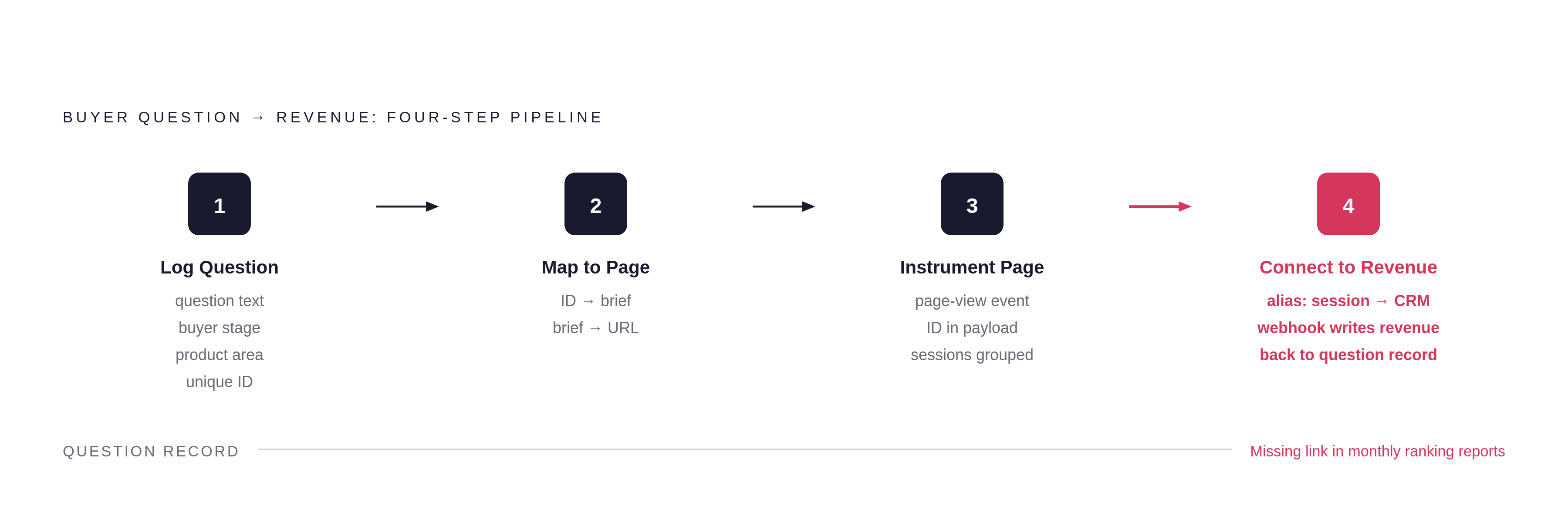
To make the design concrete, follow a vendor-selection question from a sales call into a guide and then through measurement. The first step is to log it at the source. Its record contains the question text, the stage of the buyer who asked it, the product area it concerns, and a unique identifier. Questions from support tickets and community threads can be logged in the same way.
The second step maps that record to a page. If a vendor-selection guide already exists, the question provides a precise basis for auditing whether the guide answers it. If no suitable page exists, the identifier passes into a new brief and stays attached through publication to the URL. This preserves the origin of the content. The conversion path can then be assessed against the question the page was created to resolve, rather than treated as a standard form added at the end.
The third step instruments the published page. Its page-view event includes the question identifier, allowing sessions on that page to be grouped against the original record. That creates a useful distinction in interpretation. The session establishes only that someone visited content mapped to the question, leaving the visitor’s exact wording uncertain. Even with that limit, the event gives the content team and the revenue team a common link.
The fourth step connects the visit to the outcome. When the visitor converts, an alias call ties the anonymous session to the CRM contact. When the deal closes, a CRM or billing webhook writes the revenue back to the question record. The original sales concern can now be followed through the published page to a closed outcome. That is the trace the monthly ranking report lacked.
AI referrals fit into this same sequence. GA4 can segment them using referral source filters where session source contains “perplexity.ai”, “chatgpt.com”, “claude.ai”, or “you.com”. When such a visit reaches the guide, the question identifier connects the session to its source question and any recorded downstream conversion. The referral is evidence of a real visit from an AI platform. It is not a complete record of every AI answer that mentioned the page.
Conversely, a guide that ranks organically but receives no AI referral traffic exposes a gap. It may answer the question in a form Google ranks but make that answer hard for AI engines to extract. Starting the brief with what the buyer asked supports an answer-first structure because the intended answer is explicit before drafting begins. This makes AI extraction part of the original content design before publication.
What the measurement layer must track once the pipeline is wired
The traditional layer needs organic sessions by question identifier, conversion rate by question-matched page, and revenue attributed to closed deals tied to a content session. These measures support different decisions. Sessions show whether people visit the mapped content, conversion rates show whether they take the next step, and closed revenue ties the recorded use of content to sales. None should be mistaken for proof that a single page caused a purchase.
The AI layer needs a separate set of signals. Brand Mention Rate in AI outputs and Citation Share of Voice against competitors describe visibility inside answers. AI referral traffic conversion rate shows what happens after a measurable visit, while correlation between citation frequency and branded search volume changes examines a possible downstream relationship. These measures should remain distinct because a mention, a citation, a visit, and a conversion are not interchangeable events.
The major AI engines publish no first-party citation data. Tracking ChatGPT, Claude, Perplexity, and Grok at scale therefore requires third-party tools that probe those engines on a cadence using the pipeline’s buyer questions. The measurement design also needs a clear definition of what counts as a mention or citation. Otherwise, the numbers lack a stable meaning. The question record lets the team compare how visible an answer is with how well its page does using the same question.
Perplexity includes clickable citations in every standard search mode, with Writing focus mode as an exception, so referral clicks can appear in GA4 as a downstream signal. Its mobile-app traffic, however, strips the referrer and appears as Direct. Because Gemini draws on Google’s live index, visibility in Gemini depends in part on how well a site does in SEO. Better traditional rankings therefore have a direct effect on citations there and are tied to AI visibility.
Pages that rank but produce no AI referrals are candidates for answer-first restructuring and richer structured data, though absent referrals alone do not prove absent citations. Pages that attract AI referrals but produce no downstream conversion signal call for examination of the CTA and how well the page answers what the buyer asked, with visibility work a lower priority.
Finally, Revenue Visibility Gap puts an estimate on the revenue at risk when AI citations are missing for high-intent questions. The proposed formula multiplies AI referral conversion rate by the volume of organic traffic that comes from outside AI channels. That yields an estimate expressed in conversions, so the financial framing must make that limit clear. Future content and channel decisions can then rest on a traceable buyer question and evidence about its outcome, rather than another impressive report that cannot support a revenue decision.