Why Content Creation Agencies Are the Wrong Answer for Technical Buyers
Technical buyers need internal control over AI discovery, not monthly agency retainers.

Content creation agencies are the wrong answer for technical buyers when the job is to build a system for discovery. AI citations depend on entity identity, freshness, and feedback that a team cannot get from a vendor it works with once a month. The better abstraction is a programmable marketing stack, with outside expertise where useful but control inside the team.
Why the agency model is the wrong abstraction for technical buyers
Technical founders approach infrastructure with a familiar instinct. They want ownership, observability, and control over how the pieces work together. A system should show enough of how it works that the team can measure and change it when it falls short. Content now presents that same problem, because publishing a page is only one step toward getting a brand found. The rest depends on how discovery systems identify, extract, and cite it.
The agency’s implicit promise addresses a different need. A team can outsource the search for domain expertise and receive content connected to its sales pipeline. That was a reasonable trade when Google search rank was the scoreboard. But AI answer engines have become another front door to discovery, where inclusion in the answer is a separate outcome from position on a results page.
What, then, is the team actually buying? A retainer buys a production relationship, while the discovery problem calls for an operating system with its own feedback loop. Adding “GEO/AEO services” to the agreement does not settle who controls the instruments or how quickly the work can change.
How AI answer engines actually decide what to cite — and why it differs from search rank
Google ranking and AI citation rely on different signals. Content built to succeed at one does not automatically succeed at the other, and the sources cited differ between answer engines. Brand websites and brand-controlled sources make up the large majority of sources AI systems cite. Communities and forums have less weight than is often assumed. Meanwhile, only a small share of domains get cited by both ChatGPT and Perplexity.
Those differences make extractability a distinct optimization task. Researchers at Princeton, Georgia Tech, and IIT Delhi established the academic grounding for generative engine optimization in a paper later published at ACM KDD 2024. Their work treats the structure of content for generative answers as different from traditional SEO. A search ranking therefore cannot stand in for evidence that an answer engine will use a page.
The signal also changes over time. Google AI Overviews, ChatGPT, and Microsoft Copilot show substantial citation volatility, while Perplexity is more stable but still shows meaningful monthly drift. A measurement from one platform cannot describe all the others. A monthly snapshot also needs a continuous feedback loop to explain what changes between reports.
What a single-vendor, single-cadence retainer cannot structurally deliver
A single-vendor, single-cadence agreement puts unlike tasks on the same clock. That structure suits a defined quantity of monthly articles better than platform-specific, freshness-sensitive optimization. The difficulty is that the contract organizes an agency’s work around delivery, while citation performance requires repeated observation and adjustment.
Martinez in 2026 characterized GEO as “a stochastic, partially observable pipeline rather than a single ranking task”. AutoGEO separately noted that there remains “no principled understanding of the underlying preferences of generative engines”. A vendor can promise a finished page, but treating citation as an equally deterministic deliverable misrepresents the system being optimized.
A useful program also needs a curated set of prompts, typically dozens, representing the buyer’s actual decision process. Someone who understands that process must own and maintain the set. Otherwise, what does an improvement in “visibility” describe? A page can rank first on Google and receive no citations from an AI engine. If the reporting substitutes traffic and rank for direct measurement, the buyer has no instrument for detecting the gap.
Where the human-review problem actually lives in an agency pipeline
Expert review is a sensible answer to AI content risk. The process weakens when teams produce more content and experts no longer control the review gate. In the described failure pattern, account managers generate drafts from briefs, proofreaders are asked to “humanize” them, and quality assurance loses priority because editing is assumed to cover it. The process still contains human review. It no longer necessarily contains technical verification.
A general editor can fix grammar and make writing flow without knowing whether a Kubernetes networking tutorial uses the right API resources. The missing ingredient is expertise matched to the claim. That distinction makes “reviewed by a human” a poor description of the safeguard a technical buyer needs.
The consequences extend beyond awkward prose. KPMG in October 2025 pulled its report, Redefining Excellence in the Age of Agentic AI, after organizations it described challenged what had been written about them. Deloitte Australia used Azure OpenAI to help draft a report for Australia’s Department of Employment and Workplace Relations. A University of Sydney researcher found fabricated academic references and a misquoted federal court judgment, and Deloitte agreed to repay the final instalment as a partial refund.
Those examples show how much can go wrong without proving that every agency fails this way. Review can bring domain knowledge to the work or just record that someone approved it. Google’s concern with nominal review rather than genuine human improvement makes that distinction consequential for discovery as well as accuracy.
What a working AI content pipeline looks like when the control gate stays in-house
The alternative is an AI pipeline whose human control gate remains inside the team. An industrial B2B supplier’s documented pipeline ran between December 2025 and August 2026, with accuracy assertions checked for each published post and zero retractions. From August 2026, it used the full 96–109-assertion suite and a 22-check AI-extraction gate. Earlier posts used a shorter list.
The decisive boundary was the point of publication. The pipeline stopped at draft, and a human with domain authority published. This example alone cannot show that every automated pipeline will work as well.
An agentic version coordinates research, writing, critique, and publishing against a CMS as the source of truth. Schema-aware tools help with that work, and people still review it at the points where their judgment matters. Hybrid human-in-the-loop models put initial processing with AI and exceptions and quality sampling with people. The aim is not to maximize manual intervention, but to preserve judgment where it changes the result.
For a team adopting this model, every step should be automatable, human-walkable, and reachable through an API. The autonomy dial then stays with the team. A team can buy help and still decide what gets published.
The ground-site and entity infrastructure that agencies don't build but AI engines require
Accurate prose still needs a recognizable entity behind it. Wikidata is one of several knowledge sources that support entity recognition in major LLMs, so lacking an entry can put a brand at a disadvantage. It is not a sole admission requirement. The broader task is to establish a consistent, verifiable identity across the sources that describe the brand.
A grounding page serves that purpose differently from promotional copy. It is an authoritative, encyclopedic page built from neutral, verifiable facts, with one fact per sentence and timestamps. An /ai-instructions/ page is not an equivalent substitute, because models treat it with the skepticism they apply to advertising. Organization schema reinforces identity through the exact brand name, logo URL, official website, and same-as links to Wikidata, Wikipedia where available, LinkedIn, and Crunchbase. GitHub belongs in that identity for technical or SaaS brands.
Plausible infrastructure claims still need empirical support. Ahrefs found that the vast majority of llms.txt files in its May 2026 sample received zero traffic. SE Ranking found no statistically significant correlation between having the file and how often AI cited the site. Google Search’s May 15, 2026 guide states that llms.txt is not needed for its generative AI Search features.
Brand mentions also predict citations more strongly than backlinks, so an SEO distribution strategy cannot simply be relabeled for AI discovery.
Measuring AI citation share — and why the measurement layer must be owned, not reported
A brand visibility score describes the share of AI responses in which a brand appears, but its meaning depends on which prompts produced those responses. Citation frequency, sentiment, and the quality of the third-party mentions that engines cite also help show how a brand is doing. The team still needs to control the prompt set. A score can be precise yet of little use if it has no link to how the buyer makes decisions.
An agency can collect results and produce reports, but the client must determine what is measured and how findings change the work. A healthy B2B program aims for a meaningful share of answer across its curated prompts by month six. That goal needs a maintained set of buyer questions.
The system must connect prompts to cited assets. It must also show how citation share moves when content changes and where platforms are over- or underrepresented. Because engines differ in volatility, that feedback cannot wait for a monthly conversation. The useful output is not just a dashboard, but evidence that can inform the next change in the content pipeline.
The strongest case for agencies — and why it doesn't resolve the abstraction problem
Developers can spot writing that shows little grasp of the technical details. Most companies also cannot quickly hire enough engineer-writers to write accurate content at scale. An agency with vetted writers who have worked in production and developers who review the work before delivery can bring expertise that an internal team would struggle to find quickly.
Why not buy that capability? For the writing itself, that may be entirely reasonable. Sourcing technically accurate prose is a content quality problem, while owning instrumentation, cadence, entity identity, and feedback is a systems problem. Solving the first does not automatically solve the second. Conversely, owning the system does not magically supply the expertise needed to review its output.
The fair resolution is to separate those decisions. A team can use outside expertise without making a vendor relationship the organizing principle of its marketing operation. AI drafting paired with domain-expert review also offers an owned route that does not require a full team of engineer-writers.
Neither approach eliminates the hardest internal responsibility. Someone must understand the buyer’s decisions well enough to maintain the prompt set and interpret the evidence. An agency account manager is not a substitute for that understanding, and neither is an unsupervised AI pipeline.
What owning a programmable marketing stack actually requires
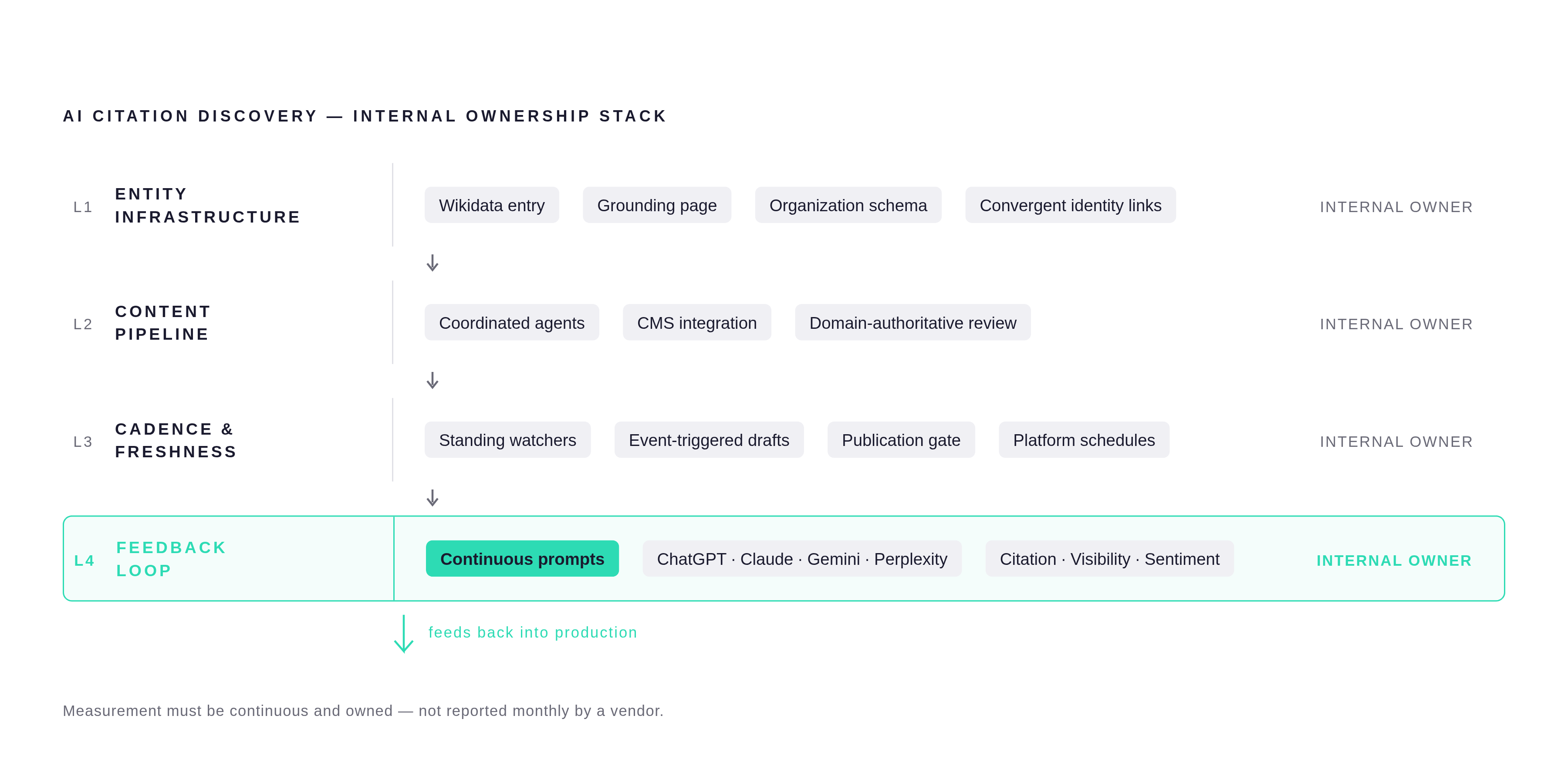
For technical teams, the practical alternative is a stack of metered, composable primitives. Its first layer is entity infrastructure, including a Wikidata entry, grounding page, and Organization schema with convergent identity links. Its second is the content pipeline, with coordinated agents working against the CMS and domain-authoritative review at meaningful boundaries. Both need an owner inside the team. Neither is complete simply because a vendor has delivered it once.
The third layer controls cadence and freshness. Standing watchers draft when something relevant happens rather than waiting for a monthly editorial calendar, while the publication gate remains separate. Perplexity’s strong preference for fresh sources makes responsiveness particularly relevant there. That gives teams a reason to use different schedules for different platforms, though it does not show that all AEO content has the same decay rate.
The fourth layer closes the feedback loop. A continuously running prompt set across ChatGPT, Claude, Gemini, and Perplexity tracks citation frequency, brand visibility, and citation sentiment, with findings fed back into production. Every capability should be accessible through an API, walkable by a human, and automatable end-to-end. Those are complementary requirements, because inspection and override should not require dismantling the system.
Small primitives let a team add the layer it needs without moving to a new platform. The final test is control. Can the team instrument the work, measure its effects, and change it on evidence, or can it only send feedback to an account manager? The former gives technical buyers a system they can improve.