When a content creation agency says it writes "in your voice" from your changelog: what a technical B2B buyer should ask for, and how to check the voice guide and the sourcing yourself
Six checks let a technical buyer test an agency's voice and sourcing claims.

An agency’s promise to write “in your voice” from your changelog is a claim a technical B2B buyer can test before signing. Inspect the voice guide and the source chain alongside the finished prose. If the agency also promises AI citations, its measurement needs the same scrutiny. Together, these checks turn a persuasive pitch into work the buyer can evaluate.
Why "we write in your voice from your changelog" is a harder claim to verify than it sounds
The pitch starts with a sensible distinction. A retrieval-augmented pipeline grounds generation in the client’s changelog and product documents. Those inputs give it something specific to say about the product. Access to source material does not show a buyer how faithfully the pipeline uses it.
The same gap applies to voice. A polished sample does not reveal whether its guide contains usable rules or merely agreeable adjectives. Neither that guide nor the draft’s source chain is usually handed over for inspection at the point of sale. As a result, voice drift and unsupported claims can remain hidden behind fluent writing. For a technical B2B buyer, incorrect API behavior, wrong pricing tiers, or a misstated security posture can create legal and trust costs well beyond a sentence that sounds off-brand.
What a usable voice guide actually contains, and how to tell one from a decoration document
Ask for rules an author can act on. “Conversational yet professional” describes an impression, while “use the second person; never use ‘leverage’ as a verb” makes a decision. Each principle should have at least one before-and-after pair drawn from the client’s published copy to illustrate the boundary. A buyer whose own guide lacks these details can ask the agency to help make them explicit.
The guide should also explain how tone changes from one surface to another. A release note, a blog post, and a cold email sound different, but the document should name the boundary that stays fixed across all three. A retired-words list keeps track of words the company once used and now rules out. Without it, older source material can clash with the language the company uses now. The guide should resolve those conflicts before an author has to guess.
Ownership and version history make those decisions usable over time. Request both a named owner with authority to approve exceptions and a two-line changelog showing revisions. The version-history test takes very little time. A blank or missing changelog provides no evidence that use has surfaced a correction, or that the correction reached the guide. It also leaves the buyer unable to distinguish the version being approved from the version the pipeline uses.
Three self-audit moves a buyer can run on any draft before it ships
Before signing, ask for a paid or unpaid sample draft and give it three targeted reads. Start with the opening sentence alone. Could it have come from any company in the same category? A voice-grounded opening names something specific to the product, audience, or problem. A generic opener signals that the draft may have settled for plausible language with little connection to this company.
Next, find the sentence the author seems most pleased with, often the most elaborately constructed one. Ask what work it does for the argument. Does it explain how two things differ, back up a claim, or show how two ideas connect? If it only decorates the page, generation may have run ahead of grounding. This is not a demand for dull prose, but a test of whether style serves the reader.
Would someone who knows nothing about the company understand what happens next? “Learn more” and “get started on your journey” offer warmth without explaining the next step in the product flow. During these reads, explicitly search for recurring contrast constructions, excessive bullet segmentation, and phrases no one at the company would naturally say aloud. These patterns can slip through a normal review, so they need a closer look than an instruction to make the draft sound human.
How the source chain behind a changelog-grounded draft can break, and what to require instead
Voice checks cannot show whether a claim is true. Retrieval-augmented generation can stay grounded at the start of a long draft, then fill later gaps with broad claims that sound true. A detail or policy mentioned briefly in the changelog can become a confident assertion about what the product does. The changelog supplied the input. The model’s inference about that input became the published claim.
So the contract should call for an inline source reference for every factual statement, product detail, and policy claim. That reference can be a URL, a document name and section, or a named interview that the client’s editor can check. Unsupported statements should remain flagged in the draft so the editor sees the gap. The flag is part of the handoff. It shows where the source material does not yet support what the draft needs to say.
Content published under the client’s name needs a checkable trail for editorial, legal, and compliance review. If the agency objects that references slow production, ask whether its pipeline generates them with the draft or adds them afterward. References should be built into the process. A pipeline that cannot show where its claims came from leaves verification to someone else.
The six questions to put to the agency before the contract is signed
Bring these questions to the first evaluation call. Start with, “Can you show the voice guide you would use for this account, in its current version, with its changelog?” Follow with, “What happens when a writer disagrees with a rule in the guide, and who has authority to approve an exception?” The second asks for accountability, and “the account lead decides” without a name leaves that unresolved.
Then ask, “In a draft grounded on the client’s changelog, how do you handle a factual gap where the changelog does not cover something the draft needs?” The answer should distinguish a sourced fact from an inference and explain how the gap is flagged. Follow with, “Can you show an example draft with inline source references before an editor touches it?” The timing is important to the test. A draft annotated only after editorial review does not show whether the generation process produces a source trail.
The final pair concerns the publication gate. Ask, “What specific criteria does the human reviewer use to block a draft from publication?” Then ask, “Can you show a draft the reviewer blocked and the reason it was blocked?” A claims check should catch “nothing new” and “unverifiable,” not merely awkward grammar. The rejected draft is especially revealing because it shows whether the stated standard has ever stopped work from shipping. A good agency can use these questions to make its process concrete.
What a cited result actually proves, and how to read a case study before you trust it
The source chain behind the agency’s own claims needs the same checks. A case study with a named client, starting figure, ending figure, and time period gives a buyer more to assess than a percentage change with no base. What changed, from what starting point, and over how long? Those details define the result’s scope. Without them, an impressive number can be difficult to interpret.
Minuttia’s published case study for Toggl describes 91 pieces, 26,000 clicks, and more than 200 conversions attributed to top performers, with a named client and a time period. That is concrete evidence to examine. It does not, on its own, show whether the work helped bring in qualified pipeline or closed revenue. Ask whether the case study shows that link and explains the attribution method it used. Traffic, conversions, and revenue answer different questions.
Ask where the client was cited before and after the work, reported separately for each engine. ChatGPT, Claude, Gemini, and Perplexity barely cite the same sources, so pooled totals can conceal substantial differences. A result across all engines is not evidence of success within each one. The case study should show the result the agency is offering to deliver, even if another metric is easier for it to report.
How AI answer engines decide what to cite, and why that changes what you should ask the agency to produce
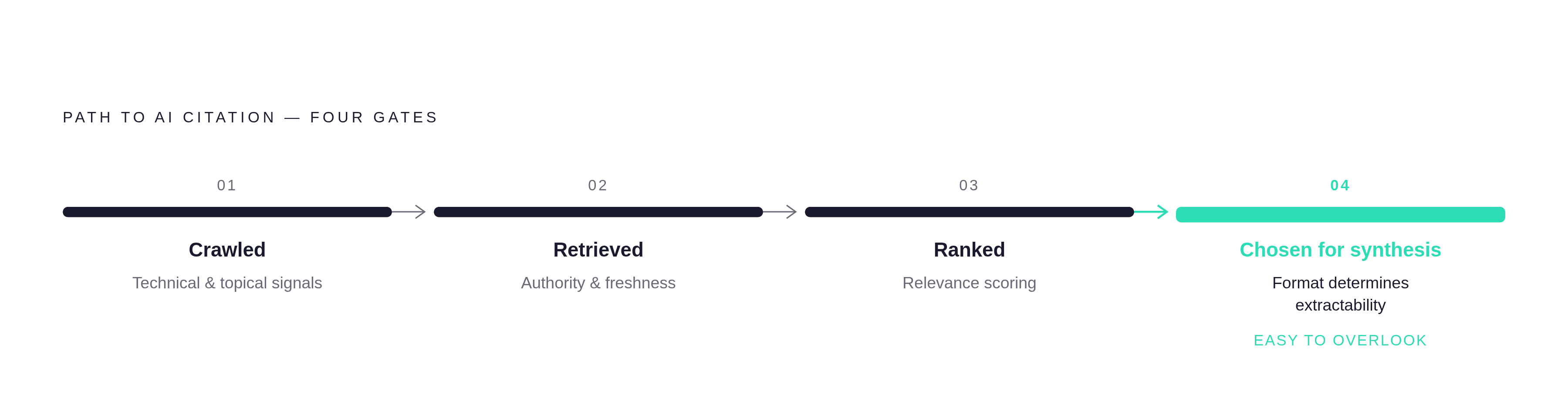
Being crawled by an AI platform is not the same as being cited in its answers. Content must be retrieved through technical and topical signals, ranked based on its authority and freshness, and then chosen for synthesis. The last stage is easy to overlook. At that stage, the information’s format can make it easier or harder for a model to extract.
Ask the agency to write passages that can answer a question on their own. A definition paragraph, table, numbered list, or FAQ block gives a model a clear unit it can lift. Prose-only articles can make the same underlying facts harder to extract than a table-first presentation. Format alone is not enough, however. The statements inside those units still need to be specific and verifiable.
“Reduced invoice processing time from nine days to two across fourteen customers” offers a checkable statement, whereas “industry-leading performance” offers praise. The former illustrates the kind of claim that requires substantiation with an actual result. The brief should connect that requirement to per-engine share of mention and presence in the top three cited sources. Perplexity lists more brands per answer than Claude, so a higher raw mention count can reflect answer length and overstate the strength of an endorsement.
The brief should also call for entity consistency. If the company is described differently on its site, LinkedIn, Crunchbase, and a podcast bio, those descriptions provide weaker evidence about what it is. Consistent descriptions help sharpen the model’s representation of the company. This is a relatively simple thing to inspect. It also makes the specification broader than article production, because the company’s own descriptions should not contradict each other.
How to measure whether the agency's content is actually being cited, and what tools make that tractable
Measurement can start without a paid tool. Server logs filtered for GPTBot, ClaudeBot, and PerplexityBot show which pages each platform crawls. That indicates citation potential only. Filtering GA4 sessions for AI platform referral traffic shows visits from engines that show links. These baselines help the buyer separate access to content from traffic that follows an answer.
Paid tools make per-engine answer tracking more tractable. Promptwatch, based in Amsterdam, tracks twelve AI models, including ChatGPT, Perplexity, Gemini, and Claude, and captures answers from real consumer interfaces as well as APIs. It serves more than 1,840 brands and agencies. Semrush’s AI Visibility Toolkit tracks mentions, citations, and sentiment across ChatGPT, Perplexity, Gemini, Google AI Mode, and Google AI Overviews, with Perplexity coverage in Brand Performance only. The toolkit pairs that reporting with SEO and content tools for acting on the results.
The contract should call for per-engine citation reports rather than pooled mention counts, and a metric that tracks position, such as presence in the top three cited sources. A mention is not necessarily a linked citation. The agency should report the difference because its size varies by engine, and the two outcomes say different things about content performance.
These arrangements need to be in place before signing, though the results come when the work is delivered. The buyer can check the voice guide, require inline source references, and set up per-engine citation measurement before signing. That makes the working rules, the evidence behind claims, and the promised outcome visible.