"ChatGPT for marketing" stalls between the draft and the buyer: what to ask of any service that promises to close that gap
Ask whether a service guards claims and measures citations.

“ChatGPT for marketing” services promise faster content, but the buying decision happens beyond the draft. For founders, heads of growth, and technical marketers, the real test is whether a service preserves context, prevents unreviewed claims from publishing, and measures whether buyers encounter the content in AI answers. Drafting speed helps only when the rest of that system works.
Why B2B buyers are now making vendor decisions inside AI chat sessions
A meaningful share of B2B buyers now begin research in AI chatbots, and a majority use ChatGPT when evaluating vendors. The shortlist can form before a site visit. If an answer cites a competitor but leaves another brand out, that omission shapes which vendors the buyer considers. There is no equivalent of “page two” inside the answer, where a patient reader might discover the missing option.
AI-referred visitors convert at a substantially higher rate than organic search visitors, so absence from these answers represents both a pipeline gap and lost exposure. Yet most “ChatGPT for marketing” services stop at drafting and never address whether their content earns a citation from the engines buyers already use.
What "ChatGPT for marketing" services actually deliver — and where they stop
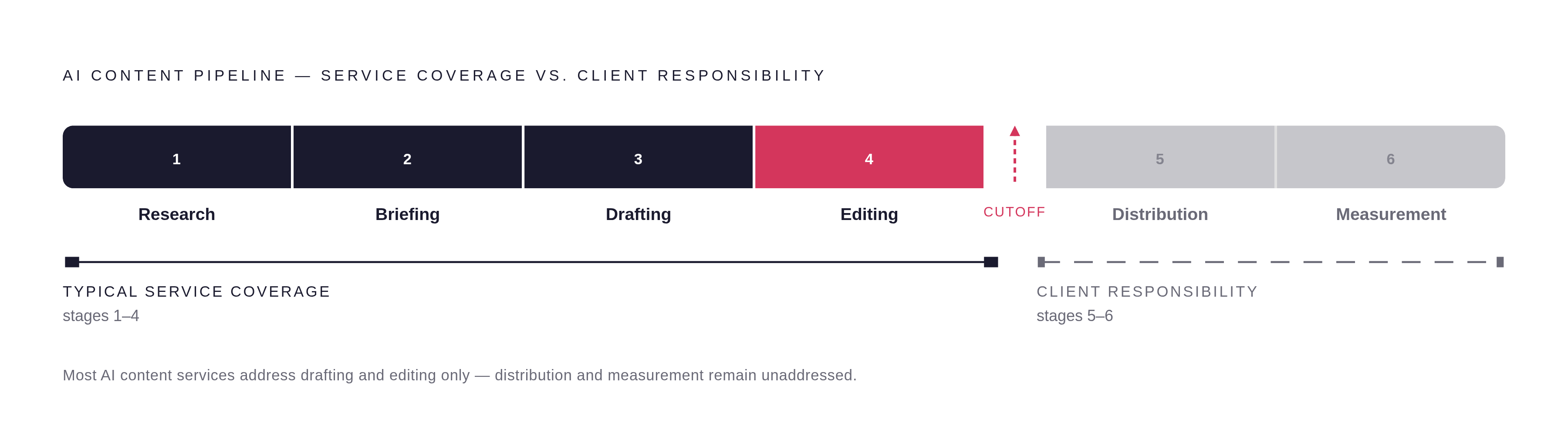
The draft is the cheapest part of producing content. The costly failures come when made-up statistics get published, context is lost between sessions, or drafts reach an editor without a structured handoff. A service may speed up writing while leaving the client to deal with all of those risks. The buyer’s diagnostic is therefore not simply whether the output reads well, but which responsibilities the service accepts after producing it.
A complete AI content pipeline covers six stages, namely research, briefing, drafting, editing, distribution, and measurement. Most services cover drafting and editing at most. In a well-designed pipeline, AI does the low-leverage work, and humans are in charge of judgment, voice, and original insight. Publication is an intermediate step because content can go live without earning a place in the answers buyers read. Treating it as the finish line leaves the downstream result unexamined.
Context also needs a home outside the chat session. Without a persistent brief, style guide, and entity registry, each draft starts from scratch, allowing voice, claims, and competitive positioning to drift across the program. A polished sample cannot show whether that continuity exists. Nor can it reveal what happens when a draft fails review.
Why AI engines cite some content and ignore the rest — the mechanics a service must understand
Good writing alone does not earn an AI citation. Retrieval-augmented generation, or RAG, lets tools such as Perplexity and Google AI Overviews search the web at query time, retrieve relevant passages, and synthesize an answer. A sentence taken out of the paragraphs around it may lose its meaning, while a competitor’s definition that stands on its own can give the answer evidence it can use directly.
Access comes before any judgment about that evidence. A service must account for whether OAI-SearchBot, Claude-SearchBot, and PerplexityBot can reach the material rather than being blocked in robots.txt. Content behind a login or paywall cannot serve as openly accessible evidence. An accordion dropdown presents the same practical question if its text is not available in the HTML. The visual presence of an answer on a page does not, by itself, establish its availability to a crawler.
Zhang, He, and Yao’s empirical study found that high-influence pages were longer, more modular, and more likely to contain extractable evidence, including definitions, numerical facts, comparisons, and procedural steps. Using Q&A formatting on its own did not improve absorption. The study separates eligibility for source selection from usefulness once selected, with authority and recognizability supporting the former and semantic alignment, structural legibility, and evidence density supporting the latter. This gives buyers a sharper way to evaluate generative engine optimization, or GEO. Does the service understand both jobs, or does it offer a formatting recipe as if that were enough?
The platform divergence problem — why optimizing for one AI engine undersells the others
The engines do not use sources in interchangeable ways. Perplexity searches the web in real time and cites sources by design, with comprehensive, structured, high-authority pages serving as a primary citation signal. It cites the most sources per prompt among the major platforms. ChatGPT cites fewer sources per prompt than Perplexity or Google, but the pages it fetches have much higher average citation influence.
Answer length further complicates comparisons between engines. Claude lists substantially fewer brands per answer than Perplexity, so raw brand-mention comparisons can conflate answer structure with brand strength. Gemini also needs separate coverage that accounts for its differences from other platforms. A service needs a view of all four engines and a reason for how its content and cadence serve their different retrieval and absorption behavior. If it has no measurement layer, it cannot know whether those choices work beyond its preferred platform.
What measuring AI visibility actually requires — and why most services skip it
A mention and a citation answer different questions. A mention means the model names a brand, while a citation means the answer links to a domain as evidence. Combining them obscures whether published content is being retrieved or the brand is being named without that evidence. A productive-looking publishing program can therefore produce a reassuring report without demonstrating that its pages support buyers’ answers. Draft counts and publication totals cannot resolve that uncertainty.
The service needs to track mention inclusion rate, share of citation, cited-source diversity, and competitor displacement. Those measures belong at the prompt level, separately across ChatGPT, Perplexity, Gemini, Claude, and AI Overviews. An aggregate conceals differences in the questions being answered and the platforms answering them. The study’s distinction between citation selection and citation absorption adds another necessary separation. A page can be selected as a source yet contribute nothing to the generated answer.
Traditional analytics provide only part of this picture. GA4 referral traffic from AI engines captures clicks and leaves unmeasured the occasions when buyers read an answer, form a preference, and never visit the cited site. Without dedicated measurement, growth leadership cannot tell whether the brand appears in category answers, displaces competitors, or gains citation share as publishing continues. Services that stop at production leave that measurement work outside their scope, along with the evidence needed to connect content activity to results.
The human review gate — what it must catch and when it must run
Measurement cannot make up for a false claim that reaches buyers. Models still invent statistics, quotations, and source URLs, so a reviewer must open every cited source, including references that look plausible. Automated checks do not substitute for that work in high-stakes B2B content. For SaaS and dev-tool companies, a hallucinated benchmark or made-up customer quote can harm their reputation far more than the time saved by skipping review is worth. The buyer is at risk when wording that reads well is taken as evidence that can be trusted.
Responsibility needs to be explicit at each review gate. The editors in charge make the strategic decisions about the thesis, competitive positioning, and claims. Senior writers and editors own craft decisions about voice, accuracy, and narrative, while governance roles own compliance checks involving legal concerns, personally identifiable information, and toxicity. This split leaves people to focus on judgments that automation cannot make. A service saying “humans review the content” has not yet explained who has authority over a claim.
High-risk content should go through automated checks for PII, toxicity, and factual consistency and require human sign-off before it enters the publish queue. Shadow content is the failure mode in which unreviewed AI output bypasses that gate and reaches production. Does the pipeline make bypass structurally impossible, or merely discourage it? Every suggestion must remain reviewable and reversible before publication, including when the client decides that an otherwise finished piece should not ship.
The off-site citation problem — why on-site content alone cannot close the gap
Even a well-reviewed, extractable site addresses only part of discovery. Queries about a brand can draw on its own pages, but category and comparison answers rely primarily on third-party sources. A service limited to the brand’s blog therefore tackles an incomplete version of the buyer’s problem. The discussion of what the service covers should include review platforms and earned mentions in trusted vertical publications because they offer evidence beyond what the company says about itself.
Owned content still has a distinct role to play. Proprietary research can earn AI attribution when it is published openly, but data behind a lead-capture form cannot give engines evidence they can access. A page that never ranked in Google might get cited often by ChatGPT, and a page can lose Google clicks while gaining LLM citations in the same quarter. That divergence supports a dedicated content layer built for answer-first retrieval and citation extraction, refreshed to serve recency-sensitive engines.
A complete service must maintain both layers. The owned site needs content that engines can extract, and trusted third-party domains give the brand a place outside its own site in category and comparison queries. Neither layer replaces the other. With those boundaries clear, the final evaluation can move from broad promises to concrete questions about ownership, controls, coverage, and proof.
The questions to ask any service before you hand over your content program
The first questions establish where the service’s responsibility ends. Which of the six stages does it own, and which remain with the client? How does it persist brand voice, competitive positioning, the entity registry, and prior claims across sessions and writers? What happens when a draft fails quality checks, and is there a structured handoff to move it beyond another pass through the same loop? These answers reveal whether continuity is part of the product or work the client must supply.
At what stage does a human see the draft, and is approval mandatory before the publish queue? Who owns the strategic gate, and what qualifies that person to judge the thesis, claims, and competitive framing? Can the client decline any output without breaking the pipeline or needing a manual workaround? A promise of oversight is incomplete until the service explains who can stop publication and when.
Does the service audit crawler access rather than assume that published content is reachable? Does it arrange definitions, numerical facts, comparisons, and procedural steps so they can be used for passage-level extraction? Does it maintain or advise on entity grounding through Wikidata entries, Organization schema, and sameAs properties, or leave that to the client? The useful distinction is between work the service performs and dependencies it merely expects to exist.
Coverage and reporting need equally concrete answers. Does the service distinguish ChatGPT, Perplexity, Gemini, Google AI Overviews, and Claude, and account for differences in freshness and domain authority? Does its technical checklist include Bing indexing, given that ChatGPT’s browsing mode retrieves via Bing? Which visibility measures does it report per prompt, and does it separate citation selection from absorption? How often does measurement run, and how do the findings change what gets published next?
Does the service address third-party citation channels, including review platforms and earned mentions in trusted vertical publications? Is original research published in crawlable HTML, or is it put behind forms that crawlers cannot access? A service may reasonably own only part of this work, but that limit should be explicit before the content program changes hands. Faster drafts are a useful purchase only when they are not mistaken for the complete route to the buyer.
Sources
- From Citation Selection to Citation Absorption: A Measurement Framework for Generative Engine Optimization Across AI Search Platforms
- Understanding ChatGPT Citations: Evidence from Production Web Search Across Model Generations
- Humanity's Last Choice: A Common Evaluation Standard for Generative Engine Optimization