When "business growth consulting" means the vendor plans the experiments and runs them: what a technical B2B founder should ask before the plan, the tests and the results live in someone else's Slack and weekly call
Ask who owns the experiments, data and accounts before signing.

When business growth consulting includes planning and running experiments, a technical B2B founder is handing over more than execution. Experiment knowledge, measurement access, and AI-visibility infrastructure may never become assets the company controls. A specialist should help the business move faster while leaving it able to carry on when the specialist leaves. The questions that protect that independence belong before the contract.
Why AI answer engines have become the front door to B2B vendor research
G2's 2026 Answer Economy research found that a majority of B2B software buyers now start their software research with an AI chatbot more often than Google. That share was notably lower just one year earlier. Buyers can now do their vendor research from start to finish in a chat interface, without going through a search results page. For a vendor, absence from the answer can mean absence from the shortlist. The point of discovery has moved.
That shift changes what a growth program must produce. A substantial majority of AI Overview citations go to third-party sources, including blogs, roundup posts, Reddit, and YouTube. Being named in the answer is different from owning the top link. Generative engine optimization, or GEO, thus calls for different choices about what to produce than traditional SEO does, and a brand can rank on Google's first page while never appearing in ChatGPT. As people move away from blue-link search to find information, AI citation becomes a key organic channel for B2B SaaS companies to invest in. That gives founders a sound reason to hire specialists to run it, but it also creates a new question about who will control the resulting program.
What "running the growth program" actually means when a consultant takes the wheel
An execution engagement reaches well beyond a strategy deck. The consultant may plan experiments in its project management tools, produce content through its CMS templates, and report results from its dashboard accounts. The work also creates knowledge in the team's heads, internal notes, and Slack conversations. A specialist can reasonably arrive with systems that already support the job, rather than asking the client to build everything first.
The job itself has a broad scope. GEO execution can include regular owned-content production, technical hygiene for AI crawlers through robots.txt, llms.txt, and schema, and entity signals across Wikipedia, Wikidata, LinkedIn, Crunchbase, and third-party directories. Off-site work can include review platforms, publications that cover the field, and a planned presence in communities. The team then measures citation share across more than one engine. These parts of the work need to fit together because the company's own domain is only one of the sources an engine may draw from.
Citations change a great deal in Google AI Overviews, ChatGPT, and Perplexity, so someone needs to keep checking them and updating content each week. Perplexity heavily favors recently published content, while ChatGPT's real-time search weights recency. A pillar piece that earned citations in 2024 may no longer show up unless someone has kept it fresh. The consultant's promise of tooling, templates, production cadence, and specialist expertise is therefore credible. The client may receive the workflow's output without retaining the workflow itself.
The three assets that walk out the door when the engagement ends
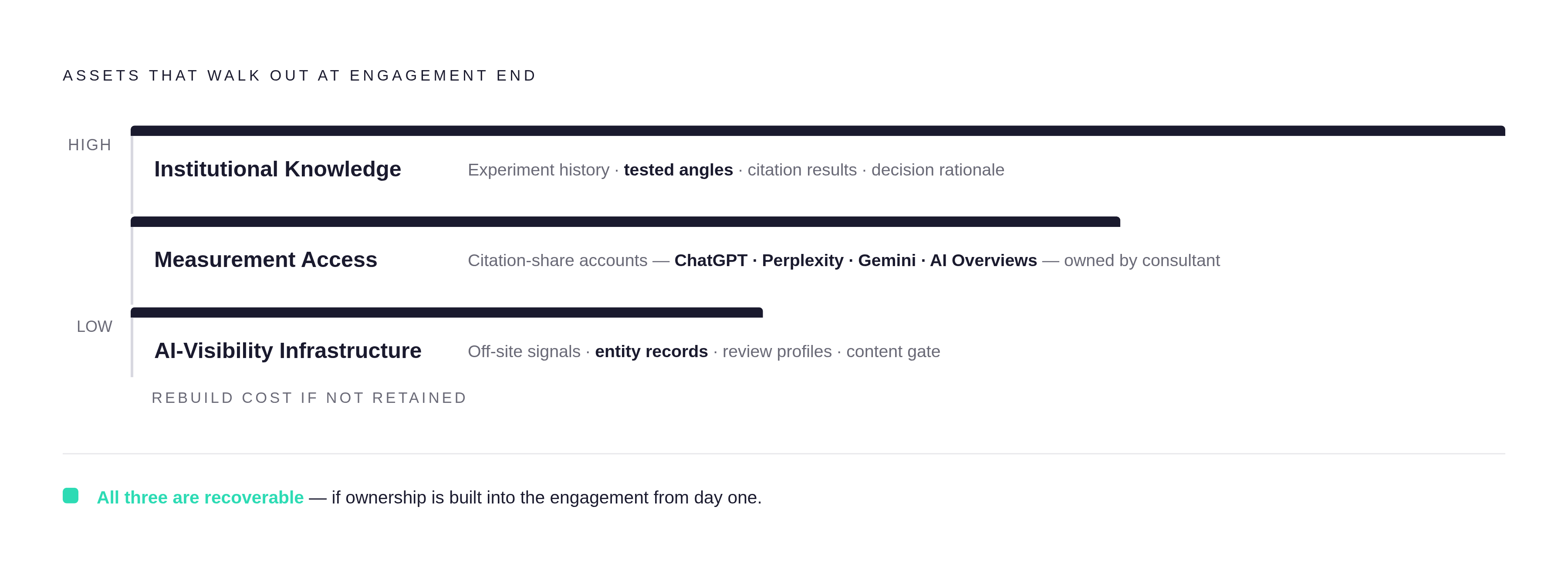
The first asset is institutional knowledge, specifically the experiment history and the reasoning behind it. A roadmap records what was planned, but a useful history also explains which content angles were tested, what citation results they produced, and why some approaches were abandoned. Those distinctions are easy to lose in weekly calls. If the reasoning stays in the consultant's internal notes and Slack channels, a new hire cannot pick up where the program stopped.
The second asset is measurement access. Dedicated AI-visibility platforms track citation share across ChatGPT, Perplexity, Gemini, and AI Overviews, but access depends on accounts. When those accounts belong to the consultant, the founder may see reports but have no control over the past data behind them. That is a consequential gap because attribution from AI mention to website visit to conversion is already difficult. Without access of their own, the founder cannot check citation share, test how the results were read, or easily take the history to a new provider. The business then keeps spending based on numbers it cannot fully check for itself.
The third asset is AI-visibility infrastructure, including content architecture and the off-site signal layer. Owned pages make up only a small share of the sources AI engines cite. Much of the work is on third-party roundups, review-site profiles, community presences, and entity records on Wikipedia and Wikidata. The founder cannot own someone else's domain, but can control a record of what was placed, where, what anchor text was used, and which sources each engine draws from. Without that record, the next team will lack the details it needs to keep the off-site layer working or rebuild it.
This infrastructure also includes the process that determines what can publish under the brand's name. An AI content pipeline without documented human review gates leaves no clear owner for checking its output. That is a separate risk from losing account access. Microsoft's preprint by Mark Russinovich, Ram Shankar Siva Kumar, and Ahmed Salem, Phantom References: Hallucinated Citations That Survive Peer Review at Top-Tier Conferences, illustrates hallucinated citations passing review and entering a permanent record in a different domain. It shows why the existence of a review stage alone is not enough to establish reliable checking.
Why the speed-to-execution argument doesn't resolve the ownership problem
The strongest case for outsourcing is straightforward and reasonable. A consultant with templates, measurement accounts, production systems, and off-site relationships can establish a functioning GEO cadence faster than an in-house team starting from scratch. A founder does not need to dismiss that advantage to ask for ownership. Speed has a real operational value. The problem begins when faster delivery is treated as a reason to leave records, access, and control outside the business.
Speed-to-execution is not the same as speed-to-learning. If the founder's team never touches the program, it does not acquire the knowledge needed to govern, audit, or extend it. The consultant can keep producing content while no one sees that the team lacks this knowledge. At renewal, however, the choice is no longer simply whether the service is worth its cost. It also depends on whether anyone else can carry on the work, because speed helps while the work is being done, but the missing knowledge affects everything that comes after.
GEO rewards experience-anchored claims, including specific examples from real client engagements, named frameworks, and primary-source detail. A vendor writing about the founder's category is unlikely to get those claims right without regular input from subject-matter experts. Structurally correct content can still be factually thin.
Could documentation at the end solve this? Only partly, because a late handover can bring together what was made without recovering the reasons for the choices behind it. A content library does not explain why an angle was rejected or why one result justified another test. That reasoning should be captured while decisions are being made. Ownership and speed need not be opposites when documentation and client access are part of the working process.
Questions to ask before the plan, the tests, and the results live in someone else's stack
A technical founder should ask the vendor the kinds of questions they would ask before giving a supplier API access to production infrastructure. What can the supplier change, who can inspect it, and what remains when access ends? For a growth engagement, they translate into questions about experiment records, measurement accounts, publishing authority, and the maintenance of off-site work. The useful time to ask is before signing.
For experiment knowledge, ask what format the experiment log takes and how often the client receives it. Does it record what was tested, what citation results followed, and why each decision was made? Then make the handover concrete by asking what a new in-house team member would receive if the engagement ended in month four. An answer should identify an artifact. For a founder treating GEO as a durable asset, a vendor that cannot name the format for records and knowledge transfer has not met a basic requirement.
For measurement, ask which platforms track citation share across ChatGPT, Perplexity, Gemini, and AI Overviews, and whether accounts will be provisioned in the client's name from day one. Can the client query the data at any time without sending a request through the consultant? Does cancellation leave the account and its history intact? Dedicated measurement platforms exist and are accessible, so independent access is a practical request. A reporting dashboard should not substitute for the ability to inspect the evidence behind the report.
For off-site work, ask which review-site profiles, third-party roundups, entity records, and community presences are in scope. Which sources do the target engines actually cite in the company's category, and how does the consultant systematically pursue inclusion in those sources? The answer needs to connect the work to the channel. A program limited to owned content leaves most citation-driving sources unaddressed. The same conversation should establish who maintains each placement, what the client controls after departure, and how that work will be documented.
Ongoing maintenance deserves an equally concrete question. When an engine drops a citation, what triggers a response, what is the protocol, and who does the work? A policy statement about quality is not an answer to a question about the actual gate.
Finally, ask what content the client owns outright and whether ownership starts at publication rather than depending on completion of the engagement. Can the company continue publishing independently on its own domain? Can its team pause or override the publish queue at any time? Every AI-generated suggestion destined to ship under the brand should remain reviewable and reversible before publication, rather than becoming untouchable in the name of velocity.
What a well-structured engagement looks like when ownership is built in from the start
A sound engagement should make these answers visible in its structure. Owned content publishes to a domain the founder controls, on a cadence the founder can inspect. Human sign-off is a mandatory, documented contractual step before content enters the publish queue. Automation still has a place in that arrangement. A pipeline can move through brief, draft, human review, audit, and publish without removing the client's ability to say no.
AI-visibility tracking accounts covering ChatGPT, Claude, Gemini, and Perplexity should be provisioned in the client's name from the first day, with independent client admin access. The experiment log should live in the client's own systems and record tests, citation data, iterations, and their reasons. That makes continuity part of ordinary work. A new hire should be able to read the record and continue the program, rather than reconstruct it from finished pages and presentation slides.
For off-site work, the client needs to own a placement register with enough detail to keep entity records, review-site profiles, and third-party placements up to date or rebuild them without the consultant. With those arrangements in place, the consultant can supply specialist execution while the company retains the means to govern it. The right relationship treats AI visibility as an engineering discipline, measured in accounts the client owns and changed on evidence the client can inspect.