"ChatGPT for SEO, grounded in your site's own data": what a technical founder should test before trusting a managed connector that reads Search Console for the model
A founder's test plan for connector limits in permissions, scope, rows, and rate limits.

Grounding ChatGPT in your Google Search Console data is a sound way to improve historical SEO analysis. But a managed connector adds an authentication layer and a data pipeline, and you need to test their limits before you can trust its answers. Analyzing your past Google performance is not measuring whether AI answer engines mention or cite you.
Why every GSC-to-ChatGPT route adds an intermediary you do not control
There is no official Google Search Console MCP server, and ChatGPT has no built-in integration for it. So a working connection needs an intermediary between the Search Console API and the model. That intermediary authenticates on your behalf and passes along either data or a computed answer. Someone has to own that layer.
With a managed connector, the provider makes choices about OAuth scopes, pagination, error handling, and storage. Those choices may be invisible in the conversation. A self-hosted route gives the founder more control, but also makes the founder responsible for operating it. Trust therefore depends on whether the path between ChatGPT and Search Console preserves the meaning and limits of what it reads.
The five routes in practice, and what each one inherits from the API
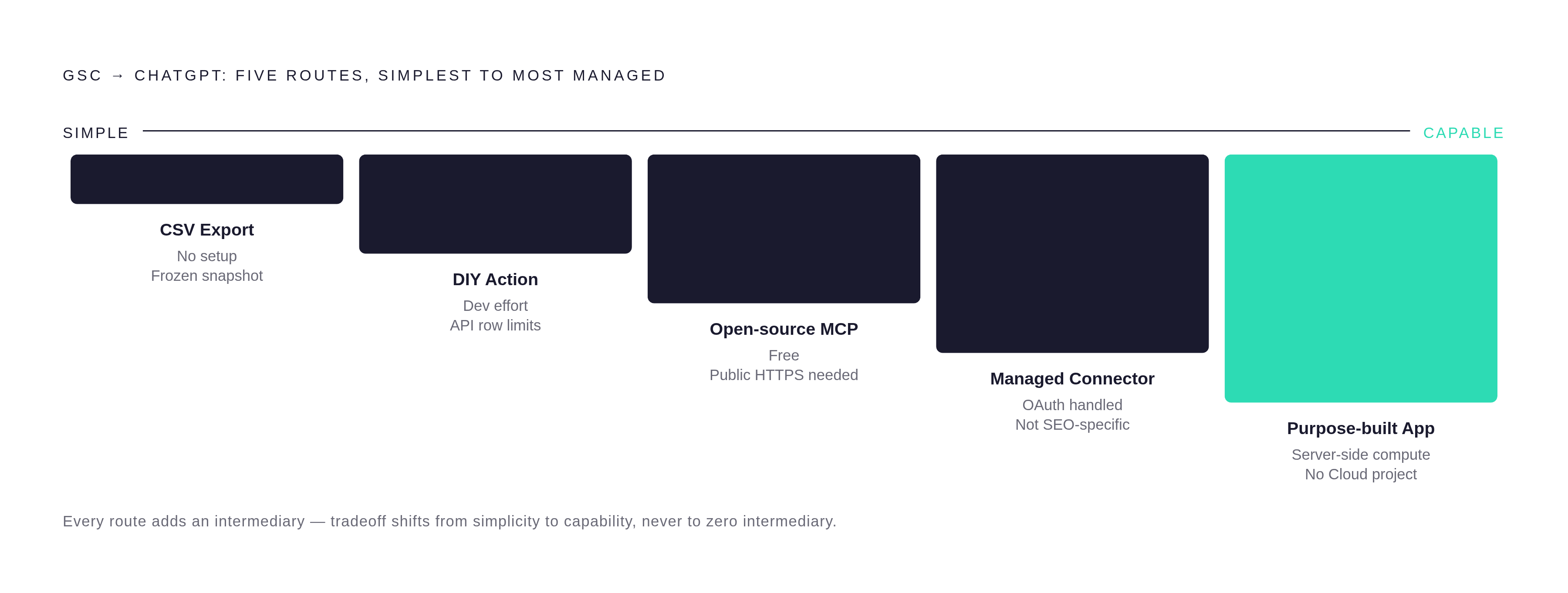
CSV export and paste is the simplest route. It needs no setup, but the Search Console interface caps how many rows it exports per view, so the long tail can disappear before ChatGPT gets any data. The model then does arithmetic over a frozen snapshot. That makes it useful for a one-off gut check on a small site.
A DIY Action and a self-hosted open-source MCP server offer different ways to build the connection yourself. Both inherit the API’s row limits. Packages such as gsc-mcp-server and mcp-server-gsc are free and readable line by line, but reaching a self-hosted server from ChatGPT requires a public HTTPS endpoint that the founder deploys and maintains. Free software still needs an operator.
A multi-source managed connector such as Porter Metrics handles OAuth, rate limiting, and pagination, then gives ChatGPT structured data. It has a free tier and suits teams already centralizing ad and analytics platforms, though it is not built around SEO-specific analysis such as content decay or keyword cannibalization. Purpose-built apps such as Ryze AI or the MCP Search Console read-only hosted server instead compute analysis server-side before ChatGPT receives it. They are added through Settings, Apps, and Create app with Developer mode, without a Google Cloud project or OpenAPI schema. This distinction affects where the arithmetic happens, while the underlying API’s limits remain in place.
ChatGPT plan tier controls what the connector can actually do
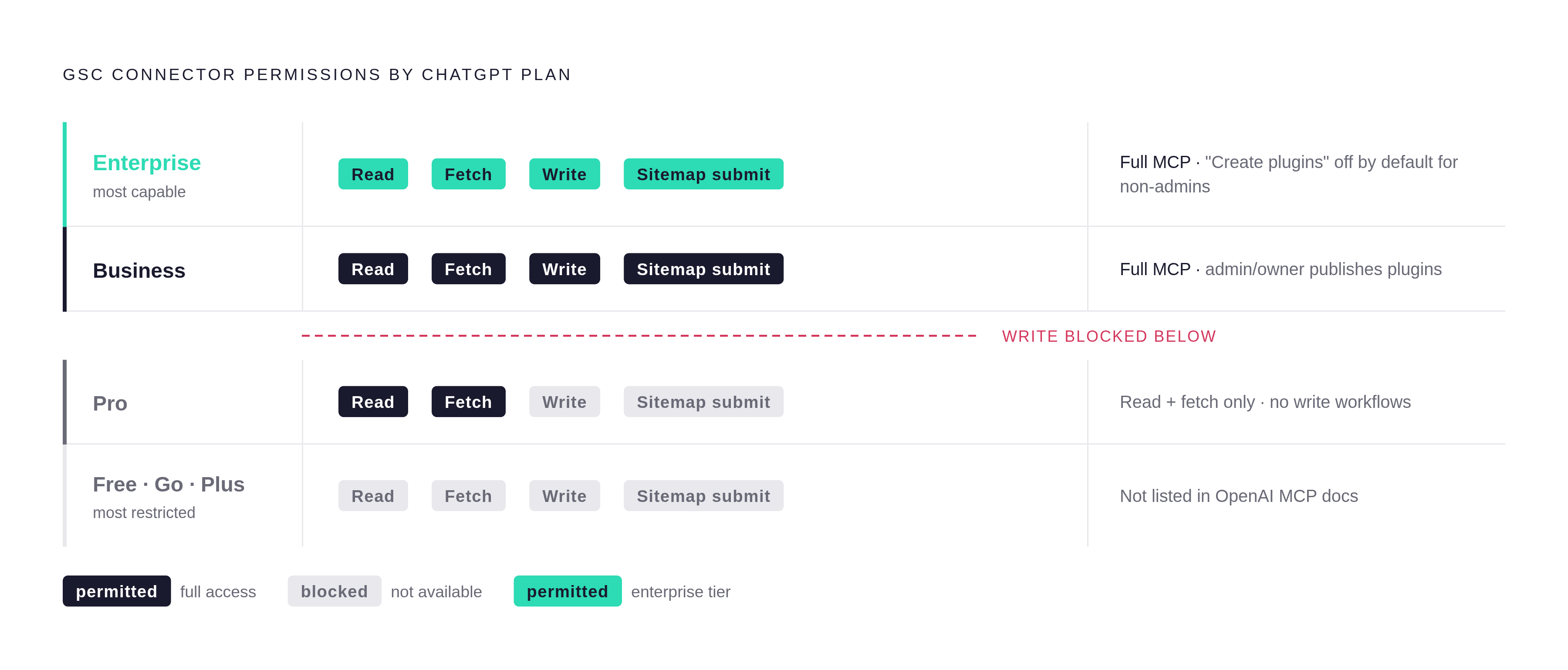
OpenAI’s help article reserves full MCP capabilities for Business and Enterprise/Edu, while Pro gets read and fetch permissions only. Free, Go, and Plus are not named in that article. Connection support cannot be assumed from a tutorial. A Pro user attempting write-dependent workflows, such as sitemap submission, reaches a permissions boundary the connector cannot bypass.
Workspace roles impose another gate. OpenAI allows only admins and owners to create and publish custom MCP plugins on Business. On Enterprise, other members need the Create plugins with MCPs permission granted through role-based access control, which is off by default for non-admin roles. Setup must also happen on ChatGPT web because adding MCP servers from the mobile app is not supported. Before testing data quality, the founder needs to establish that the intended connection and operations are permitted.
OAuth scope exposure and what read access to your search data actually means
Permission to connect is separate from permission to act on Google data. Google labels the webmasters scope as allowing data reading and sitemap submission or removal. Its narrower webmasters.readonly scope also exists. The requested scope deserves a close look.
Ryze’s two sitemap tools need the broader scope, which explains why an app sold as a tool for analysis may ask for more than read access. The practical test is to inspect the consent screen before approving it and compare the requested scope with the functions needed. A read-only workflow raises a straightforward question. Why would it need write access?
Authentication can also extend beyond the consent screen. Truto generates an MCP server URL containing a cryptographically hashed token that serves as authentication, so possession of that URL grants access. It must be treated as a secret. The least-privilege approach is to use a Google login limited to the properties the connector needs and involve IT before authorizing a work account.
The row-limit and data-completeness problem that silently truncates your analysis
Once access is established, the next question is what actually arrives. The Search Console API limits the number of rows returned per call. A request for all queries over the last 16 months on a high-volume site can therefore produce only a first page unless the connector handles pagination.
Truto’s engineering guidance says a proper MCP implementation must expose pagination cursors and instruct the model to narrow date ranges or apply dimension filters. Without those steps, both the model and the reader may miss that rows are missing. When raw rows go into the conversation, ChatGPT can get totals, averages, or joins wrong across thousands of rows. Server-side computation reduces that arithmetic burden but does not by itself prove completeness.
The probe is to ask how many rows a broad query returned, compare the result with a known baseline in the Search Console interface, and establish whether pagination occurred. Is this the dataset or its first page? Even a correctly paginated result has a separate blind spot, because a large share of queries are anonymized. Keyword-level strategy based only on Search Console remains incomplete.
Rate-limit behavior and what happens when the connector does not handle a 429
Pagination solves only one kind of missing data. The API also enforces a queries-per-minute limit per site, so concurrent requests can trigger rate-limit errors during a large pull. What happens next depends on the connector and caller. A report can still succeed after a request fails.
Truto’s documentation explicitly states that it does not automatically retry, throttle, or apply backoff when Google returns HTTP 429. It passes the error to the caller and normalizes rate-limit information into standardized headers following the IETF specification. The AI agent framework or ChatGPT client must read those headers and implement retry and backoff logic.
If a pull stops midway and the model leaves the failure unclear, it may summarize only the rows already received. The practical probe is to trigger a large multi-dimension query and inspect the outcome. An explicit error, a partial result labeled partial, and a silent partial result presented as complete are very different behaviors.
GSC data has a built-in lag, which breaks real-time diagnostic prompts
Even complete data may be too old for the question. Search Console has a built-in reporting lag, so “Why did traffic drop this morning?” can ask ChatGPT to explain a period absent from the source. The data may not cover yesterday either. Completeness and freshness are separate tests.
If the connector does not flag that cutoff, the model can answer without saying that data for the period is missing. To probe this, ask a time-sensitive question framed “as of today” and compare the answer with the latest data point in the Search Console interface. The gap reveals whether the connector exposes the lag. For routine analysis, the practical guard is to use date ranges ending at least three to four days before today and verify the most recent timestamp before interpreting a trend.
Site ID format and URL Inspection API quirks that break LLM tool calls
Correct dates are not enough to construct a valid API call. Search Console differs from a standard CRUD API, and its property identifiers are actual site identifiers. Domain properties use a form such as sc-domain:example.com, while URL-prefix properties require different parsing. The distinction belongs in the tool description.
Truto’s engineering guide identifies site ID formatting as a source of malformed requests. Its other warnings concern Search Analytics dimensionality and URL Inspection. Search Analytics needs exact dates for startDate and endDate, along with a dimensions array. A request for an entire year of keyword data without filtering may time out or reach the row limit, so the tool needs pagination support and instructions to narrow the range.
Google’s API reference states that URL Inspection returns the status of the version in Google’s index. That limits what an inspection answer can establish. The UrlInspectionResult payload is also deeply nested, with separate indexStatusResult, ampResult, and richResultsResult objects. Without flattening or strong typing, the model may fail to extract the specific reason a page is not indexed.
Submit a Domain-property ID to a connector configured for a URL-prefix property and inspect whether the error is clear. Then request inspection of a known non-indexed page and verify that the answer names the specific exclusion reason. A fluent explanation is not evidence that either boundary was handled correctly.
What the connector genuinely does well, and the prompts worth running
Within these limits, a well-configured connector makes historical analysis less tedious than constructing filters by hand. Useful prompts ask for striking-distance queries in positions 4–15 with meaningful impressions, or for pages competing for the same keywords. Content-decay comparisons across available date ranges are another good fit. These questions match the source’s actual scope.
CTR-versus-position curves and device or country breakdowns can also turn a conversational request into useful segmentation. Purpose-built tools that aggregate and join data server-side cut down on the arithmetic errors the model can make when it works with raw rows. That is a concrete advantage over CSV paste for sites with significant query volume. The tool’s legitimate role is a faster analyst of past Google performance.
The category error at the center of most GSC-connector pitches
Using ChatGPT to analyze a report is different from measuring visibility inside ChatGPT’s answers. Search Console describes Google search performance. It does not reveal whether an answer engine extracted a passage, named a brand, or cited a page. The model reading the report does not change what the report measures.
ChatGPT’s answers rely primarily on Bing’s index and OpenAI’s own crawler index, with Google’s index playing a supplementary role. Google indexing and ranking therefore have no direct relationship to whether ChatGPT cites a particular page. A piece of content can get fewer Google clicks and more AI citations in the same quarter. A page that never ranked in Google may still be cited regularly by ChatGPT.
The strongest objection is that retrieval-augmented models use search results, so better rankings can feed AI visibility. That is partly true for engines retrieving live information, including Perplexity and Bing-grounded ChatGPT. But retrieval overlap does not make the measurements interchangeable. Search Console cannot say whether indexed content was extracted and cited, and the content strategy and optimization loops remain distinct. “ChatGPT for SEO” describes who performs the analysis.
What measuring AI answer-engine visibility actually requires
AI answer-engine visibility requires structured prompts run directly against ChatGPT, Claude, Gemini, and Perplexity, with the results tracked. The engines differ substantially in which domains they cite for the same question, and overlap across all four is very low. One engine cannot stand in for the others.
The measurement units change with the task. Mention rate tracks how often an engine names the brand, while citation rate tracks how often it links to the brand or credits it as a source. Another measure is how consistent each engine is when the prompt changes. These signals answer questions that Google rank position and impressions cannot.
The content work also concerns extraction. Answer-first structure gives a clear question a direct answer in the first two sentences, followed by a named source and supporting detail. Machine-readable references ground entities, while crawler access policies let retrieval bots reach the pages. Because engines extract passages rather than whole pages, each section’s heading and answer need to make sense on their own.
The practical conclusion is to keep the connector for historical Google analysis and build a separate measurement loop for AI answer-engine presence. They are complementary instruments with different data contracts. Before trusting either tool, the founder needs to ask whether it measures the outcome they want to understand.