A vendor MCP server is a door, not a strategy: what marketing buyers should ask before wiring an AI-visibility platform into their agents
Compatibility is just the floor, so here are five questions that separate AI-visibility platforms.
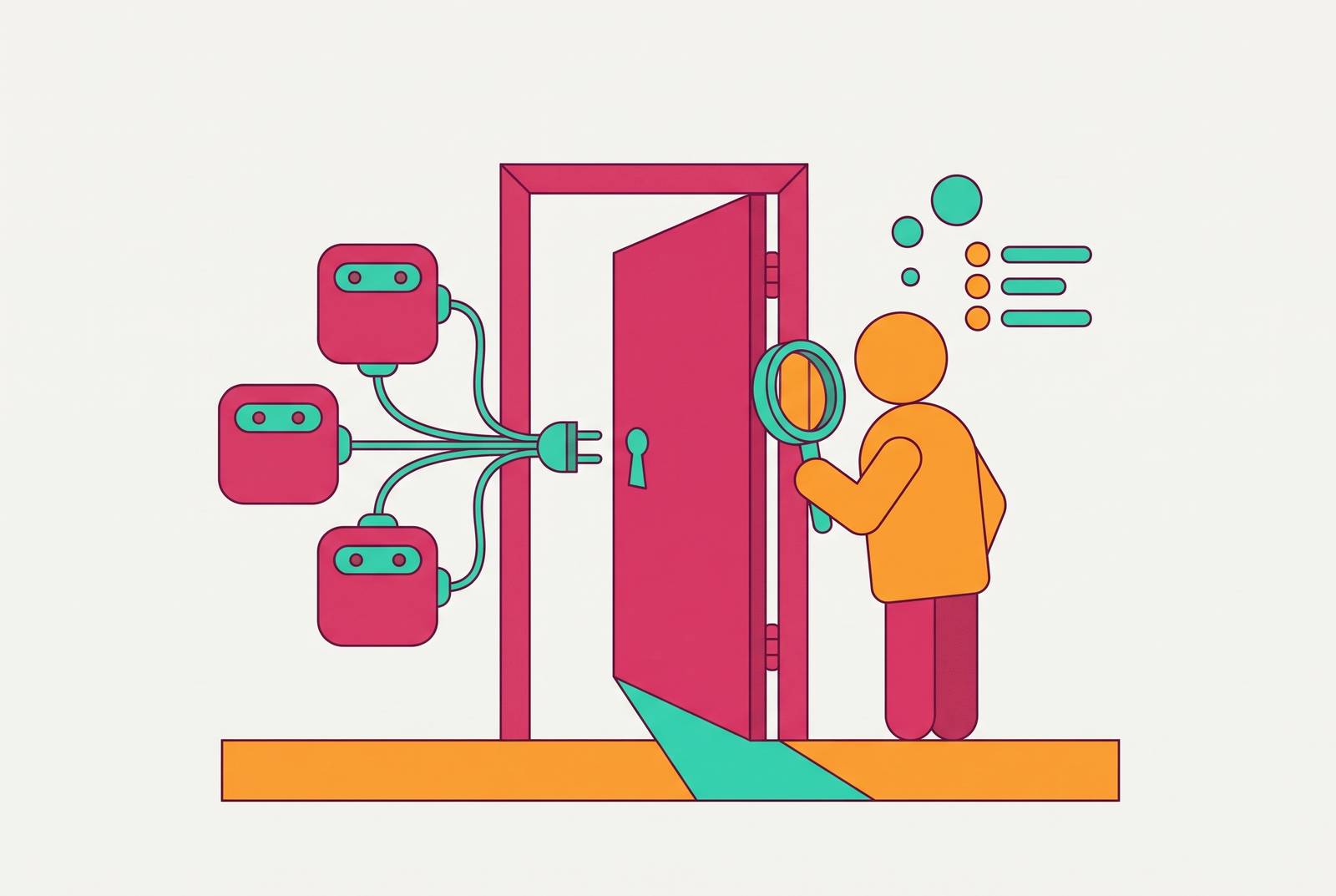
A vendor MCP server is a door. For marketing buyers connecting an AI-visibility platform to their agents, the real test is what lies beyond that door. Can the agent act, who approves its actions, and does the underlying content and measurement deserve the connection? Compatibility is the starting point. A durable system also needs governed actions and workflows the buyer can keep.
Why MCP compatibility is now the floor, not the ceiling
Anthropic developed Model Context Protocol, or MCP, and donated it to the Linux Foundation’s Agentic AI Foundation in December 2025. It has become the de facto open standard for connecting AI agents to tools, databases, and APIs. That is a real infrastructure advance. A marketer can ask an assistant for live visibility data, and the agent can query the relevant server. The response can come from current records.
For AI-visibility platforms, that common connection changes the buying threshold. An MCP server is no longer a capability held by a few vendors that sets them apart. Its presence is a baseline requirement. Not having one is a reason to disqualify a platform from an agent-connected workflow, while having one leaves the harder evaluation ahead.
What the MCP connection layer actually does and does not do
MCP gives an agent a predictable way to discover the operations a server supports, choose one for a task, and chain operations together in response to a plain-language request. The protocol does not decide which visibility signals to act on or whether a page needs changing. Those judgments still depend on the data, instructions, and workflow connected through it.
The first important distinction is between reading and writing. A read-only server exposes data for retrieval, allowing an agent to answer questions about the vendor’s reports. A read-write server can also let an agent change setups, start work, or trigger content pipelines. These are different grants of authority. An agent allowed to explain a visibility decline is not necessarily allowed to change the work intended to reverse it.
MCP also leaves ownership and dependency unresolved. It does not make model behavior, prompts, fine-tuning, infrastructure, or proprietary data layers portable. A compliant system can still keep context and policy inside one vendor’s control plane. Most enterprise implementations therefore begin read-only across one or two tools, validate accuracy, and then extend write permissions with governance controls. The connection can be standardized before the actions are trusted.
The five questions that actually separate platforms once MCP is assumed
The first question is commercial. Which plan actually unlocks MCP and API access, and what is its published price? Some platforms include MCP on entry-level plans, while others make buyers agree to enterprise terms, get custom pricing, and speak to sales. The notes identify at least one offering with MCP and API access starting on a $29 monthly plan, but do not identify it.
The second question concerns the work itself. Does the server write to the content workflow, or only read the vendor’s reports? A read-only connection is useful for monitoring, but it cannot by itself support an agent expected to act on a finding. Even a claim of write access needs a clear object. Changing a tracking setup and triggering a content pipeline are both actions, but they do different jobs.
What review must happen before anything the agent drafts or modifies goes live? Automated checks for factual consistency and source verification belong in that process, with mandatory human sign-off for high-risk content. Permission to use a tool is not editorial approval. Without that distinction, an authorized action can still send unreviewed material toward publication.
Can the buyer export all tracked prompts, citation data, and visibility history in an open format on reasonable notice? A promise that export is possible does not establish what the buyer will receive or when. If the vendor is replaced tomorrow, what exactly breaks in the agent pipeline?
How the leading AI-visibility MCP platforms compare on these questions
GEOboom says every plan has MCP access as of November 2026, with both read and write tools. Its write actions need separate permission scopes that the owner has approved. Sending email and spending credits are off by default, and AI apps add a confirmation step before either action. Those are concrete permission boundaries. They do not, by themselves, establish a mandatory editorial review gate for every piece of high-risk content.
GEOboom says it focuses on acting on the pages AI cites. It works with Claude, Claude Code, ChatGPT, and Cursor, although that compatibility list is not a list of AI engines whose visibility it measures. The distinction is important for a buyer comparing coverage. The material provided gives no starting price, full measurement-engine list, or export terms. Its stated action controls are therefore more specific than the available evidence about its measurement and exit provisions.
Radarkit is positioned around a full AI-visibility workflow, including citations, prompts, local tracking, competitors, and sources. Its stated emphasis is broader tracking coverage. The notes say it covers multiple AI platforms, but do not supply their names or the starting price referenced in the outline. They also do not specify which plan unlocks MCP, whether its MCP tools can write, or what human approval and export controls apply.
GEOboom has a stated read-write model and specific controls around certain consequential actions, while Radarkit has a stated range of visibility-tracking functions. Neither description answers all five questions. For a buying decision, the missing terms remain open requirements. An integration claim can establish access without establishing suitability for the whole workflow.
Why read-write access without a human gate is the risk buyers underestimate
That gap becomes consequential when an agent can do more than retrieve a report. Write permission lets work move forward, but it does not establish that the work is fit to publish. An owner can authorize an operation without reviewing the content it produces. This is where “shadow content” can emerge. AI-drafted or AI-modified material reaches production because the approval step was bypassed.
Microsoft’s July 2026 preprint audited tens of thousands of accepted academic papers and found hallucinated citations in the permanent scholarly record. References that looked valid had passed peer review despite pointing to no real work or to the wrong authors. The example concerns academic publishing, not marketing platforms. Its relevance is the failure mode, in which a convincing reference can survive a review process without being grounded in a real source.
For a marketing team publishing at scale, the same kind of error can undermine the credibility it is trying to earn. Content that cites a nonexistent source, or attributes a source incorrectly, lacks the grounding needed to support its claims. More output does not repair that weakness. Pages that earn AI references offer something original, such as a measurement, a structured comparison from proprietary data, or a verdict based on experience that a human editor has approved. Generated material that merely fills a calendar rarely earns that role.
Authority to act should be separate from authority to publish. High-risk content should pass automated factual-consistency and source-verification checks and must have human sign-off. Only after both pass should the artifact enter the publish queue. The review gate belongs in the workflow so that publication is conditional on approval rather than dependent on someone remembering to ask for it.
Why MCP portability does not solve the vendor lock-in problem it appears to solve
If the connection is standard, can the buyer simply switch vendors when permissions, quality, or pricing become unsuitable? The answer depends on what must move. MCP can make tool integrations reusable, but it does not make the prompts, guardrails, orchestration logic, memory, and normalized data surrounding them portable. A replacement connection is not a replacement operating system for the work.
The dependency often sits in those surrounding parts. They determine what an agent is trying to achieve, what it is allowed to do, and which context it uses. Several also serve as security controls. Moving away from a vendor therefore involves more than restoring access to a dataset. The workflow must retain the policies and permissions that made its actions acceptable in the first place.
Zapier’s enterprise survey released in early 2026 found that many were worried about how much they relied on AI vendors. A significant share of respondents said at least one key business function would stop working correctly if their primary AI vendor’s services ended. That finding concerns the end of a service, not a temporary interruption. It helps explain why exit provisions belong in the initial evaluation. The dependency can reach into how a business function operates.
Data portability needs similarly concrete terms. A defined export format, a defined timeline, and a survival clause preserving the right after contract termination provide more substance than “data can be exported on request.” Even then, exported records are only part of the system. The defensive position is to own prompts, standards files, normalized data, templates, and review gates in portable form. The model can then be treated as a replaceable component reached through open standards, rather than mistaken for the place where all the lock-in resides.
What a durable AI-visibility infrastructure actually looks like
Owning that workflow layer means keeping prompts, review gates, and orchestration logic in the buyer’s own files and systems, expressed in portable form. It does not require owning the model. The organization rents the service and keeps the knowledge of how to run the work. Standards and templates belong with that knowledge because they define acceptable work. A vendor change should not require rebuilding the editorial rules that gave the workflow its purpose.
Pages published under an organization’s name should rest on retrievable, real evidence. Originality gives that evidence a useful role. A measurement, a structured comparison, or an experience-based verdict offers something an AI engine can reference, especially when the page is structured for clean extraction. Publication under a named expert or organization with a verifiable track record also gives readers a way to assess who stands behind the claim.
Measurement then has to test the intended result. Measurement must establish whether ChatGPT, Claude, Gemini, and Perplexity actually name and cite the organization. A score alone does not answer that question. Tracked prompts, citation records, and visibility history give the workflow the signals it is meant to use. Keeping those records portable preserves the basis for evaluation when the tools around them change.
Finally, every capability should be reachable by an agent through an API and by a person through a user interface. Automation must not remove human control. The requirement is for the system to be automatable end-to-end, human-walkable step-by-step, and interoperable through API and MCP hooks, with the ability to override it at any stage. With that setup, the platform manages the work and measures its results while the buyer also keeps both.